All posts by BradleyCobb

Taking a Short Break

A note to our wonderful readers:

We will be taking off the rest of this week to focus on getting more work done on the Apostles series (Peter and Paul are the last two!), preparing more books for the Jimmie Beller Memorial eLibrary, and getting things ready to go in order to get back to out regular schedule next week!

I do apologize for the fact that there won’t be any new posts the rest of the week (barring something unforeseen taking place).  But we’ll be back next week, not to worry!

Thanks again to all of you who make running this website such an enjoyable experience.

-Bradley S. Cobb

The Disciple Whom Jesus Loved – The Life of the Apostle John (part 5)

John as an Author

It is often argued that the writings of John (the Gospel, his three letters, and Revelation) were the last ones to be written, and are to be dated between AD 90-100.1 It is more in keeping with the biblical information to place his writings before AD 70.2  By this time, John was an older man3 who was writing to Christians to warn them about apostasy,4 to remind them to stay faithful,5 to encourage downhearted Christians,6 to remind them about the words of the Lord in regards to the overthrow of Judaism,7 and to comfort them with the knowledge that their persecutors will be overthrown.8

The Gospel According to John

By this point, three other gospel accounts had already been written,9 so there was no need for John to write one unless he had information that needed to be presented that wasn’t in the other accounts.

Matthew wrote to convince the Jews that Jesus was the Messiah, and thus focused on Old Testament prophecies, starting with the birth of Jesus.  Mark wrote to convince the Roman readers that Jesus was a powerful leader who died for them, beginning with the herald announcing His coming.  Luke wrote to show the humanity of Jesus in precise historical terms.  By the time John wrote, however, a large contingent of Jewish Christians were leaving the faith, going back into Judaism.10 By doing this, they were denying the power of Christ.  So, when John wrote, his focus was to show the origin, power, and authority of Jesus Christ.

In the beginning was the Word, and the Word was with God, and the Word was [in His very nature] God.  The same was in the beginning with God.  All things were made by Him; and apart from Him, nothing was made that was made. 
 He came to His own [people] and His own [people] did not receive Him. But as many as received Him, to them He gave power to become children of God, believers into His name: which were born, not of blood, nor of the desires of the flesh, nor of the desires of man, but of God.  And the Word was made flesh and dwelled among us (and we admired His glory as of the only begotten of the Father), full of grace and truth.11

John repeatedly stresses the deity of Jesus throughout his gospel account.  John 1:1, 14 shows us that the Word which became flesh is, by His very nature, God.12  Several times, John records Jesus applying the words “I AM” (which the Jews would have understood as a reference to Jehovah) to Himself.13  John says an Old Testament vision of Jehovah was actually a vision of Jesus.14  In short, John wrote to prove the deity of Jesus and to show that it is only through Jesus that eternal life can be gained.15  This is quite powerful when you consider that Jewish Christians were leaving Christianity in large numbers at the time it was written—this book would have been quite timely.16

The Letters of John

Like Peter did in his second letter, John stressed the reality of Jesus Christ by appealing to himself as not only an eye-witness, but also an ear-witness, and one who studied and touched Jesus while He was here on earth.17  He also made it a point to remind them of what they possessed through Jesus Christ: (1) the forgiveness of sins, (2) the knowledge of God/Christ, (3) overcoming Satan, and (4) strength.18  He also forcefully stated that just because someone is a Christian doesn’t mean they are incapable of sinning—in fact, far from it:

If we say we have no sin, we are deceiving ourselves, and the truth is not in us.  If we confess our sins, He is faithful and just to forgive us our sins, and to cleanse us from all unrighteousness.  If we say that we have not sinned, we make Him a liar, and His word is not in us.19

He focuses on the importance of love quite as bit as well, telling them what they are supposed to love (each other),20 and what they are not to love (the world, neither the things of the world).21  And he also shows his care for the faithful,22 while also showing his frustration with and repudiation of false teachers23 and those who tried to rule the church.24

Like Paul, John’s wrote both to individuals and to congregations (with benefit to the universal church).25 And thank God that he wrote these letters, because they contain wonderful comforting information about salvation, both then and now.26

Revelation

While John was on Patmos, an island which was a “rock quarry
used as a place of banishment for certain types of offenders,”27 he received a revelation from Jesus Christ.  It’s generally assumed that he was exiled to Patmos by the Roman Emperor,28 but that’s not explicitly stated.  It might be that he was evangelizing.29

In writing the Revelation, John simply wrote what he saw and how he reacted to it.  He was overwhelmed by all that he saw, at one point fainting,30 at another point breaking into tears,31 and then worshiping the angel who delivered the message to him.32

This book was written to encourage faithfulness,33 to foretell the vindication of Christ and His apostles,34 to describe the glorious church,35 and to comfort first-century Christians with the promise of the destruction of their persecutors.36

-Bradley S. Cobb

1 See Guy N. Woods, A Commentary on the Gospel According to John, Nashville: Gospel Advocate Company, 1989[?]pages 18-19, and Woods’ A Commentary on the New Testament Epistles of Peter, John, and James, Nashville: Gospel Advocate Company, 1963[?], pages 206-207.

2 The promise of miracles from God in the church (including inspiration) was limited to the time between the death of Jesus Christ and the destruction of Jerusalem (see Zechariah 12:10-14:2, especially noting 13:2), a 40-year period (see Micah 7:15), which would take place during the “last days” of Judah and Jerusalem (Joel 2:28-32, Acts 2:16-21, Isaiah 2:1-2).  When the completed word of God came, the miracles would cease (1 Corinthians 13:8-10).  Since, according to the Bible,  miracles ended in AD 70, then the completed word of God also had to be finished by that time as well.  For a much more in-depth explanation of this topic, see the Appendix, “The End of Miracles” in this author’s book, The Holy Spirit in the Book of Acts.

3 2 John 1.

4 2 John 7-11.

5 2 John 8.

6 3 John.

7 1 John 2:18 (see especially in Greek, where John says “it is the final hour, and as you have heard that antichrist shall come, even now there are many antichrists: therefore we know it is the final hour,” and compare it with what Jesus said in Matthew 24:24 in regards to the signs preceding the final overthrow of the Jews and the Jewish system).

8 See the entire book of Revelation.  The persecutors who will be overthrown by God in Revelation are the Jews.  Compare Matthew 23:34-39 with Revelation 18:10-19:2.  See also Arthur Ogden’s fantastic work, The Avenging of the Apostles and Prophets, and this author’s work, Things Which Came to Pass: A Study of Revelation, Class Handouts, Cobb Publishing, 2014 (As of this writing, the commentary/teacher’s guide, Things Which Came to Pass: A Study of Revelation, is still being prepared).

9 Matthew was written first, around AD 40 (see chapter on Matthew for more information), while Mark and Luke were written in the mid to late 50s.  Since Luke doesn’t include any of the information from John’s gospel (except that which is also found in Matthew), yet claims that he “traced accurately” (implying that he did much research) the things which he wrote.  The only logical, biblical conclusion that can be drawn from this is that Luke wrote his gospel prior to John writing his.  Since Acts (Luke’s sequel to the gospel) was written around AD 62, it is no stretch to say that the gospel could easily have been written by AD 58.  For more information on the dating of the New Testament writings, see Redating the New Testament by J.A.T. Robinson.

10 See the entire book of Hebrews.

11 John 1:1-3, 11-14.

12 The arrangement of the words in Greek, as well as the lack of the definite article in Greek before “God” at the end of John 1:1 shows that what is under consideration is the nature or character of the Word.  Jesus Christ is, in His nature, God.  He is distinguished from God, when it is a reference to the Father, but He shares of the same nature.  What God is, the Word is.  See the New English Translation (NET) at this verse.

13 John 6:35, 48, 51; 8:16, 23-24, 28, 58; 9:5, 9; 10:7, 9, 11, 14; 11:25; 13:19; 14:6; 15:1, 5; 18:6, 8.

14 John 12:39-41, a reference to Isaiah 6:10 where the word “Jehovah” is used.

15 John 20:30-31.

16 Certainly there are other reasons John wrote, and many other things we could mention that are unique to John’s gospel account, but these will suffice for our purpose.  For more study on the uniqueness of John’s gospel, see the introduction to Guy N. Woods’ Commentary on John.  Most commentaries on John’s gospel will include mention and elaboration on these points.

17 Compare 2 Peter 1:15-19 with 1 John 1:1-4.  Since they are dealing with the same problem (people denying the reality of Jesus Christ), it make no sense to say (as some do) that John’s first letter couldn’t have been written until AD 90 because he is supposedly dealing with Gnostic teachings which didn’t arise until very late in the first century.  It’s universally agreed that Peter was killed during the reign of Nero, yet he dealt with the same issues, so this “proof” for a late date for First John is ridiculous.

18 See 1 John 1:12-14.

19 1 John 1:8-10.

20 1 John 2:10, 2 John 5-6.  It’s worth noting here that, according to John, the command to love one another also includes walking in the commandments of Jesus Christ.

21 1 John 2:15.

22 3 John 1-4.

23 2 John 7-11.

24 3 John 9-11.

25 3 John was written to Gaius.  2 John was written to “the elect lady and her children,” which is most likely a reference to the church in Jerusalem and the members thereof.  It cannot be that John is writing about a specific individual woman, for this “lady and her children” are said to be known and loved by “all them that have known the truth.”  There was no woman that well-known.  But the church in Jerusalem was known to all Christians (what Christian hasn’t heard about Pentecost and the Jerusalem church in the book of Acts?).  It is also possible that this is speaking of the church universal, but that makes John’s closing statement in 2 John very confusing.  If the “elect lady” is the universal church, who is her sister?

26 1 John 1:7, 9; 5:13.

27 Burton Coffman, commentary notes on Revelation 1:9.

28 Among the early writings that take this position, there is not agreement about which emperor banished him there.  Many claim Domitian, and thus some expositors take the position that it had to have been written around AD 95-96.  John A.T. Robinson (in Redating the New Testament) says that Domitian acted as emperor (even calling himself the emperor) prior to Vespasian’s arrival in Rome to take the throne, and so it could have taken place around AD 70.  However, there are very early Bible translations (second century) which include in the title of the final book of the New Testament, “
when he was exiled to Patmos by Nero.”

29 Foy E. Wallace argues that John went to Patmos for the purpose of receiving the Revelation and evangelizing.  See his The Book of Revelation, notes on Revelation 1:9.

30 Revelation 1:17.

31 Revelation 5:4.

32 Revelation 19:10.

33 Revelation 1:3, 2:10.

34 Revelation chapters 18-19.

35 Revelation 21.

36 The entire book of Acts shows that the primary persecutors of Christianity in the first century were the Jews.  It is their overthrow that is pictured in the book of Revelation.  For more details, see Things Which Came to Pass: A Study of Revelation by this author.

Salvation in the Old Testament

Today’s post is a lecture that I gave recently at a congregation in Oklahoma City.  I hope you find it interesting and encouraging!

Introduction

The word “saved” (or “salvation” or any of their various forms) is used in different ways in the Bible.  For example, the same word translated “saved” in the New Testament is also translated “healed,” “made whole,” “do well,” and “preserve.”  The basic idea is taking someone from a bad state and placing them in a better state.  Taking someone from sickness to health, from slavery to freedom, from sinner to saint, from earthly life to heavenly life—the Bible uses the Greek word sozo to describe each of these transitions.

The topic for this lesson is salvation in the Old Testament, but I wanted you to understand before we get there that the word “saved” in the Bible doesn’t always mean salvation from sin (though it is also used in that way).  In fact, most of the time that we see that word in the Old Testament, it doesn’t specifically describe salvation from sin.

The Main Meaning of “Salvation” in the Old Testament

God sent Isaiah to King Hezekiah, to tell him to “Set your house in order: for you shall die and not live” (Isaiah 38:1).  But Hezekiah went to God in tears, pleading for more time.  And after God granted him another 15 years, Hezekiah wrote the words “The LORD was ready to save me” (Isaiah 38:20).  This is salvation from sickness.  But this isn’t how it is normally used.

Hannah was horribly depressed.  She was one of two wives to her husband Elkanah.  His other wife had given him children, but Hannah was barren, and the other wife missed no opportunity to rub that in her face.  We all know the story about how the family went to Shiloh, and Hannah went off by herself to pray, mouthing the words, but making no sound.  She was praying for a son, and said that in return, she would dedicate him to God.  After her prayer was answered, and she fulfilled her vow to God, she prayed again, this time with the words, “My heart rejoices in the LORD, my horn is exalted in the LORD: my mouth is enlarged over my enemies, because I rejoice in Thy salvation” (1 Samuel 2:1).  This is salvation from the mocking of her husband’s other wide, salvation from her barrenness.  But this isn’t how it is normally used.

Read these passages, which are just a sampling, and see for yourself what the primary type of salvation was in the Old Testament.

When the Israelites were standing on the shores of the Red Sea, the Egyptians hot on their heels, scared that they were going to be killed, Moses said:

Moses said to the people, “Fear ye not, stand still, and see the salvation of the Lord, which He will show to you today: for the Egyptians whom you have seen today, you shall see them again no more forever!” (Exodus 14:13).

After Moses raise his rod, the Red Sea split, and the Israelites walked across on dry ground.  When the Egyptians tried to follow them, God brought the walls of water crashing down on them, drowning Pharaoh’s entire army.  The inspired record then says:

Thus the LORD saved Israel that day out of the hand of the Egyptians; and Israel saw the Egyptians dead on the seashore (Exodus 14:30).

Forty years later, the Israelites are at the side of another body of water, the Jordan River, and Moses is giving a series of sermons, delivering to this new generation the laws and commands of God, as well as the promises.  Hear what he says to them:

It shall be, when you are come night unto the battle, that the priest shall approach and speak unto the people, and shall say to them, “Hear, O Israel, you approach this day unto the battle against your enemies: let not your hearts faint, fear not, and do not tremble, neither be ye terrified because of them; for the LORD your God is He that goes with you, to fight for you against your enemies, to save you” (Deuteronomy 20:2-4).

This is the same thread that runs throughout the books of history.  Judges 6 and 7 uses the word several times to describe the salvation that God would bring to Israel by the hands of Gideon and his 300 men.  Salvation from the Philistines is mentioned several times in the books of Samuel.  Here’s just one of those passages:

By the mouth of my servant David I will save my people Israel out of the hand of the Philistines, and out of the hand of all their enemies (2 Samuel 3:18).

In the books of Kings and Chronicles, there are instances of the people going to God in prayer, crying “Save us!”  But these are all asking for physical salvation from their enemies.

Now therefore, O LORD our God, I beseech Thee, save Thou us out of his hand, that all the kingdoms of the earth may know that Thou art the LORD God, even Thou only (2 Kings 19:19).

What we need to recognize in all of these is that they weren’t asking for salvation from sin; they were asking for physical deliverance from their enemies.  But make no mistake about it, there was a spiritual component to this as well, as we will see.

Old Testament Salvation Based on their Attitudes and Actions

In the book of Judges, we see over and over the rollercoaster of the Israelites—they go from faithful to fallen, then God sends a nation to conquer them.  Eventually, they cry out to the Lord in repentance, and God sends a deliverer, a judge, to save them from their enemies.  In short, God didn’t save them when they continually rejected Him.  This is a constant theme throughout the entire Bible (Old Testament and New Testament).  If you doubt it, just read Hebrews 10:26-31.  Moses, soon before his death, told the Israelites that they needed to learn the lesson of faithfulness:

It shall come to pass, if thou wilt not hearken to the voice of the LORD thy God, to observe to do all His commandments and His statutes which I comman thee this day, that all these curses shall come upon thee and overtake thee. 
 And thou shalt grope at noonday as the blind gropeth in darkness, and thou shalt not prosper in thy ways: and thou shalt be only oppressed and spoiled evermore, and no man [literally, “no one”] shall save thee (Deuteronomy 28:15, 29).

Obedience was required if they wanted physical salvation.  But so was humility.  After David had been saved from Saul (The king of God’s people, the Israelites), he was inspired to write:

“The afflicted people [“humble people,” NKJV] thou wilt save, but Your eyes are upon the haughty, that You may bring them down” (2 Samuel 22:28).

Here is a contrast being made between two people who are in a covenant with God.  On one hand, you’ve got the mighty King Saul, the haughty, high-minded King Saul.  On the other hand, you’ve got the humble servant of God, David.  Being saved physically in the Old Testament was based on one’s attitude towards God.  And brethren, our salvation today is based on our attitude of humility as well—Humble yourselves in the sight of the Lord, and He will lift you up (James 4:10).

He will save the humble person (Job 22:29).

The sixth Psalm shows the heart of a humble person before God, including these words:

Have mercy on me, O LORD, for I am weak: O LORD, heal me, for my bones are vexed.  My soul is also sore vexed: but Thou, O LORD, how long?  Return, O LORD, deliver my soul: of save me for Thy mercies’ sake (Psalm 6:2-4).

When David’s son Solomon went before the people after the completion of the magnificent temple in Jerusalem, he preached to them and offered a public prayer to God.  In it, he showed the connection between their physical deliverance and their spiritual condition.  Hear his words:

If they sin against Thee (for there is no man which sinneth not), and Thou be angry with them, and deliver them over before their enemies, and they carry them away captives unto a land far off or near.  Yet if they bethink themselves in the land whither they are carried captive, and turn and pray to thee in the land of their captivity, saying, “We have sinned, we have done amiss, and have dealt wickedly”; if they return to thee with all their heart and all their soul in the land of their captivity wither they have carried them captives, and pray toward their land which thou hast given to their fathers, and toward the city which thou hast chose, and toward the house which I have built for thy name; then hear thou from the heavens, even from thy dwelling place, their prayer and their supplications, and maintain their cause, and forgive thy people which have sinned against thee (2 Chronicles 6:36-39).

Without any doubt, the lost people of God, in order to expect salvation, had to repent of their sins against God.  It was a requirement for their salvation.  But I want you to notice something very specific from this passage, and that is:

Forgiveness (and therefore Salvation from Sin) Existed Under the Old Testament.

I can’t tell you how many times I’ve heard people say that the people under the Old Testament weren’t forgiven, their sins were just “rolled forward” until the cross.  I wish someone would give me book, chapter, and verse for that, because I’ve never seen it.  Now, I will readily agree that the forgiveness, and thus salvation from sin, under the Old Testament was on the basis of the sacrifice of Jesus Christ (Hebrews 9:15 makes that pretty clear), but that doesn’t mean forgiveness somehow didn’t exist under the Old Testament.

The Law of Moses is filled with all the various sacrifices which had to be offered in order for someone to receive forgiveness of their sins (see the book of Leviticus).  When you knew you had sinned in a certain area, it was off to the priest so you could offer a sacrifice.  You might wonder why God commanded these sacrifices to be offered, and there are some very good reasons for it: (1) to show that sin deserves death.  Have you ever considered that it was God’s amazing grace that allowed people to offer animal sacrifices to atone for their sins?  Since sin deserves death (Romans 1:28-32, 6:23), God could have required the death of the sinner—but in most cases He didn’t.  (2) To make people think about the cost of sin.  Animals weren’t cheap, and the animals that God required for sacrifices weren’t the cheap ones (unless the person was extremely poor and couldn’t afford one of the other animals).  Imagine you’re a farmer, and you’ve sinned.  Your sin just cost you one of your best cows.  Do you know how much a cow sells for today?  Do you think you could easily lose that much money each time you wanted forgiveness from God?  It would act as a deterrent of sorts, because someone might think twice before sinning when they realize what it is going to cost them.

But even more than sacrifice, what was really required for forgiveness of a child of God under the Old Testament was (1) confession of sin, (2) repentance, and (3) a humble spirit.  People could offer sacrifices all day long, but if their heart wasn’t right, it didn’t matter.  Psalm 51 is David begging God for forgiveness for what he did with Bathsheba and to her husband Uriah.  In verse 3 he confesses: “I acknowledge my transgression, and my sin is ever before me.”  In verse 13 (among other places) he shows his repentance: “I will teach transgressors thy ways; and sinners shall be converted unto thee.”  He shows his humble spirit in verses 16-17: “Thou desirest not sacrifice; else I would give it.  Thou delightest not in burnt offering.  The sacrifices of God are a broken spirit: a broken and contrite heart, O God, thou wilt not despise.”

To add to the reality of salvation from sin under the Old Testament, let’s look at Ezekiel 3:17-21:

Son of man, I have made thee a watchman unto the house of Israel: therefore hear the word at my mouth, and give them warning for me.  When I say to the wicked, “Thou shalt surely die;” and thou givest him not warning, nor speakest to warn the wicked from his wicked way, to save his life, the same wicked man shall die in his iniquity; but his blood will I require at thine hand.  Yet if thou warn the wicked, and he turn not from his wickedness, nor from his wicked way, he shall die in his iniquity; but thou hast delivered thy soul.

Again, When a righteous man doth turn from his righteousness, and commit iniquity, and I lay a stumbling-block before him, he shall die: because thou hast not given him warning, he shall die in his sin, and his righteousness which he hath done shall not be remembered; but his blood will I require at thine hand.  Nevertheless if thou warn the righteous man, that the righteous sin not, and he doth not sin, he shall surely live, because he is warned; also thou has delivered thy soul.

Not a bit of this statement from God is about salvation from something physical.  This is completely about being saved from their sin.  If they die in their iniquity, they are lost eternally; but if they repent, their soul is saved.  This was written to Ezekiel, who was preaching to people in Babylonian captivity—people who, for the most part, would never return to their home of Judah.  There was no physical salvation for the majority of the people Ezekiel preached to.  My friends, this is speaking of spiritual salvation, salvation from sin!

It all pointed to Jesus Christ

Later on in Ezekiel, the prophet spoke on behalf of God and foretold that God would:

save them out of all of their dwelling-places, wherein they have sinned, and will cleanse them: so shall they be my people, and I will be their God.  And David my servant shall be king over them; and they all shall have one Shepherd: they shall also walk in my judgments, and observe my statutes, and do them (Ezekiel 37:23b-24)

David had been dead and gone for hundreds of years when this was written, but the Jews knew that God had foretold a descendant of David would rule over His people.  This descendant was known as the Messiah in Hebrew, or in Greek, Christ.

The apostle Paul helps us to see that the physical salvation that the Israelites experienced in coming out of Egypt and through the Red Sea was a type, a picture of what salvation would be in the New Testament:

I would not that ye should be ignorant, how that all our fathers were under the cloud, and all passed through the sea; and were all baptized into Moses in the cloud and the sea; and did all eat the same spiritual meat; and did all drink the same spiritual drink: for they drank of that spiritual Rock that followed them: and that Rock was Christ (1 Corinthians 10:1-4).

Just as they were baptized, leaving slavery behind, being made free in crossing the Red Sea (a baptism into Moses), we are baptized, leaving slavery to sin behind, being made free in being baptized into Christ.

The physical salvations of the Old Testament point forward to the spiritual salvation in Jesus Christ!

Conclusion

If you take nothing else from this lesson, remember this one thing: Though salvation in the Old Testament was usually a reference to a physical deliverance from enemies, it was still based on the obedience and repentance of the people; and ultimately gives us a picture of salvation in the New Testament.

There are numerous examples in the Old Testament of God’s children losing their salvation, and we’ve already looked at passages that showed what was required for them to get it back: confession, repentance, and a humble spirit.

If you’re a child of God who has gone astray, take this lesson to heart and come back to God.


The Disciple Whom Jesus Loved–The Life of the Apostle John (Part 4)

John after the Ascension

After listening to Jesus teach about the “things pertaining to the kingdom of God” and seeing the Lord ascended into heaven, John stayed in Jerusalem with the rest of the apostles.1  On the day of Pentecost, John heard the sound of a mighty rushing wind, and he started preaching the gospel in another language.  People gathered around to listen, and were amazed by what was happening.2  After Peter spoke up and proved that Jesus is the Messiah that had been prophesied in the Old Testament, John spent several hours baptizing people into Christ,3 and rejoicing at the salvation received by them.

Some days later, John accompanied Peter to the temple during the hour of prayer, 3:00 PM.4  They came upon a man who had never walked before, a man who was physically impaired from the time of his birth to prevent him from ever being able to walk.  Men carried him each day to the temple gate so that he could beg for money to survive.  As John walked towards the temple, the man asked him and Peter for money.  Instead of money, the man was given something even greater—healing.  John and Peter walked into the temple area with this man clinging to them, leaping for joy, as the people began to stare and follow them because they recognized this as the lame man who had been unable to ever walk.5  Peter took the opportunity to preach a sermon to the people, resulting in thousands believing in Jesus.  But the priests and Sadducees were extremely upset,6 and they arrested John and Peter, leaving them in jail overnight.7

The next morning, John, as well as Peter, was called to stand before the Sanhedrin, and questioned about how they were able to accomplish this great miracle.  The council wanted to know where John and Peter got the miraculous power, and also by whose authority it was done.8  They already knew that the miraculous ability had to have come from God (see John 3:2), but they wanted to know who gave them the authority to go into the temple complex and heal this man.  The book of Acts only records Peter speaking, but it is obvious that John wasn’t silent during this time, because after they were done answering, condemning the Jewish leaders for murdering Jesus Christ, the Bible says: “Now when they saw the boldness of Peter and John, and perceived that they were unlettered and common men, they marveled, and recognized that they had been with Jesus.”9

The council couldn’t speak against John or Peter, because the proof of their claim was standing right next to them in the form of the formerly crippled man.  Instead, they threatened them not to speak at all or teach in the name of Jesus, to which John and Peter both replied, “You judge whether it is right in the sight of God to listen to you more than to God; for we are not able not to speak the things which we have seen and heard.”10  Even though threatening John and Peter was completely ineffective, they threatened them again before finally letting them go, because they were too afraid to punish the two apostles.11

John and Peter, after being released, went to the other apostles,12 and reported what had happened.13  The whole group prayed together, asking for continued boldness, and as a result, God filled them with the Holy Spirit, and they spoke again with boldness, and were able to exercise “great power.”14

Sometime later, after Stephen was murdered and Saul of Tarsus began to viciously persecute the church, John and the other apostles received word that Philip had gone into Samaria and converted many of them to Jesus Christ.  They were excited about this new information, certainly remembering the words of Jesus before He ascended that the gospel would be spread from Jerusalem, to Judea, and to Samaria as well.15 The apostles chose John and Peter to go to the Samaritans,16 with the purpose of facilitating their reception of the miracles which were given by the Holy Spirit.17  It is interesting that John was sent, since at one time he asked for power to call down fire on a village of Samaria18—what a difference now!  Some have suggested that John and Peter were sent in order to confirm to the Jews in Jerusalem that the addition of the Samaritans was approved by God, and not just something cooked up in the mind of Philip.19

After arriving, John and Peter went to God in prayer on behalf of the Samaritan Christians, asking that they might also receive the miraculous gift of the Holy Spirit.  They were then guided by God to lay hands on certain individuals for this purpose. 20 When Simon, a magician-turned-Christian with a significant desire for prominence, saw this, he offered the two apostles money if they would give him the power to pass on the miraculous gifts.  Peter and John both replied, condemning his actions and him as well if he did not repent, after which Simon asked them to pray to God on his behalf so that the things which they had said wouldn’t happen to him.21

After this incident, John and Peter gave their testimony about Jesus, and proclaimed the word of the Lord to them.  Then they left that city, returning to Jerusalem, but stopping to preach in many Samaritan villages along the way, converting more souls to Jesus Christ.22  Upon returning to Jerusalem, they no doubt gave a first-hand report of the things which occurred in Samaria to the other apostles who had sent them, and joined with them in rejoicing about the new souls that had joined in the Kingdom of Jesus Christ.

The joy in the growth of the church continued, but John also experienced some sadness.  The Gentiles had just begun to be added to the church, which upset many of the Jews greatly.  Herod, who continually sought for the approval of the Jews, arrested and killed John’s brother, James.23  Such a thing pleased the Jews, and certainly John was happy that his brother had passed into Paradise, but there was no doubt a great sadness that he would no longer see his brother in this life.

Within a few years, a great controversy erupted in the church over whether Gentile converts to Christianity must first be circumcised.  Paul, Barnabas, and Peter were the star witnesses for God during a large gathering in Jerusalem to deal with this issue.  After the matter was decided, John, Peter, and James (the brother of our Lord)24 gave Paul and Barnabas the right hand of fellowship, showing that they endorsed the preaching of the gospel to the Gentiles.25

Thus we see John being connected with the gospel in Jerusalem, Samaria, and the uttermost part of the earth.

-Bradley S. Cobb

1 Acts 1.

2 These events are recorded in the second chapter of Acts, specifically verses 1-12.

3 If we assume that the apostles were not hurrying people along, we can estimate that each apostle baptized one person per minute (it can be done much quicker than that, but we’ll go with longer period here for the sake of argument).  That means that each apostle could baptize 60 people per hour.  There’s 12 apostles, so that makes 720 baptisms per hour.  At that rate, the apostles themselves could have easily baptized the 3,000 souls into Christ in just over four hours.  And since the sermon took place around nine in the morning (Acts 2:15), that would make the baptisms completed by around 1:30-2:00 in the afternoon.  Even if they went twice as slow, they’d still have gotten everyone baptized while there was still daylight.

4 It should be noted that this was not a time which was commanded by God, but was something that the Jews had gradually turned into a tradition.  There was nothing wrong with it, and the two apostles did not sin by observing the religious traditions of the Jews.  They would have sinned if they had attempted to bind it on others, or if they had condemned others for taking that time to pray.  Religious traditions, so long as they do not violate the Law of God, are fine—understanding that they are traditions and not something to be bound upon others, nor something to condemn others for observing.

5 This incident is recorded in Acts 3.

6 The priests were upset because if what Peter and John were preaching was true, their service in offering sacrifices was no longer valid.  Additionally, as the priests were teachers in the temple area, they would have had quite a fit of jealousy when the people flocked to hear John and Peter.  The Sadducees were extremely upset because Peter’s sermon was promoting the resurrection—something which they vehemently denied.  In essence, Peter’s sermon identified the Sadducees as false teachers, and they didn’t like it one bit.

7 The response of the people is seen in Acts 4:1-4.

8 Acts 4:7.  Campbell makes the following observation on the question of the council: “ΠοÎčα ΎυΜαΌΔÎč, not Ï€ÎżÎčα Î”ÎŸÎżÏ…ÏƒÎčα—physical strength.  In what strength—in what name?  There was strength and authority also in the name of the Lord.  But as to the spectators—in this case of physical infirmity—their attention was absorbed in the strength put forth.” (Alexander Campbell, Acts of the Apostles, Translated from the Greek, on the Basis of the Common English Version.  With Notes.  New York: American Bible Union, 1858, page 25).

9 Acts 4:13.  KJV says “unlearned and ignorant,” but this isn’t accurate according to the present use of those terms.  Robertson says, “Unlearned
Unlettered men without technical training in the professional rabbinical schools of Hillel or Shammai. 
ignorant
a layman, a man not in office (a privatae person), a common soldier and not an officer, a man not skilled in the schools.” (Robertson’s Word Pictures, on Acts 4:13).  The Greek word translated “ignorant” is idiotai, from where we get our word idiot.

10 Acts 4:19-20.  Note the two negatives in the last part, “we are not able not to speak.”  In other words, “It is impossible for us to remain silent.”

11 Acts 4:21-22.

12 Acts 4:23.  The word “company” (KJV) certainly includes the apostles, though some believe it includes other Christians as well.  Campbell says “
to their own friends, not especially to the Apostles.” (Acts of the Apostles, page 28).  This is unlikely.  The Greek word, idios, means “one’s own,” and is used in the Bible to refer to one’s own countrymen (John 1:11), one’s own family (1 Timothy 5:8), one’s own disciples (John 13:1), and one’s own friends (Acts 24:23).  The group under consideration all prayed together, asking for continued boldness, and the result was a miraculous filling with the Holy Spirit (Acts 4:31), and “great [miraculous] power” was exercised by the apostles, not by the Christians in general (Acts 4:33).  The context, and what we learn from Acts 8 relative to the way miraculous gifts were passed on (including the inspiration mentioned in Acts 4:31), leads us to conclude that John and Peter went to their own company, that is, they went to the other ten apostles.

13 The other Apostles (and other Christians too), would have been worried about John and Peter, since they no doubt would have heard of their arrest and heard that there was going to be a trial of sorts.  Most likely, the apostles were gathered for a time of prayer on behalf of John and Peter.  Christians did this same thing in Acts 12 when Peter was in jail (see especially verse 12).

14 Acts 4:31, 33.  See also the author’s notes on this passage in The Holy Spirit in the Book of Acts.

15 Acts 1:4.

16 Literally, the apostles apostled John and Peter (Acts 8:14).  The word “sent” (KJV) is the verb form of apostle.

17 Acts 8:14-16.  This passage is treated extensively in The Holy Spirit in the Book of Acts by this author.  See there for a much fuller explanation and proof that the reception of the Holy Spirit is equivalent to being able to perform miracles.

18 Luke 9:54.

19 See Robertson’s Word Pictures on Acts 4:14.

20 It was not a universal promise that all Christians would receive the Holy Spirit.  Acts 2:38-39 limits it to a single generation, and then only to those whom God selected for that purpose.  It is obvious that Simon had become a Christian (Acts 8:12-13), but he only knew that the Holy Spirit was given by what he saw take place when the apostles laid hands on others—he did not know it from person experience, but only from seeing it.  Thus we have an example of a Christian who never “received the Holy Spirit.”

21 Acts 8:18-24.  Simon’s response in verse 24 proves that John wasn’t a silent partner in the condemnation.  Simon said, “You [plural] pray to the Lord for me so that none of these things which you [plural] have spoken happen to me.”  Whether Simon ever truly repented is difficult to say.  We would like to think that he did, especially based on his belief of the condemnation that was pronounced on him, but that is inferring something that might not be a necessary inference.  It is the almost universal declaration of early Christian writers that Simon remained apostate and worked to lead people away from Jesus.  See the International Standard Bible Encyclopedia, “Simon Magus.”   Ignatius calls him “the firstborn of Satan” (James Hastings’ Dictionary of the Bible, “Simon Magus”).

22 Acts 8:25.

23 Acts 12:1-2.  It is generally assumed (and quite probably right) that James was beheaded (see Johnson’s The People’s New Testament with Notes, on Acts 12:2), though the words used by Luke don’t demand that interpretation. “The Jews considered beheading a shameful death” (Robertson’s Word Pictures, on Acts 12:2), which explains why it please them to see it happen to one of the leaders of the Christian movement.

24 See chapter dealing with this James for more information on his role during this incident.

25 Compare Acts 15 with Galatians 2:1-10.

A Very Early History of the Restoration Movement

The year was 1844.  A man named I. Daniel Rupp had the idea to compile an authoritative encyclopedia of the various religious bodies in the United States.  So he appealed to members of each group to submit a history of their rise and progress, with specific mention of any doctrines that made them different from the others.

Robert Richardson, who would later go on to write the two-volume Memoirs of Alexander Campbell, was selected to submit this early history.

RichardsonDisciples

You have to remember that at this time, both Thomas and Alexander Campbell ere still alive.  Barton W. Stone was still alive (he would die later that year).  The missionary societies had not yet reared their ugly head; and none of the churches had introduced instrumental music.

So Richardson’s entry pictures the Disciples at a time when they were still united on the Bible, on biblical principles, on biblical worship, and on the biblical plan of salvation.

As always, we’ve tried to remove any typos, correct the spelling, and reformat this book for the Jimmie Beller Memorial eLibrary so that you can enjoy it as much as possible.  On this offering, we’ve also taken the two footnotes and inserted them into the text in parentheses (they were short footnotes).

Just click the link below!

Disciples of Christ (Robert Richardson, 1844)

-Bradley S. Cobb

An Important Announcement

We try to offer up encouraging and educational articles, and even sometimes things to put a smile on your face.  And we thank you for taking the time to read what we’ve written.

We are beginning to undertake a large project that we truly hope will be a blessing to the church across the country.  Thankfully, we’ve got a good group of people involved to help with it.

I’d like to take a moment to tell you about it.

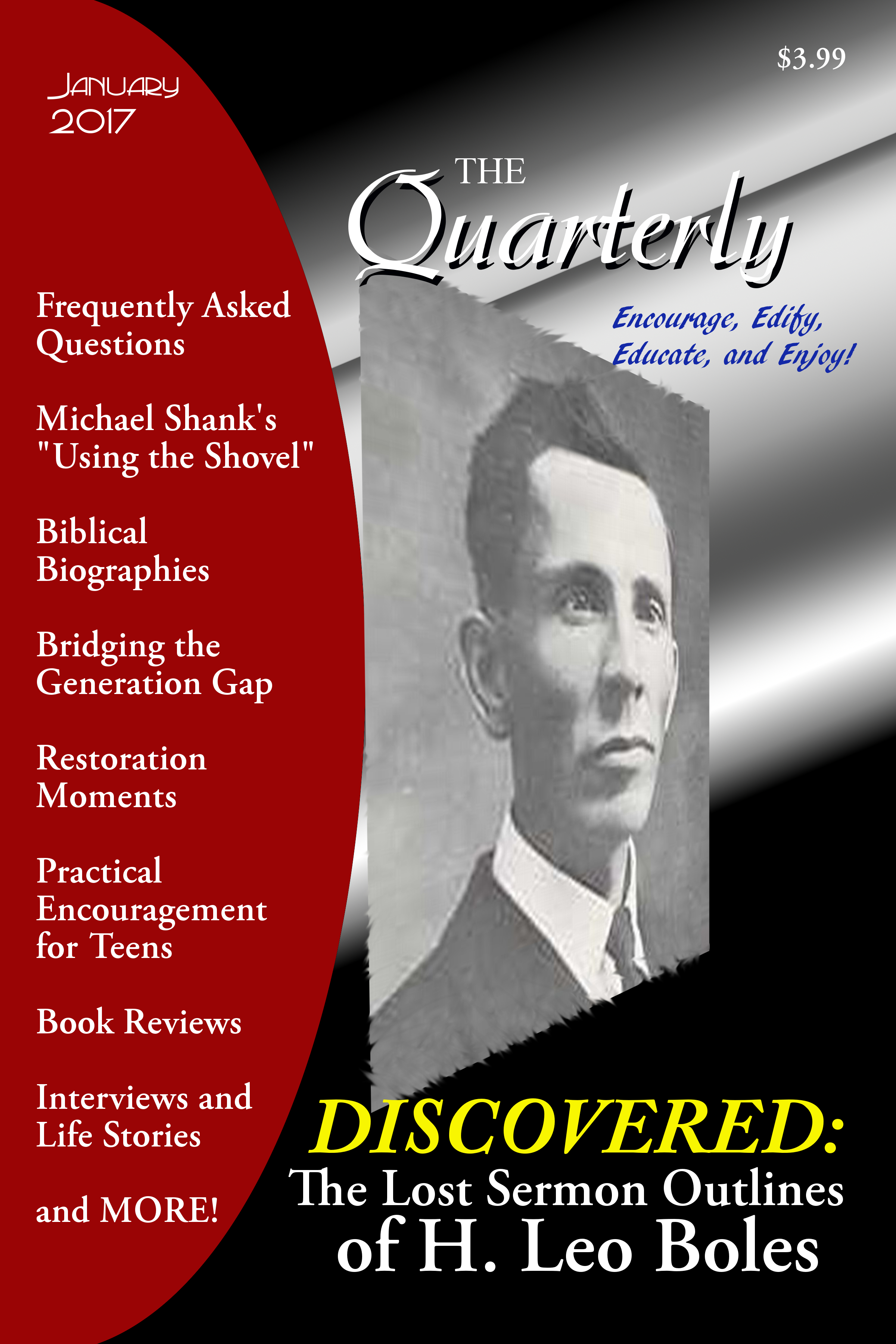
We are starting a new quarterly publication called “The Quarterly,” with the subtitle of “Encourage, Edify, Educate, and Enjoy!”

This publication will start officially in January of 2017.  We’re hoping to have a preview edition ready by September, so that people can see what it will be like before they subscribe.

The Quarterly will have several great features, including interviews with long-time Christians about their unique experiences, Biblical Biographies, a Question/Answer section, “The Tabernacle Shadows,” interesting events in Restoration Movement History, and much more!

We’ve got a great stable of writers who will be working with us, including some who have never been published before, and others who are seasoned pros at it.

I would like to take this moment to ask you to consider subscribing to this magazine-sized publication.  We are offering it in both digital and print forms.  If you think your congregation might be interested in receiving multiple copies, contact us and we will give you the best price we can. (The cost of the print subscription is our actual cost to print/ship them to you–we’re not making any money on it.)

For more information, click here.

Here is a look at the preliminary cover (It might be changed before we go to press with it).

Quarterly01Front


-Bradley S. Cobb

Teaching About the Sower

The Text: Mark 4:1-20 – He began again to teach by the seaside; and a great multitude was gathered together with Him, so that He entered into a ship, and sat in the sea; and the whole multitude was by the sea on the land.  And He taught them many things by parables, and said to them in His teaching:

“Listen! Behold, a sower went out to sow [seed].  And it came to pass, while He sowed, [that] some fell by the roadside, and the birds of the air came and devoured it up.  And some fell on stony ground, where it had not much soil; and immediately it sprang up, because it didn’t have deep soil.  But when the sun was up, it was scorched; and because it had no root, it withered away.  And some fell among thorns, and the thorns grew up and choked it, and it yielded no fruit. And other [seed] fell on good ground, and did yield fruit that sprang up and increased.  And [they] brought forth [fruit], some thirty, and some sixty, and some a hundred.”

And He said to them, “He that has ears to hear, let him hear.”

And when He was alone, those who were around Him with the twelve asked Him about the parable.  And He said to them, “To you it’s given to know the mystery of the Kingdom of God, but to those who are outside, all [these] things are coming in parables.  So that ‘Seeing, they may see and not perceive; and hearing, they might hear and not understand; lest at any time they might be converted, and their sins might be forgiven them.’”

And He said to them, “Do you not perceive this parable?  And how, then, will you know all [these other] parables?

“The sower sows the word.  And these by the roadside are they where the seed is sown, but when they have heard, Satan comes in immediately, and takes away the word that was sown in their hearts.  And likewise, these which are sown on stony ground are they who, when they have heard the word, immediately receive it with gladness; and have no root in themselves, and so [they] endure only for a time.  Afterwards, when affliction or persecution arises for the word’s sake, immediately they are caused to stumble.  And these which are sown among the thorns are they such as hear the word, and the cares of this world, and the deceitfulness of riches and lusts of other things entering in choke the word, and it becomes unfruitful.  And these which are sown on good ground are they such as hear the word, and receive it, and bring forth fruit, some thirtyfold, some sixty, and some a hundred.”

Introduction

The parable of the sower is one of the best-known of Jesus’ parables.  I don’t have any idea how many times I’ve heard some part of it referenced (often the “cares of this world” line), but it’s a lot.  It’s mentioned by Matthew (chapter 13), Mark (chapter 4), and Luke (chapter 8).  And though many people refer to it as the “parable of the soils,” Jesus called it “the parable of the sower” (Matthew 13:18).  Therefore, while Jesus spends a lot of time dealing with the different kinds of soils, His main emphasis is on the sower.

The Text, part 1 – The Setting (Mark 4:1-2)

[Jesus] began again to teach by the seaside.  And a great multitude gathered [together around] Him, so that He entered into a ship, and sat in the sea; and the whole multitude was by the sea on the land.

Matthew 13:1 tells us that at first, Jesus sat to teach by the seaside (most likely next to the sea of Galilee).  But the crowds gathered, and Jesus stood up, walking to a ship that He could board so that He could teach the crowds without being mobbed.  Then, He sat down on the ship and began to teach the multitude that was on the shore.  This wouldn’t have been like a rowboat, but probably one of the fishing boats.  Jesus must have had a very strong voice to be able to teach this great crowd of people while sitting on this boat.

And He taught them many things by parables.

The word “parable” comes from the Greek parabole, which literally means “to throw beside.”  It’s the idea of putting two things side-by-side for comparison’s sake.  A parable is often described as “an earthly story with a heavenly meaning,” and quite often that is true.  I’d be more specific, and say that a parable is a story dealing with things that are known and understood in order to explain something that is not necessarily known or understood. Every parable that Jesus gave dealt with things that the listeners could identify with and understand, things like planting and harvesting, or losing something valuable and rejoicing when it is found (Luke 15).  And behind all these parables were deeper truths.  Some parables foretold the rejection of the Jews (Matthew 21:33-45), while others taught Godly attributes (like the Good Samaritan).

And in His teaching to them, He said “Listen.”

Jesus didn’t speak to waste His breath.  He expected those people who gathered around to pay attention to the things He was trying to teach them.  As followers of Jesus Christ today, we should respect the Lord enough to listen to Him and listen to His word being proclaimed.

The Text, part 2 – The Parable Given (Mark 4:3-8)

“Behold”

This word means not just to look, but to perceive, to comprehend.  So, as Jesus began to speak, He opens with the words, “Listen.  Perceive.”  In other words, Jesus is telling them that in order to understand His teaching, they would have to pay attention, and do some thinking.  He explains why a little later on.

“A sower went out to sow”

Literally, “the scattering one went to scatter.”  This kind of sowing is done by a person with a large bag, like a large purse, with the handle over his shoulder and neck.  He reaches inside the bag, grabs a handful of seeds, and then scatters them all across the field as he walks.  He knows ahead of time that not all the seeds will take root, but given the sheer number of seeds that he throws out there, he knows that some of them will produce the desired plant.

“Some [seed] fell by the road, and the birds of the air came and devoured it up.”

The road, whether it be rock or dirt, was packed down so hard that no seed could penetrate—so it just sat there, and was free food for the birds who gladly take advantage of it.

“Some [seed] fell on stony ground, where there was not much soil; and immediately it sprang up because it had no depth of soil.”

You might imagine soil with lots of gravel or little rocks mixed in with it, but that’s not what Jesus is describing.  He’s describing ground where there is a very small layer of soil, and underneath that is just rock.  That’s why He says “it has no depth of soil [or earth].”  Anyone who has ever tried to plant a garden in this kind of soil knows that it is almost impossible to get much to grow and produce, because there’s simply not enough soil to support the plant.

“But when the sun was up, it was scorched; and because it had no root, it withered away.”

When Luke records this statement, he says that the plant withered away because it “lacked moisture.”  The thin layer of dirt couldn’t hold on to the necessary moisture to sustain these plants, and the plants died as a result.

“Some [seed] fell among thorns; and the thorns grew up, and choked it, and it yielded no fruit.”

These are weeds among which the seed fell.  These weeds, with thorns, stole moisture and nutrients from the soil, and worked to overtake the plant, keeping it from being able to produce any fruit.  This is why anyone who has much experience with gardening knows you’ve got to “weed” (or de-weed) your garden so that your crops can grow and produce.

“Other [seed] fell on good ground, and did yield fruit that sprang up and increased; and brought forth, some thirty, and some sixty, and some a hundred.”

This here is the reason why the sower goes out and scatters the seed: because there is good soil out there, and if he scatters enough seed, some of it will land in that soil.  That seed will then sprout, take root, and produce a good harvest.

The person sowing the seed during those days wasn’t usually the land owner—at least not on the bigger fields.  It was someone working for the person who owned the field.  Usually, there were several working the fields at once, and they would scatter the seed all over the place, covering every possible area.  Some of it would land in bad soil, but some of it would land in good soil.  These workers oftentimes had no way of knowing what kinds of soil were all around them.  Their job was merely to scatter the seed.

The Text, part 3 – Hearing and Understanding (Mark 4:9-13)

He said to them, “He that has ears to hear, let him hear.”

This is something that Jesus said on more than one occasion.  He said it after telling His disciples that John the Immerser was the fulfillment of the prophecies about Elijah (Matthew 11:7-15); after asking them whether a candle should be hid under a bushel (Mark 4:21-23); after chastising the Pharisees for elevating their traditions over God’s word (Mark 7:1-16); after explaining the parable of the tares (Matthew 13:36-43); after instructing the multitude on the cost of discipleship (Luke 14:25-35); and at the conclusion of each of the letters to the seven churches in Asia (Revelation 2-3).

The phrase means that everyone (because they all have ears) is supposed to listen.  In fact, the phrase “let him hear” is the same as the word translated “Hearken” (KJV) or “Listen” that Jesus used back in verse 3.  It is a command to hear the message that is being presented.

But not everyone understood the message


When He was alone, they that were around Him, with the twelve, asked Him about the parable.

Mark is the only one who gives us this piece of information, that is, that they waited until Jesus was alone to ask this question.  They apparently didn’t want to ask the question in front of the multitude, and they also didn’t want to interrupt Jesus’ teaching.  So, they waited until later.

Mark is also the only one who tells us that it was more than just the apostles asking this question.  Matthew and Luke simply say “the disciples,” which sometimes is a reference to just the twelve.  But this was the entire group of Jesus’ disciples, all the ones who were faithfully following Him—including the apostles.

It appears that none of them understood the deeper meaning behind Jesus’ parable of the sower.

He said to them, “To you, it’s given to know the mystery of the Kingdom of God, but to those who are outside, all these things are coming in parables.”

The disciples, including the apostles, were being taught about the Kingdom of God by Jesus.  He told them that it was “at hand,” and showed its power to them by casting out demons and healing the sick.  But there was more to it than just power.  The Kingdom of God included enduring rejection by the very people Jesus came to save.  The disciples needed to understand that the key to understanding Jesus’ parables was knowing about the Kingdom.  The Kingdom would be spread by sowing the word of God (as He will allude to momentarily) in the hearts of people.

But to those who don’t understand, who haven’t opened their eyes to the reality of Jesus spiritual kingdom, these parables would have no meaning—for they didn’t have the key.

The KJV says these things are “done” in parable, but literally, He says they are “coming” in parables.  That is, He’s presenting those things in parables to the masses.

“So that ‘Seeing, they might see, and not perceive; and hearing, they might hear, and not understand”

Jesus quotes Isaiah 6:9, and applies it to His own teaching in parables—a definite claim that He is the Messiah.

The parables are spoken, according to Jesus, so that they would have the opportunity to see and perceive, to hear and understand—if they had the right heart and desire.  It isn’t made clear in English, but the verbs are in the subjunctive mood, showing possibility.  So, literally, Jesus is saying “Seeing, they might see, and might not perceive; and hearing, they might hear, and might not understand.  Some people have accused Jesus of intentionally hiding the truth from people so that they couldn’t understand it—but that’s not the case at all.  He’s teaching in a way that helps those who sincerely want to understand to put everything together.  In fact, the word translated “understand” is a compound word in Greek which means “bringing together.”

“‘Lest at any time they might be converted, and their sins might be forgiven them.’”

Again, these are conditional statements.  Some of the people did listen to Jesus, and some of them were converted, and did have their sins forgiven.  But the majority did not.  In Isaiah 6, where this statement came from, the Lord sent Isaiah to proclaim the truth that the people really didn’t want to hear—that their cities were going to be utterly wasted.  And the more they heard that they didn’t like, they more they ignored the prophet.

The same thing happened with Jesus (see John 6:66).  There were hard-hearted people who didn’t want the message of a spiritual kingdom that required godly living and evangelism and obedience.  So, Jesus spoke it to them in parables, keeping the true meaning just under the surface—those who were spiritually-minded would dig and find it, while those who weren’t interested would just think it was a story and shrug it off.

And He said to them, “Do you not perceive this parable?  How then will you perceive all [the other] parables?”

Jesus was kind (because He explains the parable to them), but at the same time, this statement expresses a disappointment in the disciples.  They, the ones who should be best equipped to understand the meaning, didn’t see it.  And you have to know that it stung a bit when Jesus quoted Isaiah 6:9, and then immediately afterwards asked them if they were among the ones who fit the description of “not perceiving.”

This parable is a fairly straight-forward one, and when we understand that it is about the kingdom of God, the rest of the pieces fall into place pretty easily.  And Jesus asks them how they could hope to understand His other parables if they didn’t understand this parable.  So many people want to jump headfirst into the deeper matters of the Bible without first having an understanding of some of the simpler parts.  If you can’t grasp the simple parts, you have no hope of understanding the more difficult ones!

The Text, part 4 – The Explanation (Mark 4:13-20)

“The sower sows the word.”

That statement is the key to the entire parable.  Luke records it as “the seed is the word of God” (Luke 8:11).  Without this knowledge, the parable is hidden in a mist of confusion.  But when you know that “the seed is the word of God,” everything else makes sense.

“These by the road are they where the word is sown; but when they have heard, Satan comes immediately and takes away the word that was sown in their hearts.”

The word of God makes no lasting penetration into these hearts.  Just like the birds eating seed off the hard ground, Satan has no trouble removing the word of God from the hearts and minds of this kind of people.  They aren’t really spiritually-minded to begin with, and so they don’t take in the word of God, they don’t treasure it.  It’s just there, ready to be forgotten at the first opportunity.

“Likewise, these which are sown on stony ground are they who, when they have heard the word, immediately receive it with gladness; and they have no root in themselves, and so they endure but for a time.  Afterwards, when affliction or persecution arises for the word’s sake, immediately, they are caused to stumble.”

These are what you might call “shallow” Christians.  They want the salvation that comes through Christ, but they don’t have any roots, no depth to their faith, and so when things get tough, they simply fall away.

It’s interesting that in the parable, Jesus described the sun as part of the reason the plant died, and then he describes affliction and persecution as what causes a believer to die (spiritually).  But the sun has a very positive effect on plants which are properly planted; and persecution and affliction has a very positive effect on Christians who are properly planted in God (see James 1:2-4, Acts 5:40-41).

The word “offended” (KJV) or “stumble” (NKJV) is the Greek word scandalizo.  It’s where we get the word “scandal.”

“These which are sown among thorns are those, such as hear the word, and the cares of this world, and the deceitfulness of riches, and the lusts of other things entering in, choke the word, and it becomes unfruitful.”

In contrast to the previous people, these aren’t “shallow” Christians.  These are people who know the truth, believe the truth, and may have even at one time been very fruitful in the truth.  But they are the ones who have gotten caught up with cares of the world (friends, family, work, politics, fun, pleasure) and as a result, they’ve relegated God’s word to second place (or third or fourth or fifth
) in their lives.  These are the ones who have allowed the material things to become the focus of their lives (money, wealth, things).  Jesus adds that it’s also “the lusts of other things.”  It’s basically Jesus saying, “and other things like these.”

When those things become the focus, it chokes out the word of God in your life, and you become unfruitful.  Even if you were at one point in time an active, evangelistic, fruitful Christian, you can still fall—you can still get so tangled up in the cares of this world that you end up forgetting that this world isn’t our home, and we’ve got a better world awaiting us.

“These which are sown on good ground are those, such as hear the word and receive it, and bring forth fruit, some thirtyfold, some sixty, and some a hundred.”

These are active, faithful, working Christians.  These are those who are productive for the Lord.  There’s two different ways we can look at what this “fruit” is:

First, we could use the word “fruit” as John the Immerser did in Matthew 3:8, “Therefore, bring forth fruits suitable for repentance.”  By this, the “fruit” would have a reference to works (in our context, it would be good works).  Paul uses the phrase in a similar way in Romans 7:5-6.

Second, we could look at something God says about “fruit” in the creation account in Genesis 1:11: “And God said, “Let the earth bring forth grass, the herb yielding seed after his kind, and the tree yielding fruit, whose seed is in itself, after his kind: and God saw that it was good.”  Since the fruit has the seed inside it, and the seed is the word of God, then to “bring forth fruit” would be converting people to Christ.  Each person you convert to the Lord now has the word of God (the seed) inside them.

Ultimately, the two options are really two parts of the same thing.

Application

Preparing the Sower

Since Jesus called it the “parable of the sower,” He wanted His disciples to view it from that direction first.  In telling them this parable, He was preparing them for the different kinds of reactions that they would receive when they went about preaching the word.  We need to take the same lesson from it as well, and know ahead of time that there will be people who are so hard-hearted that the word of God won’t take hold in their heart.  We need to realize ahead of time that some people will accept it, but they will be shallow and fall away.  Some will accept it, and stick with it, but they won’t bear fruit because they’re too busy with the things of this life.  These things aren’t our fault—that is on them.  But we also need to know that there are people out there who will gladly receive the word of God and who will bear fruit.  That is the reason we need to keep trying to bring others to Christ, because these kind of people are out there!

Preparing the Soil

The secondary purpose of this parable is from the standpoint of the soils, or the heart.  What kind of heart do you have?  Is it a hard heart?  A shallow heart?  A rocky heart?  Or a good and pure heart?  As most of you are certainly aware, bad soil doesn’t have to stay bad soil.  It can be broken up, tilled, cared for, rocks removed, weeds removed, and it can become productive.  The same thing is true of your heart.  If you honestly look at your heart and discover that you are one of the first three, then you can do something about it!  You can cultivate your heart, be more conscious of where your focus is, on what is most important, and then you can start being fruitful for the Lord!

Invitation

Just possessing he seed isn’t enough.  Just tossing it on the ground isn’t enough.  In order for that seed to produce a plant, there’s something else that has to be present, and that’s water.  The same thing is true with the word of God.  Just having it isn’t enough to save you.  Just believing it isn’t enough to save you (for the demons believe and tremble, James 2:19).  It’s when you make the decision to repent of your rebellion to God, and add water—being baptized into Christ for the forgiveness of your sins—that you become a Christian.

Won’t you please become a fruitful follower of the Lord today?

-Bradley S. Cobb

A Debate on Infant Baptism and the Lord’s Supper

Continuing our theme of new additions to the Jimmie Beller Memorial eLibrary this week, we’re proud to offer you this:

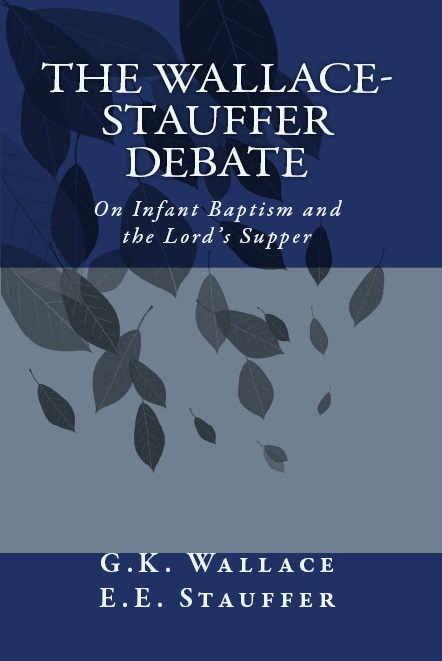
WallaceStaufferCover


Where does the Bible authorize–or even mention–infant baptism?

It doesn’t.

This debate, held in 1937, is between G.K. Wallace (Christian) and E.E. Stauffer (Lutheran).  Wallace attacks the false doctrine of infant baptism from several different angles, and leaves Stauffer with nothing to say except for “let’s move on to the Lord’s Supper.”

Wallace then exposes the false idea that the Lord’s Supper literally turns into the physical skin and blood of Jesus.  Stauffer is unable to counter his arguments and calls the debate to a close.

Back in 2014, we took this debate and gave it the full Cobb Publishing treatment, correcting all the mistakes we could find, and refurbished the whole thing to give you the best possible reading experience.  We still have it available in print (just $5.99), but we’re also making it available as an eBook for free in the Jimmie Beller Memorial eLibrary!

To read it online, or download for later enjoyment, just click the link below!

Wallace-Stauffer Debate on the Lord’s Supper and Infant Baptism

-Bradley S. Cobb

Some Brief Congregational Sketches … Written in 1869!

Today’s free book, exclusively from the Jimmie Beller Memorial eLibrary, is a brief one, but with a nice, long title.

Licking County Disciples

This book is only 12 pages, but it gives some interesting historical notes about the Lord’s church and the preachers who worked in that area.  If you’re a Restoration Movement enthusiast, or you like short histories, this one is for you.

As always, we’ve prettied this one up, correcting the typos we found and reformatting it to make it easy on the eyes.

To read it online, or to download it to your computer for later perusing, just click the link below.

Historical Sketches of the Disciples Churches in Licking County

-Bradley S. Cobb

A FREE Restoration Movement History Book

We hope you haven’t gotten overwhelmed with all these new additions to the Jimmie Beller Memorial eLibrary the past couple weeks, but we’ve got a lot of books that have been sitting ready to go into the library, and we thought it’d be cruel to make you wait a week for each new one to be posted.  🙂

Tyler-HistoryOfDisciples

Today’s book was originally written as an entry to The American Church History Series, a multi-volume encyclopedia of all the different religious groups in America (this appeared in volume 12).  It was edited by Philip Schaff.

But though it was originally an encyclopedia entry, don’t think that it’s some short little thing.  B.B. Tyler (author of another book titled Concerning the Disciples of Christ) wrote a lengthy, 10-chapter book (our version is 143 pages) about the history of the Restoration Movement.

As always, we’ve gone through it and fixed any typos we ran across, and reformatted it to make it more pleasing on the eyes.

Click the link below to read it online or to download it for later enjoyment!

A history of the Disciples of Christ in America (B.B. Tyler)

-Bradley S. Cobb