All posts by BradleyCobb

Toils and Struggles of the Olden Times

You’ve been a soldier in the war of 1812.  But now, you’ve found Jesus.  The only problem you’ve got is that the religious world is telling you all sorts of conflicting things.  Which one is right?  How can you tell?

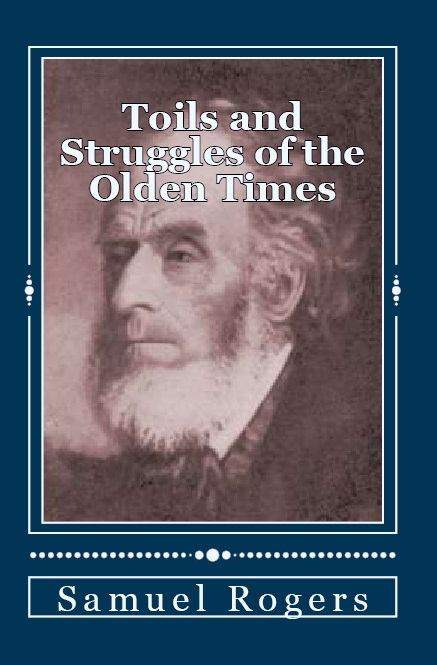
This is the story of Elder Samuel Rogers, or as J.W. McGarvey called him, “Uncle Sammy.”

SamuelRogersCover

Samuel Rogers was a soldier and a preacher. His life was lived as a soldier for Christ. He planted many congregations throughout Indiana, Illinois, Missouri, and the surrounding areas. One estimate says that he personally baptized over 7,000 people.

Along the way he survives a wildfire, is confronted with kindness that crosses racial borders, and meets Alexander Campbell.

This new, revised edition has been completely reformatted, meticulously proofread for any typos, and updated with modern spelling–all to bring you, the reader, a more pleasant reading experience.

We’ve been publishing this book since 2013 (and you’re still welcome to buy a copy from us for just $9.99), but we’re now making available for FREE in eBook format in the Jimmie Beller Memorial eLibrary!

Just click the link below to download it or read it online!

Toils and Struggles of the Olden Times: The Autobiography of Elder Samuel Rogers

-Bradley S. Cobb

Identifying the True Family

The Text: Mark 3:31-35 – His brothers and His mother then came there, and standing outside, they sent to Him, calling Him.  And the multitude sat around Him, and they said to Him, “Behold, your mother and your brothers outside are looking for you.” 

And He answered them, saying, “Who is my mother or my brothers?”  And He looked around at those who were sitting around Him, and said, “Behold, my mother and my brethren!  For whoever will do the desires of God, the same is my brother, and my sister, and my mother.”

Introduction

Jesus gave some difficult commands in His life, but they were always ones that He Himself was ready to follow as well.  He has been preaching and teaching, proclaiming the Kingdom of God in the face of opposition from His associates (who thought He was crazy) and the scribes (who claimed He was possessed by Satan), but He didn’t stop.  And now, Jesus’ family shows up, wanting Him to stop teaching so He can come talk to them.

The Text, part 1 – Earthly Family Calling (Mark 3:31-32).

Satan uses peer pressure and false accusations to try to disrupt God’s work.  That’s what he did against Jesus earlier in this chapter.  Now, he uses another—very potent—device to try to stop Jesus: His own family.

Then, there came His brothers and His mother

Let’s just get this out of the way from the start.  These aren’t Jesus’ cousins.  These are the children of Mary and Joseph, all younger than Jesus, who arrived with their mother, Mary.  Matthew 13:55-56 shows that Jesus was known by the people in His own area as “the carpenter’s son” whose mother was named “Mary,” and “His brethren, James and Joses and Simon and Judas” and who had “sisters.”  It is ridiculous to claim, as the Catholics do, that the people who knew Jesus had to identify Him by His earthly father and mother, and then rattle off the names of four of His cousins, and then add that He’s got female cousins (“sisters”) too.  These are the actual brothers (half-brothers, to be specific) of Jesus who have come with Mary.

Some Greek manuscripts also include “sisters” with this group that was trying to get to Jesus.

This is the family that Jesus has known His whole earthly life.  He certainly had a spot in His heart for them.  Even though John 7 portrays them as non-believers, He visited James after the resurrection, which led to all of the brothers being present in Jerusalem, gathered with the disciples (Acts 1:13-14), and later becoming well-known Christian examples (1 Corinthians 9:5).  So these brothers of Jesus were not beyond reaching with the gospel, and Jesus knew that.  This fact would have made it very tempting for Jesus to go talk to them and try to convince them to believe in Him.

Standing outside, sent to Him, calling Him

Luke tells us that they couldn’t get to Jesus because of the massive crowd of people (Luke 8:19) who were sitting around Jesus, so instead of going to Him, they began calling to Him.  The Greek word is “phoneo,” which means they were using their voices.  So, they were telling people at the edge of the crowd, “Tell Jesus that we’re out here, and that we are looking for Him.”  So, from the edge of the crowd, this message was sent (the Greek word is “apostello”) until it reached Jesus.

The multitude sat around Him

This is something that only Mark mentions. Remember that earlier in the chapter, those close to Jesus thought He was crazy because He was allowing these massive crowds of people to crowd around Him.  But Jesus is in no danger of being crushed.  The multitude is sitting around Him.

They said to Him, “Behold, your mother and your brothers are outside looking for you.”

The message had made its way through who knows how many people to finally get to Jesus.  He’s told that they are “seeking” Him.  The same word is used in Matthew’s account, where it is translated “desiring” to speak to Jesus (Matthew 12:46-47).  In other words, they wanted Jesus to stop what He was doing and come outside to talk to His physical family.

The Text, part 2 – True Family Identified (Mark 3:33-35)

As Jesus’ family stood outside, the crowd looked at Him, probably wondering what He would do.  Would He stop preaching and teaching to go talk to them?  Would He send them a message back through the multitude?  Would He ignore them?

He answered them, saying “Who is my mother or my brothers?”

As literally-minded as some of Jesus’ disciples were, you have to think that some of them were quite confused by this statement.  What?  Jesus, you know
your mother?  Mary?  Don’t you remember her?  And your brothers, the ones you lived with for years?  What do you mean, “Who is my mother or brothers?”  Maybe this statement, for a moment, reinforced the idea that some of them had that Jesus had lost His mind.

But Jesus wasn’t pleading ignorance, nor was He crazy.  He was asking a question to get the people to start thinking.  He wanted them to start thinking about which relationships are most important.  He wanted them to change their focus from the physical to the spiritual.

He looked around at those who sat around Him

This is Jesus pausing for effect, looking at the people who were listening, making sure they are paying attention.  Then Jesus lifts up His hand, and points it towards His disciples (Matthew 12:46-47).

And [He] said, “Behold my mother and brethren!”

The crowd had said “Behold, your mother and brother are outside,” and Jesus’ response is “Behold, my mother and brother” are right here!  Jesus explains what He means by this in the next verse, but I want you to put yourself in the shoes of Mary, or of James, Jude, Simon, or Joses.  The message certainly got back to them, and it probably didn’t make the brothers too happy.  But what about Mary?  Do you think another incident popped into her head?  Perhaps an incident that the Bible says “she kept
in her heart”?

Now His [Jesus’] parents went to Jerusalem every year at the feast of the Passover.  When He was twelve years old, they went up to Jerusalem after the custom of the feast.  And when they had fulfilled the days, as they returned, the child Jesus tarried behind in Jerusalem; and Joseph and His mother did not know it.  But they, supposing He was with the company, went a day’s journey; and they sought them among their relatives and acquaintances.  And when they did not find Him, they turned back again to Jerusalem, seeking Him [this is the same word as in Mark 3:32].  And it came to pass, that after three days they found Him in the temple, sitting in the midst of the teachers, both hearing them and asking them questions.  And all that heard were astonished at His understanding and answers.  And when they saw Him, they were amazed: and His mother said to Him, “Son, why have you dealt this way with us?  Behold, your father and I have sought you, sorrowing.”  And He said to them, “How is it that you sought me?  Did you not know that I must be about my Father’s business?”  And they did not understand the saying which He spoke to them.  And He went down with them and came to Nazareth, and was subject to them: but His mother kept all these sayings in her heart. (Luke 2:41-51).

Even from the time Jesus was 12 years old, He knew the difference between His earthly family and His true family.  The incident from Jesus’ boyhood, along with the incident in Mark 3, shows us without a doubt that Jesus knew which family was most important.

For whoever shall do the desires of God, the same is my brother, and my sister, and my mother.

Now, just to make things crystal clear, Jesus isn’t saying that His disciples were somehow His spiritual mother (or sisters).  He is saying that His true family is the spiritual family.  His true family are the people who obey the Father’s will.  Here’s something that you might want to contemplate: your earthly family is only temporary.  Your spiritual family is forever.  But praise God when your earthly family is counted as part of your spiritual family too!

The Peter began to say to Him, “Look, we’ve left everything and followed You.  And Jesus answered and said, “Truly I say to you, there is no man that has left house, or brothers, or sisters, or father, or mother, or wife, or children, or lands for my sake, and the gospel’s, but he shall receive a hundred-fold now in this time, houses and brethren, and sisters, and mothers, and children, and lands, with persecutions; and in the world to come, eternal life. (Mark 10:28-30).

The ones who have put Jesus ahead of their earthly family will receive a much greater family—brothers and sisters of untold numbers—here, in this life.  A person who obeys the gospel immediately gains a family of brothers and sisters in Christ—and new family members are made every day!

Jesus warned about placing your physical family ahead of Him—being a disciple of Jesus must come first in your life!

[Jesus] said to them, “If any man comes to me, and does not hate his father, and mother, and wife, and children, and brothers, and sisters, yes, and even his own life too, he cannot be my disciple. (Luke 14:26).

Jesus isn’t saying that you have to despise your family, but He is saying that you have to put Him first.  Earthly ties are to be secondary to your ties to Jesus Christ.

Application

Put Your Family First—Your TRUE Family.

I don’t need to tell you that people have fallen away from God, left the family of God (the church, 1 Timothy 3:15), because of their physical family.  Maybe it’s a domineering husband who berates his wife for going to worship with the saints.  Maybe it’s a wife whose religious ties are to a denomination, and she’s nagged or guilted her husband into joining her.  Maybe it’s someone who has children who are living in wickedness, but they can’t bring themselves to admit that they are lost, so they stop worshiping with the saints, lest someone ask about them, or lest they hear a lesson that deals with the sins that their children happen to be guilty of.  I know a man who left the church and tried to split it on his way out because someone dared to tell him that it was wrong for his daughter to be cheating on her husband.

We must be like Jesus, and realize that regardless of our earthly ties, it is our Father’s family, our true family that matters the most.

How Do I Become Part of God’s Family?

We become part of a physical family by being born into it.  Similarly, in order to become part of God’s family, Jesus’ family, the spiritual family, the family that Jesus claimed as His own, we must be born into it as well.  But this birth isn’t something done when you come out of your mother’s womb.  Since this is a spiritual family, it requires a spiritual birth.

“Truly I say to you, unless a man is born again, he cannot see the kingdom of God.”  Nicodemus said to [Jesus], “How can a man be born when he is old?  Can he enter the second time into his mother’s womb and be born?”  Jesus answered, “Truly, truly I say to you, unless a man is born of water and the spirit, he cannot enter into the kingdom of God” (John 3:3-5).

James 1:18 says “Of his own will begat he us with the word of truth, that we should be a kind of firstfruits of his creatures.”  The word “begat,” when describing a father’s actions, means that he has provided the seed so that a new creature can be born. In the genealogical lists, it is said “Adam begat Seth” or “Abraham begat Isaac” and so on. The fathers didn’t give birth to them, but they provided the seed so that a birth could follow. When God begat us, He provided the seed so that a birth could follow. But what was that seed?

James tells us that it is “the word of truth”

The seed that God provided so that our new birth could take place is the word of God. The word of God is described as the seed from which Christians come (Luke 8:11). In the parable of the sower (Matthew 13), Jesus described the seed (the word of God) as going to people’s hearts. When it took hold of good and honest hearts, Christians came forth.

There is NO CHANCE of being born again without the Scriptures—the word of truth. Some people claim they had some religious “experience” and they could tell by their “feelings” that they were saved. James says quite plainly that the new birth comes by the word of truth. Being born again doesn’t come from feelings, from experiences, or from a direct action of God upon the person. It comes from following the word of God.

Peter reiterates the same idea in saying “Being born again, not of corruptible seed, but of incorruptible, by the word of God which lives and remains forever” (1 Peter 1:23).  You read the Scriptures (the seed) and plant it in your heart. The birth which follows comes when you obey the commands to believe (John 3:16), repent (Acts 2:38) and be baptized (Acts 22:16).

For you are all children of God by the faith, in Christ Jesus, Because as many of you as have been baptized into Christ have put on Christ. (Galatians 3:26-27).

Come be a part of God’s family today!

-Bradley S. Cobb

Alexander Campbell’s Commentary on Acts

Back in the mid-1800s, Alexander Campbell received the ire of many religious bodies for having the audacity to produce a new translation of the New Testament (Because, they would say, God Himself inspired the translators of the King James’ Version).  In the first edition, he took most of the translation from various well-respected commentaries (George Campbell [no relation], MacKnight, and Doddridge) and edited it together in one volume.  In the second through fourth editions, he made several changes, seeking to have more uniform translating principles throughout.

It’s really interesting to note the background given above, because some years later, the Baptists organized a translation committee with some other religious groups (including the Disciples) called The American Bible Union.  And they recognized that Campbell was no slouch when it came to knowing the original language–so they chose him to translate Acts of Apostles.

As each book was translated for the A.B.U., it was published and distributed for comment, and it would then be revised prior to its inclusion into the finalized New Testament.

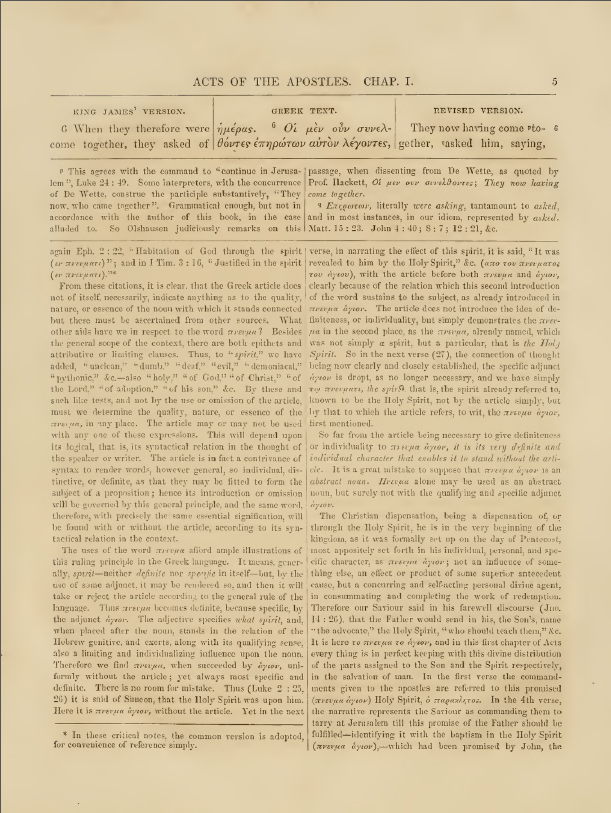
Alexander Campbell’s translation of Acts was published in a large size (8 1/2 x 11), with his commentary included–and was nearly 240 pages long.  This commentary is different from what you would expect.  It included the following features:

  • The King James’ Version text of Acts
  • The Greek original of Acts
  • His “Revised Version” of Acts
  • Translation notes on all three.

CampbellActsInside

Because of the sheer amount of Greek, and the amount of notes (see picture above), we have decided to add this book to the Jimmie Beller Memorial eLibrary as published, and not attempt (at this time) to do any updating to to it (as we have with all the other books in the library).  It would just be too overwhelming of a project for now, but we want to get this book out for as many people as possible to enjoy.

Now, pay attention here, because we’re giving you two options:

The higher quality scan, as seen in the image above, is too large for us to upload to our website (115 Meg), so you will have to download it from a special link (no worries).

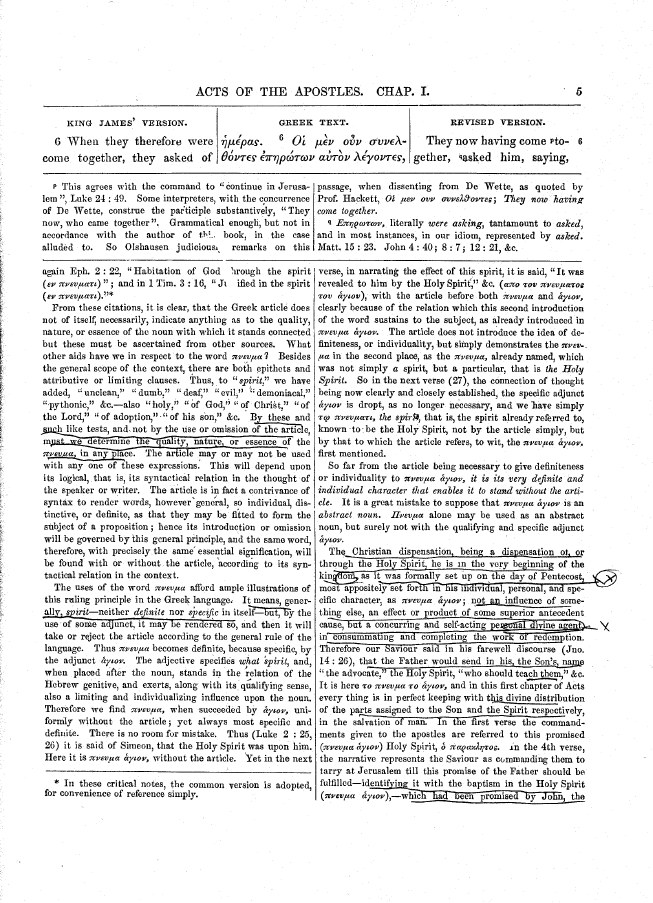
The second option is black/white, and is 1/10 the size of the other one, and while it is easier to read, it has a LOT of underlining and notes in the margins (This was a scan we made from Jimmie’s personal copy).  Note the picture below is the same page as the picture above, from the other copy.

CampbellActsInside(1)


To download the higher quality version, click the link below:

Alexander Campbell’s Acts of Apostles (HQ)

To download the B/W version (easier to read, other than the underlining and notes), click this link below.

Campbell, Alexander – Acts of the Apostles

A Tribute to Sixteen Years

Some of you already know this story, but most of you probably don’t.

It was 1993, at Roundhouse, in Pell City, Alabama, that I first met Jesse Roderick. (Roundhouse is an annual gathering of members of the church who homsechool.)  Back then, I was much younger, somewhat skinnier, and wasn’t near as cool as I am today.  But, for some reason, Jesse still thought I was cool.  I thought she was out of my league.

Then, in 1994, at the next Roundhouse, she got to witness my very first wreck as I backed my parents’ van into a tree, putting a nasty dent into the back door which allowed the rain through…  But still, she thought I was a fun guy.

But in 1995, she didn’t show.  Something about going to college or something like that.  Yeah, like college is really that important…  But, afterwards, I called her up and we talked for a little while.

And then there was silence…

Life went on for both of us, and then out of the blue, in February of 2000, something seemingly inauspicious happened.  A mutual friend (from Roundhouse) sent an email to several people in his address book.  I didn’t pay any notice to all the people he sent it to, but Jesse Roderick did.  She saw the name “Brad Cobb” and thought to herself, “I haven’t talked to him in forever!”

So, she sent me an email.

This came as a great surprise to me, since it’d been five years.  But, I immediately went to writing her a reply.  And when I finished my reply, I clicked “Send.”  Or, at least, I thought I did.  Turns out, I clicked “save” instead, and it didn’t send at all.  It was two or three weeks later that I realized what I’d done, so I typed out another email, apologizing, and promising to be a better correspondent.

We emailed every day after that, and also began to spend a lot of time on the phone (her in Arkansas, me in Illinois).  In early April, I drove to Arkansas under the guise of being on my way to Texas to see a friend get married.  We had our first date on that trip (CiCi’s Pizza and a mountain hike), and we were officially engaged before I went back to Illinois.

On June 22 (just two months later), at the Gravel Hill church building, we stood before friends, family, and God and vowed to be husband and wife til death do us part.

That was sixteen years ago, and though we’ve had rough spots and struggles, these have truly been the best sixteen years of my entire life.  I am not exaggerating  in the slightest when I say that the worst day of our married life is still better than the best day of my life before we got married.

And through the past sixteen years, I’ve grown more and more in love with my Jesse Cobb, and I think she’s grown more beautiful with every passing day.

Jesse, I love you, and I look forward to many more wonderful years together.

-Bradley S. Cobb

An Address on the Importance of the Lord’s Supper

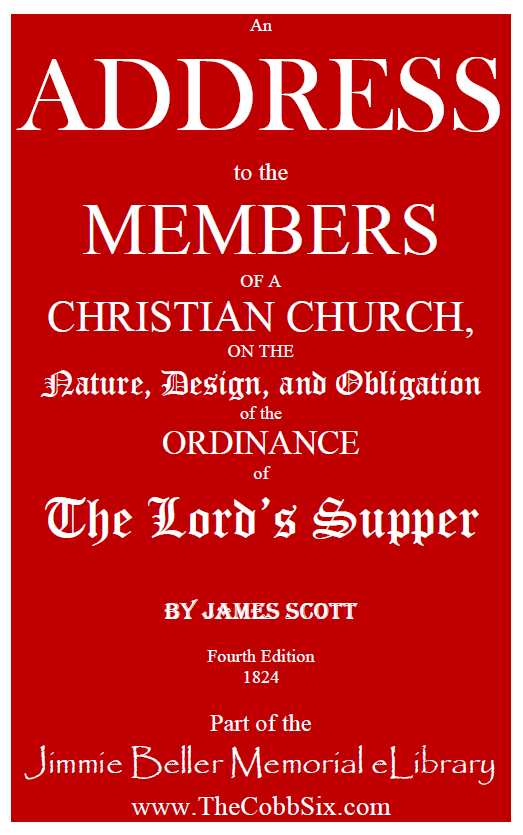
Sometimes you stumble upon a book by accident, and it becomes a blessing, helping you to grow as a result.  I’ve opined before about how the Lord’s Supper, in some congregations, is given a diminished importance, when it should be the focal point of our Lord’s Day gathering (see that article here).  This was something that was a problem almost 200 years ago as well.

Today’s addition to the Jimmie Beller Memorial eLibrary is a short book (just 16 pages), but it is full of valuable observations about the importance of the Lord’s Supper in the life of a Christian.

AddressOnLordsSupper

Now, I’ll tell you ahead of time, I don’t know the religious background of the author, and I don’t agree with some of his interpretations of a couple passages.  But there are enough good points in this book that we thought it to be well worth sharing with you.  Here’s a couple short excerpts:

The institution itself is well adapted to commemorate this interesting event. The broken bread is a just and striking emblem of the body of Christ, which was wounded and crucified; and the cup of wine is an effectual memorial of his blood shed for the remission of sins; it also reminds us of the obligations and blessings of the new covenant which was sealed and ratified by his blood. And by partaking of these elements, the disciples of Jesus are naturally led to reflect upon the relations in which they stand, and the duties which they owe to their common Lord, and to each other.

and

We live in a state of frailty and imperfection; the objects of sense have too much influence upon our minds; and kind and amiable as the friend of sinners is, we are too apt to forget him. But Jesus well knew that a constant affectionate remembrance of him at his table, would inspire his followers with a penitential sorrow for sin, kindle in their bosoms an unfeigned ardent love to him, a lively gratitude for the blessings they derive from his gospel, animate them with heroic zeal and fortitude in his cause, unite them to each other in the bonds of undissembled affection, and that it would induce them to aspire to the highest attainments in universal excellence. The celebration of the Lord’s Supper tends to perpetuate the memory of his sufferings and death, not only in our own hearts, but also in the church and in the world. By frequenting his table, we openly profess our value and esteem for a crucified Redeemer; show that we are not ashamed of our Master, but glory in our relation to him; that we are not ashamed of his gospel, but obedient to its requisitions, and that we are not ashamed of his cross, but cheerfully enlist ourselves under its banner.

We’ve gone through this book, updating the spelling and punctuation, correcting any mistakes, and reformatting the entire booklet to give you the best possible reading experience (trust me…you should have seen what we had to work with to begin with…it was a MESS!)

To read or download this book, just click the link below!

Scott, James – Address on the Lords Supper (James Scott)

-Bradley S. Cobb

The Man Behind “The Last Will and Testament of the Springfield Presbytery”

Most Restoration Movement enthusiasts and experts rank the “Last Will and Testament of the Springfield Presbytery” as perhaps the most important document in the effort to restore New Testament Christianity (or at least the second-most important).  The man who was behind this document is rarely mentioned, though.  His name is Richard McNemar.

Today’s addition to the Jimmie Beller Memorial eLibrary (yes, I know this is Monday, but we’re feeling generous, and I’m behind on my apostles notes) is the rest of the story.

McNemar Cover


We first published this book back in 2014, and if you want it in print, we’ll be happy to sell you a copy (just $5.99), but now you can read it for FREE on your computer or electronic device.

I’m sure you want to know something about it, so here’s a bit of information:

From the Preface:

Richard McNemar is an enigma to many students of the Restoration Movement. He shows up as a co-worker with Barton W. Stone, and his name is on one of the most historically significant documents of the Restoration. Yet he is not much more than a footnote in the history books. This primarily stems from his conversion to Shakerism in 1805. However, for those students who want to know more about him, and want to know what happened to him after the Last Will and Testament of the Springfield Presbytery, this book is for you.

This is a sad tale of a preacher who had great potential, but who was caught up in false doctrines.

The author of the book (J.P. MacLean) was a historian of the Shakers (publishing several Shaker-related books), and a Universalist minister from Ohio. Since much of McNemar’s work as a Shaker was in Ohio, it caught MacLean’s attention and influenced him to put together this work, originally published in 1905.

This work on the life of Richard McNemar has undergone several editorial changes in spelling, punctuation, and formatting.  Additionally, several footnotes have been added to explain various words and phrases that aren’t familiar to most readers.   There is also a new section added to the end of the book which gives a very brief overview of the history and beliefs of the Shakers.

We do trust, however, that you will find this work, A Sketch of the Life and Labors of Richard McNemar to be interesting, and that it will help you know “the rest of the story.”

Contents:

Preface.
Chapter One: Early Life.
Chapter Two: Charges of Heresy.
Chapter Three: The Kentucky Revival
Chapter Four: Conversion and New Order
Chapter Five: An Account of Labors and Suffering.
Chapter Six: Travels and Special Missions.
Chapter Seven: Literary and Other Industries.
Chapter Eight: Persecution, Expulsion, Triumph, and Death
Bibliography.
Appendix: A Brief Overview of the Shakers

Published by Cobb Publishing, 2014.

To read this book or download it for your PDF collection, just click the link below!

Richard McNemar

-Bradley S. Cobb


Questioning Jesus’ Sanity and Source (The Blasphemy of the Holy Spirit)

The Text: Mark 3:20-30 – The multitude came together again, so that they couldn’t so much as eat bread.  And when those close to Him heard, they went out to restrain Him, for they said, “He is crazy!”

And the scribes which acme down from Jerusalem said, “He has Beelzebub, and by the prince of demons He cats out demons.”  And He called them, and said to them in parables, “How can Satan cast out Satan?”

“And if a kingdom is divided against itself, that kingdom cannot stand.  And if a house is divided against itself, that house cannot stand.  And if Satan rises up against himself and is divided, he cannot stand, but has an end.”

“No man can enter into a strong man’s house and take his goods, unless he first binds the strong man; then he can rob his house.”

Truly I say to you, ‘All sins shall be forgiven to the sons of men, and blasphemies as many as they shall blaspheme; but he that shall blaspheme against the Holy Spirit never has forgiveness, but is in danger of eternal damnation.”

[Jesus said this] because they said, “He has an unclean spirit.”

Introduction

In the last half of Mark chapter three, the writer deals with what people thought about Jesus’ mental state and His allegiance; and that’s followed by Jesus’ words regarding who His true family was.  While Mark records actual, 100% true events, they might not be recorded in chronological order.  Luke, who claimed to write his gospel “in consecutive order” (1:3, NASB), records some of these events in chapter 11, and then the last part seen in Mark 3 is recorded in Luke 8.  This doesn’t affect the inspiration of the Scriptures at all, for Mark never made the claim that he was writing chronologically.  Instead, there’s a logical progression to Mark’s unfolding of events.

The Text, part 1 – The View of His Associates (Mark 3:20-21).

In verses 20-21, the focus is on how certain people close to Jesus viewed His mental state because of His actions here.

And the multitude comes together again

This is the great crowd of people who just about crushed Jesus earlier in the chapter.  Jesus requested a small ship be prepared so that He wouldn’t be “thronged” or crushed like a grape.  But now, the same scenario arises again—except that this time there’s no ship, because Jesus is at a house (see verse 19).

So that they couldn’t so much as eat bread.

Whoever the “they” is (whether it’s Jesus and the apostles, or the crowd), the point is that there was so many of them that having the space and taking the time to eat was an impossibility (literally, they did not have the power even to eat).  The crowd wanted Jesus’ time and attention—it’s all they cared about.  It seems as though this is the same kind of thing that happened when Jesus ended up feeding the 4,000:

Jesus called His disciples and said, “I have compassion on the multitude, because they continue with me now three days, and have nothing to eat: and I will not send them away fasting, lest they faint in the way (Matthew 16:32).

Have you ever been so focused on Jesus and wanting to be close to Him that you forget to eat—or don’t think eating is important enough to stop reading His word and going to the Father in prayer?  Jesus said “blessed are those who hunger and thirst after righteousness, for they shall be filled” (Matthew 5:6); and He told His disciples, “My [food] is to do the will of Him that sent me” (John 4:34).  When our hunger for spiritual things becomes greater than our hunger for physical things, we have grown greatly in Jesus Christ.

Many of those who followed Jesus (including, certainly, many in this multitude) were not interested in His teachings, but in seeing a miracle or being the recipient of His healing power (Mark 3:10).

And when those near Him heard of it


There’s debate as to who these people are.  The KJV and ASV say “friends,” the NKJV and NASB say “His people,” while the ESV (and many commentators) says “His family.”  Literally, the text says “the ones beside Him.”  Regardless of who it was (I tend to think it is His newly-appointed apostles whom He said would be “with Him”—Mark 3:14), these were people who cared about His well-being.

They went out to grab hold of Him

They wanted to rescue Him, to save Him from the crowds that put His life in danger before by mobbing Him.  Given the size of the crowd, it took some courage for these people to work their way to Jesus and try to take Him away from the mob.

For they said, “He is beside Himself!”

Literally, they said “He is crazy!”  It’s as though they were questioning Jesus’ sanity in going back out to the mob that all wanted to touch Him and crowd Him.  If indeed it is the apostles under consideration, imagine what they’re thinking.  They were selected that morning, and now, to them, it looks like Jesus is trying to commit suicide by letting the mobs come rush Him again.

But Jesus wasn’t crazy.  What His associates didn’t understand is that Jesus had the power to stop the mob in their tracks if He wanted.  He could have simply walked through the crowd like He did in Luke 4:28-30:

And all they in the synagogue, when they heard these things, were filled with wrath, and rose up, and thrust Him out of the city, and led Him to the brow of the hill on which their city was built, so that they might cast Him down headlong.  But He, passing through the midst of them, went His way.

Mark doesn’t tell us what happened next.  He doesn’t say that the associates of Jesus pulled Him into the house, and doesn’t say they Jesus told them not to worry.  It’s simply left with their thought that Jesus was crazy.

The Text, part 2 – The View of the Scribes (Mark 3:22)

And that leads directly into verse 22, which tells us that the scribes held a somewhat similar view—but with a completely different motive.

The scribes which came down from Jerusalem


These were some of the religious teachers who were supposed to be well-acquainted with the Law of Moses, having copied much of it by hand.  The fact that they were the scribes in Jerusalem meant that they were the most prestigious scribes in the nation.  Their words held a lot of weight with the people.

They came “down” from Jerusalem, because Jerusalem is situated on a mountain.  They weren’t using “down” to mean “south” like we do when looking at a map.  They walked, and so anywhere out of Jerusalem was “down” to them.

[They] said, “He has Beelzebub”

Beelzebub is a name the Jews used for Satan.  Literally, it means “Lord of the flies,” but it’s also been said that this originated with the idea that the flies buzz around piles of poop.  Thus, according to some who have studied the issue, the name Beelzebub is a derogatory name to describe Satan as “poop lord” or “the poo-poo god.” (and yes, that is a direct quote).

So when the scribes from Jerusalem made this accusation, it wasn’t just that they were questioning Jesus’ power and authority (which, if we are really lenient, we might say they did in ignorance), they were also degrading Jesus.  It wasn’t a scared, fearful, “He serves Satan,” but instead a sneering and mocking, “He has the poo-poo god.”

In the Old Testament (1 Kings 16), the Philistines worshiped “Baalzebub,” which is almost definitely the same name.  Ahaziah, one of the kings of Israel, was sick and injured, and instead of enquiring of God as to whether he would recover, he sent messengers to go enquire of Baalzebub.  Elijah stopped them and sent them back with a message: because the king would rather enquire of Baalzebub than of the God of Israel, he was going to die.  Over a hundred men were killed with fire from heaven in the course of the chapter, all going back to the actions of the king.

“By the prince of demons, He casts out demons.”

There’s not a single good motive behind what these scribes said of Jesus.  They said that He has Beelzebub, as though He’s possessed, not just by any demon, but by Satan himself, the ruler of demons!  He who was casting out demons, they claim, is the most possessed man there is!

Now don’t miss what they’re saying.  They are admitting, without a doubt, that Jesus was casting out demons.  Thus, they are admitting that Jesus possesses supernatural power—miracle-working power.  And they are so opposed to Jesus that they take the ridiculous position that He’s actually working for and with Satan!

Now, for the sake of the argument, we should recognize that in casting out demons, there were only two possibilities—either the power of God was behind it, or the power of Satan (the ruler over demons) was behind it.  The scribes tried to convince the people that Jesus was controlled by Satan, or working with him, in an effort to trick people into following Satan, by casting out the demons.  In effect, their accusation was that Satan was trying to pretend to be an angel of light to draw away followers after himself.

His associates thought He was crazy, but His enemies claimed He was Satan-possessed!

The Text, part 3 – A House Divided (Mark 3:23-27).

Jesus’ response is to show the ludicrousness of their accusation.  Mark doesn’t give us everything Jesus used in response, but he gives us enough to make the point pretty clear.

He called them, and said to them in parables, “How is Satan able to cast out Satan?”

Mark wants to make sure that his readers don’t miss the point of these parabolic statements from Jesus.  They each are given as ways of asking the same question, “How is Satan able to cast out Satan?”  The word translated as “can” in the KJV is the word dunamai, the noun form of which is very frequently used to describe miracle-working power.  When it appears here, the question is “How does Satan have the ability [or power] to cast himself out?”

Jesus, who knew what the scribes were thinking and saying, called them and presented a series of arguments to them.

“If a kingdom is divided against itself, that kingdom cannot stand.”

Imagine a king who tries to undermine the very laws that he uses to govern people.  Or a ruler who bombs his own army.  If Satan is casting out Satan, it’s the same as though a king was banishing himself from his own kingdom, or perhaps banishing all his subjects (since Satan is the ruler of the demons).  Once there are no more subjects, there’s no kingdom.

Jesus’ point is that no one with any sense at all would actively seek to destroy his own kingdom, and Satan isn’t stupid—he isn’t going to actively try to destroy his own power, and therefore himself.

“If a house is divided against itself, that house cannot stand.”

Jesus goes from the large (the kingdom) to the small (the family) to show that this principle applies all the way around.  A family which does nothing but fight isn’t really a family at all any more, except perhaps in name only, because the people in that family have destroyed it.

“If Satan rises up against himself, and is divided, he cannot stand, but has an end.”

Jesus makes it clear that the demons that have been cast out are loyal to Satan; by casting out the demons, it is an attack on Satan himself.  Thus, if this is being done by Satan’s power, then Satan is attacking himself.  And if Satan is attacking himself, neither he nor his kingdom can stand.  If Satan is attacking himself, he has an end—he is committing suicide.

However, Satan isn’t stupid.  Satan isn’t attacking himself.  Satan isn’t committing suicide.

But something is going on
 Satan is being attacked
 His soldiers are being defeated
  His kingdom is shaking.

No one can enter into a strong man’s house and steal his goods, unless he first binds the strong man; then he can rob his house.

The scribes’ accusation was that Jesus was possessed by Satan.  Jesus’ response is to say, in essence, Are you kidding me?  Satan’s kingdom is falling, and he’s not doing it himself.  I’m the one who is doing it, for Satan—as strong as he is—is no match for me.  I’m taking his kingdom.

It is a statement of Jesus’ amazing power.  He, as God in the flesh, has come and beaten Satan at his own game.  Satan went after Him hard and heavy, tempting Him during those forty days (Mark 1:13), but Jesus came out victorious, and began to announce that the Kingdom of Heaven was at hand.  Satan continues to fight back, but his kingdom is losing power every day that Jesus works.  Satan is the “strong man,” but Jesus is even stronger!

The Text, part 4 – The Blasphemy of the Holy Spirit (Mark 3:28-30).

Understanding the context is key to understanding what the blasphemy of the Holy Spirit actually is.  Jesus didn’t just spit out these words are a random moment; He thoughtfully said them in response to an actual event.  And it’s rather important that we notice the progression of what’s happened here in His interaction with the scribes.

  1. They make the accusation that He’s doing miracles by the power of Satan.
  2. He shows the ridiculous nature of their accusation.
  3. He declares His superiority in power over Satan (which is actually a claim to be Deity).

And now, Jesus warns them that eternal damnation (which He has in His power to administer) awaits those who make such accusations.

“Truly I say to you, All sins shall be forgiven to the sons of men”

Murder, robbery, hatred, etc., all of the things we think of as sin will be forgiven by God if we repent.  Of course, this is not saying that God will forgive every sin period.  There is no grace for those who sin willfully (Hebrews 10:26), or for those who don’t know God or who reject the gospel (2 Thessalonians 1:8).  But Jesus is saying that forgiveness is available for all sins
except for one.

“Even blasphemies, as many as they shall blaspheme”

Blasphemies are speaking evil of someone, speaking against them.  Even blasphemies will be forgiven by God.  Saul of Tarsus blasphemed (1 Timothy 1:13), but was forgiven.  Blasphemy itself does not guarantee eternal damnation.  But one kind does


“But he that shall blaspheme against the Holy Spirit never has forgiveness, but is in danger of eternal damnation.”

Jesus brought this up for a reason, which Mark gives in verse 30.  The scribes had seen first-hand the power of Jesus to cast out demons (see Luke 11:14-15), but were so hard-hearted that they’d rather give the glory for this wonderful miracle to Satan than to Jesus, who did it by the power of the Holy Spirit.  They, the teachers of the law, the supposed experts, were calling good “evil.”

Woe to them who call evil “good,” and good “evil”; that put darkness for light and light for darkness; that put bitter for sweet and sweet for bitter! Woe to them who are wise in their own eyes, and prudent in their own sight! 
 Therefore as the fire devours the stubble, and the flame consumes the chaff, so their root shall be as rottenness, and their blossom shall go up as dust: because they have cast away the law of the LORD of hosts, and despised the word of the Holy One of Israel.  Therefore is the anger of the LORD kindled against His people
(Isaiah 5:20-21, 24-25).

Miracles, which came from the Holy Spirit, were given as absolute confirmation from God Himself that the things spoken were divinely approved, and that the messenger was from God (Mark 16:20, Mark 2:10).  If someone saw the evidence given by God, and still rejected it, and even worse, claimed that it was Satan that was doing it?  That is a full-on attack on God Himself, His nature, His goodness, His power, and His deity.  The person who is that hard-hearted has destroyed his chance at forgiveness.

Some Greek manuscripts read “guilty of eternal sin,” which gets the same basic idea across.  It is a sin that never dies, that never goes away.

People often wonder (and worry) about possibly committing this same sin today.  First, you need to remember what it is: accepting the miracles of the Holy Spirit, but rejecting the message, the messenger, and attributing those miracles to Satan.  So, the only way you could commit this unpardonable, eternal sin today is if you admitted the miracles of Jesus and the apostles took place, but agreed with the scribes that it was done through the power of Jesus.  Or perhaps if you said that the Bible itself (given by inspiration of the Holy Spirit) was a product of Satan, and not of God.

The point to remember is that if you’re trying to be right with God, there is ZERO chance that you could commit this sin.  It isn’t a sin that is committed on accident.  The scribes intentionally spoke against the miracles of Jesus.  It wasn’t that they questioned them, or just weren’t certain; they did it on purpose.  That is what made it unforgiveable.  They knew it was a miracle, and they intentionally gave credit to Satan for it instead of God (via the Holy Spirit).

[He said this] because they said, “He has an unclean spirit.”

Jesus has completely turned the tables on them.  They came with what they probably thought was an ingenious argument, and they left exposed and condemned.  Their condemnation came because they had said Jesus Himself had an unclean spirit—specifically Satan—guiding His movements.  How hard-headed and close-minded do you have to be to claim in one breath to believe in God and His word, and in the next denying God’s power, and by implication praising Satan???

Is it any wonder that they left condemned?

Application

You Might Not Know the Whole Story


The associates of Jesus (regardless of who they were) wanted to help Him, to essentially save Him from Himself.  But they didn’t understand the whole story.  They didn’t fully grasp what was going on, who Jesus was, and what power He had.  There are times in our lives where we make assumptions about other people, and sometimes those assumptions turn out to be completely wrong.  The ones who went to grab Jesus were acting out of concern for His well-being, and that is absolutely commendable.  It’s an example we should follow.  But at the same time, they were acting on an assumption.

When you start to question the motives of others, stop and ask yourself if you’re assuming they have bad motives, or if you know for certain that such is the case.  It might be that you have misunderstood what is happening.  It might be that their motives are pure and they simply made a mistake.  It might be that they just plain don’t have the same level of understanding that you do in some matters.  In all things, instead of making assumptions, we should go to the person and help them, make sure we know the truth about any given situation so that we can be able to act based on facts and not assumptions.

The Other Unforgiveable Sin

Jesus said that blasphemy against the Holy Spirit was not forgivable; but there is another sin that is unforgiveable.  That sin is the one that you know you’ve done, but don’t repent of.  Hebrews 10:26 says “if we sin willfully, after having received a knowledge of the truth, there remains no more sacrifice for sins
”  To sin willfully is to know you’re sinning, to do it on purpose.  1 John 1:9 says “if we confess our sins” (and the idea is not just saying “yep, I did this,” but confessing it to God with a repentant heart), “He is faithful and just to forgive us our sins, and to cleanse us from all unrighteousness.”  That word “if” means that when you don’t repentantly confess your sins to God, you won’t be forgiven.

Brethren, when you know you’ve sinned, repent and ask God for forgiveness for it, and He will forgive you.

Invitation

Those verses were written to Christians who had already taken hold of the blood of Jesus Christ through humble obedience to His word.  The very first sermon delivered after the resurrection of Jesus is found in Acts 2.  In that sermon, Peter’s goal was to help people be saved.  After getting their attention, Peter said, “hear these words,” and proceeded to tell them about the death and resurrection of Jesus.  He appealed to both Scripture and miracles to prove it to them, so that they would believe it.  When the people realized he was telling them the truth, they were cut to the heart and asked, “What shall we do?”  Peter’s response to these people who were not yet Christians, and who wanted to be forgiven, was this: “Repent and be baptized, every one of you, for the remission of sins.”

If you have not obeyed the gospel commands, please delay no longer.  Follow those simple God-given directives and enjoy a new life with your old sins all erased!

-Bradley S. Cobb
An interesting Restoration Movement Coincidence(?)

Abner Jones wasn’t the kind of man to toot his own horn, like his co-worker, Elias Smith, was.  True, he wrote his autobiography at the request of friends and co-workers in the kingdom who wanted a first-hand account of his efforts at restoration, but if you read it, he doesn’t make a big show out of himself.

Abner, for the most part, quietly went about his work of preaching and teaching and trying to help plant congregations and build them up.

Meanwhile, the denominational mindset that he hated so much had worked its way into the congregations that he had been laboring for. It started off innocently enough in 1808, with ministers from the New England area decided to get together for a meeting of sharing news and encouragement and fellowship.  Then they met again in 1815, and discussed whether it was scriptural to have a conference like that to discuss matters.  They decided, based on Acts 15, that it was, and so they made it an annual event.  After that, they began to elect officers to preside over the meetings.  Then they started making decisions for the whole group.  In 1824, this group, calling themselves the United States Christian Conference, decided to welcome any church, whether they practiced baptism or not, so long as they weren’t opposed to the practice.

As we saw in a post last week, this stance put them at odds with the Bible, and also with the disciples, Christians with whom Alexander Campbell was associated.  It is interesting that this resolution came at the first meeting after Campbell began writing and arguing heavily about the essentiality and mode of baptism.  Already there had been some congregations who had started uniting with the disciples, due in large part to the Scriptural stance they were taking.

It was in 1832 that Barton W. Stone, as a representative of the Christian Church (Christian Connexion) in the midwest, officially gave the right hand of fellowship to Raccoon John Smith, the representative of the disciples.

The portion of the Christian Church (Connexion) in New England wasn’t as thrilled by this measure, and there were some who wanted official resolutions against the disciples and this union that they did not agree to.  So, later that year, when they came together for the annual meeting of the United States Christian Conference, they  turned to Abner Jones, their elder statesman, to preside over it all.

And then something quite extraordinary happened.  Under Abner Jones’ leadership, a motion was made, seconded, and passed, “dissolving the United States Christian Conference forever.” (Herald of Gospel Liberty, June 16, 1910, pages 758-759).

It seems that Abner Jones knew that this body was primed to act in a very un-Christian way.  It also appears that Jones was ready and willing with work with the disciples as brethren in Christ, endorsing the union of forces.

To the outsider, the dissolution of this body, so soon after the union of the Christian Church (at least the part that followed Barton Stone) and the disciples, might appear to just be a coincidence.  But it wasn’t.

It is no coincidence that the dissolving of this body–the body who had, just eight years earlier, denied that baptism was essential for salvation–came immediately after the union of Stone and Campbell.  It is also no coincidence that it was eliminated as a decision-making body through the leadership of Abner Jones.  It is almost as though it was his way of retracting the horrible decision they made in 1824, and his desire to remove any obstacle to working together with the disciples.

Unfortunately, the elimination of the conference didn’t last long.  The next year, a prominent Christian Church (Connexion) preacher called for a conference, and the whole mess started up again.  On the funny side, they met again in 1834, and there was great confusion, because no one could agree on why they were there.  Some thought there was an official convention (like before), others thought it was just a meeting to discuss the publishing of books by members of the Christian Church.  It was agreed and resolved that the United States Christian Conference had dissolved, and so they must be there because of book publishing. (Herald of Gospel Liberty, June 23, 1910, page 790).

In 1838, Abner Jones presided over the meeting, and made it a point to stress that it was a meeting regarding the “General Book Association.”  Jones died before the next meeting (which was now being held every four years).  It wasn’t long before these meetings once again morphed into a decision-making body over the churches.

But in 1832, a wonderful thing took place; something that might, on the surface, seem like just a coincidence; yet was anything but.

-Bradley S. Cobb

(NOTE: Abner Jones’ autobiography is included in our book, Abner Jones: A Collection.)

The Disciple Whom Jesus Loved–The Life of the Apostle John (Part 3)

John after the Resurrection

John stayed at the cross until after Jesus had died, and witnessed first-hand the soldier shoving a spear into the side of Jesus.  He watched as the blood and water came flowing from the wound, and it made an indelible impression on him.  Years later, when he wrote his account of the gospel of Jesus Christ, he made sure to include this information, and even stressed that he was there to see it firsthand.1

After the death of Jesus, John was quite sad and upset. He still didn’t understand the Scriptures, that Jesus would rise from the dead.2 But the next morning, Mary Magdalene, along with Joanna, and Mary, the mother of James,3 came running to him and the other apostles, most likely with tears and confusion, saying, “They’ve taken away the Lord out of the sepulchre, and we don’t know where they’ve laid him.”  They also said that they had seen men in shining clothes who told them that Jesus had risen.  But the apostles thought they were making things up and didn’t believe them.4

However, John and Peter took off running immediately for the tomb where Jesus had been laid.  John was the faster of the two men, and beat Peter there.  Then, while waiting for Peter to get there, John bent down and looked inside.  There he saw the linen burial clothes laying inside the rock tomb, but he didn’t enter.  Then, Peter finally arrived and went straight in the place where Jesus’ body had been placed a few days earlier.  John followed Peter in, and saw again the burial clothes laying there, and also noticed that the face cloth was laying by itself, “rolled up” (ASV) together.  Seeing this was enough to make John believe that Jesus had risen from the dead, even though he didn’t understand yet that it was what the Scriptures had foretold.5  Coffman has some interesting comments at this point:

Commentators who refer this to some mere tidying up of the grave, or the folding of the garments (there were no garments; but medical bandages), miss the point. Since when has it ever been supposed that a folded garment, or cloth, proved that the dead had arisen? The certain implication of this astounding narration is that Jesus had risen through the winding shroud of bandages, napkin and all, leaving behind the positive and undeniable evidence of his supernatural triumph over death. Remember, this evidence convinced John. The very amount of space accorded this phenomenon in this Gospel is far more than enough to indicate the extraordinary implications of “the linen cloths lying.” Matthew has a remarkable corroboration of this account in the words of the angel, “Come see the place where the Lord lay” (Matthew 26:6), thus emphatically implying all that John here related.


The napkin around the head would not have connected with the winding shroud; and that independent placement was preserved in the manner of the linen cloths lying.6

Barclay agrees:

Then something else struck him–the grave-clothes were not disheveled and disarranged. They were lying there still in their folds—that is what the Greek means—the clothes for the body where the body had been; the napkin where the head had lain. The whole point of the description is that the grave-clothes did not look as if they had been put off or taken off; they were lying there in their regular folds as if the body of Jesus had simply evaporated out of them. The sight suddenly penetrated to John’s mind; he realized what had happened—and he believed. It was not what he had read in scripture which convinced him that Jesus had risen; it was what he saw with his own eyes.7

That evening, word had spread that Peter had seen the Lord,8 and John gathered together with all the apostles (except for Thomas, who was absent).9  They kept the doors shut, in fear that the Jewish leaders might come after them—especially now that whispers were spreading that the tomb was found empty, and people were claiming to have seen Jesus very much alive.10  While they were gathered together, Jesus appeared in their midst, and said “Peace to you,” and showed them His hands and His side, proving that it was Him.  Joy cannot begin to describe the feeling that John was experiencing.  But at the same time, Jesus upbraided them because they hadn’t believed the ones who had told them that He had been raised.11

Some time afterwards, John accompanied Peter and some of the other apostles onto a boat where they went fishing all night, but caught nothing.  The next morning, John saw a man on the shore, who called out to them, “Children, do you have any food?”  After they replied in the negative, John heard the man say, “Cast the net on the right side of the ship, and you’ll find [fish].”  When they did this, there were so many fish that they couldn’t draw the net in.

The other apostles apparently didn’t realize who it was on the shore, but John did.  He said to Peter, “It’s the Lord!”  John was left with the boat as he watched Peter jump into the water and swim to shore.  John and the other apostles brought the ship to shore, dragging the net behind them, and then sat down with Jesus and ate.

After they finished eating, Jesus began to walk with Peter, and John followed them.  It is probable that John heard at least part of the conversation, including Jesus’ foretelling of Peter’s death, and Peter asking Jesus, “What about this man?” (referring to John).  Then John heard Jesus’ reply of, “If I desire that he remains until I come, what is that to you?  You follow me.”  Decades later, this conversation about John was still remembered, so that when John wrote his account of the good news of Jesus, he had to make it clear that Jesus wasn’t saying John would never die—just that John’s fate was unimportant to the command of Jesus to “follow me.”12

That is a lesson that we would all do well to remember—it doesn’t matter what anyone else does, our command is to follow Jesus.

-Bradley S. Cobb

1 John 19:30-35.  John does not emphasize his status as an eyewitness for any other specific event his gospel account.  This shows that the blood and water coming from Christ has a major significance.  See Romans 6:3-5; Acts 22:16; Revelation 1:5, 7:14.

2 John 20:9.

3 Luke 24:10.  Most likely, this is Mary, the mother of Jesus Christ.  Since they had not yet seen Jesus Himself raised, she would have been called by the name of her oldest known living son, which was James.  Luke has a general habit of not mentioning someone by name unless he expected the reader to already know who that person was, or unless that person showed up elsewhere in his writings.  Joanna was mentioned in Luke 8:3, Mary Magdalene in 8:2.  Other than Mary Magdalene, Luke mentions two women named Mary: Mary, the sister of Martha and Lazarus, and Mary, the mother of Jesus Christ (and his brothers, including James).  Since it was already common knowledge (thanks to Matthew’s gospel which was published and distributed around 20 years earlier) that James was the brother of Jesus and the son of Mary, Luke could identify the mother of Jesus as “Mary, the mother of James,” and the readers would have known exactly what he meant by it.

4 John 20:1-2 only mentions Mary Magdalene speaking to John and Peter, but she says “we don’t know where they’ve laid Him.”  Luke 24:10-11 mentions two other women by name, and includes “others.”  It is possible that the women split up in order to get the news spread to the apostles quickly.

5 John 20:1-9.

6 James Burton Coffman, comments on John 20:6-7.

7 The Daily Study Bible Commentary on John, notes on John 20:1-10.

8 Luke 24:33-34.  The actual appearance to Peter isn’t described in the Scriptures, but it is referenced in this passage, as well as 1 Corinthians 15:5.

9 John 20:24-25.  For why Thomas may have been absent during this meeting, see the chapter dealing with him.

10 Even the Jewish leaders knew the tomb was empty, for they paid the soldiers who were guarding it to lie and say that the disciples stole the body (Matthew 28:11-15).

11 Mark 16:9-15.

12 This whole incident is found in the last chapter of John, especially

As Touching Those Who Were Once Enlightened…

Two men, once prominent in the Lord’s church, announced that they were leaving and joining a denomination.  On their way out, they tried to verbally attack the bride of Christ, throwing many accusations (with no evidence), and in effect condemning (and denying the intelligence and honesty of) the very people with whom they had labored for a quart of a century!

Not only did they say these things, they also put it in print for people all over the country to read.  This was in 1946.

Today’s addition to the Jimmie Beller Memorial eLibrary is a book that was written in answer to their accusations, insinuations, and outright misrepresentations.

The full title of this work is:

As Touching Those Who Were Once Enlightened

Being a Review of the Reasons Given by Two Former Friends and Co-Laborers When they “Went Back and Walked No More With Him.”

A brief history is given, including the full text of the letters written by the two men in question (brothers Reedy and Etter), and then Brewer answers their charges, and shows the flaws in their excuses so that other Christians wouldn’t be led astray by them.

This might not be every person’s cup of tea, but the book is still very relevant, for there are preachers in the Lord’s church who are making the same statements as Reedy and Etter made 70 years ago.

As usual, this book has been completely reformatted, corrected, and made pretty to give you a more pleasant reading experience.

Click the link below to download!

As Touching Those Who Were Once Enlightened (GC Brewer)