
All posts by BradleyCobb

The Preview…

quarterly00_front

FREE FREE FREE FREE FREE FREE FREE!!!!!!

(did that get your attention?)

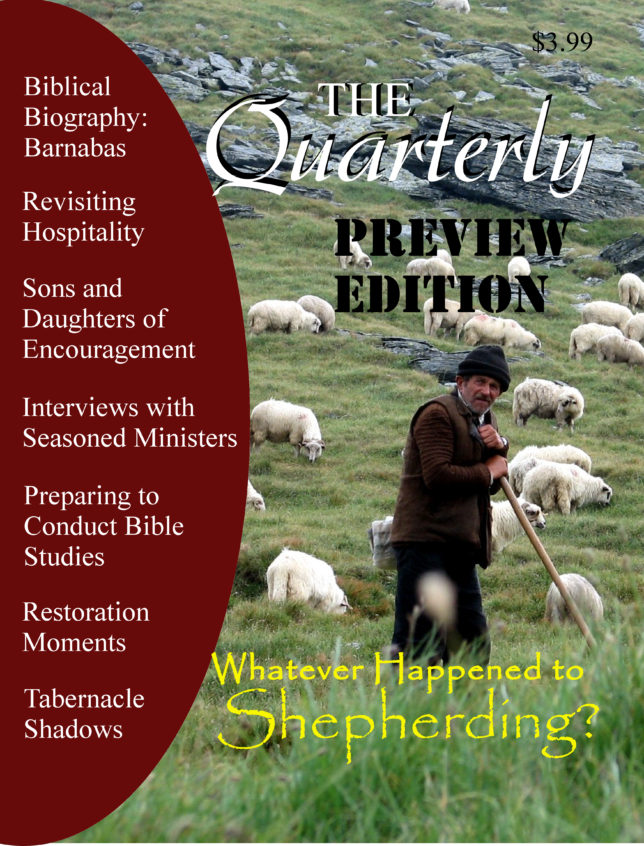
The Preview Edition of the Quarterly is now available.  If you want to download the digital preview — FREE — the link is at the end of this post.  But first, let me tell you a bit about it.  🙂

This preview edition has 15 articles, and 48 pages of encouragement, edification, education, and enjoyment from good, dedicated, Christian writers.

One writer with a lot of experience in personal evangelism is writing a series on preparing for Bible studies and getting people to agree to have them with you.  We’ve got stories of conversions, interviews with “seasoned ministers,” a look at understanding “hospitality,” and even the first few chapters of a novel that we are certain you will find interesting and worthwhile!

Take a look for yourself:

  1. Editorial: An Important Note
    Bradley S. Cobb
  2. Insights from Seasoned Ministers: Loren (L.L.) Gieger and Stafford North
    Interviews by Jim Mitchell
  3. Equipping
    Jim Mitchell
  4. I Can Do All Things Through Christ Which Strengtheneth Me
    Roderick L. Ross
  5. Restoration Moments: The Conversion of Blue Dick
    From the Life of Knowles Shaw, Singing Evangelist
  6. The Parable of the Lighted Candle
    Devin Self
  7. Biblical Biography: Barnabas
    Bradley S. Cobb
  8. What Ever Happened to Shepherding?
    Jamie Beller
  9. Paul Darst: A Novel
    Daniel R. Lucas
  10. Funny and Not-So-Funny Events in the Life of Elijah Martindale
    Bradley S. Cobb and Elijah Martindale
  11. Poetry Corner
  12. Sons and Daughters of Encouragement
    Gerald Cowan
  13. The Tabernacle Shadows
    Mark McWhorter
  14. Preparing Yourself to Conduct Bible Studies
    James Sims, Sr.
  15. Hospitality Revisited
    Perry Hall

If you like what you see, then by all means, download the digital copy of the preview (did we mention it’s free?).  If you’re like me, and you much prefer having things in your hand, you can order the print version of the Preview for just $3.99 (see the option below).  If you want to order 10 or more to share with others (friends, family, your local congregation), then contact us  for a specific price quote (orders of 10 or more get a 25% discount).

And when you’re done reading it, please consider subscribing to either the print or digital edition.  Each subscriber will receive, as  BONUS, either 35% off of a book we publish (in print), or a free eBook of your choice from any that we publish.

Here’s the link for the digital preview:

The Quarterly – Preview Edition (eBook)

And if you want to order the print edition, just use the link below (or click here).

-Bradley S. Cobb

The Roller-Coaster of Faith – The Life of the Apostle Peter (Part Nine)

ApostlesLogoThe Garden of Gethsemane

After the apostles all pledged their allegiance to Jesus, they walked to a place where Jesus instructed them to sit while He took Peter, James, and John a bit further.  The lord was “exceeding sorrowful, even unto death,” and told the three to wait there and watch on His behalf.1  He went further on and prayed, but instead of watching, Peter and the two brothers fell asleep.

When Jesus returned to find His three closest followers sleeping, His words were directed at Peter, whom the Lord apparently expected to show some leadership: “Simon, you’re sleeping?  You couldn’t watch for even an hour?”2  By this point, the other two apostles apparently had awakened, because Jesus said, “You all watch and pray, lest you enter into temptation.  The spirit truly is ready, but the flesh is weak.”3  But after the Lord went away to pray again, Peter’s weakness took over and he again went to sleep with the other disciples.

Jesus didn’t wake them the second time He returned, but when He came back the third time, He sarcastically said, “You sleep now, take your rest.  Enough!  The hour is come!  Look, the Son of man is betrayed into the hands of sinners.  Get up; let’s go!  Look, he that betrays me is at hand.”4  Then Peter and the rest of the apostles stood and took their place by Jesus’ side as Judas and a band of Roman soldiers, as well as many Jewish officials came to arrest Jesus.5

Peter watched as Judas came forward and gave Jesus a kiss, and then saw the armed men make their move to grab Jesus.  It’s at this point that Peter, standing beside Jesus, unsheathes his sword, and with amazing accuracy (or perhaps just lucky dodging on the part of his target) slices the right ear off of a man named Malchus, a servant of the high priest.6  While Jesus probably appreciated the show of loyalty, He told Peter to “Put up your sword,”7 and “Allow this to take place.”8  Then Jesus touched Malchus’ ear and healed him, effectively counteracting Peter’s actions.9  It was soon after this, all the disciples realizing that Jesus wasn’t going to fight—nor let them—that they all ran away and left Him alone with His captors.10

-Bradley S. Cobb

1 Matthew 26:38.  Jesus told these three men to “watch,” but He didn’t mean “watch me while I pray.”  He meant to watch for anything that might happen (specifically the arrival of Judas and the soldiers he would bring with him).

2 Mark 14:37.  It is worthy of note that Jesus calls him “Simon” once again, which appears to indicate disappointment in him; or at the very least, showing that Peter was not living up to his divinely-given name of “Rock.”  The fact that all three were sleeping, but that only Peter was chastised, shows that Jesus expected more of him than the others.

3 Mark 14:37-38.  Verse 37 has singular pronouns, showing that Peter was being chastised; while verse 38 has plural pronouns, showing Jesus speaking to the three disciples.

4 Mark 14:41-42.  The NET Bible says, “Are you still sleeping and resting? Enough of that! The hour has come. Look, the Son of Man is betrayed into the hands of sinners. Get up, let us go. Look! My betrayer is approaching!”

5 The word “band” in John 18:3 refers to a cohort, a collection of 600 Roman soldiers, though it is occasionally used to refer to as many as a thousand, or as few as 200 (see NET Bible notes, Barclay’s Daily Study Bible notes on the passage).  Matthew and Mark call this group it a “great multitude” of armed men (Matthew 26:47; Mark 14:43), which may have included some of the Jewish temple guard.

6 Matthew and Mark tell us that the attacked man was a servant of the high priest.  Mark is the one who informs us that the disciple with the sword was standing by Jesus.  Luke tells us that it was the right ear that was cut off.  John is the one that gives us the identity of both the attacker and the attacked: Peter and Malchus.  John 18:10.

7 John 18:11.

8 Luke 22:51.  The word “suffer” (KJV) means “allow.”  Jesus spoke this to the disciples—primarily Peter—telling them to let it happen.  After all, Jesus had told them several times previous that He was going to be betrayed, taken, and killed.  If the apostles fought, they were fighting against God’s plan.

9 Luke 22:51.

10 Matthew 26:56.

The Roller-Coaster of Faith – The Life of the Apostle Peter (Part Eight)

ApostlesLogo
The Denial of Denial

While they were in this upper room, Jesus said that one of them would betray Him, causing all the apostles to begin to question which one it would be.1  Peter, wanting to know the answer, but apparently not willing to ask Jesus himself, told John to ask for him—and when Jesus gave the answer, Peter apparently still didn’t get it.2 But soon thereafter, having left the upper room and gone to Mt. Olivet,3 Jesus told the apostles that He was going away.  Peter didn’t understand, and said, “Lord, where are you going?”  To this, the Lord replied “Where I go, you [Peter] can’t follow me now; but you will follow me later.”4  Jesus was about to be murdered, and this could be seen as a prophecy that Peter will also be murdered for his faith.5

Still not quite understanding what Jesus meant, Peter said, “Lord, why can’t I follow you now?  I will lay down my life for your sake!”6  Jesus looked at Peter and spoke directly to him:

“Simon, Simon;7 Look, Satan has demanded you [apostles], so that he might sift you like wheat.  But I have prayed for you [Peter], so that your [Peter’s] faith doesn’t fail.  And when you [Peter] have returned, strengthen your brethren.”8

It is in this statement that Peter is given a special commission unique to him—he is commissioned to strengthen, to encourage, to uplift the other apostles after the death of Jesus.  Jesus knew that they would all forsake Him (and He will say as much momentarily), but He had been praying for Peter so that Peter would have the strength to not completely lose his faith, and so that he would be able to build up the other apostles—the apostles who would have been very depressed and in need of encouragement.

But also in this statement is a prophecy that Peter would have a need to return.  That is, Peter was going to go astray.  This pronouncement is what caused Peter to say, “Lord, I’m ready to go with you, both into prison and to death.”9

The Lord replied by saying that not just Peter, but all the apostles (Judas had already left) would “stumble because of [Him] this night.”10  But Peter spoke up again, “Although all of them shall stumble, yet not I!”11  Peter’s self-exaltation was about to be deflated, because Jesus replied with perhaps the most memorable words spoken to Peter in the entire Bible:

“Truly I say to you [Peter], that this day—even in this [very] night—before the cock crows twice, you shall deny me—deny that you [even] know me—three times!”12

Then Peter replied again, this time vehemently,13 “Even though I might die with you, yet I won’t deny you!”  And the rest of the apostles said the same thing.14  But it wasn’t too long after this that they all abandoned their Lord.15

-Bradley S. Cobb

1 Luke 22:21-23.

2 John 13:21-30.  The apostles thought that Jesus had sent Judas on an errand; even at this late hour, they didn’t understand that Judas was the one who would betray the Lord.  See the chapter on Judas Iscariot for more details.

3 See Matthew 26:30-35; Mark 14:26-31; and compare them with Luke 22:31-34.

4 John 13:33, 36.  The pronouns in this verse are singular, showing that Jesus is speaking directly to Peter, not to the other apostles.

5 Regardless of whether this is a prophecy of how Peter would die, it is a prophecy that Peter would die as a faithful follower of Jesus Christ—otherwise, he wouldn’t be able to follow Jesus where He was going: heaven.

6 John 13:37.

7 Jesus calls him “Simon,” probably to emphasize that Peter isn’t going to be much of a “rock” during the events which were about to happen.  But then Jesus says, “When you return, strengthen your brethren,” or in other words, “be a rock for your brethren.”

8 Luke 22:31-32.  The pronouns in the Greek show that Satan asked for all the apostles, but that Jesus prayed for Peter specifically.

9 Luke 22:33.

10 Mark 14:27.  The word “stumble” is the Greek word skandalizo, where we get “scandalize.”  They would act as though it was a scandal to follow Jesus.

11 Mark 14:29.  Peter elevates himself over the rest of the apostles by saying this, Even if they are scandalized by you, I won’t ever be!  This makes Jesus’ next statement even more powerful, for it shows the truth of Jesus’ statement that “Whoever exalts himself shall be brought low” (Luke 14:11).

12 Mark 14:30.  The phrase “deny that you [even] know me” comes directly from Luke 22:34.  Mark’s account says “before the cock crows twice.”  The other biblical writers just say “before the cock crows.”  This supposed contradiction has been sufficiently explained and harmonized in many places.  See Gleason Archer’s Encyclopedia of Bible Difficulties, pages 339-341, and Eric Lyon’s The Anvil Rings: Answers to Alleged Bible Discrepancies, Volume 1, pages 74-78.

13 Mark 14:31 mentions that Peter got vehement in this response.

14 Matthew 26:35

15 Matthew 26:56.

The 1957 Lipscomb College Bible Lectures

We are sorry for not getting more posted this week.  We will be making up for that next week, where each daily post from Tuesday through Friday will (Lord willing) contain multiple additions to the Jimmie Beller eLibrary to finish celebrating the one-year anniversary.

We spent the early part of this week at the hospital with one of the families from the congregation here in McLoud.  Kitty Patterson, a wonderful friend and sister in Christ, was hospitalized last week, and the doctors discovered a 4-inch cancer that ended up getting into her stomach, intestines, and colon.  They gave her no chance of surviving the surgery, but through the prayers of her Christian family, she came through it with flying colors.  She will be hospitalized for close to another week, and then will have to be in a rehab center for several weeks while she recovers.

I know you’ll understand when I say that being there for her and her family was tops on our priority list, and getting new posts done fell by the wayside until today.

And now, on to our new addition to the Jimmie Beller Memorial eLibrary.

EmailFooterLogo

What we are giving you today is a series of lessons, given by some very prominent preachers of the last century.  It is the 1957 David Lipscomb College Bible Lectures (Part 1).  I don’t know if a part 2 was ever published, but if it was, I don’t have a copy of it.  🙂

If you’d like to know what is contained in this eBook, you have two choices: download it and read it, or just look below.

Contents

  1. The Hope Of The World (John H. Banister)
  2. The Place Of The Bible At Lipscomb (Batsell Barrett Baxter)
  3. The Pattern For Personal Development (E. G. Couch, Jr.)
  4. Facing Denominational Trends (Carroll B. Ellis)
  5. The Scriptures—Our Pattern (Reuel Lemmons)
  6. The Pattern—The Bible (Jim Bill Mcinteer)
  7. Christ, Our Pattern In Teaching Our Young (Wyatt Sawyer)
  8. The Pattern In Sound Doctrine (Rex A. Turner)
  9. Lessons From The Past (Howard A. White)
  10. Where There Is No Pattern (Athens Clay Pullias)
  11. Principles Of New Testament Congregational Cooperation (Cecil N. Wright)
  12. Facts That Support Our Faith (Joe E. Sanders)
  13. Christ-Centered Living (Ernest O. Stewart, Jr.)
  14. The Objectives Of Lipscomb (Athens Clay Pullias)

To read this fully-reformatted eBook, or to save it for later perusal, just click the link below:

Lipscomb Lectures – 1957

-Bradley S. Cobb

The Roller-Coaster of Faith – The Life of the Apostle Peter (Part Seven)

ApostlesLogo

Simon Peter’s Experiences During the Passion Week

The Cursing of the Fig Tree

On Monday of Jesus’ final week, Peter walked with Jesus and the rest of the apostles from Bethany towards Jerusalem.  Jesus saw a fig tree, but it had no figs on it, so Jesus cursed it.1  The next morning, as they walked by the same spot, Peter saw the tree completely dried up, and in his amazement said to Jesus, “Master, look!  The fig tree that you cursed has withered away!”  Jesus responded by telling the apostles, “Have faith in God.”2

The Prophecy about Jerusalem

Later that same day, when Jesus finished teaching in the temple, one of the disciples (some have suggested that it was Peter himself)3 said to Him, “Master, look at the quality of these beautiful stones and the quality of the buildings!”4  But Jesus replied that these beautiful buildings of the temple complex would all be destroyed.  After they went outside Jerusalem to Mt. Olivet, Jesus sat down and Peter came to him with Andrew, James, and John, and specifically asked him, “Tell us, when shall these things happen?  What shall be the sign (of your coming and the end of the age) when all of these things are fulfilled? ”5  In response, Peter and the other three apostles are informed about the overthrow of the Jewish people, the great tribulation that would come on that nation, and the destruction of their city and temple—which Jesus called “the coming of the Son of man.”6

The Passover and the Foot-washing

Wednesday,7 the disciples asked Jesus what He wanted them to do so they could celebrate the Passover.8  Jesus sent Peter and John into Jerusalem, telling them that they would meet a man with a pitcher of water, and that they were to follow him into his house, and ask him where the guest room was so that they could eat the Passover.  Then Peter and John prepared the Passover meal for Jesus and the rest of the apostles.9

While the Passover was being observed,10 Jesus stood up and wrapped Himself with a towel and began to wash the feet of the apostles, and to dry them with the towel.  When He came to Peter, the apostle tried to stop Him, saying, “Lord, you wash my feet?”11  Jesus kindly answered, “You don’t know what I’m doing now, but you will know after this.”  Peter still wasn’t having any of it and said, “No!  Never shall you wash my feet!”12  But Jesus silenced this protest with a warning: “If I don’t wash you, you have no part with me.”13  In other words, if Peter refused, he would be giving up his apostleship and all of the promises that were made to him.  So, Peter responds, “Lord, not only my feet, but [also wash] my hands and my head!”14  The Lord said washing Peter’s feet would be enough, and took the opportunity to again foretell that one of them wasn’t faithful.  Afterwards, He explained to them that they needed to be servants, and not try to be masters over others.15

-Bradley S. Cobb

1 Mark 11:12-14.  The chronology of the Passion Week is best served by Mark, who gave specific time markers, such as “on the morrow” (11:12) and “in the morning” (11:20), and “after two days” (14:1).

2 Mark 11:20-22.  Jesus gave more in response, emphasizing the strength and power of faith, in verses 23-24, but it is all summarized in the phrase “Have faith in God.”

3 See Robertson’s Word Pictures on Mark 13:1.  The reasoning behind this suggestion is because Mark gives the exact quote of what was said, and many believe that Mark’s main source of information was Peter himself.

4 Mark 13:1, mixed with the information (beautiful stones) given in Luke 21:5.  The word translated “what manner” (KJV) is a description of the quality of something, hence our translation above.

5 Mark 13:2-4.  The section given in parentheses above come from Matthew’s account of their questions (Matthew 24:3).  For the Jew, the destruction of the temple symbolized the “end of all things” (1 Peter 4:7), so it is no wonder that they would associate this with “the end of the world” (KJV) or “the end of the age” (NKJV).  See McGarvey’s comments in The Fourfold Gospel, pages 619-620, and his Commentary on Matthew and Mark, page 204.

6 Matthew 24:27, 30.  Among faithful brethren, there is a disagreement over whether Jesus’ discourse on the destruction of Jerusalem continues past verse 34.  Many (both conservative and liberal) believe it continues through the end of chapter 25; while many (both conservative and liberal) believe that beginning in 24:35, Jesus speaks of the end of the universe.  Part of this disagreement is based on the translation of verse 3, “the end of the world” (KJV) vs. “the end of the age” (NKJV).  If it is “the end of the world,” then it would make sense that Jesus addresses that topic.  But if it is “the end of the age,” then it could be a reference to the Jewish age—which in practice ended AD 70.  It’s validity ended no later than the day of Pentecost, AD 30 (Acts 2).

7 See the notes dealing with the final Passover meal in the chapters on Andrew and John for more specifics.  To the Jew, what we consider to be Wednesday evening would have been the beginning of Thursday (their new day started at 6pm).

8 Mark 14:12; Matthew 26:17.

9 This information is found in Luke 22:7-13.

10 The KJV of John 13:2 says “supper being ended,” but this cannot be the correct translation.  Jesus sat back down at the table (verse 12), and was still eating (verse 26) after this.  Almost every other translation (except the NKJV) renders this as “during supper” (ASV, ESV, McCord) or “while they were at the supper” (Living Oracles).

11 John 13:6.  The Greek order of this phrase put emphasis on the pronouns, and is most literally translated: “You of me wash feet?”

12 John 13:8.  Literally, Peter says, “No, not 
 into the ages!”  It’s a very strong statement, saying that even into eternity, he will not let Jesus wash his feet.

13 John 13:8.

14 John 13:9.  Peter didn’t just want a part with Jesus; he wanted as big a part as possible!

15 John 13:10-20.  The apostles had several times argued over who was the greatest among them; and they would do it again this same night—after Jesus gave them this lesson.  The principle of being a servant is something that they didn’t quite understand until after the resurrection.

Studies in Philippians

EmailFooterLogo

With today’s entry into the Jimmie Beller Memorial eLibrary, we have reached the conclusion of the R.C. Bell series, “Studies in the Scriptures.”  Just go on over to the eLibrary and download his volumes on Romans, Ephesians, and Galatians under the “Commentaries/Bible Studies” section if you missed them.

Today’s addition to the library is “Studies in Philippians,” a series of twelve “essays” on this inspired letter from Paul to the Christians in Philippi.  At the end of each essay is a series of questions for discussion, making this a good tool to use in Bible classes or personal study.

To read this online, or to save it for future enjoyment, simply click the link below!

Studies in Philippians (R.C. Bell)

-Bradley S. Cobb

Studies in Galatians

EmailFooterLogo

Continuing our month-long anniversary celebration of the Jimmie Beller Memorial eLibrary, we give you yet another FREE book to enjoy and learn from!

R.C. Bell wrote four books in his “Studies in the Scriptures” series.  We gave you Romans last week, Ephesians yesterday, and today we give you his work on Galatians! (come back tomorrow to get the fourth book).  This entire collection is available as one volume in print from Amazon.com, if you want it in a more permanent format.

Bell-StudiesGalatians

This book contains twenty “essays” on the book of Galatians, complete with discussion questions at the end of each one, making it useful for a Bible class setting, or for personal study.

To download this fully-reformatted and corrected book, just click the link below!

Studies in Galatians (R.C. Bell)

-Bradley S. Cobb

Studies in Ephesians

EmailFooterLogo

As we promised last week, We are now giving you — FREE of charge — another volume in R.C. Bell’s “Studies in the Scriptures” series.

Today’s addition to the Jimmie Beller Memorial eLibrary is “Studies in Ephesians,” which was originally published by Firm Foundation nearly 60 years ago.  This book contains twenty “essays” on the book of Ephesians, designed to be used in a Bible class setting or for personal study.

For those who would like R.C. Bell’s complete “Studies in the Scriptures” series in one convenient volume, it is available in print from Cobb Publishing at Amazon.com.

Also included in this volume is the autobiography of R.C. Bell, which, if you are a long-time reader of The Cobb Six, you may have seen here.

We hope you enjoy and are edified by this completely reformatted book!  To read online, or to download for future use, simply click the link below!

Studies in Ephesians (R.C. Bell)

-Bradley S. Cobb

The New Birth, or How and When is One Born Again?

EmailFooterLogo

Perry Cotham was a great gospel preacher who passed away back in 2013.  He wrote several tracts during his lifetime, and this is one of his best.  He wrote clearly, biblically, and convincingly.

Today’s addition to the Jimmie Beller Memorial eLibrary is called “The New Birth, or How and When is One Born Again?”  It is a discussion of the most important question for any and every person on earth: “What must I do to be saved?”

Cotham-NewBirth

Chapters

  1. The New Birth
    1. The Man Nicodemus
    2. The Kingdom of God
    3. Born of Water and the Spirit
    4. A New Life Begins
  2. The Voice of Scholars
  3. Parallel Scriptures
    1. Statements of Jesus Regarding Entrance into the Kingdom
    2. The New Birth Explained by the Great Commission
    3. Comparison of the Language of Jesus and Paul Regarding Entrance into the Kingdom
  4. The New Birth Demonstrated
    1. The Three Thousand on Pentecost
    2. The Samaritans
    3. The Eunuch
    4. Saul of Tarsus
    5. Conclusion
  5. General summary and Conclusion

To read this completely reformatted and corrected work, just click the link below.  You’ll be benefited by it!

The New Birth (Perry Cotham)

-Bradley S. Cobb

The Roller-Coaster of Faith – The Life of the Apostle Peter (Part Six)

ApostlesLogo

Simon Peter’s Assumptions

Peter had a habit of speaking out of impulse.  He would often say things or answer questions without giving much thought to what he was saying, whether it was correct, or if it was pleasing to God.  He was often directed by the moment.

At one point, some Jewish authorities approached Peter1 with a question: “Doesn’t your master pay tribute [the temple tax]?”2  Peter, apparently without giving much thought to the question, or their possible motives,3 just answered “Yes.”4  Peter walks into his house, and before he can say a thing to Jesus, the Lord asks him, “What are you thinking, Simon?5  From whom do the kings of the earth take taxes or tribute?  From their own sons, or from strangers?”6  Peter rightly answered, “From strangers.”

Jesus takes this opportunity to kindly criticize Peter, but also to teach him a lesson in expediency.  The Lord tells him, “Then the sons are free.”7  In saying this, Jesus reminds Peter of the confession that he made not too long before.  Since the tax was to pay for the upkeep of the house of God (the temple), then logically, the Son of God was free from paying the tax.  Then the Lord adds:

“Nevertheless, lest we might cause them to stumble,8 you go to the sea and cast a hook, take up the first fish that comes up; and when you’ve opened his mouth, you will find a stater.  Take that and give to them for you and me [both].”9

Even though it was something that was not commanded of Jesus to do, He went ahead and paid it anyway—because Peter opened his mouth without thinking.10

—–

At some point later, after the Lord has given instruction on how to treat a brother who sins against you,11 Peter approaches Jesus and asks Him a question that may have been an attempt to elicit praise from the Lord: “Lord, how often shall I forgive my brother when he sins against me?  Until seven times?”12  The rabbis of the time generally taught that you only had to forgive someone up to three times, but Peter more than doubled this number in his question.13 The answer from Jesus was unexpected: “I don’t say to you ‘Until seven times,’ but ‘Until seventy times seven.’”14  It’s a good thing that Jesus didn’t agree with the rabbis, because if He did, Peter would have used up all three of his chances the day that Jesus died—by denying the Lord thrice.

Jesus then gave a parable about forgiveness as a fuller answer to Peter’s question.15  In the parable, Jesus taught Peter about (1) the great debt (sin) we cannot repay to God, (2) God’s great and willing forgiveness of that debt, (3) the comparatively minuscule debt (sin) that others owe us, (4) the importance of our willingness to forgive, and (5) the consequences if we do not forgive.  All of this adds up to the ultimate answer to Peter’s question: Forgive from the heart those who ask, regardless of how many times they sin against you, otherwise you will not receive forgiveness from God.  So, if Peter wanted to stick with his suggestion of “seven times,” then he couldn’t expect any more forgiveness than that from God.16  Praise God for His grace!

——

Prior to Jesus’ final week, the last thing that the Bible specifically records mentioning Peter takes place after the rich young ruler has departed in sadness.  Jesus had told the man that what he lacked was to sell his possessions, give them to the poor, and follow Him.  But the man was very rich, and couldn’t bear to give up all that he had.17  Afterwards, Jesus spoke of the difficulty of rich men entering heaven—because, like the rich young ruler, they are unwilling to give up what they have on earth to follow Jesus and receive “treasure in heaven.”18

In order to show that they were not like that, Peter speaks up for himself and the rest of the apostles, “Behold, we’ve forsaken everything and followed you; therefore what shall we receive?”19 Jesus’ response gives a great promise to the apostles, as well as a promise to all Christians.20

“Truly I say to you, that you [the apostles] who have followed me, in the regeneration, when the Son of man shall sit in the throne of His glory, you also shall sit on twelve thrones, judging the twelve tribes of Israel.  And everyone who has forsaken houses, or brothers, or sisters, or father, or mother, or wife, or children, or lands, for my name’s sake, and the gospel’s, shall receive a hundredfold now in this time houses [family], and brothers, and sisters, and mothers, and children, and lands, with persecutions; and in the world to come, shall inherit eternal life.”21

The “regeneration” is the time after Jesus’ resurrection, the time when people could be “regenerated” or “reborn” through Him.  After the resurrection, the apostles declared the judgment of God against Israel—“Let all the house of Israel known for certain that God has made this same Jesus, whom you have crucified, both Lord and Christ.”22  By inspiration, they pronounced the terms of judgment and forgiveness; and by inspiration, they taught how man could be “regenerated”—through baptism.23

-Bradley S. Cobb

1 Why they approached Peter and not Jesus is, like almost every other detail in this account, subject to different opinions in the minds of the commentators.  Some have said that since Jesus lived with Peter while in Capernaum, Peter was responsible for his Lord’s tax.  Others have said that Jesus always paid Peter’s tax, and so the collectors are asking if Jesus has changed his mind and made Peter a violator of the law by not paying it for him. Some say they were in such awe of Jesus that they didn’t want to trouble him with such a mundane matter—so they troubled Peter instead.  And some have implied that since they couldn’t trip up Jesus, they’d try to trip up one of his disciples instead.

2 Matthew 17:24.  The tax here is literally called the didrachma, for the amount of money that each Jew over the age of 20 was expected to pay for the upkeep of the temple (see McGarvey’s Fourfold Gospel).  Commentators can’t seem to agree on most of the details surrounding this tax.  Some say it was voluntary (see Boles’ Commentary on Matthew, page 364), others that it was compulsory, and others that it was both (Coffman can’t seem to make up his mind and asserts all three in his short note on this verse).  Some claim that rabbis were exempt (see Coffman), others say they weren’t (most others make it a universal tax among adult Jewish males).

3 Harold Fowler, in the College Press Commentary series, says, “Their question does not necessarily betray any hostility 
 This may or may not be another move to entangle Jesus.”  Meanwhile, Coffman says the question was brought up because no matter how he answered, they could try to make a claim against Jesus for either being (1) not a real rabbi (who were supposedly exempt from this tax) or (2) a lawbreaker, refusing to pay the tax.

4 Every possible excuse has been offered for Peter’s answer: (1) That Peter knew Jesus paid all the common taxes (Barnes); (2) that Peter assumed Judas would take care of paying it out of the general fund, and/or that Jesus had probably paid it several times in the past (Coffman); but the most likely is, as Ted Clarke phrases it, “They asked Peter if his rabbi paid the temple tax, and Peter instantaneously said of course he does. Probably defensively.” (Preaching School Notes, on Matthew 17:24).  To this agrees John Criswell, who says, “Cornered and caught off guard, 
 Peter might also suspect that the collectors’ question is an insinuation that Jesus will not pay, so Peter quickly answers in the affirmative” (Contending for the Faith Commentary on Matthew, page 501).

5 It’s noteworthy that Jesus calls him “Simon” here, and not “Peter.”  The word “Peter,” as was shown earlier, means a rock, and shows stability, strength, and trustworthiness—something that Peter has not exhibited in this incident.  So Jesus refers to him as “Simon,” perhaps showing that he is still struggling with his old character.

6 Matthew 17:25.  The word translated “children” in most versions is actually the Greek word for male children—sons.  The word “strangers” might be better understood here as “non-family.”  That isn’t a literal translation, but that seems to be the meaning.  See H. Leo Boles’ A Commentary on the Gospel According to Matthew, page 365.

7 Matthew 17:26.

8 The Greek word here is skandalizo, from which we get our English word “scandal.”

9 Matthew 17:27.  The “piece of money” (KJV) that Jesus mentions in this verse is literally a stater, that is, a specific coin which was worth two didrachmas, and thus was sufficient to pay the tax for two people.

10 Jesus paid the tax (1) to keep the collectors from “stumbling,” or perhaps better rendered would be “to keep them from causing a scandal”; but also, (2) because Peter had basically obligated Jesus to it.  Especially after Peter’s answer, for Jesus to refuse to pay would have been seen as a rift between Him and His disciples, lessening His influence as a teacher.  Therefore, it was expedient for Him to pay the tax on at least two different levels.

11 Matthew 18:15-17.

12 Matthew 18:21.  Robertson says, “Peter thought that he was generous as the Jewish rule was three times.”  To this agrees most other commentators who touch on the topic.

13 Robertson says, “Peter thought that he was generous as the Jewish rule was three times.”  To this agrees most other commentators who touch on the topic.  Criswell (Contending for the Faith Commentary on Matthew, page 527) says, “The Babylonian Talmud instructs, ‘When a man sins against another, they forgive him once, they forgive him a second time, they forgive him a third time, but the fourth times they do not forgive him.’”  Johnson, in his People’s New Testament with Notes, suggests that Peter expected the forgiveness demanded by the Savior to be greater, which is why he increased the suggestion to seven.

14 Matthew 18:22.  Some translations (NIV, NRSV, NAB) say “seventy-seven times.”  The meaning is still the same regardless of how it is translated: there is to be no limit on forgiveness.  In Greek, the numbers are identical with the LXX rendering of Genesis 4:24: “Because vengeance has been exacted seven times on Cain’s behalf, on Lamech’s it shall be seventy times seven” (Brenton’s English Septuagint).  There, it was used to describe the measure of vengeance—but Jesus used those numbers to describe the measure of forgiveness.

15 See Matthew 18:23-35.  From a practical, daily Christian living standpoint, this is perhaps the most important parable Jesus gave.

16 This wasn’t a rebuke of Peter’s question, as though he was “legalistic” or “seek[ing] to define the limits of required forgiveness” (as Criswell suggests, Contending for the Faith Commentary on Matthew, page 526-527)—far from it!  Peter was seeking to be more liberal in forgiveness than was expected; and Jesus couldn’t be upset with Peter’s attitude, but is letting him know that he needs to take that attitude even further.

17 This is recorded in Matthew 18:16-26; Mark 10:17-27; and Luke 18:18-27.

18 See Matthew 19:21.

19 Matthew 19:27.  Mark and Luke both give Peter’s statement, but Matthew is the only one who adds the question, “therefore what shall we receive?”

20 Jesus doesn’t contradict Peter’s claim, but instead gives a promise based on the truthfulness of the claim.  Some might read into Peter’s words some kind of bragging, but given what we know about Peter, it seems more likely that he was trying to assert his faithfulness to the Lord (which, as we have seen, wasn’t always there).

21 This is a combination of Jesus’ statement as recorded in Matthew 19:28-29 and Mark 10:29-30.

22 Acts 2:36.

23 For the “regeneration” aspect of baptism, see Titus 3:5; Romans 6:3-5; and John 3:3-5.