All posts by BradleyCobb

From Murderer to Missionary – The Life of the Apostle Paul (Part One)

ApostlesLogo

Before we get into this post, let me first say that I love my wife!  If you read the post from last Friday, you’ll remember that my SD card with quite a bit of un-backed-up work was lost.  After hours of searching and cleaning, she found it.  If not for her tireless and impressive work (did I mention that it was the garage she was cleaning and searching?), today’s post wouldn’t be here.  Now, on to today’s post–the latest part of our series on the apostles!

The last apostle chosen by Jesus Christ, Saul of Tarsus (better known as Paul) is arguably the best-known of the group, due to his prominence in the book of Acts and the many letters which he wrote which are contained in the New Testament.1  He is the only official apostle who was not from the Promised Land (which by the time of the first century was divided into Judea, Samaria, and Galilee), and is also the only one that we know for sure was a Roman citizen.

The Youth of Saul

Saul was born in the city of Tarsus, which was not a small city at all.2  In fact, Tarsus was a combination of two cities—one built on both sides of a river, and the other one built into the hills and fortified with walls.  The actual land mass that was considered to be Tarsus was perhaps 400 square miles, and the population is estimated to have been close to a million people.3  It was a center of learning, which some ancient historians say excelled the learning of Athens in Greece and Alexandria in Egypt.4  Because of their support of Rome, Tarsus was declared a “free city,” meaning that they could select their own rulers, live by their own laws, and not have to pay taxes to Rome (which might explain why the population was so large).5

Though he was born in Tarsus, Saul was brought up in Jerusalem, learning at the feet of a well-respected Jewish rabbi, Gamaliel.6  Gamaliel, a Pharisee, served as the head of the Sanhedrin during the reigns of Tiberius, Caligula, and Claudius Caesar,7 and the Jewish Mishna says that when he died, “the reverence for Divine Law ceased, and the observance of purity and piety became extinct.”8  Thus, we are safe in concluding that Saul, whose father was a Pharisee, 9 was raised with a very high regard for the inspiration of the Scriptures, with respect for the Law of Moses, and with strict adherence to morality.  Add to that the fact that he was from Tarsus, a city known for its learning, and that fitted Saul perfectly to be used by God.

One other item, which comes into play later in his life, is that Saul was born a Roman citizen.  The city of Tarsus was a “free city,” but the inhabitants were not granted Roman citizenship.  Paul’s citizenship had to have come through his father—though how his father gained Roman citizenship is not known.10

-Bradley S. Cobb

1 Paul wrote at least 13 letters of the New Testament.  The letter to the Hebrews has historically been attributed to him as well, bringing the total to 14.

2 Acts 21:39.

3 Hastings’ Dictionary of the Bible, “Tarsus.”  The plain that encompassed two rival cities (one of which was Tarsus) was 800 square miles, and by the time of Christ, Tarsus had the preeminence.  Thus the estimate of 400 square miles might actually be low.

4 Fausset’s Bible Dictionary, “Tarsus.”  The tutor of Augustus Caesar was from Tarsus, as were several famous poets.  But Saul of Tarsus is the most famous of them all.

5 Hastings’ Dictionary of the Bible, “Tarsus.”

6 Acts 22:3.  Gamaliel’s influence with the religious leaders in Jerusalem is evident in Acts 5:33-40.

7 Fausset’s Bible Dictionary, “Gamaliel.”

8 Hastings’ Dictionary of the Bible, “Gamaliel.”

9 Acts 23:6.  Some have suggested that this is a reference to his teacher, Gamaliel, instead of his physical father.  Had Paul been referring to Gamaliel (who by this point in time would have been dead, for he died in AD 52), he would have mentioned him by name—he still being held in high esteem by the Pharisees.

10 It could be that his father was wealthy (which is plausible, since he could afford to send his son to private school in Jerusalem) and purchased his citizenship (see Acts 22:28).  It might also be, as suggested in Hastings’ Dictionary of the Bible (“Paul,” 3. Roman Citizenship), that Paul’s father or grandfather had done service to Rome, and had citizenship given to them as thanks for their service.

An Unexpected Delay (and some Unsolicited Advice)

It happened.  I knew it would.  And it’s my fault.

I’ve been asked when my book on Revelation will be released.  After all, I had said several weeks ago that I expected it to be ready by around October 10th.  And those of you who can read a calendar know that date has already come and gone.

Oh, I’ve got some good excuses for why it isn’t ready yet.  Really, I do.  Two weeks of being gone from home with a laptop that wouldn’t recognize the SD card I’d stored the book on–meaning I couldn’t get any work done on it during that time.  A Restoration Movement Seminar in Texas (and my three lectures for it).  Spending time visiting members here.  Sermon preparation.  Class preparation.

Then came today.

We left the house this morning to go visit some members, when I discovered that my SD card wasn’t in the pocket that I had put it in.  And we haven’t found it yet.  My family and I have scoured the vehicle, the garage, the house, and everywhere else I can possibly think of.  I’m rather concerned…

Right about now, you’re probably saying to yourself, “Why are you so upset?  Surely you have a backup copy, right?”  Well… I do… from August 12th.  So, it’s not completely lost.  But the backup I have only has 81 pages done.  The version on the missing SD card has 175 pages done.  Needless to say, this is a significant setback.

And just for the sake of humiliating myself further, I am also going to admit that the SD card was also the place where I was storing my book on the Apostles (thankfully, I have a backup copy of it from a month ago here somewhere), as well as the text of all three lectures I gave on the Restoration Movement last Saturday (no backups, and I gave my printed notes away).  So I’ve lost at least 50 hours of work that will have to be re-done–all because I didn’t keep up with backing up my files.

I hope this explains the delay in publishing my Revelation book.

Now for the unsolicited advice

We have all heard people say “make sure to back up your files.”  And I agree, it is a good idea.  But you need to do it regularly.  As in, when you get done working on a project, or updating it, or copying pictures to your computer, or whatever–make sure to back them up.

I kept letting it slip; kept saying, “I’ll do it later.  I’m too busy to do that right now.”  And now I am reaping what I sowed through my negligence.

If you think backing up your computer files is important, remember this: It is nowhere near as important as making sure you are right with God.

Christians know they should pray to God; know they should confess their sins to Him; know they should repent–but they put it off, and put it off, and eventually forget what they needed to confess in the first place.

Do it regularly.  Don’t let it slip, because you don’t know what might happen.

-Bradley S. Cobb

Slavery in the Roman Empire

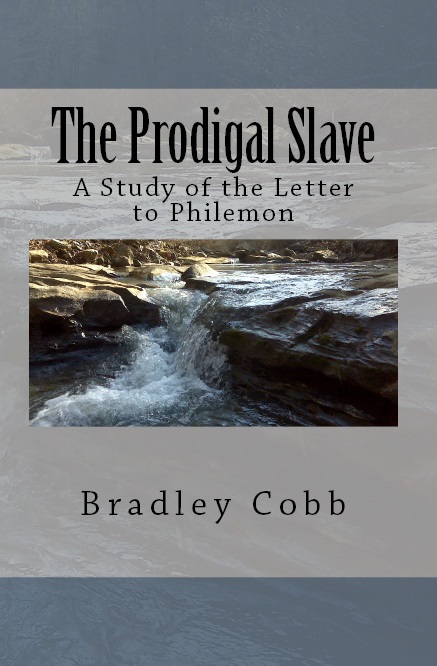
PhilemonCover

(The following is from the introduction to Philemon in “The Prodigal Slave: A Study of the Letter to Philemon” by Bradley S. Cobb)

Philemon owned at least one slave, a man named Onesimus.  It was because of this slave that the book which bears Philemon’s name was written.   This slave had run away and somehow found himself with the apostle Paul.  After a period of time, Paul sent Onesimus back to his master with this letter.  But why would a man of God send someone back to a life of slavery?

Because of the culture in which we live today, we have ideas about slavery that did not exist in the first century.  In the United States, slavery is generally viewed as inherently sinful.  The idea that one man can own another is repulsive to the vast majority of Americans.  However, the Bible never once condemns slavery.  The book of Philemon, along with Colossians (see 4:1), makes it clear that slavery is not sinful in and of itself.

By some estimates, there may have been as many as 60 million slaves in the Roman Empire during the first century.  This is even more shocking when you note that the whole of the Roman Empire numbered 120 million!  Regardless of the specific number, it is quite sufficient to say that slavery was a common practice throughout the Empire.  However, not all people became slaves in the same way.

  1. Some became slaves because they were part of a conquered people. When armies conquered new areas, many were taken as slaves.  Sometimes it was considered a sign of prestige if you had a Greek slave, especially if that slave was an educator for your children.  Others, such as the Gauls and Barbarians, were prized because of their strength.  These became slaves for life.
  2. Some were born to parents who were slaves, thus becoming property of the master.
  3. A large section of the slave population became slaves because they owed more money than they could pay back. There were no bankruptcy courts back then.  If you amassed a debt and could not pay it back, your possessions would be sold.  If that still did not cover what you owed, your family would be sold or you would sell yourself into slavery.  If you did not owe a tremendous amount of money, you may only have to be a slave for a relatively short time until that debt to the man was paid off.  Other times, you may owe one man the money, and someone else will pay it off, buying you in the process.
  4. The Plebes (the poorest class of people) would often sell themselves into slavery so that they would not starve to death.  In effect, becoming a slave was actually a step up for them, guaranteeing them food, clothing, and shelter.  Possibly, these were the ones who were given the most menial tasks, because they did not have any skills like some of the other slaves.

Slaves literally became the property of their owners.  Think about owning a car.  If the car stops working well, you might decide to try to fix it, and if that does not work you might sell it or even have it crushed.  If a slave was not working as well as the master wanted, the master could try to correct him (possibly by talking with him, or by punishing him).  If that did not work, he might sell him to someone else, continue to beat him, or maybe even kill him.  If a slave was disobedient to his master or talked back, the master had full legal right to sell the slave’s wife and children as punishment.

It is also important to note that not all slaves were treated the same way.  Just as there is everywhere else, good and bad people exist.  There were forgiving masters, but there were also vicious masters.  Some slaves were treated kindly, others were beaten mercilessly.  Many masters would simply view the slave as an employee, like one might view a butler or a maid.  Others made the slaves the object of all of their anger and hatred.  After the Civil War, when Abraham Lincoln had abolished slavery in the US, there were some slaves who did not wish to leave their master’s house.  They stayed on because they had been treated well by their owners.

In the first century, slaves had the same rights as widows and orphans: none.  This is the life that Paul was sending Onesimus back into.  Would you be willing to go back?

-Bradley S. Cobb

Don’t Miss the “Must”

SermonWednesday

We went to Lowe’s recently, and on the receipt, there was a website listed where you can be entered for a $300 Lowe’s gift card, just by filling out a survey.  The survey took about four minutes, but there was one part that really stuck out: you have to enter in your name, address, and phone number in order to be entered into the drawing.  It said you must fill out all the information requested in order to be entered.

That word “must” is pretty clear.  It means that if you don’t fill out all the information, you lose out on the potential reward.  If you fill out some, you aren’t entered.  If you fill it out incorrectly, you aren’t entered.  There is no wiggle room when they use the word “must.”  Pretty much everyone understands that when you use the word “must,” you are saying that it is a requirement, that it is mandatory, that you cannot be or receive what is offered without meeting the conditions stipulated by the word “must.”

The Bible uses this word as well, and it is very important that when God uses the word “must,” His followers pay attention!

Old Testament – Circumcision

The first time the Bible uses the word “must” is in Genesis 17:13.  He that is born in thy house, and he that is bought with thy money, must needs be circumcised: and my covenant shall be in your flesh for an everlasting covenant.  This is God speaking to Abraham, making a covenant with him that he would be the father of many nations (Genesis 17:5).  Notice what God says:

 Genesis 17:10-14 – This is my covenant, which ye shall keep, between me and you and thy seed after thee; Every man child among you shall be circumcised.  And ye shall circumcise the flesh of your foreskin; and it shall be a token of the covenant betwixt me and you.  And he that is eight days old shall be circumcised among you, every man child in your generations, he that is born in the house, or bought with money of any stranger, which is not of thy seed.  He that is born in thy house, and he that is bought with thy money, must needs be circumcised: and my covenant shall be in your flesh for an everlasting covenant.  And the uncircumcised man child whose flesh of his foreskin is not circumcised, that soul shall be cut off from his people; he hath broken my covenant.

In order to be part of the covenant with God, the descendants of Abraham must needs have been circumcised.  The ones who were not circumcised were cut off from the people.  In order to be part of this covenant, circumcision was an absolute requirement; it was mandatory; there was no wiggle room or loophole.  Being a physical descendant of Abraham wasn’t enough to be in this covenant—circumcision was required—and it was non-negotiable!

Don’t miss the “must” here!  People could claim to be in this covenant with God, but if they were not circumcised, they were claiming a falsehood—they were lying!  By claiming to be in the covenant with God without circumcision, they were calling God a liar—saying that His requirements weren’t really requirements at all.

Old Testament – The Passover

In Leviticus 23, God gives commands regarding the various feast days that the Israelites are to observe.  One of those is the Passover.  You’ll remember that God instituted the Passover back in the book of Exodus, to commemorate His passing over the Israelites when He brought the tenth plague on the land of Egypt.  But here in Leviticus, God uses the word “must.”

Leviticus 23:4-8 – These are the feasts of the LORD, even holy convocations, which ye shall proclaim in their seasons.  In the fourteenth day of the first month at even is the LORD’S Passover. And on the fifteenth day of the same month is the feast of unleavened bread unto the LORD: seven days ye must eat unleavened bread. In the first day ye shall have a holy convocation: ye shall do no servile work therein. But ye shall offer an offering made by fire unto the LORD seven days: in the seventh day is a holy convocation: ye shall do no servile work therein.

When God issues this command to Moses to pass on to the Israelites, He doesn’t give every detail—He doesn’t mention the Passover Lamb, the time in which it is to be killed, the casting out of all leavening from the house—but He does make one thing abundantly clear: they must eat unleavened bread for seven days in order to keep this holy feast.

Don’t miss the “must” here!  If they ate leavened bread, they weren’t keeping the holy feast.  If they had unleavened bread in the house, but they didn’t eat it, they weren’t keeping the holy feast.  People could claim to be keeping the Passover, but if they didn’t eat unleavened bread for seven days, then they were claiming a falsehood; they were profaning God’s divinely-instituted feast.

Somewhere along the way, after this command was passed on from God to Moses to the Israelites, the people had left the proper observance of the Passover—some believe they had forgotten the Passover completely!  But after the book of the Law was rediscovered in the days of Josiah, it was observed properly again.

2 Kings 23:21-23 – And the king commanded all the people, saying, Keep the Passover unto the LORD your God, as it is written in the book of this covenant.  Surely there was not holden such a Passover from the days of the judges that judged Israel, nor in all the days of the kings of Israel, nor of the kings of Judah; but in the eighteenth year of king Josiah, wherein this Passover was holden to the LORD in Jerusalem.

Other Old Testament Examples

We could also mention how the ones who took the Nazarite vow were told that they “must” keep the vow in a certain way (Numbers 6:1-21, especially verse 21).  We could show that Moses had been shown by God that he “must” die without being able to cross into the Promised Land because of his sin (Deuteronomy 4:21-22, 31:14)—which means that if Moses made it across the Jordan River, God was a liar. We could show that the Angel of the LORD told Manoah, “If thou wilt offer a burnt offering, thou must offer it unto the LORD” (Judges 13:16)—which means that God would not accept any burnt offering that was offered to anyone else.  We could look at the reaction of the Israelites when Ezra told them they had to make confession to God and put away their strange wives—they said, “As thou hast said, so must we do” (Ezra 10:11-12).  They understood that to be right with God, they were required to confess their sin and show their repentance through action—any other response would have been inadequate; they could claim to be following God, but without the confession and repentance, they would have been lying.

Don’t miss the “must”!  In each of these examples from the Old Testament, if the person didn’t follow the “must,” they weren’t truly followers of God.  They could claim it all they wanted, but they would have been doing nothing more than usurping the title of “children of God,” profaning the commands of God, and implying that God is a liar.

Certainly, the word “must” is important!

But let’s now look at some “musts” from the New Testament.

New Testament – The Sufferings of the Messiah

The Jews, for the most part, had a much different view of the Messiah, the Christ, than God did.  They expected a military marvel, a sequel to the victorious David, leading their armies to prominence and their nation to freedom from the Roman Empire.  But that’s not how God had it planned.

After hearing the confession of Peter, that Jesus was the Christ, the Son of the living God, and foretelling that He would build His church, the Scriptures say this:

Matthew 16:21 – From that time forth began Jesus to shew unto his disciples, how that he must go unto Jerusalem, and suffer many things of the elders and chief priests and scribes, and be killed, and be raised again the third day.

Mark’s account says that Jesus told them the “Son of man” must suffer those things (Mark 8:31).

After the transfiguration, Jesus answered their question about the Elijah that must come first, and said again that the Son of man must suffer many things and be set at naught (Mark 9:11-13).

The night of Jesus’ betrayal, Peter took out his sword and attempted to protect his Master.  But Jesus told him to put away the sword, and said:

 Matthew 26:53-54 – Thinkest thou that I cannot now pray to my Father, and he shall presently give me more than twelve legions of angels?  But how then shall the scriptures be fulfilled, that thus it must be?

There are other passages that make this same point, but these should suffice.  Jesus said unequivocally that He must suffer; He was required to suffer and die.

Don’t miss the “must”!  If Jesus did not suffer and die, then He was not the Messiah.  If Jesus did not suffer and die (and rise up again on the third day), then He was a usurper of the name “Christ,” He was a liar, He was a blasphemer, and He is someone who should not be followed.  However, the evidence shows conclusively that Jesus did suffer, that He did die, and that He was raised from the dead.  He said that it must happen, and it did!

New Testament – Born Again

When Nicodemus came to Jesus by night, in John 3, Jesus said to him (starting in verse 3),

“Verily, verily I say unto thee, Except a man be born again, he cannot see the kingdom of God.”  Nicodemus saith unto him, “How can a man be born when he is old? Can he enter the second time into his mother’s womb, and be born?”  Jesus answered, “Verily, verily, I say unto thee, Except a man be born of water and of the Spirit, he cannot enter into the kingdom of God.   That which is born of the flesh is flesh; and that which is born of the Spirit is spirit. Marvel not that I said unto thee, Ye must be born again.”

Notice what is said there—without being born again, you can’t see the kingdom of God; and Jesus equates being born again to being “born of water and spirit” (the word “the” isn’t in the Greek there). Then to make it abundantly clear, the Lord says “You must be born again.”

Don’t miss the “must”!  There are people today who claim to be Christians, but who have never been born of water and spirit—they have never been born again!  They have simply taken the divinely-given name, claimed it for themselves, all the while never doing that which makes the name valid: being born again.  My friends, these people are not Christians!  No amount of claiming the name will make it so!  They are not part of the kingdom of God, because they haven’t done the thing which Jesus said must be done to be part of it!

The Scriptures define what being “born again” is.  Romans 6:3-5 describes the process which culminates in “rising to walk in newness of life”—a new life, a new birth out of the water (John 3:5 literally says “born out of water”) to be free from sin.

Conclusion

When God says “must,” you’d better pay attention!  If someone wasn’t circumcised, they were not part of the covenant—no matter what they claimed.  If someone didn’t eat unleavened bread, they were not observing the Passover—no matter what they claimed.  If Jesus didn’t suffer, die, and rise again, then He wasn’t the Christ—no matter what He might claim.  If we are not baptized for the remission of sins, then we are not Christians—no matter what we claim.


Some brethren in need

This is not what I had planned on posting today, but this is a lot more important than anything I had to say.

Saturday, Caelyn Adams, 16 years old, was knocking on doors, inviting people to attend a gospel meeting, when a drunk driver ran into her and killed her.  Her father, Nick Adams, is the preacher for the Middle Fayetteville church of Christ in Fayetteville, GA.

A brief news item about the incident can be found here.

I first met Nick and his family a few years ago at Roundhouse.  He is a dedicated man of God, and a good encourager.

Keith Cozort, a fellow preacher and long-time friend of mine, is organizing a collection of funds to help this family in their time of need.  Money can be sent by mail or via Paypal.

To send help to this family, you can mail a check (made out to Nick Adams or Keith Cozort) to:

Keith Cozort
314 E. Harker St.
Mountain Grove, MO 65711

Or if you use Paypal, you can send money to Keith.Cozort@sbcglobal.net

Please remember this family in your prayers.  They need it.

-Bradley S. Cobb

A Break…

Roundhouse begins Sunday, and so we will begin our trek that direction this evening.   It will be nearly two weeks before we actually make it back home (driving time and all), and as such, there will be no new posts until that time, unless something important needs to be said.

We thank you for reading our writings, and we pray that the Lord blesses you as you do His work!

-Bradley S. Cobb

The Preacher Who was Kicked out of the Church…

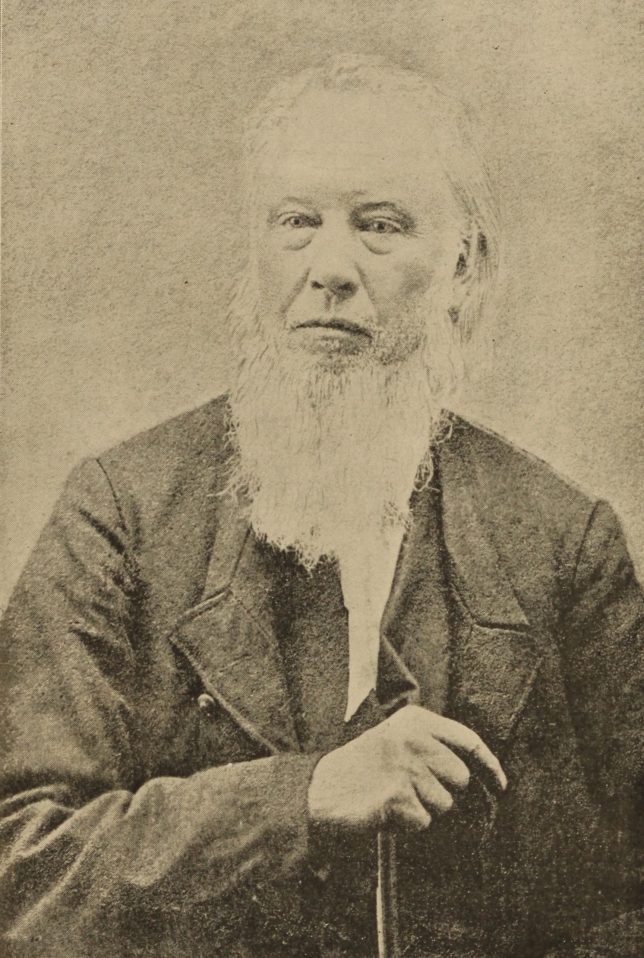
martindale-elijah

Elijah Martindale, a pioneer preacher of the 1800s, was quite an interesting character.  If you read the free preview edition of the Quarterly (you can download it here), then you got to read some of the interesting things that happened in his life, including the fact that he was kicked out of the church that he was preaching for…

because he preached the truth on baptism and salvation.

There are a lot of interesting things that happened in this man’s life, and we only touched a few of them in the Quarterly.  But today, we are giving you a much fuller picture.

Today’s addition to the absolutely free Jimmie Beller Memorial eLibrary is The Autobiography and Sermons of Elijah Martindale.  Take a look at what you can read in this free eBook:

  • Chapter I.
    Birth and Early Training — Emigration to Ohio — To Indiana — Indian Troubles — Returning a Second Time to Our New Home — Religious Impressions.
  • Chapter II.
    Marriage — Deep Conviction for Sin — Christian Experience and Baptism — A Journey with William Stubbs — Uniting with the Newlight Church.
  • Chapter III.
    Ordained to the Ministry — First Sermon — Poverty and Persecution — Mourners Uncomforted — Preaching Near New Lisbon — Flattery.
  • Chapter IV.
    The Jerusalem Doctrine Calls Down Persecution — Voted Out of the New House — Some Things Lacking — Controversial Preaching — Ministers Exhorted to Faithfulness.
  • Chapter V.
    Preaching the Gospel — Desire for Union — Love for the Erring — Zeal of the Old Preachers
  • Chapter VI.
    Preaching Near Middletown.
  • Chapter VII.
    Preaching at Bentonville.
  • Chapter VIII.
    A Flourishing Church at Hillsboro.

Sermons and Articles

  • Chapter IX.
    On Family Training.
  • Chapter X.
    The Gospel Invitation.
  • Chapter XI.
    A Sermon on Supporting the War
  • Chapter XII.
    Sermon On Prayer.
  • Chapter XIII.
    Letter To Church Members.
  • Chapter XIV.
    Object And Form Of Local Churches.
  • Chapter XV.
    On Exhortation.
  • Chapter XVI.
    Parable Of The Ten Virgins.
  • Chapter XVII.
    Religion And Politics.
  • Chapter XVIII.
    Where Is The True Church Of Christ?.
  • Chapter XIX.
    Letter To My Brother John.
  • Chapter XX.
    Extract From Speech Delivered At An Old Settlers’  Meeting At New Castle, Ind.
  • Chapter XXI.
    Sermon delivered at the Christian Chapel, New Castle, April 13, 1873.
  • Song I Used To Hear My Father Sing.
  • A Brief Excerpt Of The History Of The Martindale Family In America.

I found this to be a very interesting read, and I think you will too.  It’s not that long–actually only 67 pages.

If you like the church, the truth, conflict, and history, you’ll get all of it in this book that we’ve proofread, reformatted, and made into a nice-looking eBook just for you!

Read it online, or download it for later reading by clicking the link below:

Autobiography and Sermons of Elder Elijah Martindale

-Bradley S. Cobb

Did Jesus Really Exist?


BibleQA(new)

Introduction:

  1. One of the many attacks against Christianity and the validity of the Bible is that Jesus Christ never even existed.
    1. Albert Schweitzer said “Jesus never had an existence.”
    2. One of the founders of our nation, Thomas Paine, said Jesus was not a real person.
  2. This accusation truly cuts to the core of belief in the Bible.
  3. If Jesus did not exist, then there is no justification for Christians or Christianity.
  4. If Jesus did not exist, the entire NT is useless!
  5. If Jesus did not exist, we have wasted our lives in studying about Him.
  6. The purpose of today’s lesson is to examine the evidence for the existence of Jesus Christ.

The Gospel records show the existence of Jesus Christ.

Intellectual honesty demands that all ancient documents be treated as historically accurate until proven otherwise.

  1. This is the standard used for all other historical records.
  2. It is this standard that gives us an enormous part of our knowledge of history.
  3. We know of wars and dates from history because of documents and inscriptions.
  4. The Bible should be given the same assumption of authenticity.
    1. It is an ancient document.
    2. It claims to be a reliable historical account.
    3. It has NEVER been proven false by archaeology or other historical documents.

The gospel records all attest to the existence of Jesus.

    1. His birth is recorded (Matthew 2:1).
    2. His earthly parents are described (Luke 2:48).
    3. His friends are mentioned (Matthew 10:1-4).
    4. Many of His teachings are recorded (Matthew 5-7).
    5. He was hungry (Matthew 4:2).
    6. His hometown is mentioned (Luke 2:52).
    7. His trials are recorded (John 18-19).
    8. His death is described (Mark 15:24-37).
    9. His burial is recorded (Mark 15:42-46).

The gospel records were written by reliable historians.

  1. Matthew was a disciple of Jesus Christ.
    1. Matthew wrote, giving his occupation: a tax collector (Matthew 10:3).
      1. If Matthew was not a reliable historian, he would have left that bit of information out.
        1. Tax collectors were seen as traitors to the Jewish people because they took money from Jews and paid it to Rome.
        2. Matthew’s primary purpose in writing was to show the Jews that Jesus was the Messiah.
        3. If Matthew was willing to lie about anything in his writing, he would have lied about his occupation.
        4. Lying about his occupation would have taken away some animosity towards his writing by the Jews.
    2. Being a disciple (one of the 12 apostles) of Jesus Christ, Matthew had first-hand knowledge of the things he wrote.
    3. He was an eye-witness to the life and teachings of Jesus.
  2. Mark was a companion to two different apostles.
    1. Mark was a nephew of Barnabas (Colossians 4:10); Barnabas was a close associate of the apostles in Jerusalem (Acts 4:36) as well as a close friend of Paul (Acts 9:26-28).
    2. Mark was with Paul on his first missionary journey (Acts 12:25), though not on the second (Acts 15:37-39).
    3. Mark was requested to come to Paul while he was in prison (II Timothy 4:11).
    4. Mark was also a companion of Peter (I Peter 5:13).
    5. The church in Jerusalem gathered at his mother’s house, indicating that he was possibly familiar with all the apostles (Acts 12:12).
    6. Some believe Mark mentions himself in Mark 12:51-52, which—if true—would have Mark following Jesus while he was on earth.
    7. The evidence shows that Mark would have been a person who could easily ascertain the facts from multiple eyewitnesses, and may have even been an eyewitness to many of the events himself.
  3. Luke was a dedicated historian and a companion of an apostle.
    1. Luke declares that his gospel account came from eyewitness accounts (Luke 1:2).
    2. He declares that he writes because he has “perfect understanding” of the events
      • ASV says “have traced the course of all things.”
      • This is to say that Luke claimed to have done extensive research to make sure his account was true.
    3. He states that his account is trustworthy (Luke 1:4).
    4. He was a travelling companion of the apostle Paul (Colossians 4:14, II Timothy 4:11).
    5. His second book (Acts) has been said to be written by a “historian of the first-degree” by a man who was an atheist intent on proving Acts false (Sir William Ramsay).
    6. Because of his historical reliability (especially seen in the people and places mentioned in Acts), Luke gains instant credibility as a historian.
    7. Though Paul was not an apostle during the lifetime of Jesus, he was likely in Jerusalem during much of Jesus’ ministry, and would have been able to pass on eyewitness accounts as well.
  4. John was one of Jesus’ most trusted and beloved apostles.
    1. He is called “the disciple whom Jesus loved” (John 21:20-24).
    2. He was one of the first disciples to follow Jesus after His baptism (Mark 1:16-20, possibly John 1:35-41).
    3. He was one of only three (the others being James and Peter) who were chosen to see Jesus transfigured (Luke 9:28-36).
    4. He was one of the three taken to keep watch while Jesus prayed (26:36-38).
    5. He was possibly at the trial of Jesus (John 18:15).
    6. He was at the cross while Jesus was dying (John 19:25-27).
    7. He claimed to teach only what he heard, saw, examined, and touched (I John 1:1-4).
    8. John was an eyewitness, a companion with Jesus during his entire ministry, and would be in a perfect position to write about the life of Jesus.

Early Christian writers attest to the truth of the existence of Jesus.

  1. The epistles of the apostles state that Jesus truly existed.
    1. Paul spends an entire chapter dealing with the resurrection of Jesus (I Corinthians 15).
      1. In order for one to be raised from the dead, he had to have died.
      2. In order for one to have died, he would have to have been alive.
      3. Paul, therefore, asserts that Jesus lived.
    2. Paul states that Jesus came to earth as a man and died on a cross (Philippians 2:5-8).
    3. John states that he was an eyewitness to Jesus (I John 1:1-4).
    4. Peter describes being on the mount of transfiguration with Jesus (II Peter 1:16-18).
    5. Jude condemned those who denied Jesus as Master (showing He existed – Jude 4).
      1. He spoke of the apostles of Jesus Christ (showing he believed in the truth of the gospel accounts – Jude 17).
      2. He called himself the brother of James (likely James, the brother of Jesus – Matthew 13:55).
    6. James calls himself a servant of Jesus Christ (James 1:1), and was likely the brother of Jesus (Galatians 1:19).
  2. The post-Biblical writings of Christians show that Jesus actually existed.
    1. Christianity had spread across the Roman Empire, and it was being fought tooth and nail by the leaders of Rome.
    2. Still, Christians wrote in order to convince the heathen (Jews and Gentiles) that Jesus was indeed the Christ.
    3. Justin Martyr wrote trying to convince Trypho (a Jew) that Jesus was the Christ prophesied about in the OT, and that he was resurrected (indicating He had actually lived).
    4. Papias claimed to get some of his information from those who were disciples of Jesus Himself, as well as from those who studied under the 12 apostles.
    5. Quadratus spoke of knowing some of those who were healed or raised from the dead by Jesus and His disciples, showing a historical belief that Jesus existed.

Non-Christian writings prove that Jesus existed.

  1. Josephus mentions Jesus Christ as a real person.
    1. In Antiquities of the Jews, he states, “About this time came Jesus, a wise man, if indeed it is appropriate to call him a man. For he was a performer of paradoxical feats, a teacher of people who accept the unusual with pleasure, and he won over many of the Jews and also many Greeks. He was the Christ. When Pilate, upon the accusation of the first men amongst us, condemned him to be crucified, those who had formerly loved him did not cease to follow him, for he appeared to them on the third day, living again, as the divine prophets foretold, along with a myriad of other marvellous things concerning him. And the tribe of the Christians, so named after him, has not disappeared to this day.”
      1. Some textual critics say that part of that quote was added or embellished by later Christian scribes in order to make their case for Jesus.
      2. Other manuscripts have been found which read differently, but still they mention Jesus: “At this time there was a wise man who was called Jesus, and his conduct was good, and he was known to be virtuous. And many people from among the Jews and the other nations became his disciples. Pilate condemned him to be crucified and to die. And those who had become his disciples did not abandon their loyalty to him. They reported that he had appeared to them three days after his crucifixion, and that he was alive. Accordingly they believed that he was the Messiah, concerning whom the Prophets have recounted wonders.”
    2. In another passage of the book (one which is not disputed), he mentions James, the brother of Jesus.
      1. “Festus was now dead, and Albinus was but upon the road; so he assembled the Sanhedrin of judges, and brought before them the brother of Jesus, who was called Christ, whose name was James, and some others; and when he had formed an accusation against them as breakers of the law, he delivered them to be stoned.”
      2. Josephus did not believe in Jesus as the Christ, but fully acknowledged that there was a man named Jesus who was crucified (as in the earlier passage) that was called by many “Christ.”
    3. This report is from a Jew, who was opposed to Christianity; yet, he still admits that Jesus was a real person.
  2. Pliny the Younger mentions followers of Christ.
    1. Pliny was a governor of sorts in Bithynia shortly after the first century.
    2. He wrote to the emperor asking what to do with the Christians, and stating what he had been doing up to that point.
    3. In a letter to the emperor Trajan, he stated, “Those who denied that they were or had been Christians, when they invoked the gods in words dictated by me, offered prayer with incense and wine to your image, which I had ordered to be brought for this purpose together with statues of the gods, and moreover cursed Christ — none of which those who are really Christians, it is said, can be forced to do — these I thought should be discharged. Others named by the informer declared that they were Christians, but then denied it, asserting that they had been but had ceased to be, some three years before, others many years, some as much as twenty-five years. They all worshiped your image and the statues of the gods, and cursed Christ.”
    4. For some to be a follower of Christ, even at a time in the past, they must have believed He was a real person.
  3. The Talmud says that according to early rabbis, Jesus was a transgressor in Israel which led the people astray, claiming not to destroy the Law, but to add to it.
    1. This is a Jewish source, which was very hostile to Christianity.
    2. They still admitted Jesus was an actual person.
  4. Tacitus, a Roman historian (wrote in 116), admits Jesus existed.
    1. He said: “Nero fastened the guilt of starting the blaze and inflicted the most exquisite tortures on a class hated for their abominations, called Christians by the populace. Christus, from whom the name had its origin, suffered the extreme penalty during the reign of Tiberius at the hands of one of our procurators, Pontius Pilatus, and a most mischievous superstition, thus checked for the moment, again broke out not only in Judaea, the first source of the evil, but even in Rome, where all things hideous and shameful from every part of the world find their centre and become popular.” (Annals)
    2. The Roman Empire persecuted the Christians, but they also were very aware that Jesus was an actual person.
  5. Suetonius (Lives of the 12 Caesars) describes an event involving Christians.
    1. As the Jews were making constant disturbances at the instigation of Chrestus, he [ Claudius ] expelled them [the Jews] from Rome“.
    2. This event has its Biblical parallel in Acts 18:2 – “And found a certain Jew named Aquilla, born in Pontus, lately come from Italy with his wife Priscilla (because that Claudius had commanded all Jews to depart from Rome), and come unto them.”
    3. At this point in time (AD 49), Christianity was viewed by many as a sect of Judaism.
    4. Because of the riots which came about from the Jews persecuting the Christians, all Jews were forced to leave Rome.
    5. That there were Christians 19 years after Jesus died is confirmed by historical record.
    6. This shows that less than two decades after His death, people believed Jesus was a real person, and that belief had spread all the way to Rome from Jerusalem.
  6. Lucian, a satirist (AD 125-180), acknowledges the belief that Jesus was a real person around 100 years after His death.
    1. “The Christians, you know, worship a man to this day — the distinguished personage who introduced their novel rites, and was crucified on that account… You see, these misguided creatures start with the general conviction that they are immortal for all time, which explains the contempt of death and voluntary self-devotion which are so common among them; and then it was impressed on them by their original lawgiver that they are all brothers, from the moment that they are converted, and deny the gods of Greece, and worship the crucified sage, and live after his laws.”
    2. He shows that he is not in agreement with the actions of the Christians, but he does acknowledge that Jesus lived and was crucified.
  7. Mara bon Sarpion alludes to Jesus.
    1. This man was in prison, and wrote a letter to his son asking him to pursue wisdom (approximately 73 AD).
    2. What advantage did the Athenians gain from putting Socrates to death? Famine and plague came upon them as a judgment for their crime. What advantage did the men of Samos gain from burning Pythagoras? In a moment their land was covered with sand. What advantage did the Jews gain from executing their wise king? It was just after that that their kingdom was abolished. God justly avenged these three wise men: the Athenians died of hunger; the Samians were overwhelmed by the sea; the Jews, ruined and driven from their land, live in complete dispersion. But Socrates did not die for good; he lived on in the teaching of Plato. Pythagoras did not die for good; he lived on in the statue of Hera. Nor did the wise king die for good; he lived on in the teaching which he had given.”
    3. The only person who fits the description of the “wise king” is Jesus.
      1. This would fit in perfectly with the time period in which this letter was written.
      2. Jesus was well-known as “the King of the Jews,” for Pilate even had heard of it before meeting Jesus.
    4. This is a non-Jewish, non-Christian reference to the existence of Jesus, written in the first century!

Conclusion:

  1. Did Jesus really exist?
  2. The consensus of historical writings says that He did.
  3. Both friends and foes of Christianity speak in favor of His existence, all within 100 years (some even earlier) of His death.
  4. One admitted unbeliever in the Jesus of the Bible admits that “It was a group of French philosophers during the French Revolution in the late 18th century who first suggested that Jesus was a mythical character” and “The vast majority of historians and theologians have always believed in the reality of Jesus’ life.”
  5. We can have confidence that Jesus Christ did indeed exist!
  6. We do not follow cunningly devised fables!
  7. What are you doing with Jesus?
    1. Are you with Him or against Him?
    2. You cannot be neutral!
    3. Come to Jesus today!

-Bradley S. Cobb

A New Book on Revelation

Back in 2012, I was asked to preach a series of sermons on the book of Revelation.  That turned into 48 lessons–and the Bible study adventure of a lifetime!

As I studied through the book, I discovered that most of what I had been taught about its contents was wrong.  It could be understood.  It did have meaning–both then and now.  And so I embarked on a quest to understand it as best as possible, and to take what I learned and make it understandable to others.

Since completing that series of sermons, I have had numerous requests to put them in print, both from the members here, as well as others who have read through the material.  In fact, people I don’t even know have emailed me, saying that other people (who I also have never met) told them that they needed to get my Revelation material.  It is both gratifying and humbling to know that the 48 sermon outlines I put together have been so well-received.  It is also a scary proposition, because while most people will say that (within certain parameters) the interpretation of Revelation doesn’t matter, I’ve seen more heated arguments over this topic than almost any other among some preachers.

Because of the continual encouragements to make this material available in a permanent format, I have been editing, reformatting, correcting, and expanding my detailed sermon outlines, and preparing them for publication.  It’s not complete yet, but it is getting there–and it looks like it will be well over 450 pages by the time it is done.

Here is what others have said about this material:

I’ve studied the Bible for over fifty years, and this is the first time Revelation has ever made sense to me.–A long time Bible teacher.

I can’t believe I didn’t see this before.  You’ve made it so clear and easy to understand.–An elder.

Awesome.  Just awesome.–Another elder.

If you want to understand Revelation, talk to Bradley Cobb–Michael Shank

[Your] ability to rightly divide the Word of truth never ceases to amaze me.  How can your points be argued, debated, refuted, discredited, minimized?  They can’t be!–A well-know preacher and author.

The material you have online has been a great help to me in my studies.–A long-time preacher.

We need to get this material out in the brotherhood–it makes it so easy to understand!–Shane Otts, preacher, Judsonia church of Christ.

Our target release date is Monday, October 10th.

The Roller-Coaster of Faith – The Life of the Apostle Peter (Part Ten)

ApostlesLogo
The Denials at the Trials1

Peter couldn’t stay away.  Both he and John had a change of heart, and turned back to follow the mob.  Peter followed at a distance, while John went ahead and rejoined Jesus.2  Peter couldn’t get into the palace of the high priest on his own, so John came back out and talked to the girl who served as a doorkeeper, and convinced her to let Peter in.3  But soon afterwards, she said, “You aren’t one of this man’s disciples, are you?”  And Peter said, “I’m not.”4

After a little while had passed, another girl saw Peter, and told the men around him that “This man is one of them.”5  One of those men (the others being in agreement) then made the accusation at Peter, who replied, “Man, I’m not.”6

About an hour later, a servant of the high priest who was also a relative of Malchus (whose ear Peter had cut off) confidently said, “Didn’t I see you in the garden with Him?  Truly you were also with Him: for you are a Galilean, and your speech betrays you!”7  After this eyewitness accuses him, Peter denies loudly and vehemently, “Man, I don’t know what you’re saying! I don’t know the man you’re speaking of,”8 and he cursed and swore to emphasize the point9—as he lied to them.

This is all happening as Jesus is being questioned, mocked, and abused by the Sanhedrin.  False witnesses all came to speak against Him10—what was Peter thinking during this time?  Did he ever have to fight the urge to stand up and scream, “They’re lying!”?  Peter saw Jesus being beaten, slapped, and spat upon,11 but didn’t stand up for the Lord—instead, he hurt Him further by denying Him.  As Peter made his final denial, Jesus turned, momentarily ignoring the questioning and accusations He was enduring, and looked at Peter.  Then the weight of what Peter had done came crashing down on him, and he remembered how bold he had been, proclaiming how he would never deny Jesus; and remembering how Jesus had foretold that he would deny Him three times—then Peter went out of the palace and wept bitterly.12

It is possible that this was the last time Peter saw Jesus alive—until after the resurrection, that is.13

-Bradley S. Cobb

1 John’s account (chapter 18) shows that Peter’s first denial took place when Jesus was being tried by Annas, while his final denial took place when Jesus was being tried by Caiaphas.

2 Luke 22:54 shows Peter followed from a distance.  This is no surprise, considering he had just sliced off the ear of one of the servants of the high priest—he was curious, but also fearful for his own safety.  Meanwhile, John 18:15 shows that by the time Jesus entered the palace of the high priest, John accompanied Him.

3 John 18:16.

4 John 18:17.  Robertson and Vincent both point out that the question is phrased in such a way that the girl expected a negative answer.  Vincent gives it as “thou art not, art thou?”  Luke’s account (Luke 22:55-57) shows that Peter had already sat down by the fire inside before the girl came and asked him this question.

5 Mark 14:69.

6 Luke 22:58 shows one man making the accusation, while John 18:25 shows that there was a group of men who asked if he was one of Jesus’ disciples.

7 The first part of this quotation comes from John 18:26, while the second can be found in the other three gospel accounts: Matthew 26:73; Mark 14:70; Luke 22:59.

8 The quotation given here is an amalgamation of Luke 22:60 and Mark 14:71.

9 Matthew and Mark both mention Peter’s cursing and swearing.  Some confusion exists regarding what exactly this is.  Some have said that it is basically cussing—as no one who was truly a follower of Jesus would be seen publicly cussing.  Others have said that these were oaths: that Peter was calling down curses on himself if he was lying, vowing to God that he was telling the truth.  Either explanation shows the great lengths that Peter went to in order to convince people that he wasn’t associated with Jesus—which was far worse than Judas’ betrayal.

10 Mark 14:56-59.

11 Mark 14:65.

12 Luke 22:60-62.  Luke is the only one who mentions that Jesus actually looked at Peter after the third denial.  Their eyes must have met, and Jesus almost assuredly showed a look of disappointment.

13 This is the last time Peter is mentioned until after the resurrection.  It is possible that he came and watched Jesus on the cross from afar, but if he did, none of the gospel writers saw fit to mention it.  It’s possible that he couldn’t bear to let Jesus see him again, out of shame, and that he found the rest of the apostles and stayed with them (except for John, who was at the cross).