Autobiography of R.C. Bell

Taken from the pages of the upcoming “Studies in the Scriptures: Romans, Galatians, Ephesians, and Philippians,” we present to you the autobiography of R.C. Bell.

Autobiography of R.C. Bell

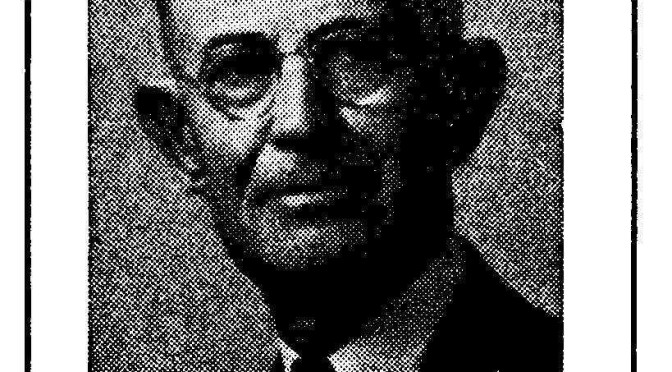
On a farm near Bell Buckle, Tennessee, I, Robert Clark Bell was born, March 20, 1877. My father, S. A. Bell, Sr., was of Scotch Irish and my mother, Sally Catherine Hoover, of Pennsylvania Dutch descent. I inherited a sound bodily construction and a mind of quiet, studious bent rather than of the quick, brilliant type. As my parents were both faithful members of the church when they were married, I went to church regularly every Sunday from babyhood.

Native Religious Temperament

As indicative of my natively serious autumnal, rather than of gay vernal temperament, the first reading I did of my own choosing was a page, colored by pious thought and feeling, entitled, “Home Reading” in the Gospel Advocate, a paper that came into our home every week. (This page was long since discontinued, but the old man is grateful that the boy had a chance to read it.) I came into the church at fifteen years of age, during a meeting conducted at Fosterville, Tennessee, by E. A. Elam. At the close of this meeting, Brother Elam asked those who had just been baptized if they were so disposed, to promise, by reading three chapters on week days and five on Sundays, to read the entire Bible within a year. I promised, and for three consecutive years read the Bible through yearly, according to this plan.

Nashville Bible School

At the age of eighteen years, I entered the Nashville Bible School, Nashville, Tennessee, to alternate for five years attending this institution and teaching in the rural schools of Tennessee. Under the influence of David Lipscomb and James A. Harding, I soon saw that Paul’s description of some who would hold a form of doctrine, but deny its power, fit me. Especially, Brother Harding’s living, magnetic, contagious faith in God as a real personal friend matched the wavelength of my spirit. I slowly enough imbibed his enthusiasm for God’s fatherly care of individual Christians, for Christ’s brotherly sympathy and fellowship with them, and for the empowering Holy Spirit’s residence in them. In other words, for Brother Harding’s conception of Christianity as a “divine-human encounter,” in which spiritual communion between God and man, the sweetest of human experiences, was enjoyed.

I gradually came to realize, however, that the spiritual power of the church was contingent upon the actual personal presence and working of the triune God in and through Christians. More and more the conviction grew on me that Brother Harding’s interpretation of Christianity, which was Paul’s too, was needed to save the church from being merely a human organization with a formula to follow, a prayer to recite, and a dull, demagnetized program to render; with professional preachers in her pulpit mechanically saying dead words detached from the living realities of which they spoke, dealing in trite moralizings, threadbare platitudes, and heartless preaching about the heart and passion of Christ. This kind of a church instead of being the divine organism, instinct with the life and power of God, as designed by her Founder! In short, Brother Harding’s interpretation was needed to save the church from changing divine dynamics to human mechanics.

Potter Bible College

This fuller understanding of revolutionary Christian truth began to turn my “world upside down,” and to open up for me a new world of worship, of work, and of values in general. Consequently, when Brother Harding started another Bible school at Bowling Green, Kentucky, to be known as Potter Bible School and asked me to become one of his teachers for the fall of 1901, I, believing that God was guiding, eagerly accepted. Thus, began my half-century of teaching Bible in our Christian schools. Every member of Brother Harding’s faculties was expected to teach at least one class in Bible daily. Four happy years were spent at Potter. Bessie Sparkman of Era, Texas, who had been a classmate at Nashville, became my wife September 24, 1902. As sweethearts at Nashville, we, as only young people can, together accepted the view of Christian life and work that has continued and bound us together as “God’s fellow-workers.” All these years, we have never doubted God’s will for us was being fulfilled and that in such school work we could best serve ourselves, our fellow-men, and our God, the maker of us all. Each of our three daughters is a graduate of a Christian college.

Westward

By the fall of 1905 J. N. Armstrong, R. N. Gardner, and I (three teachers at Potter), and B. F. Rhodes (a student at Potter from Kansas), were ready, with evangelistic fervor, to open a Bible school west of the Mississippi River at Odessa, Missouri, to be known as Western Bible and Literary College. After four years, Armstrong, Rhodes, and I went to Cordell Christian College, Cordell, Oklahoma. Both of these schools, as such, have long since ceased to operate, but their influence lives on. For instance, how many native Africans will be saved eternally because these unpretentious schools lived, no man can know. The Scotts, the Reeses, the Shorts, and the Lawyers (three of these families have already furnished two generations of workers in Africa), some of our first American missionaries, all came through these schools.

Thorp Spring

My work in Thorp Spring Christian College, Thorp Spring, Texas, began in the autumn of 1911. After five years with this school, I saw that with the constantly rising educational requirements for teachers, my continued teaching in our schools demanded an academic degree recognized as standard by the ac-crediting agency for colleges. Therefore, I went to Sherman, Texas, to preach for the old Walnut Street church a year and to do enough college work in Austin College to standardize the B.A. degree, received at Potter years before. The next year was spent in Southern Methodist University, Dallas, Texas, working out the M.A. degree. Then, I returned to Thorp Spring for a year’s teaching. During this last year at Thorp Spring, I first met, as a member of my freshman English class, Don H. Morris, now president of Abilene Christian College.

Abilene

I became a member of the faculty of Abilene Christian College, Abilene, Texas, in September, 1919. Twenty-five of the thirty-two years intervening between then and now, were spent teaching in this college. Of the remaining seven years, one year was spent in Harper College, Harper, Kansas, two years were spent in Harding College, Morrilton, Arkansas, before it moved to Searcy, and the other four years in David Lipscomb College, Nashville, Tennessee. Fifty years of teaching Bible in eight different schools, located in seven different states is not such a hodgepodge as it may seem at first thought. In the first place, halt of the time was spent in Abilene Christian College. More important, the fifty years, in reality, is all of a piece like a tree. Its general purpose, direction, and objective remained unchanged throughout.

In Retirement

Some old men regret the choice they made in youth of their life work. I am so far from such regret that were a second life to be lived on earth, I should be most happy to have an open door into such work for another long life through. I even like to toy with the fancy of living it all over again just for the privilege—I say, not duty—of teaching God’s word and of making a new generation of Christian friends. I should labor to do the same work, only with purer motives. That is, without personal ambition, without pride of human recognition and position, and without envy of others; and with more diligence, patience, kindness, hope, and love. In brief, with less flesh and more Spirit; with less self and more Christ.

And now that the sail is reefed, I shall take things a bit easier, and, being somewhat lifted o’er the strife of life, shall live the remainder of life’s book as God turns the pages, remembering in grateful thanksgiving and prayer the men and women who helped me as I helped them, and the friends I have made and kept through the years who are still bound to the whirl of the wheel of life. And, since such friends are too good to lose, I shall, in mellow musing, dream of greeting them again in the future life with God, as friends, “lost for a while” recovered; and therefore a little different from the host of stranger-friends from many races, times, and climes whom I shall meet in heaven for the first time. Is it not a great and blessed thing to be able to view the eventide of life here as a resting time, “Ere I be gone once more on my adventure brave and new” in the hereafter, somewhat as the period for tired football players between halves? One life—first half lived on earth and the second half in heaven. “Thanks be to God for his unspeakable gift” in Christ.

“Grow old along with me!
The best is yet to be,
The last of life, for which the first was made.
Our times are in his hand
Who saith, ‘A whole I planned’;
Youth shows but half. Trust God; see all, nor be afraid!”

—Robert Browning

“I think the sheriff has very little ability and no guts.”

These words were spoken by Major General Milton Foreman about Sheriff Melvin Thaxton of Williamson County, Illinois, back in 1922.

You see, for days, everyone knew tensions were rising in Herrin, IL, then the biggest city in the county.  One of the mines had brought in non-union men (“strikebreakers”) to work during the UMWA strike.  The mine had brought in hired guns as “guards” who terrorized people who drove down the roads that crossed over mine property.  The union miners had robbed stores of guns and ammunition, saying “charge it to the union” as they left.

The governor was receiving telegrams from concerned citizens about the events, but when the Major General of the Illinois National Guard contacted Sheriff Thaxton, the sheriff said, “I have everything well in hand.”  And he added that there was no need for troops to be sent.

Even as June 22, 1922 came, and literally thousands of union miners and sympathizers attacked the mine, took the miners and guards prisoner, dynamited the mine equipment, and led the men at gunpoint to the city, the Sheriff did nothing.  In fact, he was nowhere to be found, having gone to a neighboring county to investigate a shooting (which wasn’t even in his jurisdiction).

Even after reports surfaced of prisoners being dragged from behind cars, shot, stabbed, beaten, and hanged, the Sheriff told the national guard “I have everything under control.”

When Major General Foreman was asked what he thought of the Sheriff’s response, he replied “I think the sheriff has very little ability and no guts.”

See, the Sheriff knew what was going on and did nothing to stop it.  He either supported the actions (my personal guess) or he was to big of a wimp to stop it.

You might wonder at this point why I’m even mentioning all of this.  I’ve noticed (and I’m sure you have too) that there are many Christians who fit this same description.  They have very little ability to fulfill their role as Christ’s messengers and they have no guts.

I don’t say this to sound demeaning towards these people.  I really don’t.  I’m talking about people who have been Christians for years, but who couldn’t tell someone the plan of salvation and prove it from the Bible if their life depended on it.  I’ve heard of preachers who passed out a worksheet to the congregation asking for this exact information.  The overwhelming majority of the congregation couldn’t tell you where the Bible says to hear, or to believe, or repent, or confess, or be baptized.

These Christians have very little ability–because of their own choice.  The writer of Hebrews chastised people like this because they should have been able to teach others–instead, they needed someone to teach them again!

We’d think there was something wrong if a baby was born and 15 years later, he was still a baby, unable to walk, to talk, or to chew food.  But for some reason, we give people a pass when they remain spiritual babies for 5, 10, 15, or more years!  This ought not be!

Another great fault of many Christians is that they have no guts.  Obviously, the ones who don’t know how to even show something as basic as the plan of salvation have good reason to be afraid to engage in spiritual discussions with others.  But what about those who do know the Scriptures?

Have you noticed that in this modern age, many Christians are more concerned about how others will react than they are about their eternal judgment?  We see lost and dying souls everywhere we go, but we don’t want them to think that we’re “religious nuts” or “Jesus freaks.”  We don’t want to potentially hurt their feelings by pointing out that they’re going to hell because they’ve not obeyed the gospel of Jesus Christ.  We’ve got the greatest news in the history of mankind, yet we’re more willing to tell someone about low gas prices than we are to tell them about that which can save their soul!

In short, several Christians have no guts when it comes to spreading the gospel.

My friends, we’ve got a job to do.  Whether we feel prepared for it or not, we still have a job to do.  We can either go into the job completely unprepared and fail miserably, or we can prepare ourselves.  If we are unprepared; if we do not cultivate the ability to carry out the work of the Lord, it is our own fault.

It takes guts–it takes courage to show others that they are living in sin and what the consequences of their continued sin will be.  It takes guts to be active in the Lord’s work.  It may not be easy, but it still must be done.

When you stand before the Lord on Judgment Day, will He say “well done, good and faithful servant”?  Or will His words be more like “I think you have very little ability and no guts”?

-Bradley Cobb

Note: The above story is true, and the quotations come from an Associated Press story printed on June 24, 1922 in newspapers across the country.

Design Demands a Designer

We continue our study of Apologetics this week with the first of four installments on the question: “Does God Exist?”

We have kept this short so that anyone who wants to can print it and use it in a Bible class or expand it.  Feel free to use it to God’s glory!

Design Demands a Designer
(aka The Teleological Argument)

Charles Darwin, and others like him, have tried to undermine the very basis of the entire Bible: that God exists.

Because we can not have a true faith in Christ without hearing the evidences (Romans 10:17), it follows that if we want a true faith in God, we must hear the evidences of His existence. It is no longer a given that people believe in God; for that reason as well, we must know the evidences that prove the existence of God.

 Design does not happen by accident.

Thomas Edison did not knock over a pile of metal and glass and discover it became a light bulb. He worked for years on the design for the incandescent bulb. He failed multiple times with other insufficient designs, but finally found one that worked. Was this design by accident?  Or is the light bulb proof that someone put careful thought into it’s design and creation?

The Wright brothers did not create their airplane by accident.They were meticulous in figuring out weight, wingspan, horsepower, balance, etc
They put massive thought into their design.

Nothing that is designed came about by a mere accident. Design always involves intent. Intent implies someone involved in the designing.

Design does not happen on its own.

A watch did not simply come into existence on its own, let alone the millions of other watches that exist in this world. The fact that it exists shows that it was made by someone. The fact that there is design to it (mechanical, electrical, aesthetic) shows that someone (or more than one person) designed it.

There is design to the earth.[1] If the earth was not tilted on the 23 degree axis, there would either be no change in seasons, or such extreme changes that no plant life could survive.[2]  If the earth was closer to the sun, mankind could not survive the temperature and exposure to the sun; if the earth was further away, we would all freeze to death.  The earth has a perfect spin, not to fast, and not to slow. It is 100% perfect for life to be sustained on it.

There is design to things on the earth.  The human body is more complex than any machine ever created (Psalm 139:14). The nervous system is still not fully understood.[3] DNA is called the human’s blueprint (design).[4] But who in their right mind would claim that a blueprint can create itself?  Yet that’s exactly what so-called “scientists” and evolutionists teach!

That there is design to the earth and to things on the earth proves that there is a designer.  The Darwinist and atheist expect us to believe that the perfect design of the universe, the earth, the human body, and everything else in the world came about by complete accident.[5]

But they readily concede that the existence of design in a watch proves that someone designed it.  How inconsistent!

 Design proves that God exists.

Psalm 19:1 – The heavens declare the glory of God. The fact that the sun and stars exist screams out the existence of God. God created them to be used for “signs and seasons” (Genesis 1:14). The stars were set in the sky to be used as “signposts” for travel. Naval ships still use them to this day along with their GPS equipment.

Romans 1:20 – The invisible things are understood by the visible things. We see order (design) in the natural world; therefore, we know there was something behind it. We see the complexity, yet perfect design, of man; therefore, we know someone created it.

Mankind did not create the universe, the earth, nor man himself. Man is by far the most intelligent creature on this planet. It is admitted by all that man could not ever create the universe, the earth, or even plants or animals. If man, the smartest being on the planet, could not have created the universe, then that means someone more intelligent than anyone on earth had to have created everything.

Who could that be?

Some atheists have caved in and admitted the truth that design demands a designer, but in their incredible effort to deny that God is the Creator of the universe, they say that the earth was created by … (are you ready for this?) … aliens.[6]

Conclusion

Design does not happen by accident, and never has. Anything designed must, be definition, have someone that designed it. The universe, the earth, and everything on earth show design. Therefore, they all must have been designed by someone.

That someone is God.

-Bradley Cobb

[1] Jackson, Wayne. Fortify Your Faith. (Apologetics Press, 1974).

[2] Gish, Duane, Ph. D. “Have You Been Brainwashed?” – (tract, Creation-Life Publishers, 1974).

[3] Harrub, Brad. “The Human Nervous System: Evidence of Intelligent Design [part II].” Reason and Revelation, September 2005.

[4] Evolution/Creation. Unsigned article

[5] Harrub, “Nervous System.”

[6] Richard Dawkins made this statement in the movie “Expelled: No Intelligence Allowed” which can be watched for free on YouTube.

The Holy Spirit in Acts 17:11?

The following short segment comes from our upcoming book, The Holy Spirit in the Book of Acts.  Enjoy!

Acts 17:11

These [people of Berea] were more noble than those in Thessalonica, in that they received the word with all readiness of mind, and searched the Scriptures daily, whether these things were so.

Paul and Silas were both prophets, both spoke by inspiration of God, and Paul (perhaps Silas too) was able to perform miracles—all by the power of the Holy Spirit. Yet God takes a moment to praise the people of Berea because they weren’t content with a prophetic message; they weren’t content with an inspired message; they weren’t content with any miracles that Paul may have performed—they knew that the message had to match up with the Scriptures in order for it to be truly from God.

Prophets were temporary (Zechariah 13:2). Miracles (including inspiration) were temporary (I Corinthians 13:8-10). But God’s word remains forever (I Peter 1:23-25). The word of God is called “the sword [or the weapon] of the Spirit” (Ephesians 6:17). It is the word of God that is able to save the souls of men (James 1:21). Miracles can’t save souls—the word of God can.

The Holy Spirit, therefore, is active in every case of conversion from Pentecost through today—but His tool for converting the lost is the living and active word of God (Hebrews 4:12). The Holy Spirit is also active in guiding Christians ever since Pentecost in the very same way: through the Scripture which is able to make us perfect (II Timothy 3:16-17).

-Bradley Cobb

(NOTE: Today’s image is taken from the cover of a publication called Nobility, which is freely available from the Gravel Hill church of Christ website)

Book Review – The Life of the Apostle Paul (by Barbara Dowell)

Who was the apostle Paul?  What was there about his hometown that made him perfectly suited to be the great apostle to the Gentiles?  These questions and many more are answered throughout the brand-new book, The Life of the Apostle Paul.

DowellCover

Packed with background information on the people and places that Paul interacted with, this book helps you to see Paul’s life and travels with a much better focus.  From the background of cities like Tyre, Jerusalem, and Rome to understanding the character of men like Felix, Festus, and Agrippa, The Life of the Apostle Paul helps you to know them like the Christians of the first century would have known them.

The author, Barbara Dowell, has been a dedicated Christian, a diligent Bible student, and an enthusiastic Bible teacher for over five decades.  Her husband, Jerry, is an elder in the church of Christ that meets in McLoud, OK.

This book is the culmination of years of studying, and was used to teach a ladies’ Bible class, though the information is useful for personal study as well.

We highly recommend this 156-page book, which is available exclusively on Amazon.com for just $9.99 (or $2.99 on Kindle).  Click here to get your own copy!

Here is the first customer review on Amazon:

This book puts the life of Paul (as shown in the Bible) in chronological order, and fills in the details with historical backgrounds of the places he visited and the people he interacted with. Several historical details were included in this book that I was not aware of, and which makes it much easier to identify with the great apostle’s life. This book is an excellent addition to my library.

The Evolution of Evolution

Some of the most interesting things to read are old articles and papers that were typed up by brethren of the past.  One such article came from the typewriter of James D. Bales.  During his heyday, Bales was a highly-respected figure in the religious world, standing firm against evolution, communism, and other theories of belief that attacked the Bible.

We hope you find this article interesting.

THE EVOLUTION OF EVOLUTION

James D. Bales, Ph.D. (University of California), Searcy, Arkansas

Evolution means development. Thus men sometimes speak of the evolution of the airplane; which development was, of course, the work of intelligence and not of the blind workings of the forces of nature. The hypothesis of evolution which is widely taught today assumes that as a result of the workings of natural forces, life developed from the non-living; and from the first form of life there developed all the different forms of life which exist today, including man. Using the term evolution in the sense of development let us see how the hypothesis of evolution originated and how it develops when it is consistently applied. In other words, we want to notice something of the origin and some of the results of the hypothesis of evolution.

Evolution did not originate in scientific research, but in the bias of certain men against the God of the Bible who created the heavens, the earth, life, and man. It is based on the assumption that all past events must be explained in terms of present-day processes; even if this cannot be scientifically established. By maintaining that all must be explained naturally, the first evolutionists in our period of time put God so far away from the universe and life that He either did not exist; or if He existed He would in no wise interfere with man and the workings of the laws of nature. Thus for all practical purposes they could forget about God without having any fear that they must someday face God in judgment. They could rule their own lives without having to be subjected to the will of God.

The doctrine that all must be explained naturally was popularized in the field of geology by Sir Charles Lyell. He wrote his book on geology in order to establish this principle of uniformity as the basic principle in geology and ultimately in life itself. He accepted the idea of God, but his bias against God as revealed in the Scriptures is indicated in his contention that Moses had brought great mischief and scandal into the science of geology; and he spoke of driving certain men “out of the Mosiac record.”

Charles Darwin was converted to the idea that all must be explained naturally; and, of course, as this belief grew upon him, his disbelief in the Bible grew. Since Darwin had decided that all must be explained naturally, the very truth of evolution itself was taken for granted. The only question was, since evolution must have taken place, what laws in nature are sufficient to account for life’s origin and manifold form. So deep-seated was Darwin’s bias against God that, although he never became an atheist, but was an agnostic, when reason led Darwin to God he savagely turned on reason and discredited reason. As he said in his autobiography written in 1876:

“Another source of conviction in the existence of God, connected with the reason, and not with the feelings, impresses me as having much more weight. This follows from the extreme difficulty or rather impossibility of conceiving this immense and wonderful universe, including man with his capacity of looking far backwards and far into futurity, as the result of blind chance or necessity. When thus reflecting I feel compelled to look to a First Cause having an intelligent mind in some degree analogous to that of man; and I deserve to be called a Theist. This conclusion was strong in my mind about the time, as far as I can remember, when I wrote the ‘Origin of Species;’ and it is since that time that it has very gradually, with many fluctuations, become weaker. But then arises the doubt, can the mind of man. which has, as I fully believe, been developed from a mind as low as that possessed by the lowest animals, be trusted when it draws such grand conclusions?”[1]

Again he wrote:

“Nevertheless you have expressed my inward conviction, though far more vividly and clearly than I could have done, that the Universe is not the result of chance. But then with me the horrid doubt always arises whether the convictions of man’s mind, which has been developed from the mind of the lower animals, are of any value or at all trustworthy. Would any one trust in the convictions of a monkey’s mind, if there are any convictions in such a mind?”[2]

Reason led Darwin to God so Darwin killed reason! He trusted his mind when reasoning about evolution, but not when reasoning about God! Why should we trust anything in his writings if the human mind cannot be trusted? How could Darwin say that he fully believed in evolution when his position concerning the origin of mind made it impossible for him, when consistent, to fully believe in anything? How could Darwin continue to cling to evolution, which led him to discredit the mind, and to do so on supposedly scientific grounds? If the mind cannot be trusted at all, science is impossible. Although Darwin admitted that one could still believe in God, even if evolution were true, yet in his own life and the life of countless others faith in evolution has been the means of leading them from God. Although they may not become atheists, they usually put God so far away from man and the universe that He has not spoken and will not interfere with man in any way, including bringing man into judgment.

Darwin’s wife told her daughter, concerning the Descent of Man, that: “I think it will be very interesting, but that I shall dislike it very much as again putting God further off.”[3]

Thomas Henry Huxley, who helped fight many battles for Darwin, admitted that evolution was simply the outcome of applying the hypothesis that all must be explained naturally. He began to be converted to this idea when he was around 12 years of age. This led him to abandon the Bible as the word of God, and finally to accept evolution; because there was nothing else for a man to do once he has rejected the idea of creation by God.

There are numerous other illustrations of the fact that evolution was accepted because men wanted to get away from the idea of the God who creates. As Henry Fairfield Osborn, an evolutionist, put it: “In truth, from the period of the earliest stages of Greek thought man has been eager to discover some natural cause of evolution, and to abandon the idea of supernatural intervention in the order of nature.”[4] This bias has been abundantly documented in the forthcoming book. Why Scientists Accept Evolution.

Evolution is a faith which they accept even though they do not have adequate evidence for this faith. As A. L. Kroeber, at the Darwin Centennial, said: “Overwhelmingly, biologists had been accepting evolution because there was nothing else for them to do; but they had not proved it to their own satisfaction.”[5] He thought that the situation had improved today. Charles Darwin himself admitted that when one descended to details, and of course scientists must descend to details, evolution could not be proved.[6]

William L. Straus, Jr. said: “I wish to emphasize that I am under no illusion that the theory of human ancestry which I favor at the present time, can in any way be regarded as proven. It is at best merely a working hypothesis whose final evaluation must be left to the future.”[7]

The hypothesis of evolution is so far from being scientifically proved that a widely used text book in biology said: “The piecing together of the evolution story is comparable to the reconstruction of an atom-bombed metropolitan telephone exchange by a child who has only seen a few telephone receivers. We know something about living plants and animals, and we have some fossil remnants to go on. Extensive study of the evidence available plus ingenious hypothesis, most of which cannot be adequately tested, have given us a sort of a trial schedule of the possible directions of evolution of living organisms. ”[8]

However, so deep-seated is the bias in favor of evolution that Professor Paul Shorey stated: “An ambitious young professor may safely assail Christianity or the Constitution of the United States or George Washington or female chastity or marriage or private property… But he must not apologize for Bryan… It is not done.”[9] One does not have to accept every interpretation of the Bible made by Bryan in order to realize that thorough-going evolution contradicts the Bible.

Why is it that some scientists, who demand scientific proof in various other areas, are determined at all costs to hold to the hypothesis of evolution as being scientifically proved? They know full well, if they are acquainted with the evidence and the meaning of “scientifically proved”, that evolution has not been scientifically established.

Originating in man’s effort to get away from the God who creates and who has spoken to man in the Bible, it is obvious that the influence of evolution would be to undermine faith in the Bible. There are, of course, some individuals who think that evolution has been scientifically established and that therefore they must try to harmonize the Bible with evolution. They hold to evolution and still want to hold to the Bible. However, any hypothesis of evolution that maintains that all can be explained in terms of the workings of present-day processes must come into conflict with the Bible whether they realize this or not. As a result of the influence of the hypothesis of evolution, as well as some other influences, a great deal of the religious world has reconstructed the Bible so as to conform to evolution. Thus there are those who maintain that there was no first human pair, that there was no real fall of man, that God did not miraculously intervene in human history as recorded in the Bible, and that Jesus Christ is thus the product of evolutionary development. If an individual maintains that God did intervene as the Bible says, and that Jesus Christ is God’s Son, they have admitted divine intervention in redemption so why should they rule out divine intervention in creation?

The hypothesis of evolution has had an adverse impact upon morality. If all must be explained in harmony with natural laws then there is no moral realm different from the natural realm. After evolutionists get through explaining the origin of the conscience and moral sensitivity of man, they have in reality explained away morality. To maintain that animals do certain things, and therefore we see in them the beginning of the development of moral conscience, does not prove that I am obligated to do anything. To jump from a description of something that has happened to the conclusion that we are obligated to do this or that is to draw a conclusion that is not justified by their starting point. If men are but highly evolved animals, what right does anyone have to say that one ought to do or ought not to do a certain thing? In fact, to say that one “ought to do something” is no more speaking morally than to say that someone itches. In both cases you are describing a physical sensation. To say that a certain course of conduct would lead to social progress —however progress may be defined — is not the same thing as saying that I am obligated to follow that course of conduct. Every evolutionist must abandon evolution in order to stand for the reality and the binding nature of morality. William F. Quillian, Jr., in The Moral Theory of Evolutionary Naturalism[10] has shown the inability of the evolutionists to establish morality on a consistent naturalistic evolutionary world view.

Darwin viewed morality, religion, and everything else as traceable to something in animals. As he told a cousin: “I look upon all human feeling as traceable to some germ in the animals.”[11]

Darwin’s antagonism to religion increased as the years went on so that he was more antagonistic to religion after many religious leaders had accepted him than before.[12]

Communists pay high tribute to Darwin. In fact Karl Marx wanted to dedicate to Darwin the English translation of Marx’s book on Capital. Darwin refused because he thought it would give pain to some in his family.[13] Karl Marx on December 19, 1860 wrote to Engels that Darwin’s book “is the book which contains the basis in natural history for our view.”[14] On January 16, 1861 he said: “Darwin’s book is very important and serves me as a basis in natural science for the class struggle in history.”[15]

If man is but an evolved animal, there is no moral grounds on which you can condemn the Communists for wanting to establish animal farms, as it were. If morality is simply the evolved customs of man, the Communists have as much right as anybody else to evolve their own moral customs, and there is no moral law in the light of which we can say that they are wrong and we are right. If the survival of the fittest is the way of progress, then those who survive are the fittest by mere virtue of the fact that they survive. In other words, might makes right.

These, then, are some of the consequences that logically flow from naturalistic evolution. There are those, of course, who try to explain the origin and manifold forms of life naturally while maintaining that God is and that is more than an animal and more than matter. If this is true then God has supernaturally intervened in some way to make man more than matter. Once we grant this supernatural intervention we have destroyed the naturalistic hypothesis of evolution. If we are going to say that God super naturally intervened in some way in the creation of man, why not accept the Biblical account of the supernatural intervention?

That evolution has not been scientifically proved can be illustrated by the fact that it would be a rare scientist indeed who would sign the following proposition: Resolved that the evolutionary origin of life and of man has been scientifically proved. If you know of a scientist who will sign this affirmation, we shall be happy to debate him, the Lord willing.

[1] Francis Darwin, Editor, The Life and Letters of Charles Darwin, New York: D. Appleton and Co., 1898, Vol. 1, p. 282.

[2] Ibid., Vol. 1. p. 285

[3] As quoted in Gertrude Himmelfarb, Darwin and the Darwinian Revolution, London: Chatto & Windus, 1959, p. 316.

[4] Henry Fairfield Osborn, The Origin and Evolution of Life, New York: Charles Scribner’s Sons, 1918, pp. ix-x.

[5] Sol Tax. Editor, Evolution of Man, p. 2

[6] The Life and Letters of Charles Darwin, Vol. II, p. 210.

[7] The Quarterly Review of Biology, September 1949, p. 220.

[8] Relis B. Brown, Biology, Second Edition, Boston: D. C. Heath and Company, 1961, p. 531.

[9] Atlantic Monthly, Vol. 142, Oct. 1928, p. 478.

[10] New Haven: Yale University Press, 1945.

[11] Himmelfarb, op. cit., p. 317.

[12] Ibid., p. 319.

[13] Ibid., p. 316.

[14] Marx and Engels, Selected Correspondence, 1846-1895, New York: International Publishers, 1936. p. 126. Translated by Dona Torr.

[15] Ibid., p. 125.
An Introduction to Apologetics

Life has been extremely busy the past few weeks, leading to our less-than-stellar frequency of posts here at TheCobbSix.  Thanks for sticking with us.  🙂

Beginning this week, we are studying Apologetics in our Wednesday night Bible class.  We hope you will find these lessons as useful as we do!

What Is Apologetics?

Now, seemingly more than in any other time, apologetics is needed. “Apologetics” comes from “apologia,” which means “a formal, usually written, defense or justification of a belief, theory, or policy”[1]

God is being attacked on many different fronts by different people. There are some that completely deny His existence. Some will acknowledge His existence, but deny the Scriptures are really His  Word and are inspired by Him. And there are literally billions of people in the world today who do not believe that Jesus Christ was the Son of God, and is indeed deity.[2]

Because of this, and the constant onslaught of teachings that come along with these  three topics, we are devoting some time for the next several weeks to study apologetics — the defense of the truth of these things.

 Why should anyone study apologetics?

Everyone should study apologetics to establish or solidify their own faith in God, His  Word, and His Son Jesus. Perhaps you are sitting, thinking, “I already believe in God and those other things.” But why do you believe? Is it just because that is what you’ve been taught?[3] Or have you weighed the evidence?

God never expected people to operate on “blind faith.”  God sent the ten plagues on Egypt so that They would know that He was the Lord (Exodus 14:4). God sent the quail and the manna to the children of Israel in the wilderness so that they would know that He was the Lord (Exodus 16:12). Jesus performed miracles so that people would see that He was from God (John 3:2). God has always, since the beginning of time, shown His existence. Our faith must be built on the evidence, not on what someone else has told us.

You should study apologetics so that you can teach others.  There are many in the world who call themselves “agnostics” who say that there is not enough evidence to prove God exists or to prove that He doesn’t exist.[4]  Simply put, these people just don’t know what to think.  Most want to know one way or the other, and the only way to prove it to them is to show them all of the evidence. You would not want a judge deciding a case against you without presenting him with all of the evidence, so why would you not want to teach a lost soul and show them all the evidence for the existence of God?

When you have that faith that is rock-solid because it is based on all of the evidence,  you are much more likely to convince someone else to become a Christian.

You need to study apologetics so that you can combat false teachings. In the schools (and everywhere else for that matter), evolution is being paraded as the truth about the origin of man and everything else.[5]  This denies the existence of God.  This denies that the Bible is inspired from God.  This denies that Jesus exists.  We must be able to combat these falsehoods that are being taught to everyone, especially our children.

There are false teachings even within the church that need to be combated with apologetics.  There are those who say they believe in God, but also claim to believe in evolution.[6]  This contradicts Genesis 1, Exodus 20:11, 31:17, and others which clearly state that creation began and ended in a total of six 24-hour days.

This would make Moses a liar or uninspired. If Moses was uninspired, so was Jesus who quoted him and who was called the      prophet like Moses (Acts 3:22). To say evolution is true is to, ultimately, deny the inspiration of the Bible and the deity of Jesus Christ!

 Can these things really be proven?

Yes! They can be proven!  God gave us everything that pertains to “life and godliness” (II Peter 1:3).  This would include proof that He indeed exists.  If there was no proof God’s existence, there would be nothing on which to base faith.

The heavens declare that God exists (Psalm 19:1).  The fact that there is design in the universe shows that someone had to design it.  The fact that nothing comes from nothing shows that someone had to create the universe.[7]

The complete accuracy of the Bible (even though it had many writers over a period of 1500 years) historically, doctrinally, and scientifically screams out that it is inspired of God. Skeptics have tried over and over to show the Bible as being historically wrong on something, yet it always turns out that they were wrong and the Bible was right.[8]

The Bible has stated scientific facts that were not discovered until thousands of years later.[9] The Bible predicted specific world events, sometimes tens and sometimes hundreds of years before they happened.[10]

The Bible records all the things we need to believe in Jesus as the Son of God (John 20:30-31).  Once we establish the inspiration of the Bible, we can see that Jesus Christ is indeed the Son of God.  The Jews heard Him say this, and they called it blasphemy because they knew it meant that He was claiming to be deity (John 10:24-33).  Jesus truly was God (John 1:1).

 What to Expect

We will see in the rest of this study various things that prove the existence of God, the inspiration of the Scriptures, and the deity (God-ness) of Jesus Christ. We will also look at arguments used against these things and show why they are wrong and should not be accepted. Ultimately, the goal of this study is to make your faith strong and to help bring others to Christ.

[1] Encarta World English Dictionary: “Apologia.”

[2] The “Jehovah’s Witnesses” claim that Jesus was the first being created by God, and is not deity (see their translation of John 1:1 as “the word was a god”). Other religious groups, such as the Muslims, claim Jesus was a good man and perhaps even a prophet, but deny that He is deity. Others, such as Buddhists, believe that if Jesus ever did exist, He was just a man. Still many others claim that Jesus never existed in the first place. As strange as it might seem to some of us, this denial of Jesus’ deity is held by the majority of people living today.

[3] Remember that Aquila and Priscilla had to teach Apollos more perfectly the way of the Lord. He did not have all the evidence, and thus was teaching an inadequate gospel (Acts 18:24-26). We must be ready to search the evidence to find out if these things are true (see Acts 17:11).

[4] The word “agnostic” means “no knowledge.” (Encarta) They believe it is impossible to know if God exists.

[5] Nearly every science textbook in public schools teaches the theory of evolution as a fact, and offers no alternative to it.

[6] There are examples that could be given, but this is not the place to list names of brethren who hold this belief. Suffice it to say, if one does much investigating into the topic, they will find numerous brethren of both today and times past that hold this stance.

[7] The Law of Biogenesis states that living things can only come from other living things, and not from non-living material. Basically stated, spontaneous generation is impossible.

[8] See later lessons on the inspiration of the Scriptures for specific examples.

[9] Again, see later lessons on the inspiration of the Scriptures for specifics.

[10] Specifically, the destruction of Jerusalem was predicted by Jesus approximately 40 years before it happened (Matthew 24:2-3); Daniel prophesied the Babylonian Empire would fall to the Persian Empire, which would fall to the Greek Empire of Alexander the Great, and that there would be a fourth kingdom, that being Rome. It was during the days of the Roman Empire that the church would be established. Daniel wrote this hundreds of years before the fact (Daniel 2, especially verse 44).

The Holy Spirit in the Book of Acts

It’s been months in the making, but our latest book, The Holy Spirit in the Book of Acts is just about done.  We believe that you will find it to be a worthwhile and valuable resource.

Features:

  • An in-depth look at every passage in Acts which mentions or alludes to the Holy Spirit.
  • Each passage is examined to come to a better understanding of the work of the Holy Spirit as described in the book of Acts.
  • Opposing viewpoints are considered (when such exist) in light of the context of each passage and the book as a whole.
  • No stances are taken on interpretation of a passage without first proving from the Bible that it is the proper one.
  • An appendix on the end of miracles.

This book came about because of the wrangling that is done throughout the church over the issue of the Holy Spirit, His work, and how various passages in Acts are used or misused in an effort to prove each side’s arguments.

Coming in at just over 200 pages, this book is easy to read and understand, but it is in-depth, and backs up its conclusions with careful Bible examination.  Unlike some books which attempt to tell you what to believe on the issue, this one attempts to prove from the Scriptures what the proper belief is.

Issues covered in the book include:

  • Miraculous inspiration
  • Miraculous fulfillment
  • The purposes of miracles
  • The end of miracles
  • To whom does “the gift of the Holy Spirit” of Acts 2:38-39 apply?
  • How was the Holy Spirit a witness for the believers?
  • Prophecy given and fulfilled by the Holy Spirit.

We do hope that you will consider checking the book out.  Look for it (Lord willing) by the end of this month!

The Great Importance of a Two-Letter Word

Have you ever noticed how much difference one word makes? Take, for example, the word “not.” Insert that word into a sentence, and the meaning is completely opposite! What about the importance of just a single letter or two? There is a writer who once wrote in one of his Bible commentaries, “Jesus is not sitting at the right hand of God.” Do you notice the problem? It was a typographical error, and was instead supposed to read “Jesus is now sitting at the right hand of God.” The difference was only one single letter, but it changed the meaning of the entire sentence! One sentence was Scriptural, the other blasphemous!

There is a common false doctrine called “Perseverance of the Saints” or “once saved, always saved” that permeates the religious world, as well as infiltrates the thinking of the Lord’s church. The inspired apostle, Paul, speaks clearly against it. He states “I declare unto you the gospel
By which you are saved” (I Corinthians 15:1-2a). However, he does not end the sentence there. He specifies that Christians are only saved by means of the gospel “if ye keep in memory what I preached unto you” (I Corinthians 15:2b). Do you notice the importance of that one little word: “if”? The gospel saves, but only if it is kept in memory (meaning that one continues to walk in it – see Romans 8:1, Revelation 2:10). When one becomes a Christian, yet does not continue in the gospel, he is not saved. Are you truly keeping the gospel in your memory?

Bible Q&A – Will the Wicked Be Resurrected Too?

Question: When the final judgment takes place, will the wicked be raised too? I’ve been reading several books lately, and some of them say that the wicked will simply be destroyed and cease to exist. What are your thoughts? – W.A.A., California.

Thanks for taking the time to write. I appreciate your writing to get my thoughts, but I’m sure that you’ll agree that what’s really important is what the Bible says on the matter.

The doctrine that you have read about is generally called annihilationism. That is, the belief that the wicked, instead of being sent to a place of torment, will simply be annihilated—being completely removed from existence. Their punishment, according to this belief, would be that they simply cease to exist. This view is held by the majority of Jehovah’s Witnesses, but it has also been advocated by respected men in the church like Homer Hailey.

But again, the question is: what does the Bible say?

First, we can look at the teaching of Jesus about the rich man and Lazarus (Luke 15:19-31). In that teaching, whether you call it a parable or not, Jesus teaches the reality of torment for the wicked after death. This is a conscious torment—the rich man was very much aware of his pain and anguish. He was not annihilated at the point of his physical death.

Secondly, and perhaps most convincingly, are the words of Paul from Acts 24:14-15. “[I am] believing all things which are written in the law and in the prophets, and have hope towards God
that there shall be a resurrection of the dead, both of the just and unjust.”

Thirdly, the Scriptures teach that at the judgment, all men will have to answer for the things done in the body, whether they be good or evil (II Corinthians 5:10). This shows that everyone will be present at the final judgment—not just the saints.

Fourthly, Jesus constantly speaks of a place of constant torment for the wicked. He calls it “outer darkness” where there will be “weeping and gnashing of teeth.” He calls it the place where the fire is never quenched and the worm doesn’t die. He also calls it “hell.” There is no need for such a place if the wicked simply cease to exist. Since there will be “weeping and gnashing of teeth” in that place, that means there will be people there—the wicked people.

The Scriptures are pretty clear that the wicked will be raised and stand before the judgment seat of Jesus Christ. After their sentence, they will be sent to hell-a place of constant conscious torment.

That’s not my opinion—that’s what the Bible says.

-Bradley S. Cobb