Category Archives: Articles

Your brother needs your prayers

Less than two years ago, after helping a congregation get back on firm footing, grounded in the truth, James Sims, Sr., was asked to go to Florida to help a small congregation which was struggling with which direction they needed to follow.  After a year and a half of struggles, of extremely difficult work, and very little financial support, James decided he and his family needed to find another place to work.

He, along with many of his friends who also preach, have been praying that God would open a door of opportunity for him.  And God has thrown open the most unexpected door of all!  Let me tell you about it.

An Episcopal Church [that’s the American version of the Church of England] in another state decided to endorse homosexual marriage, in clear violation of the Bible’s description of marriage as between a male and a female.  As a result, several members there left and decided to start their own church.  Many of them live in the same community as one of James’ relatives.  This relative let them know that she had a preacher in the family, and they invited him to come speak to them for a week.

This is a group of people who obviously think that the Bible is God’s word, and that following it is important.  So this Lord’s Day (October 4th) James presented the pure gospel message to them, straight from the Bible.  Studies have been set up, and he has been requested to go over some of the material again with them.

What this brother needs right now is prayer.  Pray for his strength to speak God’s message.  Pray for the listeners to respond with open and honest hearts.  Pray for God to take that seed that has now been planted and “give the increase.”

Additionally, if you want to give him some words of encouragement, you can leave them in the comments section and he will see them.

Other people have been stepping up to help him with this endeavor.  One kind brother supplied several copies of the Modern Literal Version to give out to these truth-seekers. He also came prepared with several copies of a DVD called “Why Are There So Many Churches?”

Won’t you please pray for this brother in Christ who is being blessed with an absolutely amazing opportunity?

Is Today Really My Birthday?

Thirty-seven years ago today, so I’m told, I was born.  I am certain I was there, but to be honest, I can’t remember any of it.  So, I have to take other people’s word for it.  It is something that I have to take on faith.

I’m sure that some people would scoff at that and say, “well, there is documentation that proves you were born that day at that time in that place.  The documentation is conclusive proof.”

That sounds good, but people can forge documents.  It happens all the time.

Ultimately, I have to trust that the people who signed the forms and the people that filed them were all honest people who were telling the truth.  I have to trust that my parents have been telling me the truth for the past 37 years about the time and place of my birth.

By now you probably think I’m just paranoid and having a mid-life crisis or something.

No, I’m just trying to make a point.

People want to discredit the Bible by saying things like “You can’t know for certain that the Bible was written when it claims to have been written.”  Or “How do you know that these men are really reliable historians?”

I could point to the historical accuracy of the Bible, the non-biblical writers who verify much of the information contained in it, and many other things which give proof that the Bible is reliable and that it is exactly what it claims to be.  But all that evidence still isn’t going to convince some people.

To an extent, we have to take those things on faith.  But it doesn’t take any more faith than it does for me to believe the birth certificate which says I was born on September 28th, 1978.  The Bible actually has more evidence going for it than my birth certificate does.  The funny thing is, no one doubts my birth certificate.

Then why doubt the Bible?

-Bradley Cobb

When Did You Wake Up?…Or Did You?

If you’ve done much driving, you’ve had this experience. You’re on the road when you start getting tired. You’ve heard about people who fell asleep behind the wheel, and you know how dangerous it can be to drive tired, but you knew that it wouldn’t get you. You’re a good driver.

That’s what everyone thinks.

The question is, when you realized that you were getting sleepy, what did you do?

Fight it?

Some people fight off sleep, realizing that they’re nodding off and struggle against it. Maybe they roll down the window and stick their head out. Maybe they pull over and walk around the car a few times. Maybe they turn up the music. Whatever it is, they recognize that they are starting to nod off and they work to make sure they wake up.

Spiritually, there are people who are self-aware enough to realize that they’re starting to drift off to sleep, and they make a concerted effort to wake themselves up. They will rededicate themselves to the Lord. They will put more thought into their prayers and singing. They will get back to studying their Bibles. In short, they make certain that they don’t fall into the trap of falling asleep spiritually.

“Therefore, let us not sleep as others, but let us watch and be sober” (1 Thessalonians 5:6).

Need a warning?

On the road, cars and trucks are often seen drifting onto the shoulder until they hit that warning—the rumble strip. That warning is often enough to wake up the driver. It makes the driver stop and think “I’ve been getting tired and I need to wake up.” And many times, that’s all it takes.

1 Corinthians 11:30 was a warning designed to wake up the Christians in Corinth before it was too late. Because of a lack of thought and dedication, Christians were getting spiritually sick and some had even fallen asleep—they were spiritually dead!

“Careless soul, O heed the warning, for your life may soon be gone. O, how sad to face the judgment unprepared to meet thy God.”

Get scared?

One time, I was driving early in the morning, delivering newspapers, trying not to fall asleep. I had turned onto a road that led to a fancy subdivision. And that’s all I remember until I heard the loud WHAM! as I ran into the mailbox of the Lutheran Church and sent it flying fifty feet or so into their yard. That jolt, that noise scared me so badly that I had no problem staying awake the rest of the morning.

Nathan, a prophet of God, came and spoke to David about his sin with Bathsheba (2 Samuel 12:1-13). David had committed these horrible atrocities against Uriah (Bathsheba’s husband) and Bathsheba herself, but for some reason, the impact of those sins didn’t get through to him. He knew his actions were wrong, because he kept trying to hide them. But spiritually, he was asleep. It wasn’t until Nathan told the parable and explained that David was the sinner in question that David finally woke up. That was the scare that got him to realize that he’d drifted from God.

Down in the worst possible condition?

Many years ago, when my brother had just gotten his license, he was out delivering newspapers when he fell asleep. His vehicle went off the side of the road, and he went down into a culvert. He didn’t wake up until his vehicle was upside-down, all the windows shattered, and he was hanging upside-down from the seat, held on only by the seatbelt.

It takes a lot to wake some people up, spiritually. They have to be in the worst possible condition before they recognize that they’ve drifted into spiritual slumber. Jesus told a story about a son who had ran off from home with his inheritance and had wasted all of it on partying and “riotous living.” He finally found himself far from home, working for a foreigner feeding pigs. He was so hungry that he actually considered eating the pig slop. It was about that time that Jesus said the young man “came to himself.” That is, he finally realized just how bad things were and woke up.

“It is now high time to awake out of sleep” (Romans 13:11).

Or did you not wake up at all?

My grandfather was taking some medicine which made him drowsy. Shortly after leaving a drive-through restaurant and getting back on the road, he fell asleep and the car wrapped itself around a tree. My grandmother survived, but my grandfather didn’t.

With some people, spiritual sleep is ignored until it’s too late. They are spiritually asleep, spiritually dead, and they don’t change. Then they die physically, and their condition is now permanent. They are lost eternally.

“There’s a sad day coming, a sad day coming, there’s a sad day coming by and by, when the sinner shall hear his doom, ‘Depart, I know you not.’ Are YOU ready for that day to come?”

Why are you sleeping?

What is it that causes spiritual sleep? Many things can contribute to it, but it is all on you. A lack of study. A lack of prayer. A lack of focus and thought. A lack of action. A lack of planning. We can blame other people and other events all we want, but when we get to the judgment, we will have to answer for our own actions. Why did YOU fall asleep? Why did you STAY asleep?

Are you sleeping?

“It is high time to awaken out of sleep” (Romans 13:11).

“Let us not sleep as do others, but let us watch and be sober” (1 Thessalonians 5:6).

-Bradley Cobb

Was Lot Really Righteous?

Question: How could Peter call Lot a “righteous man” when Genesis 19 presents him as anything but righteous?

Turning the cities of Sodom and Gomorrah into ashes, [God] condemned them with an overthrow, having made an example out of them to those that are about to be living ungodly;  And delivered righteous Lot, vexed with the filthy conversation of the wicked: (For that righteous man dwelling among them, in seeing and hearing, vexed his righteous soul from day to day with their unlawful deeds;) –2 Peter 2:6-8

Three times in this passage, Peter—by inspiration—calls Lot “righteous.”  This is not the impression one gets when reading Genesis 19.  In that chapter, Lot was willing to give up his two virgin daughters to a crowd of angry men wanting to fulfill their sexual urges.  He did not leave Sodom willingly: the angels of God had to grab him and his family and basically drag them out of the city.  He was commanded to go to the mountains to be safe, but he said that he’d be killed if he went in the mountains, showing an incredible lack of faith.  He got so drunk, he didn’t even realize his daughters had sexual relations with him.

But God calls him “righteous” three times.

Some have said that Lot was only righteous by comparison.  While Lot comes out looking good when you compare the two, I don’t think that is what we are to get out of this passage, because Peter goes on to explain Lot’s righteousness as something that existed before the events of Genesis 19 (from day to day).

Lot’s offering of his daughters is, to the modern reader, inexcusable.  Many have said that it was a cultural thing, where daughters were viewed less as family and more as property.  Some of the same people emphasize the idea of hospitality—that taking someone into your house meant that you would do anything to protect them.  Those may be the case, though I personally cannot wrap my mind around offering up my own daughters to a crowd of men.

But perhaps what we are to learn from God using the word “righteous” three times to describe Lot is that even righteous people stumble and fall sometimes, but God knows the hearts.  How would you react if you were told to hurry up and run out of the city?  Would you hesitate?  How would you react if you were told to run to the mountain—a place perhaps known as being unsafe?  Would you be scared?  How would you react if your wife, your sons, some of your daughters, and your home were all destroyed?  Do you think you might be tempted to drink away your sorrows?

God said Lot was a righteous man, and even righteous men can have their moments of weakness.  I think that is part of the lesson to be learned here.

Lot was called “righteous” because the sins of the people around him troubled him greatly.  He hated seeing the sinfulness, the debauchery, the unbridled wickedness that the city was known for.  For us to be righteous, we must also be troubled by sin.  It’s when we get so used to sin that it doesn’t bother us anymore that we are in trouble.

-Bradley Cobb


Are the Scriptures Sufficient?

There are those today who would promote the idea that the Holy Scriptures are not enough for man today.  Some of these people state that one cannot live right without a direct influence of the Holy Spirit acting individually upon each person apart from the word.  They use the words “in addition to the word of God,” but even these words show that they believe the Bible is not enough.  Some also claim that the Scriptures are not to be taken as authoritative.  These people claim that we cannot know what God wants from us because we cannot understand what they call “God-speech.” so God had to communicate to us in an imperfect system of “human-speech,” or words.  These doctrines are completely opposed to what God claims for His word in the Scriptures.

The Scriptures claim to give certainty (Luke 1:1-4) and to be sufficient to cause belief in Jesus as the Christ (John 20:30-31).  The Scriptures claim to be sufficient to deal with all teaching, correcting, instructing in doctrine and in living right (II Timothy 3:16).  The Scriptures claim to be enough to make a man “perfect” or complete, and prepared for every good work (II Timothy 3:17).  The Scriptures give us everything we need for life and godliness (II Peter 1:3).

Some say that the only way we can understand God is if the Holy Spirit directly speaks to us and/or influences us directly (apart from the word of God).  The apostle Paul denies this.  He had his message directly from the Holy Spirit, but told those in Ephesus that when they read what he wrote, they would have the same understanding that he did (Ephesians 3:3-5).  This passage proves that God deemed human words sufficient to communicate what He desired to communicate to mankind.  Besides this, notice that it was God who created human language in the first place!  When He created Adam and Eve, they were able to speak because God had created language for them.  When He scattered the people at the Tower of Babel, He confused their languages by creating new ones.  Yet, some people are so arrogant that they claim God cannot communicate using the language He Himself created!

My friends, the Scriptures are not insufficient in any way!  It is only in the Scriptures that you find the gospel.  It is only with the gospel that you can be saved (Romans 1:16).  The Scriptures show how to be saved (Mark 16:16, Acts 2:38) and how to live your life after becoming a Christian (I John 1:7-9, Revelation 2:10).  Since the Scriptures claim to be all-sufficient for every need of man, those who claim the need for additional divine help are wrong.  We ought to believe God rather than man.

-Bradley Cobb

NOTE: this article was written in 2007 and first appeared on the Gravel Hill church of Christ website.

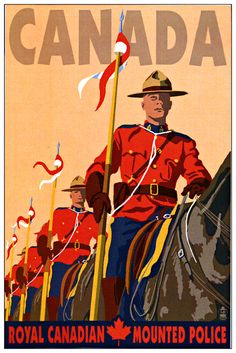
Preconceived Ideas About Mounties

There are things that you expect, things you take for granted, things that you know to be true, which turn out to be completely wrong.  Here’s one of the things that I found out when we visited Canada earlier this month, something that was very unexpected:

The Mounties don’t wear their red uniforms.

I’m serious, they don’t.  That’s no surprise to Canadians, of course, but that was quite the surprise to me.  Maybe that is because I’m the person who learned everything he knows about Mounties from Due South.  I saw police cars and police (the R.C.M.P.) in them that looked like…well…regular police.  To say I was disappointed would be an understatement.  I had made it a goal to track down a Mountie and get my picture taken with him in his red uniform.  It didn’t happen.  See, they only wear those cool red uniforms for special occasions (parades, or anything else for show).  And it was just our luck that there were no special occasions while we were in the country.

But it got me thinking.  You see, there are a lot of people in the world and in denominations who we think we’ve got figured out.  We take it for granted that all Baptists believe a certain way.  We expect that any Catholic we run into is a Christmas/Easter Catholic.  We think we know certain things about them to be true.

But the fact is, we don’t know those things at all.  Each person is different, and while some things we think we know might be true, that doesn’t mean everything we think about them is true.

Why not take the time to get to know your religious neighbors individually and start talking with them about their beliefs.  I once spent thirty minutes waxing eloquent about the sin of instrumental music in worship to a Baptist.  If I had bothered asking their view on it first, I would have found out that their congregation was adamantly opposed to it as well.

This past week, I spoke to an Amish woman who was selling items in a store and asked her what her thoughts were on selling postcards with pictures of Amish people on it.  The common view among non-Amish (even among the people who are supposed “experts” who give tours of the area) is that the Amish refuse to have pictures taken because it is a “graven image.”  But this Amish woman told us that she (and many other Amish people) have no problem with the pictures, since they aren’t things being worshiped.  “They are just memories.”

It’s amazing what you find out when you look past your preconceived ideas and simply ask “what do you believe?”

But for the record, I am still disappointed that the Mounties don’t look like Mounties.

-Bradley Cobb

A Lesson Learned from a Gravestone

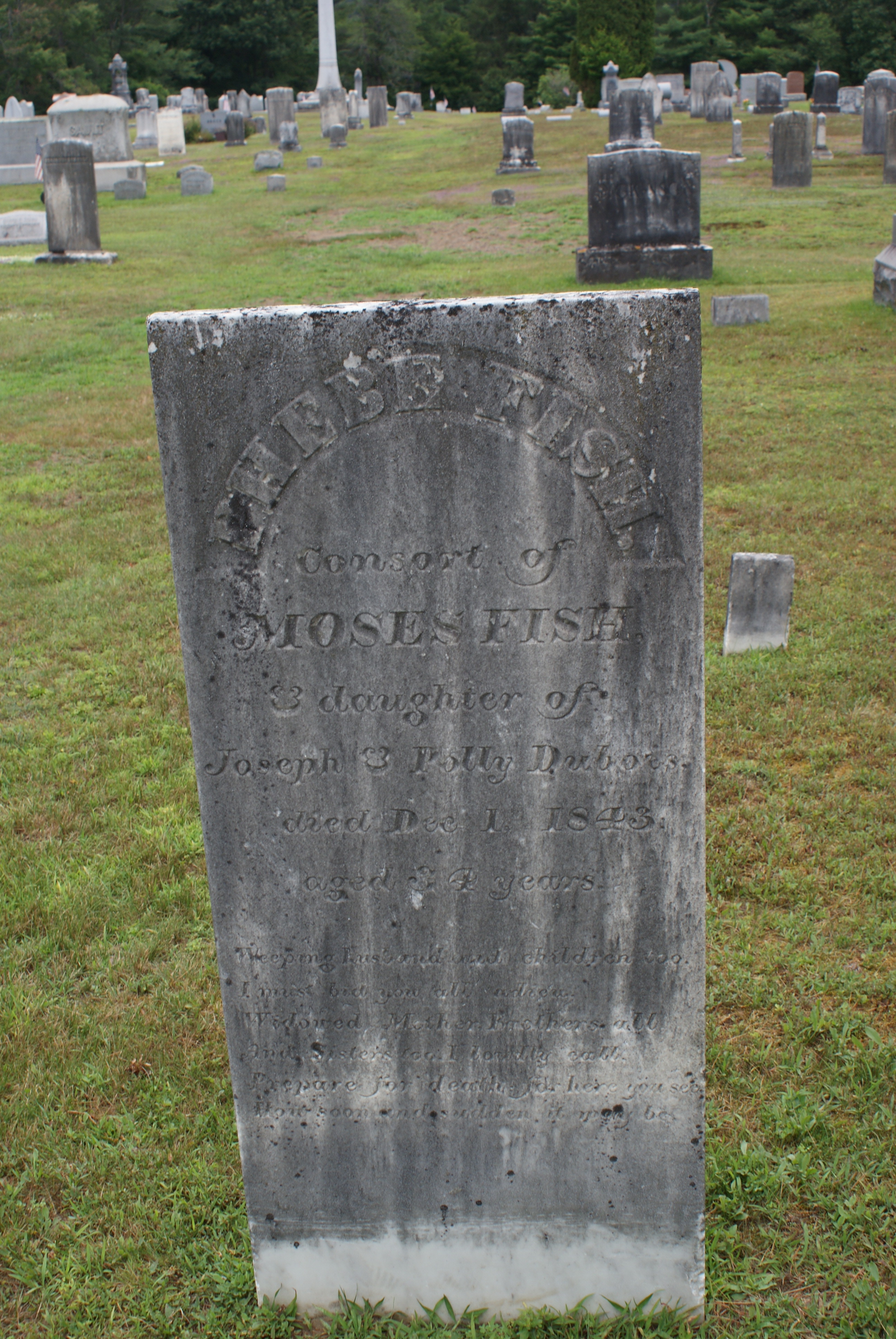
In Randolph, VT, there stands a tombstone of a woman named Phebe Fish.  There is not really much I can tell you about her except that on her tombstone is a mighty reminder that you never know when you’re going to die–and so you’d better be prepared for it.

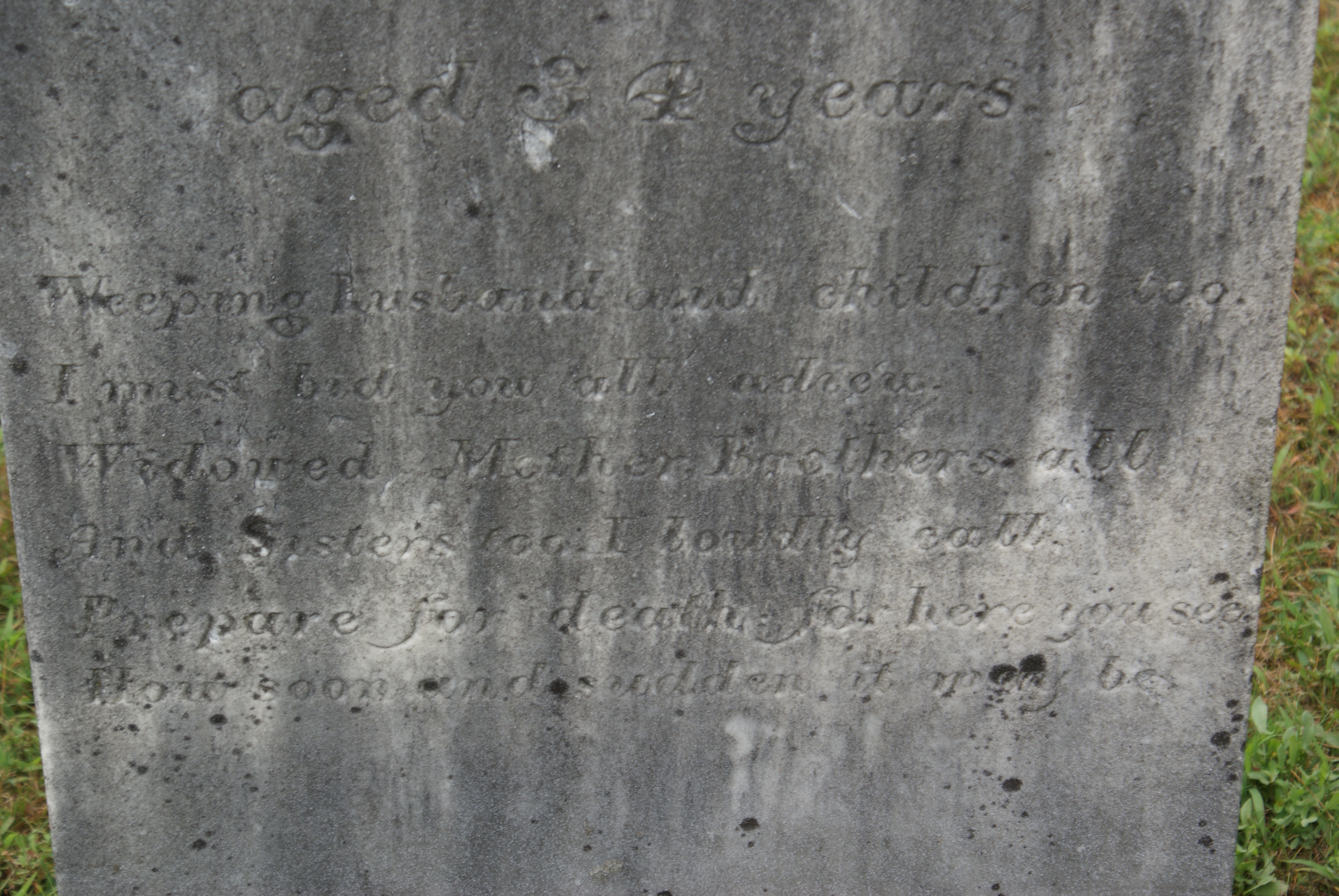
The lines under her name and age (just 34) read as follows:

Weeping husband, and children too,
I must bid you all adieu,
Widowed mother, fathers all,
And sisters, too, I sadly call,
Prepare for death, for here you see,
How soon and sudden it may be.

SONY DSC
SONY DSC

How do You Want to be Remembered?

When your time on this earth is through, how do you want to be remembered?  Some people want to be thought of as having been a great financial success, others want to be remembered as being famous, and still others want to be remembered for some single achievement that they did.

There was a man who lived in Vermont over 200 years ago.  He was at one point a deacon in the Baptist Church.  But in 1806, he led that congregation out of denominationalism and taught them to simply be “Christians Only.”  That same year, after the Baptist Church officially dissolved, he helped form the “Christian Church,” and served as an elder there for over 25 years.

In the early 1800s, he was one of the primary men who tried to help unite different groups who were trying to restore New Testament Christianity.  He was present at the baptism of both Abner Jones and Elias Smith, and was well-respected by both.  He baptized nearly 100 people during 1808.  He was instrumental in training other men for the ministry.

It has taken me a significant amount of time in research and reading to find out much about this man.  He’s mentioned in passing in several biographies and autobiographies, but never is there much detail given about him.  He never wrote a book about himself.  He never sought the limelight.  Instead, he worked tirelessly as an elder and occasional preacher for a single congregation for nearly three decades.

Near the end of his life, he moved a few towns over and helped serve a congregation there.  He died in the service of His Lord.

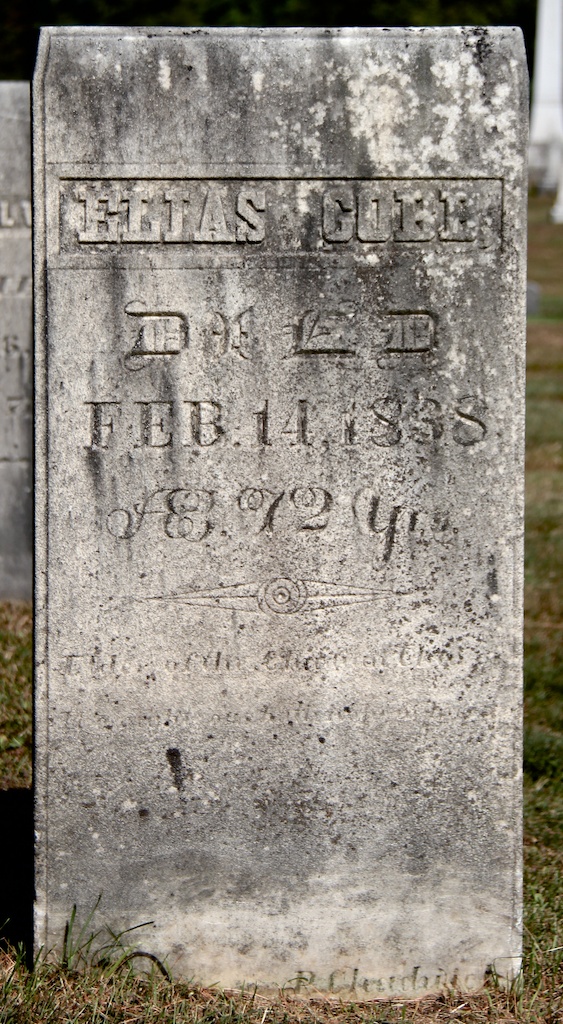
He left behind a very simple legacy.  Those who pass by his tombstone will only see his name, date of his death, and then the words “Elder of the Christian Church.”

That is what Elias Cobb [no relation] wanted people to know about him.  What do you want people to know about you?

-Bradley Cobb

Stay in the House!

There are sounds of gunfire and screaming coming from outside his window.  The man slowly moves the curtain aside to see what’s going on, his kids getting more and more worried.  “Dad, what’s that noise?  Is somebody hurt?”

The man barks at them, “get back!”

He makes his way to the front door, and with tears the kids start begging, “Dad, don’t go! Stay here with us.”

The dad opens the door slowly and lightly steps out onto the front porch. Hesitating, he turns around, looks his children in the eyes, and sternly says, “Stay in the house!”

The door shuts, and the children don’t see their father anymore.  They run to the window and look as bullets fly and their father falls to the ground dead.

And through the crying and tears, they are haunted by the question that they can never answer: Why didn’t daddy stay in the house?

Why would a man tell his children to “stay in the house!”?

Because there is safety in the house. There is security in the house. There is protection in the house.  Because there is danger outside. It could cost them their lives to go outside.

In the Bible there was a strict command given to “stay in the house!”

It’s found in Joshua 2.  The Israelites—almost 3 million of them—are camped next to the Jordan River.  Across the Jordan stands the city of Jericho, surrounded by its two protective walls.

From the top of Jericho’s walls, you can see the Israelite camp, their tents, their campfires, and more people than you’ve ever seen in your life—and they’re about to attack.  Then, two of them show up in the city; on the walls; in your house!

Scared for your life, you don’t dare turn them in—you don’t want to anger their God.  You quickly hide them on your roof, and when the soldiers come to your door, you send them on a wild-goose chase—because you don’t want to anger the powerful Jehovah of the Israelites.  You send the spies out safely, but beg them to spare you and your family when they finally attack.

The spies agree, but give you the stern warning: “stay in the house!

If you want to be safe, get in the house!

For Rahab and her family to be safe, they have to get in the house (Joshua 2:18).

The spies said “when we come into the land, thou shalt bind this line of scarlet thread in the window which thou didst let us down by: and thou shalt bring thy father, and thy mother, and thy brethren, and all thy father’s household home unto thee.”  Literally, they said, “into your house.”

The only way that anyone in the city of Jericho was going to be saved was if they got in the house.  So, Rahab found her family, and brought them into the house with her—because she wanted to be saved, and she wanted her family to be saved too.

To refuse to come into the house was to refuse salvation.  To refuse to come into the house was to bring death on themselves.

For anyone today to be saved, they have to “get in the house” (Acts 2:47).

The house of God is the church (I Timothy 3:15 – “the house of God, which is the church”).  All saved people are in the church (Acts 2:47)—there are no saved people outside of the church.  Christ’s blood is required for salvation, and it only covers those who are in the church (Acts 20:28).

You’re surrounded by enemies who are ready to destroy you—and the only way to be safe is to “get in the house!”  Salvation is only found in the church, because it is the house of God, the body of Christ.

To reject the church is to reject salvation!  To reject the church is to bring destruction upon yourself!

If you’re not in the house yet, GET IN IT!

And if you are in the house, why aren’t you trying to get other people in it with you? Do you want them to be destroyed? Are you content to think, “Well, I’ll be saved, so it doesn’t really matter about anyone else?”

If you want to be safe, stay in the house!

For Rahab and her family to be safe, they have to stay in the house (Joshua 2:19).

“And it shall be that whosoever shall go out of the doors of your house into the street, his blood shall be upon his head and we shall be guiltless.”  Basically, the spies said, “If they leave the house, they’re dead. And it’ll be their own fault.”

Rahab and her family get all their belongings, and they all huddle together in the house. They look out the window, scared for their people, but also confident that God would keep His promise. They see hundreds of thousands of soldiers march around their city once a day for six days—and the soldiers don’t say a word. It is eerie, disconcerting, and frightening.

But through it all, they stay in the house because they know that they are only safe if they stay in the house.

For anyone today to be saved, they have to “stay in the house!”

Almost every letter in the New Testament contains warnings about losing your salvation.  But this is nowhere more clearly stated than in Revelation.

Jesus walks among the seven golden candlesticks, which are his church (Revelation 1:20).  A church who ceases to follow Christ will have its candlestick removed—that is, they will no longer be part of the church (Revelation 2:5).  In fact, Jesus describes the process as vomiting them out of His mouth, His body—vomiting them out of the church (Revelation 3:16).

When you leave the church, you leave the protection of the blood of Christ—and you bring it on yourself!  Those who returned to the Law of Moses willingly left the church of Jesus Christ—and had “fallen from grace” (Galatians 5:4).

You’re surrounded by an enemy that is ready to destroy you. You’re in the one safe place [the church] where they can’t harm you. And then you open the door and walk out—into the destructive hands of the enemy.  That’s like being in a storm cellar in the middle of a tornado, and then getting out as it goes right over you. You’re dead!

Instead, stay gathered with your family—your brothers and sisters in Christ—stay safe in the house (the church).

Conclusion:

On the seventh day of the siege, the hundreds of thousands of Israelite soldiers marched around the city seven times. The people in Jericho knew something was coming. As they looked out over the wall and through windows, they could see nothing but soldiers—silent soldiers—being led by God Himself.

Then, without warning, trumpets blast and six hundred thousand voices scream all at once. The ground shakes and the walls of the city crash to the ground. And through the dust they see the screaming soldiers running straight into the city with their swords swinging. Blood splatters and pools on the ground and person after person falls lifeless to the ground. Then comes the fire, destroying the city and everything in it.

But one section of the wall never fell. One small section of the wall still stood, with a house sitting on top of it. Inside that house was a woman who wanted to be saved. Inside that house was her family. Inside that house was a group of people who trusted in God’s promise.

What made that house different? Why did it stand when all the others fell?

After all, there were plenty of other houses. There were plenty of other people huddled in other houses. What made this one different? This house had a window. Out of that window hung a cord—a scarlet cord. That cord is what made that house stand out. That cord is what marked that house for salvation. That scarlet cord saved the spies, and now it saved Rahab and her family.

“And Joshua saved Rahab
and her father’s household” (Joshua 6:25).

On the final day, destruction will come upon this entire world. The trumpet will sound and Jesus will shout (I Thessalonians 4:16). No one will be able to stand in the face of His fierce destruction. And then comes the fire—the eternal fire (Mark 9:43-48).

But one house is spared. Inside that house are people who wanted to be saved when destruction came. But what made that house different? What makes this CHURCH different? After all, there’s plenty of other churches out there.

This church is different because of scarlet—the scarlet of Jesus’ blood. It is that blood which sets this church apart. It is that blood that makes this church stand out. The scarlet marks this church—this house—for salvation.

The people in this house are also saved by Joshua—of course, we know this Joshua by His Greek name, Jesus.

Jesus said He would build HIS church (Matthew 16:18). There is only one church that Christ recognizes. There is only one church that God adds to (Acts 2:47). Christ only built one church. Man has built many. Only Christ’s church—the one protected by the scarlet—will be saved.

The question now is this: Are you part of that church?

-Bradley S. Cobb

Did Paul Receive the Holy Spirit by the Laying on of Hands?

Question: The book of Acts says that Ananias came and laid hands on Paul so that he would “receive the Holy Spirit.”  Does that mean that he had the Holy Spirit before he was baptized? –F.B.U.

To answer this question, we need to look at the text that it comes from:

Acts 9:17-18

And Ananias went his way and entered into the house. And putting his hands on him, he said, “Brother Saul, the Lord Jesus that appeared to you in the way as you came has sent me so that you might receive your sight, and be filled with the Holy Spirit.” And immediately there fell from his eyes as it had been scales, and he received sight immediately, and arose, and was baptized.

Putting his hands on him
”Brother Saul
receive your sight
”

Here we see the miracle of Saul’s sight being restored. Verse 18 makes it clear that was the result of Ananias’ laying hands on him. That much is clear and undisputed by anyone who believes the Bible.

The question now, though, is what do we make of the phrase “be filled with the Holy Spirit”?

Jesus
has sent me so that you might
be filled with the Holy Spirit.

There are several opinions from scholars as to what this means. Some insist that it is the literal indwelling of the Holy Spirit being given to Saul of Tarsus—prior to baptism—by Ananias laying hands on him. Others say basically the same thing, except they say it was the gift of miracles being given to Saul prior to his baptism by Ananias laying hands on him.

When Luke uses the phrase “filled with the Holy Spirit” or “full of the Holy Spirit,” miracles (usually inspiration) are always under consideration. Examine them for yourself: John the Immerser (Luke 1:15), John’s mother, Elisabeth (Luke 1:41-45), John’s father, Zacharias (Luke 1:67-79), the apostles (Acts 2:4), the apostles again (Acts 4:31), Stephen (Acts 6:5, 7:55-56), Barnabas (Acts 11:22-24), Paul (Acts 13:9-11), and the disciples of Antioch in Pisidia (Acts 13:14, 51-52).

Understanding this, let’s now look at the evidence to come to a rational, biblical conclusion to this potential conundrum.

First, Jesus said that the purpose of Ananias’ laying hands on Saul was so he would receive his sight. That was seen in verse 12 of this same chapter. There was no indication in Jesus’ words that Ananias was going to give Saul the Holy Spirit.

Second, the only result of this event shown in the Bible is that Saul received his sight. After he put his hands on Saul, the Bible only records that Saul received his sight. It says nothing about him receiving the Holy Spirit. If we look at Acts 22, where Saul (who is also called Paul) is telling about this very event, we see that he doesn’t even mention the Holy Spirit at all—but he does mention receiving his sight again.[1]

Third, the ability to pass on the Holy Spirit was only available to the apostles. This is shown in chapter 8, verses 14-18. Ananias was not an apostle, and so—unless someone wishes to argue that Ananias should be classed as an apostle—the evidence is against his being able to pass on this gift.

Fourth, Saul was lost in his sins when Ananias laid his hands on him, and was not a candidate to receive the Holy Spirit, for he had not been baptized. This principle is seen in Acts 8:15-16. Acts 22:12-16 shows that he was still lost in sins after Ananias laid his hands on him. The Holy Spirit was promised only to those who were the obedient servants of God.[2]

Fifth, Paul makes it very clear throughout his life that he did not receive his apostleship from any man. Miracles (the gift of the Holy Spirit) and the ability to pass them on were “the signs of an apostle.”[3] Paul states that he was “an apostle—not of men, neither by man, but by Jesus Christ and God the Father who raised Him from the dead.”[4] All of the apostles received their miraculous ability direct from heaven.[5] Paul would be no different.

Sixth, we see no record of Saul performing miracles until years later. The first time we read of Saul (now called Paul) doing any miracle is in Acts 13:9-11. This is the first time where Paul is said to be “filled with the Holy Spirit.” Now, this does not mean that Paul was unable to perform miracles prior to Acts 13, but it is supportive evidence that he didn’t receive the Holy Spirit when Ananias laid hands on him. There is no evidence that Saul was able to work miracles before that event.

Seventh, it took the testimony of Barnabas to convince the apostles that Saul was really a disciple of Jesus Christ. You might ask, What does that have to do with anything? If Saul of Tarsus had the miraculous abilities given by the Holy Spirit at this point, it would have been very simple for him to prove to the apostles and other disciples that he was a Christian. But instead, it took Barnabas speaking on his behalf. Though not conclusive, this evidence seems to indicate that at this point Saul did not have the miraculous gift of the Holy Spirit.

Since the evidence implies that Saul did not receive the Holy Spirit when Ananias laid hands on him, what exactly did he mean when he told Saul “Jesus
has sent me so that you might
be filled with the Holy Spirit”?

Ananias’ mission was to heal and baptize Saul; to bring him into the family of God and Christ. As you can see from other passages in Acts,[6] the Holy Spirit was only given to those who were servants of God, and who obey Him. Ananias came to help Saul become spiritually acceptable before God, and thus also help him become a candidate for the reception of the Holy Spirit. It was preparatory work.

-Bradley S. Cobb

[1] Acts 22:12-13

[2] Acts 2:17-18, 5:32

[3] II Corinthians 12:12

[4] Galatians 1:1

[5] Acts 2:1-4, 4:29-31

[6] Acts 2:17-18, 5:32