Category Archives: Announcements

A Very Early History of the Restoration Movement

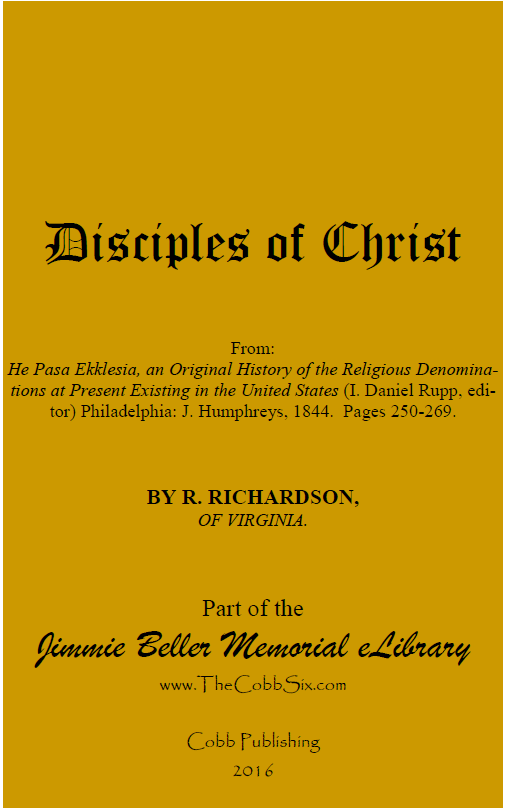
The year was 1844.  A man named I. Daniel Rupp had the idea to compile an authoritative encyclopedia of the various religious bodies in the United States.  So he appealed to members of each group to submit a history of their rise and progress, with specific mention of any doctrines that made them different from the others.

Robert Richardson, who would later go on to write the two-volume Memoirs of Alexander Campbell, was selected to submit this early history.

RichardsonDisciples

You have to remember that at this time, both Thomas and Alexander Campbell ere still alive.  Barton W. Stone was still alive (he would die later that year).  The missionary societies had not yet reared their ugly head; and none of the churches had introduced instrumental music.

So Richardson’s entry pictures the Disciples at a time when they were still united on the Bible, on biblical principles, on biblical worship, and on the biblical plan of salvation.

As always, we’ve tried to remove any typos, correct the spelling, and reformat this book for the Jimmie Beller Memorial eLibrary so that you can enjoy it as much as possible.  On this offering, we’ve also taken the two footnotes and inserted them into the text in parentheses (they were short footnotes).

Just click the link below!

Disciples of Christ (Robert Richardson, 1844)

-Bradley S. Cobb

An Important Announcement

We try to offer up encouraging and educational articles, and even sometimes things to put a smile on your face.  And we thank you for taking the time to read what we’ve written.

We are beginning to undertake a large project that we truly hope will be a blessing to the church across the country.  Thankfully, we’ve got a good group of people involved to help with it.

I’d like to take a moment to tell you about it.

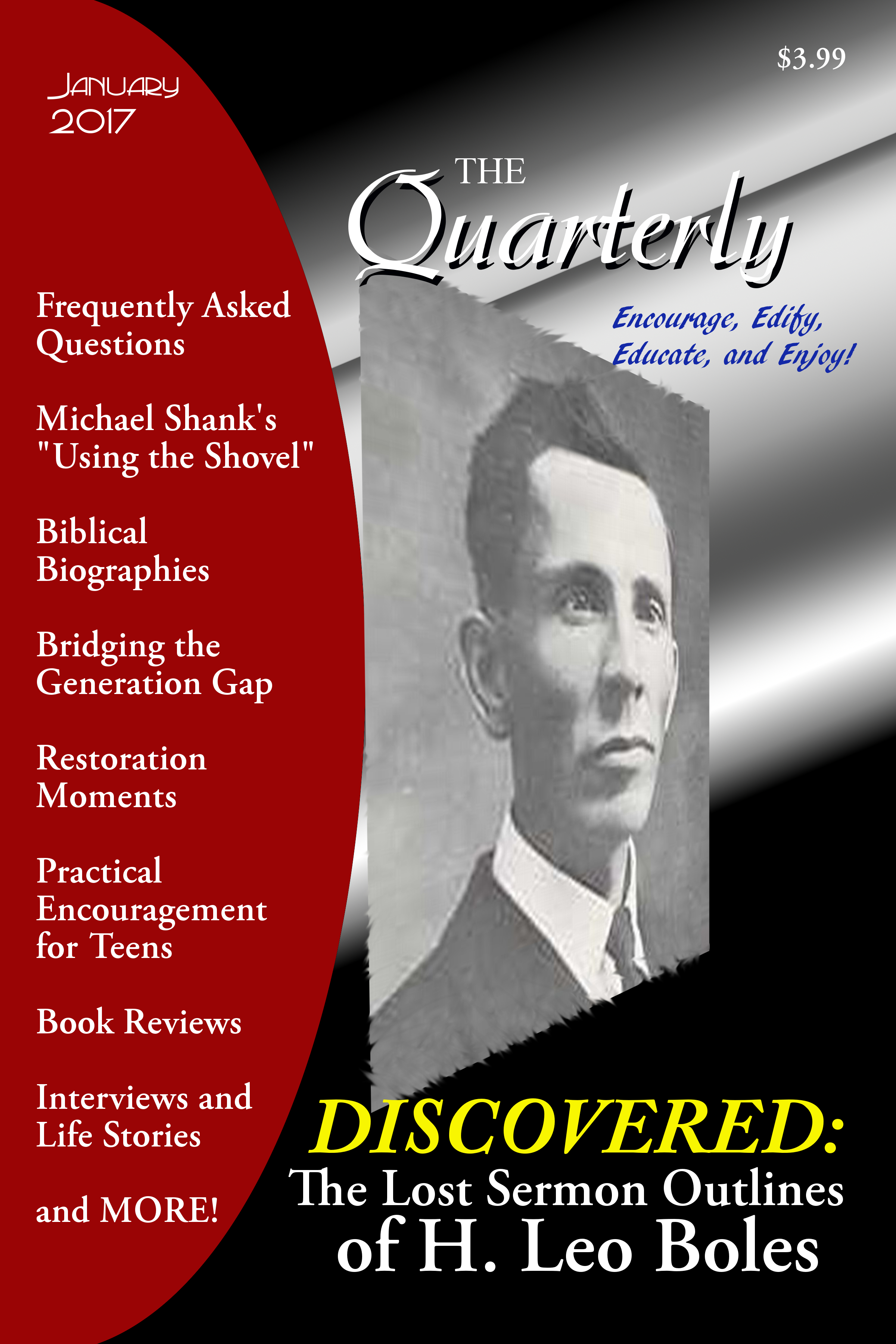
We are starting a new quarterly publication called “The Quarterly,” with the subtitle of “Encourage, Edify, Educate, and Enjoy!”

This publication will start officially in January of 2017.  We’re hoping to have a preview edition ready by September, so that people can see what it will be like before they subscribe.

The Quarterly will have several great features, including interviews with long-time Christians about their unique experiences, Biblical Biographies, a Question/Answer section, “The Tabernacle Shadows,” interesting events in Restoration Movement History, and much more!

We’ve got a great stable of writers who will be working with us, including some who have never been published before, and others who are seasoned pros at it.

I would like to take this moment to ask you to consider subscribing to this magazine-sized publication.  We are offering it in both digital and print forms.  If you think your congregation might be interested in receiving multiple copies, contact us and we will give you the best price we can. (The cost of the print subscription is our actual cost to print/ship them to you–we’re not making any money on it.)

For more information, click here.

Here is a look at the preliminary cover (It might be changed before we go to press with it).

Quarterly01Front


-Bradley S. Cobb

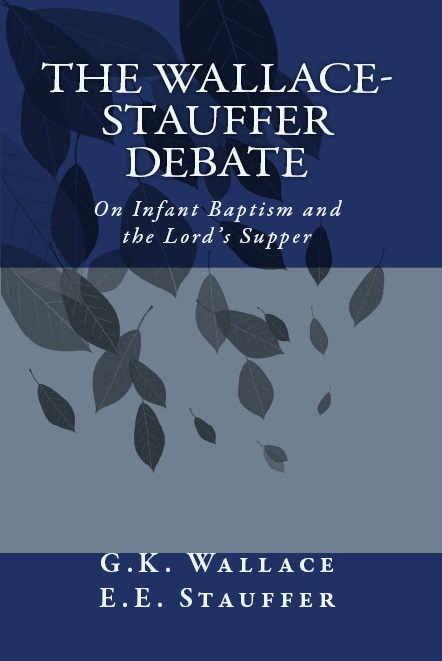
A Debate on Infant Baptism and the Lord’s Supper

Continuing our theme of new additions to the Jimmie Beller Memorial eLibrary this week, we’re proud to offer you this:

WallaceStaufferCover


Where does the Bible authorize–or even mention–infant baptism?

It doesn’t.

This debate, held in 1937, is between G.K. Wallace (Christian) and E.E. Stauffer (Lutheran).  Wallace attacks the false doctrine of infant baptism from several different angles, and leaves Stauffer with nothing to say except for “let’s move on to the Lord’s Supper.”

Wallace then exposes the false idea that the Lord’s Supper literally turns into the physical skin and blood of Jesus.  Stauffer is unable to counter his arguments and calls the debate to a close.

Back in 2014, we took this debate and gave it the full Cobb Publishing treatment, correcting all the mistakes we could find, and refurbished the whole thing to give you the best possible reading experience.  We still have it available in print (just $5.99), but we’re also making it available as an eBook for free in the Jimmie Beller Memorial eLibrary!

To read it online, or download for later enjoyment, just click the link below!

Wallace-Stauffer Debate on the Lord’s Supper and Infant Baptism

-Bradley S. Cobb

Some Brief Congregational Sketches … Written in 1869!

Today’s free book, exclusively from the Jimmie Beller Memorial eLibrary, is a brief one, but with a nice, long title.

Licking County Disciples

This book is only 12 pages, but it gives some interesting historical notes about the Lord’s church and the preachers who worked in that area.  If you’re a Restoration Movement enthusiast, or you like short histories, this one is for you.

As always, we’ve prettied this one up, correcting the typos we found and reformatting it to make it easy on the eyes.

To read it online, or to download it to your computer for later perusing, just click the link below.

Historical Sketches of the Disciples Churches in Licking County

-Bradley S. Cobb

A FREE Restoration Movement History Book

We hope you haven’t gotten overwhelmed with all these new additions to the Jimmie Beller Memorial eLibrary the past couple weeks, but we’ve got a lot of books that have been sitting ready to go into the library, and we thought it’d be cruel to make you wait a week for each new one to be posted.  🙂

Tyler-HistoryOfDisciples

Today’s book was originally written as an entry to The American Church History Series, a multi-volume encyclopedia of all the different religious groups in America (this appeared in volume 12).  It was edited by Philip Schaff.

But though it was originally an encyclopedia entry, don’t think that it’s some short little thing.  B.B. Tyler (author of another book titled Concerning the Disciples of Christ) wrote a lengthy, 10-chapter book (our version is 143 pages) about the history of the Restoration Movement.

As always, we’ve gone through it and fixed any typos we ran across, and reformatted it to make it more pleasing on the eyes.

Click the link below to read it online or to download it for later enjoyment!

A history of the Disciples of Christ in America (B.B. Tyler)

-Bradley S. Cobb

Toils and Struggles of the Olden Times

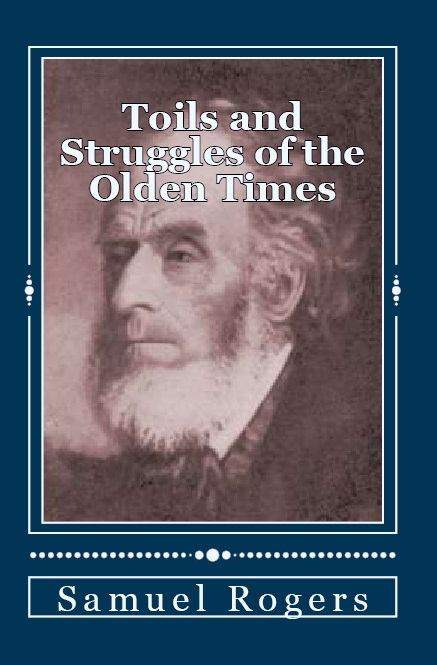
You’ve been a soldier in the war of 1812.  But now, you’ve found Jesus.  The only problem you’ve got is that the religious world is telling you all sorts of conflicting things.  Which one is right?  How can you tell?

This is the story of Elder Samuel Rogers, or as J.W. McGarvey called him, “Uncle Sammy.”

SamuelRogersCover

Samuel Rogers was a soldier and a preacher. His life was lived as a soldier for Christ. He planted many congregations throughout Indiana, Illinois, Missouri, and the surrounding areas. One estimate says that he personally baptized over 7,000 people.

Along the way he survives a wildfire, is confronted with kindness that crosses racial borders, and meets Alexander Campbell.

This new, revised edition has been completely reformatted, meticulously proofread for any typos, and updated with modern spelling–all to bring you, the reader, a more pleasant reading experience.

We’ve been publishing this book since 2013 (and you’re still welcome to buy a copy from us for just $9.99), but we’re now making available for FREE in eBook format in the Jimmie Beller Memorial eLibrary!

Just click the link below to download it or read it online!

Toils and Struggles of the Olden Times: The Autobiography of Elder Samuel Rogers

-Bradley S. Cobb

Alexander Campbell’s Commentary on Acts

Back in the mid-1800s, Alexander Campbell received the ire of many religious bodies for having the audacity to produce a new translation of the New Testament (Because, they would say, God Himself inspired the translators of the King James’ Version).  In the first edition, he took most of the translation from various well-respected commentaries (George Campbell [no relation], MacKnight, and Doddridge) and edited it together in one volume.  In the second through fourth editions, he made several changes, seeking to have more uniform translating principles throughout.

It’s really interesting to note the background given above, because some years later, the Baptists organized a translation committee with some other religious groups (including the Disciples) called The American Bible Union.  And they recognized that Campbell was no slouch when it came to knowing the original language–so they chose him to translate Acts of Apostles.

As each book was translated for the A.B.U., it was published and distributed for comment, and it would then be revised prior to its inclusion into the finalized New Testament.

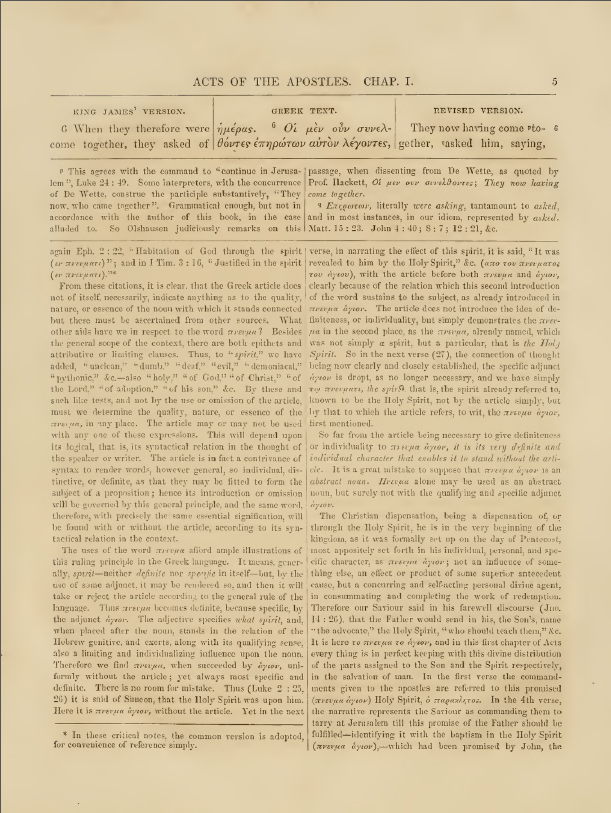
Alexander Campbell’s translation of Acts was published in a large size (8 1/2 x 11), with his commentary included–and was nearly 240 pages long.  This commentary is different from what you would expect.  It included the following features:

  • The King James’ Version text of Acts
  • The Greek original of Acts
  • His “Revised Version” of Acts
  • Translation notes on all three.

CampbellActsInside

Because of the sheer amount of Greek, and the amount of notes (see picture above), we have decided to add this book to the Jimmie Beller Memorial eLibrary as published, and not attempt (at this time) to do any updating to to it (as we have with all the other books in the library).  It would just be too overwhelming of a project for now, but we want to get this book out for as many people as possible to enjoy.

Now, pay attention here, because we’re giving you two options:

The higher quality scan, as seen in the image above, is too large for us to upload to our website (115 Meg), so you will have to download it from a special link (no worries).

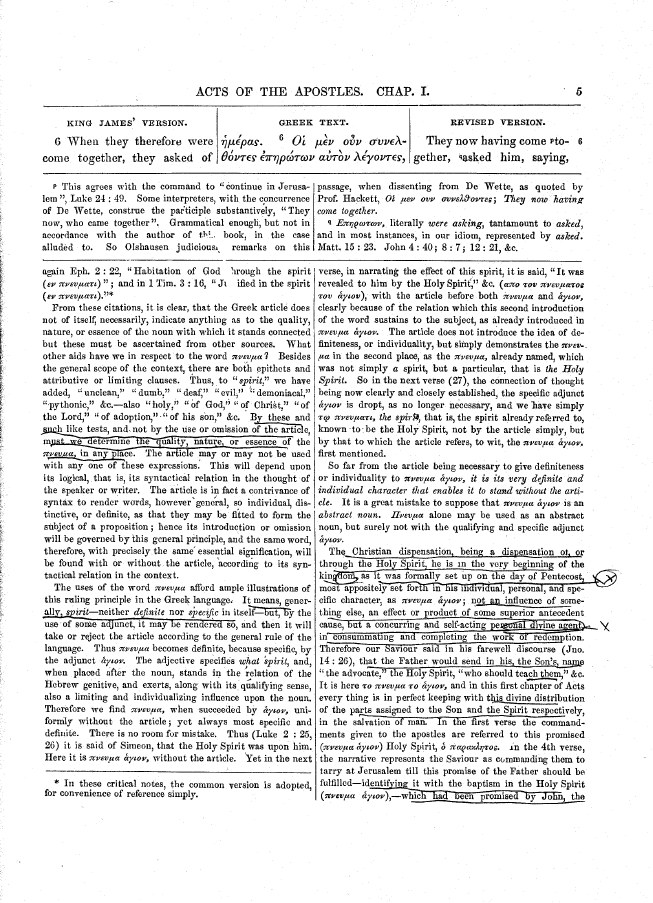
The second option is black/white, and is 1/10 the size of the other one, and while it is easier to read, it has a LOT of underlining and notes in the margins (This was a scan we made from Jimmie’s personal copy).  Note the picture below is the same page as the picture above, from the other copy.

CampbellActsInside(1)


To download the higher quality version, click the link below:

Alexander Campbell’s Acts of Apostles (HQ)

To download the B/W version (easier to read, other than the underlining and notes), click this link below.

Campbell, Alexander – Acts of the Apostles

The Disciple Whom Jesus Loved–The Life of the Apostle John (Part 3)

John after the Resurrection

John stayed at the cross until after Jesus had died, and witnessed first-hand the soldier shoving a spear into the side of Jesus.  He watched as the blood and water came flowing from the wound, and it made an indelible impression on him.  Years later, when he wrote his account of the gospel of Jesus Christ, he made sure to include this information, and even stressed that he was there to see it firsthand.1

After the death of Jesus, John was quite sad and upset. He still didn’t understand the Scriptures, that Jesus would rise from the dead.2 But the next morning, Mary Magdalene, along with Joanna, and Mary, the mother of James,3 came running to him and the other apostles, most likely with tears and confusion, saying, “They’ve taken away the Lord out of the sepulchre, and we don’t know where they’ve laid him.”  They also said that they had seen men in shining clothes who told them that Jesus had risen.  But the apostles thought they were making things up and didn’t believe them.4

However, John and Peter took off running immediately for the tomb where Jesus had been laid.  John was the faster of the two men, and beat Peter there.  Then, while waiting for Peter to get there, John bent down and looked inside.  There he saw the linen burial clothes laying inside the rock tomb, but he didn’t enter.  Then, Peter finally arrived and went straight in the place where Jesus’ body had been placed a few days earlier.  John followed Peter in, and saw again the burial clothes laying there, and also noticed that the face cloth was laying by itself, “rolled up” (ASV) together.  Seeing this was enough to make John believe that Jesus had risen from the dead, even though he didn’t understand yet that it was what the Scriptures had foretold.5  Coffman has some interesting comments at this point:

Commentators who refer this to some mere tidying up of the grave, or the folding of the garments (there were no garments; but medical bandages), miss the point. Since when has it ever been supposed that a folded garment, or cloth, proved that the dead had arisen? The certain implication of this astounding narration is that Jesus had risen through the winding shroud of bandages, napkin and all, leaving behind the positive and undeniable evidence of his supernatural triumph over death. Remember, this evidence convinced John. The very amount of space accorded this phenomenon in this Gospel is far more than enough to indicate the extraordinary implications of “the linen cloths lying.” Matthew has a remarkable corroboration of this account in the words of the angel, “Come see the place where the Lord lay” (Matthew 26:6), thus emphatically implying all that John here related.

…The napkin around the head would not have connected with the winding shroud; and that independent placement was preserved in the manner of the linen cloths lying.6

Barclay agrees:

Then something else struck him–the grave-clothes were not disheveled and disarranged. They were lying there still in their folds—that is what the Greek means—the clothes for the body where the body had been; the napkin where the head had lain. The whole point of the description is that the grave-clothes did not look as if they had been put off or taken off; they were lying there in their regular folds as if the body of Jesus had simply evaporated out of them. The sight suddenly penetrated to John’s mind; he realized what had happened—and he believed. It was not what he had read in scripture which convinced him that Jesus had risen; it was what he saw with his own eyes.7

That evening, word had spread that Peter had seen the Lord,8 and John gathered together with all the apostles (except for Thomas, who was absent).9  They kept the doors shut, in fear that the Jewish leaders might come after them—especially now that whispers were spreading that the tomb was found empty, and people were claiming to have seen Jesus very much alive.10  While they were gathered together, Jesus appeared in their midst, and said “Peace to you,” and showed them His hands and His side, proving that it was Him.  Joy cannot begin to describe the feeling that John was experiencing.  But at the same time, Jesus upbraided them because they hadn’t believed the ones who had told them that He had been raised.11

Some time afterwards, John accompanied Peter and some of the other apostles onto a boat where they went fishing all night, but caught nothing.  The next morning, John saw a man on the shore, who called out to them, “Children, do you have any food?”  After they replied in the negative, John heard the man say, “Cast the net on the right side of the ship, and you’ll find [fish].”  When they did this, there were so many fish that they couldn’t draw the net in.

The other apostles apparently didn’t realize who it was on the shore, but John did.  He said to Peter, “It’s the Lord!”  John was left with the boat as he watched Peter jump into the water and swim to shore.  John and the other apostles brought the ship to shore, dragging the net behind them, and then sat down with Jesus and ate.

After they finished eating, Jesus began to walk with Peter, and John followed them.  It is probable that John heard at least part of the conversation, including Jesus’ foretelling of Peter’s death, and Peter asking Jesus, “What about this man?” (referring to John).  Then John heard Jesus’ reply of, “If I desire that he remains until I come, what is that to you?  You follow me.”  Decades later, this conversation about John was still remembered, so that when John wrote his account of the good news of Jesus, he had to make it clear that Jesus wasn’t saying John would never die—just that John’s fate was unimportant to the command of Jesus to “follow me.”12

That is a lesson that we would all do well to remember—it doesn’t matter what anyone else does, our command is to follow Jesus.

-Bradley S. Cobb

1 John 19:30-35.  John does not emphasize his status as an eyewitness for any other specific event his gospel account.  This shows that the blood and water coming from Christ has a major significance.  See Romans 6:3-5; Acts 22:16; Revelation 1:5, 7:14.

2 John 20:9.

3 Luke 24:10.  Most likely, this is Mary, the mother of Jesus Christ.  Since they had not yet seen Jesus Himself raised, she would have been called by the name of her oldest known living son, which was James.  Luke has a general habit of not mentioning someone by name unless he expected the reader to already know who that person was, or unless that person showed up elsewhere in his writings.  Joanna was mentioned in Luke 8:3, Mary Magdalene in 8:2.  Other than Mary Magdalene, Luke mentions two women named Mary: Mary, the sister of Martha and Lazarus, and Mary, the mother of Jesus Christ (and his brothers, including James).  Since it was already common knowledge (thanks to Matthew’s gospel which was published and distributed around 20 years earlier) that James was the brother of Jesus and the son of Mary, Luke could identify the mother of Jesus as “Mary, the mother of James,” and the readers would have known exactly what he meant by it.

4 John 20:1-2 only mentions Mary Magdalene speaking to John and Peter, but she says “we don’t know where they’ve laid Him.”  Luke 24:10-11 mentions two other women by name, and includes “others.”  It is possible that the women split up in order to get the news spread to the apostles quickly.

5 John 20:1-9.

6 James Burton Coffman, comments on John 20:6-7.

7 The Daily Study Bible Commentary on John, notes on John 20:1-10.

8 Luke 24:33-34.  The actual appearance to Peter isn’t described in the Scriptures, but it is referenced in this passage, as well as 1 Corinthians 15:5.

9 John 20:24-25.  For why Thomas may have been absent during this meeting, see the chapter dealing with him.

10 Even the Jewish leaders knew the tomb was empty, for they paid the soldiers who were guarding it to lie and say that the disciples stole the body (Matthew 28:11-15).

11 Mark 16:9-15.

12 This whole incident is found in the last chapter of John, especially
As Touching Those Who Were Once Enlightened…

Two men, once prominent in the Lord’s church, announced that they were leaving and joining a denomination.  On their way out, they tried to verbally attack the bride of Christ, throwing many accusations (with no evidence), and in effect condemning (and denying the intelligence and honesty of) the very people with whom they had labored for a quart of a century!

Not only did they say these things, they also put it in print for people all over the country to read.  This was in 1946.

Today’s addition to the Jimmie Beller Memorial eLibrary is a book that was written in answer to their accusations, insinuations, and outright misrepresentations.

The full title of this work is:

As Touching Those Who Were Once Enlightened

Being a Review of the Reasons Given by Two Former Friends and Co-Laborers When they “Went Back and Walked No More With Him.”

A brief history is given, including the full text of the letters written by the two men in question (brothers Reedy and Etter), and then Brewer answers their charges, and shows the flaws in their excuses so that other Christians wouldn’t be led astray by them.

This might not be every person’s cup of tea, but the book is still very relevant, for there are preachers in the Lord’s church who are making the same statements as Reedy and Etter made 70 years ago.

As usual, this book has been completely reformatted, corrected, and made pretty to give you a more pleasant reading experience.

Click the link below to download!

As Touching Those Who Were Once Enlightened (GC Brewer)

Keeble, DeHoff, Turner, Baird, Lightfoot, Gatewood and More!!!

There is a wealth of material from great preachers of the past that sit on bookshelves — unused and unread.  Like many of the others, this one deserves your attention!

1957Harding_Cover


The whole theme of this lectureship, back when it was still Harding College, was “The New Life in Christ.  And as you’ll see from the speakers and the topics, it was a good one!

We won’t say anything else about it, as we believe the contents speak for themselves.  The link to read it online or to download it to your electronic device of choice is at the bottom.

Special thanks to Ivy Cobb for her proofreading skills.

Contents

  1. THE MEANING OF THE NEW LIFE IN CHRIST
    (Cleon Lyles)
  2. GOD — THE SOURCE OF ALL LIFE
    (Pat Hardeman)
  3. CHRIST HAS MADE POSSIBLE THE NEW LIFE IN HIM
    (Joe Sanders)
  4. FAITH IN CHRIST
    (Royal H. Bowers)
  5. REPENTANCE FROM PAST SINS
    (Rex A. Turner)
  6. CONFESSING CHRIST
    (Wilburn C. Hill)
  7. BAPTIZED INTO CHRIST
    (Charles Hodge)
  8. PUTTING OFF THE OLD MAN
    (Stephen Eckstein)
  9. PUTTING ON THE NEW MAN
    (Gaston Cogdell)
  10. ALL THINGS BECOME NEW: Continual Growth in The New Life
    (J. Roy Vaughan)
  11. “THE BIBLE—THE PRESENTATION OF THE NEW LIFE IN CHRIST”
    (George W. Bailey)
  12. THE MIND OF CHRIST
    (James O. Baird)
  13. COMPLETE DEDICATION TO CHRIST
    (F. W. Mattox)
  14. “ADD TO YOUR FAITH VIRTUE”
    (Robert D. Bankes)
  15. “ADD TO YOUR VIRTUE KNOWLEDGE”
    (Morris M. Womack)
  16. TEMPERANCE
    (L.L Gieger)
  17. IN YOUR FAITH SUPPLY PATIENCE
    (R.B. Sweet)
  18. TO YOUR PATIENCE GODLINESS
    (Neil R. Lightfoot)
  19. TO YOUR BROTHERLY KINDNESS
    (Olan L. Hicks)
  20. TO YOUR BROTHERLY KINDNESS LOVE
    (James G. Moffett)
  21. THE CHURCH, THE CORPORATE EXPRESSION OF THE NEW LIFE IN CHRIST
    (Ruel Lemmons)
  22. EXPRESSION OF WORSHIP AS A MEANS OF SPIRITUAL DEVELOPMENT
    (Paul W. Rotenberry)
  23. FURTHER EXPRESSION OF WORSHIP OF THE NEW LIFE IN CHRIST—LORD’S SUPPER AND GIVING
    (Joseph W. White)
  24. SOME FRUITS OF THE SPIRIT: Joy and Peace
    (Gussie Lambert)
  25. LONGSUFFERING, GOODNESS, KINDNESS
    (Jimmy Allen)
  26. FAITHFULNESS, MEEKNESS, AND SELF-CONTROL
    (Emmett Smith)
  27. THE NEW LIFE IN CHRIST AND THE EVANGELIZATION OF THE WORLD
    (Otis Gatewood)
  28. POLAND AND RUSSIA
    (R. J. Smith, Jr.)
  29. OUR MISSION WORK IN NORTHERN RHODESIA
    (J. D. Merritt)
  30. OPPORTUNITIES IN NIGERIA
    (Wendell Broom)
  31. THE CAUSE OF CHRIST IN JAPAN
    (Colis Campbell)
  32. THE CHALLENGE OF CHRISTIAN EDUCATION
    (George W. DeHoff)
  33. THE HOPE OF THE NEW LIFE IN CHRIST
    (Marshall Keeble)

We hope you enjoy this great book!

Harding College Lectures (1957)