All posts by BradleyCobb

The Disciple Whom Jesus Loved–The Life of the Apostle John (Part 2)

John as an Apostle

One morning, John and the rest of the disciples of Jesus were called to go up a mountain where Jesus had been praying all night.  John must have been excited by being selected as one of just twelve men that would be representatives for the miracle-working man that he believed to be the Messiah.  John then followed his cousin down the mountain, where he saw a crowd of people waiting—and Jesus healed the sick and diseased among them.1

After preaching in Decapolis, on the other side of the Sea of Galilee, Jesus returned to Capernaum2 and was approached by the ruler of the synagogue, Jairus,3 concerning his daughter who was near to death.  John was one of just three disciples of Jesus who was selected to accompany the Lord inside the house to see this little girl raised from the dead.4

Later on, John was taken by Jesus, along with Peter and James, to a mountain where Jesus prayed.  John fell asleep, but when he awoke, the sight before him was quite a shock: Jesus was positively shining, and standing with Him were Moses and Elijah.  Then a cloud overshadowed them, and they heard God Himself speak, “This is my beloved Son: hear Him.”  And then John looked, and the two Old Testament figures had disappeared, leaving only Jesus.  A mixture of fear and excitement was boiling inside John, but Jesus told them not to say anything about what they had seen until after He was risen from the dead.5

Upon returning to Capernaum, John and the other disciples argued about who was the greatest among them.  Jesus criticized them all, and said, “If any man desires to be first, he shall be last of all and servant of all.”6  This is a lesson that John apparently didn’t learn the first time, because not too long afterwards, he and his brother James had their mother ask Jesus for the two greatest seats in the kingdom, causing Jesus to say almost the exact same words: “Whoever shall be great among you shall be your servant; and whoever of you desires to be the first shall be servant of all.”7

In between these two events, John tells Jesus a story about how, when the apostles were out and about, they saw someone who wasn’t part of their group casting out demons in Jesus’ name.  John and some others went to the man and told him to cease, because he wasn’t following them.  To this, Jesus replied, “Don’t forbid him, for there is no man who shall do a miracle in my name that can speak evil lightly of me.  For he that is not against us is on our side.”8  John learned an important lesson there—don’t forbid people from doing good.

But what happens when people are staunchly rejecting Jesus?  John didn’t just want to forbid them, he wanted to kill them!

It came to pass, when the time was come that [Jesus] should be received up, He steadfastly set His face to go to Jerusalem.  And He sent messengers before His face: and they went and entered into a village of the Samaritans, to make [things] ready for Him.  And they didn’t receive Him because His face was as though He desired to go to Jerusalem.  And when His disciples, James and John, saw, they said, “Lord, do you desire that we command fire to come down from heaven and consume them, even as Elijah did?”  But He turned and rebuked them, and said, “You do not know what manner of spirit you are of.  For the Son of man is not come to destroy men’s lives, but to save them.”  And they went to another village.9

Jesus and His disciples came to the Jerusalem area, and stayed at the house of Lazarus on the Sabbath.10 On the next day, John witnessed the “triumphal entry,”11 where Jesus entered the city riding the colt of an ass, and heard the people crying out, “Hosanna! Blessed is He that comes in the name of the Lord!”12  Then John followed Jesus to the temple, where the Lord taught the people, after which they returned to Bethany (probably to the house of Lazarus, Mary, and Martha).13  On Monday, John followed Jesus back into Jerusalem.  Along the way, they saw a fig tree, and Jesus desired to eat some of the fruits from it.  However, there was nothing but leaves on the tree, and John heard Jesus utter the words “Let no fruit grow on you, henceforward forever!”14  After they came into Jerusalem, and into the temple, John watched:

Jesus went into the temple, and began to cast out those who sold and bought in the temple, and overthrew the tables of the moneychangers, and the seats of them that sold doves; and He would not allow that any man should carry any vessel through the temple.  And He taught, saying to them, “Is it not written, ‘My house shall be called by all nations The House of Prayer’?  But you have made it a den of thieves!”15

That evening, John accompanied Jesus out of Jerusalem for the night.16

On Tuesday, John again accompanied Jesus into Jerusalem, and they passed the same tree they had the day before.  Except this time, the tree was dried up from the roots—completely withered—after which Jesus spoke about the power of faith.  They then entered the city and went into the temple, where a group of scribes, elders, and chief priests confronted Jesus and demanded to know where He got His authority to do these things.  John must have smiled to himself when he heard Jesus reply by asking them where John’s authority to baptize came from—and saw the Jewish leaders feign ignorance.17

Then, John heard Jesus give a parable, condemning the Jewish leaders—and they knew it was directed at them—for rejecting Him.18  Then he saw Pharisees, Herodians, and Sadducees all working together, taking turns trying to trap Jesus.19  As they were leaving the temple, one of the disciples (we’re not told which one) said to Jesus, “Master, see what manner of stones and what buildings!”  To this, Jesus replied, “You see these great buildings?  There shall not be left one stone on another, that shall not be thrown down.”20

It was because of this statement of Jesus that John approached Jesus with Peter, Andrew, and James, and asked Jesus to “Tell us when shall these things be?  And what shall be the sign when all these things shall be fulfilled?”21  In answer to those questions, Jesus told these four men about the signs to look for, including “when you shall see Jerusalem surrounded by armies, then know that its desolation is near.”22 This he did, foretelling the destruction of Jerusalem—which took place 40 years later in AD 70.23

Thursday evening,24 Jesus came with John and the rest of the apostles to a large upper room that was prepared for them to eat the Passover.25  Earlier, Jesus had specifically selected Peter and John, sent them from Bethany into Jerusalem so that this room could be made ready.

Then came the day of unleavened bread, when the Passover must be killed.  And He [Jesus] sent Peter and John, saying “Go and prepare us the Passover, so that we may eat.”  And they said to Him, “Where do you wish that we prepare it?”

And He said to them, “Behold, when you have entered into the city, a man will meet you there, carrying a pitcher of water; follow him into the house that he enters.  And you shall say to the goodman of the house, ‘The Master says to you, “Where is the guest-chamber where I shall eat the Passover with my disciples?”’ And he will show you a large upper room furnished: there make ready.”

And they went, and found [everything] as He had said to them: and they made ready the Passover.26

Based on the command of Jesus and John and Peter’s obedience, it appears that these two disciples actually did the killing and cooking of the lamb in preparation for what is usually called “The Last Supper.”

When they were all gathered together in the upper room, Jesus said, “With desire I have desired to eat this Passover with you before I suffer.”27 It was during this occasion that Jesus instituted the Lord’s Supper, followed by announcing that one of the twelve was going to betray Him.28  The apostles all began to ask, “is it I?”29

Now there was, leaning on Jesus’ bosom, one of His disciples [John], whom Jesus loved.  Therefore, Simon Peter motioned to him, so that he should ask who it would be about whom He spoke.  He, then, lying on Jesus’ chest, says to Him, “Lord, who is it?”  Jesus answered, “He it is, to whom I shall give a sop, when I have dipped it.”  And when He had dipped the sop, He gave it to Judas Iscariot, the son of Simon.30

Then, the same old argument came up again about which one would be greatest among them.  It is possible that James and John had learned their lesson by this point and kept their mouth shut, but it’s also possible that their ego took over again.31  And like before, Jesus had to teach them the lesson about being a servant.32  Yet just hours after they were arguing about who would be the greatest, they all (even John) ran away and forsook Jesus.33

Before abandoning Jesus, however, John was taken by Jesus with Peter and James in order to “watch” while He prayed.34  But John, like the other two, fell asleep.  After being awakened by the Lord, John again went to sleep shortly after the Lord left to go pray a second time.  The next time John woke up, Judas was arriving with a band of soldiers.35

After abandoning Jesus, John regained some of his composure, and began to follow the crowd to the high priest, Annas.  The high priest knew John, which many have taken as evidence that John’s family was wealthy, and so this disciple was permitted to enter into the court to view the proceedings.  He watched as Jesus was interrogated and brutalized during this mock trial.36

Whether John followed Jesus to his other trials that morning isn’t stated, but he stood at the cross, looking up at His Master who was hanging, bleeding, and beaten.  He heard the Lord say to His mother Mary, “Woman, behold your son!”  Then John heard Jesus speak directly to him, “Behold, your mother!”  And from that moment, John took care of her.37

-Bradley S. Cobb

1 Luke 6:12-19.

2 Matthew places this incident with others which took place in Capernaum.  See Matthew 9:1 (“His own city”), 9:9-17 (the call of Matthew, followed by the feast at Matthew’s house), after which Matthew says “While He spoke these things to them, behold, a certain ruler [Jairus] came to Him
”  Mark places these events in Capernaum (Mark 2:1-22).

3 This Jairus, being the ruler of the synagogue in Capernaum, would have been on hand to see Jesus casting out the demon, as recorded in Luke 4:31-37.

4 Luke 8:51-55.

5 Luke 9:28-36, Mark 9:8-9.

6 Mark 9:33-35.

7 Matthew 20:20-24; Mark 10:35-44, especially verses 43-44.  The KJV says “chiefest,” but the Greek is the same as in 9:35 and 10:44.

8 Mark 9:38-40.  Neither Mark nor Luke (the only other gospel writer who mentions this event) tell us who this man casting out demons in Jesus’ name was.  Some (Lange, Lightfoot, and others) have suggested that this man was a disciple of John the Immerser who cast out demons by the name of the “Messiah” which he expected to come, not necessarily doing it in the name of “Jesus”—but there is no evidence that any of John’s disciples were able to perform miracles.  Others (Calvin, most notably) take the ridiculous stance that this man “proceeded inconsiderately to work miracles.”   Clarke suggests that this man might have been one of the seventy who had been given miraculous abilities, yet who decided to not be part of the mass of disciples after returning from his mission—except that this event took place before Christ chose the seventy (see Luke 9:49-10:1).

What is important to note is that John doesn’t say the man was trying to cast out demons (like the sons of Sceva in Acts 19), but that he was actually doing it.  Jesus even acknowledges that this man was actually working miracles by saying “Don’t forbid him [from casting out demons].”  Thus this man had been given miraculous power by God (probably via Christ), because he was a true disciple of the Lord, even though for whatever reason, he was unable to devote all of his time to following Jesus on His preaching tours.

9 Luke 9:51-56.  The first-rate chronological historian gives no record of events between John’s misplaced zeal for forbidding those who believed in Jesus and his desire to destroy the ones who rejected Him.  It’s as though John was saying, “Jesus, I get that we aren’t supposed to forbid those who are doing good, but surely you can’t have a problem with us wiping out those who are refusing to help you at all!”  What John didn’t understand at that point was the patience of the Lord, and that the Lord Himself will take care of punishing the wicked at judgment.

10 John 12:1-13, with special emphasis on the first and last verse of that section.

11 It is never called that in Scriptures, but it is the commonly accepted name for what took place on the Sunday prior to Jesus’ crucifixion.

12 Mark 11:9; Luke 19:38 (Luke says “Blessed is the King
”).  This is a quotation of Psalm 118:26.  Most likely, the Jews who were saying this would have quoted the verse as it is written, which is “Blessed is he that comes in the name of Jehovah!”

13 Mark 11:11, Luke 19:47.  Mark provides some specifics on the passage of days during this week (see Mark 11:12).

14 Mark 11:12-14; Matthew 21:19.  Mark adds the detail that it wasn’t time for figs yet (verse 13).

15 Mark 11:15-17.  This was a significant event which emboldened the scribes and chief priests to even more want Jesus dead (Mark 11:18).

16 Mark 11:19.

17 Mark 11:20-33; Luke 20:1-8.

18 The fullest account of this exchange between Jesus and the Jewish leadership is found in Matthew 21:33-46.

19 Mark 12:13-27. This is astounding, because these are (for lack of a better term) different political parties within Judaism.  They were violently opposed to each other (see Acts 23, for example), but they all recognized that Jesus was a danger to their positions of power.

20 Mark 13:1-2, Matthew 24:1-2, Luke 21:5-6.

21 Mark 12:3-4 is the only place that tells us that this question was asked by just these four men.

22 Luke 21:20.  Matthew calls it “the abomination of desolation” which Daniel foretold, meaning that Jesus described something that had been prophesied hundreds of years earlier.

23 There are disagreements about the exact year of Jesus’ death, but biblically and historically speaking, it is most likely AD 30, which makes Jerusalem’s destruction in AD 70 forty years away.

24 For the Jews, the new day of the week began at 6pm, because of Genesis 1, which says “the evening and the morning were the first day.”  So Thursday evening to them, because it began a new day, is what we would refer to as Wednesday evening.

25 Mark 14:12-17.

26 Luke 22:7-13.

27 Luke 22:15.  This is another way of saying, “I have desired very much
”

28 Some have argued, based on Matthew and Mark’s accounts (juxtaposed with John’s) that Judas left prior to the institution of the Lord’s Supper.  However, Luke (who claimed to write chronologically) places the announcement of betrayal (“the hand of him that betrays me is with me on the table”) after the institution of the Lord’s Supper (Luke 22:14-22).

29 Mark 14:18.

30 John 13:23-26.  It seems strange that though Jesus positively identified Judas as the betrayer, none of the other apostles seemed to catch what He was saying.  Judas had them all fooled.

31 Luke 22:24.  It’s interesting that this should come right on the heels of Jesus announcing that one of them would betray Him.  It may be that they went from saying, “Is it I?” to “It couldn’t be me,” to “I know it couldn’t be me, because I’m the most devoted follower Jesus has.”

32 Luke 22:25-30.

33 Matthew 26:56.

34 Mark 14:32-34.

35 Matthew 26:36-47.

36 John 18:15-22.

37 John 19:26-27.  Some have questioned why it is that Jesus would ask John to take care of his mother instead of asking His own brothers.  First, it is most likely that Joseph was no longer alive at this point (otherwise Jesus would be asking His mother to leave her husband, which is ridiculous).  Second, John wasn’t a stranger—he was Mary’s nephew, so John is still family.  Third, at this point, the brothers of Jesus were not believers, and perhaps Jesus didn’t want to subject His mother to staying with non-believers.  Fourth, John was apparently wealthy—the family fishing business was large enough to employ servants, and John was on friendly terms with the high priest (which couldn’t be said of many—if any—poor people).  We don’t know that the Jesus’ brothers were financially able to care for their mother.

Choosing Twelve Men

The Text: Mark 3:13-19 – He goes up into a mountain, and calls [those] whom He wanted; and they came to Him.  And He ordained twelve, so that they should be with Him, and so that He might send them forth to preach, and to have power to heal sicknesses, and to cast out demons:  And Simon He surnamed Peter; and James the son of Zebedee, and John the brother of James, He even surnamed them Boanerges, which is “The Sons of Thunder”; and Andrew, and Philip, and Bartholomew, and Matthew, and Thomas, and James the son of Alphaeus, and Thaddeus, and Simon the Canaanite, and Judas Iscariot, which also betrayed Him.  And they [all] went into a house.

Introduction

One of the most important decisions Jesus had to make while on earth was in choosing His apostles.  These were the men that would be His representatives, the men who would prepare people for entrance into Heaven’s Empire—the Kingdom of God.  People would look on these twelve men as examples, as spokesmen for Jesus Himself.  And if the wrong men were chosen, then that would reflect badly on Jesus, and people might reject the message—in other words, there were literally souls at stake: that’s how important this choice actually was.

The Text, part 1 – Jesus and the Mountain (Mark 3:13)

Some time after the events recorded earlier in the chapter, Jesus has gotten away from the mob of people and takes some time to be alone.

He goes up into a mountain

Mark, writing to the Roman audience, didn’t deem it necessary to include information supplied by Luke: that Jesus went to the mountain and spent all night in prayer to God (Luke 6:12).  Don’t miss this point: Jesus, even though He is God in the flesh, felt it necessary to get away from people and spend time alone talking to the Father.  The next day, He knew, would be when He chose twelve men to represent Him to others.  This was an extremely important decision to make, and one that He wouldn’t think of doing without prayer first.  Then there is the fact that He prayed all night.  Have you ever been that dedicated in your petitions to God that you prayed for hours straight?  Now, spending hours straight in talking to God is not a requirement for an acceptable prayer, but maybe this example of Jesus will encourage us to spend more time in prayer than we normally do.  Perhaps the most important lesson to learn from this is take time to pray.  Don’t let the pressures of the world take you away from your time alone with God.

He calls [to Himself] those who He wanted

Instead of the massive crowds that were running towards Him earlier in the chapter, Jesus calls a specific group of people.  Luke’s account says that these people were Jesus’ disciples.  He didn’t call everyone, but only a specific group of people.  The word translated “calls” is the same word used in Acts 2:39, and refers to calling for a specific purpose.  There it was a calling for the purpose of miraculous gifts, here is it a calling to select apostles (who would also be given miraculous gifts).

The phrase “whom He would” (KJV) means “who He wanted.”  He would only choose the apostles from among those who were His disciples already.  Thus, those are the only ones He called.

They came to Him

Going back to Mark’s portrayal of Jesus as the King who is announcing His impending reign and overthrow of the Kingdom of Darkness, His authority is displayed here.  Jesus has had men following Him for some time—Simon, Andrew, James, John, and Levi have all been named—and they obey when He calls them.  Jesus has a call for His people today, to go into the human fields and work, bringing in souls to Him.  Do we answer that call?

The Text, part 2 – Jesus Chooses Missionaries (Mark 3:14-15)

He ordained twelve

Literally, Jesus made twelve.  This was His choice to make a new group from among His disciples; a special group with a special role, with special gifts to go along with it.

Why twelve?  Some have asked what the significance of this number twelve is.  One of the first answers that springs to mind is that the Old Testament was given by God to the twelve tribes of Israel, and so the number twelve had a special significance to the Jews.  Also, there’s this answer that goes along with it: In Jewish thought, numbers had certain significances, certain meanings beyond their literal count.  For instance, the number three was representative of God (we can think of this as the three persons of the Father, Son, and Holy Spirit); the number four, it is said by those who have studied numerology, is representative of mankind (perhaps because our four limbs?).  Thus, when you multiply the two together, you have the number 12, which represents the interaction between God and man (the Law given to the twelve tribes, and the gospel given by the twelve apostles).

We could even go into the book of Revelation and see the number of saved as 144,000, which is 12 x 12 x 1,000.  Or, in other words, the saved of the Old Testament, and the saved of the New Testament, a huge number (1,000 means an innumerable amount).

Jesus chose twelve men, because this was to be representative of a new interaction between God and mankind.

That they should be with Him

These twelve men, who would come to be known as “apostles” (a word which, surprisingly, Matthew and Mark only use once, and John doesn’t use at all except in Revelation), were men that were basically giving up their normal lives to be with Jesus.  Their jobs had to be left behind, their families, their friends, their homes.  These men followed Jesus wherever He went, except when


He might send them forth to preach

These men were going to follow Jesus, but they would also be getting some on-the-job training.  They were expected to preach the same thing that Jesus preached: that the Kingdom of Heaven was “at hand.”  This is a wise move on Jesus’ part for a few reasons:

First, it prepares the ones who would carry on the message after His death on the cross.

Second, it helps spread the load of proclaiming the message; Jesus wouldn’t have to do it all by Himself anymore.

Third, it also may have helped with crowd control.  Mark made it clear that the people came from all over the place to Jesus because of the miracles He had done.  Now, with the addition of twelve more miracle-working men, people wouldn’t always be flocking to Jesus—they might have someone closer to home that they could go to, seeking healing.

But don’t miss that the primary reason given for choosing these men is so that they could preach.

And to have power to heal sicknesses, and to cast out demons

The miracles that drew people to Jesus, the powers that amazed the crowds (and the disciples as well) were passed on to these twelve men.  The miracles were not for show, but as a confirmation of their preaching message, showing that the prophesied Kingdom was truly near.  This is what the Jewish people had been looking forward to, longing for, for generations.  And these miracles would confirm that their hopes were about to be realized in Jesus.

The Text, part 3 – Jesus and the Men (Mark 3:16-19)

Knowing that his readers would naturally want to know who these twelve men were, Mark gives their names, along with a few descriptive phrases.

Simon He surnamed Peter

The readers see the first name, and think, Simon, okay, I remember him.  He’s one of those fishermen, whose mother-in-law was healed by Jesus.  This Simon was one of the first disciples of Jesus (actually the very first one mentioned by Mark), and so his inclusion here is not really surprising.  His name appears first in every list of the apostles, and there is no denying his special place in Jesus’ plan.

Jesus gave Simon a new name, which in Hebrew is Cephas, but which in Greek is Petros, or Peter.  Both Cephas and Peter mean the same thing: a stone or a rock.  This name stuck, because with very few exceptions, he is known by the names “Peter,” “Cephas,” or “Simon Peter” from this point forward.

It is said by many of the ancient writers that Mark’s gospel was written using the information given to him by Peter (with whom he was working, according to 1 Peter 5:13).  But this isn’t the reason why Peter is first-named among the apostles (for he appears there in all the other lists as well).

Peter was told that he specifically would be given the keys to the Kingdom (Matthew 16:18-19).  Jesus also gave Peter a specific commission that applied only to him: When you have returned (from denying Jesus), strengthen the brethren [the rest of the apostles] (Luke 22:31-32).

Though he abandoned the Lord in His hour of trial, and denied Him with an oath, Peter repented; and he went on to stand up with the other apostles on the Day of Pentecost and preach the first gospel sermon.  He is the first person recorded who told a wayward Christian what to do for forgiveness of sins (Acts 8:22).  He was the first to preach the gospel to the Gentiles (Acts 10-11, 15).  And he is one of only a handful of men whose writings were included in the New Testament.  Certainly, Peter’s spot at the top of the list is appropriate.

James, the son of Zebedee

The readers would have recognized this name too.  When James and his brother John are mentioned together, James always comes first (except for in Luke 9:28).  It’s interesting to note that James is always mentioned second in the list of the apostles, before his brother, John; but his brother is more well-known and figures more prominently in the book of Acts than James does.

James was one of the three apostles who was permitted to witness the transfiguration.  He preached and baptized on Pentecost.  But sadly, the most well-known event in his life may well have been his murder by Herod in Acts 12.  This was in fulfillment of the prophecy that Jesus gave to James and John that they would both be baptized with the baptism that He was about to be baptized with—that is, the baptism of suffering and martyrdom.

Since he’s almost always mentioned before John, and since John is quite frequently called “the brother of James,” it is logical to conclude that James is the older of the two.

John, the brother of James

Like Peter and James, John was one of the three who were permitted to witness the transfiguration.  Most scholars believe that John is the disciple spoken of in John 18:15 who entered into the high priest’s palace with Jesus for His trial.  He is also the only one of the apostles who was mentioned as being at the cross (John 19:25-27).  John was a prominent member of the church in Jerusalem (Galatians 2), and wrote a large section of the New Testament (John, the three letters, and Revelation).

Whom he called Boanarges, which is, “The Sons of Thunder”

Perhaps this is due to their fiery attitude, which was displayed in Luke 9:54, where they both wanted to call down fire on the Samaritan villages which rejected Jesus.  It’s a nickname that Jesus gave them that is only mentioned by Mark—none of the other writers ever use it.  But it is worth noting that Jesus gave nicknames to each of these three, Simon, James, and John, who would also form His “inner circle” of the apostles.

Andrew

Mark is the only one of the writers to place Andrew after James and John in the list of the apostles.  But while Andrew didn’t have the prominence of Peter in the biblical writings, he does hold the distinction of bringing Peter to the Lord in the first place (John 1).  Andrew taught, preached, baptized, and performed miracles prior to his death as a faithful saint of Jesus Christ.

Philip

Like Andrew, Philip was anxious to bring others to Jesus.  It is he that brought Nathanael (Bartholomew) to the Lord (John 1).  He (along with Andrew) brought some Greeks who wanted to see Jesus (John 12:21-22).  Philip died as a faithful servant of Jesus Christ.

Bartholomew

This man was also known by the name “Nathanael,” and was among the very first disciples of Jesus (John 1).  He was from Cana in Galilee, and was the first of the disciples to confess that Jesus was “the King of Israel” and “the Son of God” (John 1).

Matthew

Elsewhere called “Levi,” Matthew was a tax collector in Capernaum who left the toll booth by the sea in order to become a disciple of Jesus.  He held a great feast in Jesus’ honor, with a great multitude of tax collectors in attendance (Mark 2, Luke 5).  After preaching on Pentecost, and staying behind in Jerusalem when the persecution broke out under Saul of Tarsus, Matthew took the opportunity to write the gospel account which bears his name in an effort to prove to the Jews that Jesus was the Christ.

Thomas

First mentioned as a disciple who was willing to die with Jesus (John 11), Thomas was the last of the apostles to accept that the Savior had risen from the dead.  But after seeing it for himself, Thomas made the great declaration that Jesus is “my Lord and my God” (John 20).  Like most of the other apostles, Thomas died as a faithful follower of Jesus Christ.

James, the son of Alphaeus

Other than his father’s name, not much is known about this apostle.  He is the brother of Matthew (who Mark said is the “son of Alphaeus” in 2:14), and he might be the same person described in Mark 15:40 as “James the less,” or literally, “little James.”  He was a preacher, a teacher, a baptizer, and a miracle-worker who died in faith.

Thaddaeus

Matthew tells us that this man’s name was Lebbaeus, and that his surname was Thaddaeus (Matthew 10:3).  In Luke’s lists, he is called “Judas, [the brother/son] of James” (Luke 6:16, Acts 1:13).  The best way to understand it is that his father was named James (because the phrase “of James” is identical in form to “of Zebedee” and “of Alphaeus,” and in both of those instances it is translated “son of
”).  It is possible, then, that Thaddeaus was the son of James the Less (who was mentioned immediately before him).  In order to make sure that he was distinguished from the Judas who betrayed Jesus, John called him “Judas
not Iscariot” (John 14:22).

Simon the Canaanite

This man was a political revolutionary, described by Luke as “Simon Zelotes,” or “Simon the Zealot” (Acts 1:13, Luke 6:15).  The Zealots were very much opposed to the removal of Jewish customs, and to the taxation from the Roman government, and desired to overthrow them—oftentimes by murder.  Simon changed his allegiance from Jewish nationalism to the real Kingdom of God, headed by Jesus the Messiah.  And this disciple stayed faithful unto death, and was a partaker of the promised “crown of life” (Revelation 2:10).

Judas Iscariot, who also betrayed Him

Mark doesn’t give any misdirection or mystery when it comes to Judas: he introduces him to his readers as the betrayer, the one not to be trusted.  At the time he was chosen, he was a willing and faithful disciple of Jesus, but he was still human, and gave in to the doubts, temptations, and greed that led to his betrayal of the Lord.  This is why Luke 6:16 says that Judas “became a traitor” (ASV) or “turned traitor.”  The name “Iscariot” is generally thought to mean “of Karioth,” a city in Judah, though some have suggested it means “man of Issachar,” or that it is from a Greek word meaning “Dagger carrier,” describing some of the murderous assassins that whose work eventually brought the Roman army in to destroy Jerusalem.

The Bible tells us plainly that Jesus knew ahead of time that Judas was the one who would betray Him.  John 6:64 says “Jesus knew from the beginning who they were that did not believe, and who should betray Him.”  And just a few verses later, Jesus said, “Have I not chosen you twelve? And out of you, one is a devil!” (John 6:70).

And they went into a house

From the mountain to the house, these newly-chosen men go.  This was a most momentous day for all thirteen men (the twelve chosen, plus Jesus).  It was a day of joy, of satisfaction, of nervousness, and for some who weren’t chosen, it might have been a day of disappointment.  But whether they all realized it or not, Jesus had done something that day that still has effects nearly 2,000 years later!

Application

How Will You be Remembered?

To mankind as a whole, and even to Christians specifically, some of the apostles are nothing more than names.  They are remembered for being apostles, disciples of Jesus, but that’s it.  James, the son of Alphaeus, and Thaddaeus, and Simon the Zealot are all men whose works for God are mostly unknown to us today.  Meanwhile, you’ve got Matthew, who is known more for his writing than anything else he did.  Then there’s John, who is known for both his writings and some of his works as an apostle.  And of course, none of us can forget Peter, who is well-remembered for his actions (both pre- and post-resurrection) in addition to his writings.  But, there’s also Judas Iscariot.  No one remembers him at all as the dedicated disciple he once was—but the traitor who he became.

Of course, how man remembers us isn’t as important as how God remembers us.  For example, the twelve apostles (that includes Matthias as the replacement for Judas) all died in faith, and their names are inscribed on the foundation of the heavenly city of New Jerusalem (Revelation 21:10-14).  Simon and Thaddaeus are just as important in God’s eyes as Peter and John.  But Judas, by transgression, fell and went to his own place (Acts 1:25).

If we were to ask your friends to describe you, how long—if ever—would it take for the word “Christian” to come up?  Is that what you’re known for?  At all?  If very few (if any) would describe you as a Christian, what does that say about your influence and your example for Jesus Christ?

Now, if God materialized in front of us right now, and began to describe each one of us as HE sees us, would He use the word “saved” or “lost”?

Invitation

On the great day of judgment, there will only be two groups of people: (1) those who are told “Well done, good and faithful servant
enter into the joy of your Lord,” and (2) those who are told, “You wicked and lazy slave!” and who hear the words “cast the unprofitable slave into outer darkness, where there will be weeping and gnashing of teeth.”

The Lord remembers what you do here on this earth, whether you obey Him or decide to do your own thing.  He will bring that up at the judgment.  You will have to give an answer.

If your answer is “I believed in Jesus Christ; I repented of my sins; I confessed His name; I was baptized; and I tried to always live for Him,” then you will hear the words “Well done.”  But if your answer leaves any of those out; if your answer is “I believed in Jesus Christ, but that was it”; or if your answer is “I believed in Jesus Christ; I repented of my sins’ I made that confession; and I was even baptized; but I didn’t really live for Him,” then you will hear the words “depart from me.”

The judgment of God is completely up to you—how you live your life here determines what you will hear from the Lord up there.  Why not make certain of your salvation today?

-Bradley Cobb

The Restoration Movement History that Seems to Get Ignored and Twisted

Read almost any book that gives an overview of the Restoration Movement, and you’ll find the names of Abner Jones and Elias Smith mentioned.  You’ll find Barton W. Stone, Thomas and Alexander Campbell, and Walter Scott.  And the idea that you will get from reading these books is that they all joined into one, big, happy movement.

Well, that’s not actually true.  You see, Abner Jones (in 1801) and Elias Smith (a few years later) started preaching that all creeds and human names should be eliminated in favor of simply the Bible and the name Christian. The group of congregations were known as the Christian Connexion or the Christian Church.

So far, so good, right?

Barton W. Stone started teaching the same thing around that time.  In fact, letters were exchanged between the body of people whom Stone had converted to Christ and those who had been converted by Jones and Smith, with the result being that they united with each other.

Still so far, so good.

When Alexander Campbell came on the scene, he began to plead for the Bible only, and a rejection of human names and creeds and practices.  Walter Scott was very evangelistic in spreading this freedom from denominational slavery to the people.  And then, in 1832, the “Christian Church” that Barton W. Stone had been building up united with the ones calling themselves “disciples.”

Everything’s great, right?

Well, not really. It happens that the folks back in New England (the Christian Connexion, with Abner Jones and Elias Smith) weren’t too thrilled with Mr. Stone’s “defection.”  In fact, years later, their official narrative was that Barton W. Stone never joined with the disciples.  (No joke–in 1919, they even published an official booklet called “Rev. Barton W. Stone: Did He Join the Disciples of Christ?” just to promote their revisionist perspective).

The New England Christians were extremely upset because (1) Alexander Campbell argued for the use of the descriptive name “Disciples” as being “more ancient” and appearing more times in the New Testament to describe followers of Christ than “Christian.”  And (2) most of the “Christian Church” preachers taught that baptism was a good thing to do in obedience to Jesus Christ, but that it wasn’t essential–putting them at odds with the preaching of the disciples (and the Bible).  This second item was not the official stance of the Connexion until 1824, when they gathered for a conference and voted to “receive to conference membership, churches even though they did not observe the ordinance of baptism, provided such churches did not object to having the ordinance observed in the church.” (as reported in the Herald of Gospel Liberty, June 16, 1910, page 758 [page 22 of that issue])

While many of the Christian Churches merged with the disciples (often just going by the name “church of Christ”), there were several, primarily in New England, who did not, and they broke all recognition of Barton W. Stone and the churches he planted–until some years later when they decided to reclaim him as part of their history and claim he was tricked by Campbell and was too meek and humble to ever make an issue out of it.

Even more than 75 years after the unification of Stone and Campbell’s efforts, the “Christian Connexion/Christian Church” (which by this point had set up headquarters in Dayton, Ohio) still remained bitter against the Disciples/church of Christ.  Here’s a letter printed in the Herald of Gospel Liberty, the official paper of the “Christian Church,” from January 13, 1910 (Bold font added by me for emphasis).

DISCIPLE INCONSISTENCIES

The recent articles in the Herald of Gospel Liberty by Bros. Cooper and Whitaker, dealing with the inconsistencies of our Disciple brethren, brought to my mind a few things which I observed while in Pittsburgh during their recent centennial (?) celebration.

In a number of the display windows of the business houses were to be seen portraits of the Campbells and of our own beloved Barton W. Stone. The official banners in evidence everywhere and the badges worn by the delegates bore a trinity of portraits of Alexander Campbell, Barton W. Stone, and Sir Walter Scott. In their various convention sessions the names Disciples of Christ, Church of Christ, and Christian church were heard simultaneously. The enrollment and assignment headquarters were in a large downtown vacant business room. In the large display window on one side of the entrance thereto, was a conspicuous placard bearing the following inscription: HEADQUARTERS
CENTENNIAL CELEBRATION
DISCIPLES OF CHRIST.

In the window on the opposite side of the entrance a similar placard bore this inscription:
HEADQUARTERS
CENTENNIAL CELEBRATION
CHRISTIAN CHURCH.

In the homes and upon the streets the chief topic of conversation was about the great “Christian Church” convention.

While riding upon the rear platform of a crowded street car, I engaged in conversation with a Disciple brother from western Ohio. I enquired as to what was going on, and being willing to impart the desired information, he told me that the centennial convention of the Christian Church was being held in the Carnegie Institute, for which place I was bound. I made inquiry as to the faith of his church and for the distinction between his church and a people of whom I had knowledge, maintaining churches in his part of the state of Ohio and who are also designated by the denominational name of Christian. Whereupon the hobby-riding brother informed me that the people of whom I spoke were really the “New Lights” and “don’t amount to much.” Well, what I said in a brief space of time could only have been taken by an expert stenographer and I fear that I should not care to have it published for it might seem to some to be void of true Christian charity.

Brethren, is it the proper thing for us to humbly suffer these “counterfeits,” these unchristian misrepresentations, this insidious usurpation of our name? It is my conviction that we should have sent a committee, or at least an authorized representative, to Pittsburgh with authority to demand—yes, demand—that one distinctive denominational name be at once assumed by the followers of Alexander Campbell and that that name be some other than the name Christian.

One Disciple minister Informed me that they are not assuming our name; that individually they are “Christians,” but collectively, denominationally, they are “Disciples of Christ.” If this be the true attitude of their church, I move that at the next meeting of the A.C.C. we put on foot some definite movement through congressional legislation, if possible, to legally compel them to take one definite denominational name and that name some other than Christian. And In the meantime, let us create a strong sentiment In our favor by following Dr. Whitaker’s advice—“Expose it”

The truth of the matter is, we have been suffering this imposition too long already. We have become so tolerant in our eagerness to maintain a true spirit of brotherly love that we have failed in our first duty of self-protection.

Now I am sure that the brethren, especially those who know me, will not feel that I have the spirit of an unscrupulous agitator. I have the greatest love and the broadest sympathy for all true followers of our Lord Jesus Christ, but I am for the dear old Christian Church, first, last, and all the time.

W. J. Young.
Conneaut, Ohio.

Through the next several years, the Christian Connexion shrank and merged with the Congregational Church in order to continue its existence.  Then later that new group merged again with another group, and they now are known by the name “United Church of Christ.”  There is an observation to be made about what name they chose and which name they ceased using…

All this to say, while Abner Jones and Elias Smith belong, historically, to the movement to restore Christianity in the United States, and their actions resulted in many people becoming simply Christians, the next generation of their preachers were divided.  Most of them insisted on remaining separate from the “church of Christ” or the “Disciples.”  They rejected baptism’s place in the plan of salvation (Jones and Smith, by contrast, placed great importance on baptism), and as such, became enemies to the cause of restoring New Testament Christianity instead of allies fighting for it.

So, when you pick up that Restoration Movement book, and you read about the followers of Abner and Elias, and how it’s implied that they all joined into one big, happy family, you’ll shake your head.

Because now you know the rest of the story.

-Bradley S. Cobb

The Disciple Whom Jesus Loved–The Life of the Apostle John (Part 1)

Like his brother James, John was a son of Zebedee and a first-cousin of Jesus Christ.1  It is perhaps because of a close family relationship that John identifies himself as “the disciple whom Jesus loved”2 in his account of the gospel.

John as a Disciple

There is no clear, definitive evidence showing when John first began to follow the Lord.  But it is very possible that we see it in John 1:

The next day after, John [the immerser] stood, and two of his disciples; and looking on Jesus as He walked, he says, “Behold, the Lamb of God!”  And the two disciples heard him speak, and they followed Jesus.  Then Jesus turned and saw them following, and says to them, “What are you seeking?”  They say to Him, “Rabbi,” (which is to say, being interpreted, “Master”) “where are you staying?”  He says to them, “Come and see.”  They came and saw where He was staying, and stayed with Him that day, for it was about the tenth hour.  One of the two which heard John [the immerser] and followed Him was Andrew, Simon Peter’s brother.3

Apparently out of humility, the apostle John never once mentions himself by name in his gospel account.  With one exception, he always refers to himself in this book as a “disciple.”4  So it should come as no surprise if this nameless disciple, who was among the very first to follow Jesus, was in fact the apostle John.5

Assuming this to be the case, it is possible that John then went and found his brother James and brought him to Jesus as well.6  Then, John would have been present with his cousin Jesus and his aunt Mary at the marriage in Cana,7 and would have traveled with his cousins to Capernaum afterwards,8  then to Jerusalem where Jesus cast out the money-changers,9 and into Judea where John would have helped in baptizing people.10  Upon returning to Galilee, John apparently went back to his fishing business along with his brother James and their friends Peter and Andrew.

It was back in Capernaum some time later that John and his brother saw Jesus in the synagogue, teaching with authority and casting out a demon.  Afterwards, he accompanied Jesus to Andrew and Peter’s house, where Peter’s mother-in-law was sick.  After Jesus healed her, John almost certainly engaged in religious discussion with Jesus (as would Peter, Andrew, and James as well).  Some time later, John was with James, working on their fishing nets, when Jesus began to teach by the Lake of Gennesaret.11  Jesus got in Simon’s ship and after teaching, told Peter to let down his net; the net became so full of fish that Peter called for John and James to come help bring in the catch.  It is after this that Jesus called both John and James to follow Him, which they did, leaving their father Zebedee with the hired servants in the ship.12

-Bradley S. Cobb

1 This fact would also mean that he was the first cousin of James (the Lord’s brother) and Jude.  See the previous chapter for how this relationship is taught in the Scriptures.

2 This statement is found in John 13:23, 19:26, 20:2, 21:7, 20.

3 John 1:35-40.

4 The only time where John uses a different descriptive term to identify himself is found in John 21:2, where he refers to himself and his brother by the term “the sons of Zebedee.”  And even in there, he refers to himself as one of the “disciples” (see the previous verse).

5 Hovey says: “But who was the unnamed companion of Andrew? Probably the Evangelist himself. For: (1) the narrative in this place is very particular and graphic, making it probable that the writer was an eye-witness. (2) The writer of such a narrative would have been sure to mention the name of the other disciple, unless there had been some reason for withholding it. (3) The writer of this Gospel never refers to himself by name, and the same feeling which led him to withhold his name elsewhere accounts for his withholding it here.” (Alvah Hovey, Commentary on John, p. 78).  It is the details, even down to the exact time (the tenth hour, aka 4pm) that makes this even more likely.  Such is also the suggestion of Barclay, Albert Barnes, B.W. Johnson, Clarke, Coke, Dummelow, Dake, Gill, Rhoderick Ice, Lange, McGarvey, Robertson, and Vincent (among others).

6 Some have argued that John 1:41, which says that Andrew first went to find his brother Simon, indicates that the other disciple (likely John) also went to find his brother.

7 John 2:1-2.

8 John 2:11-12.

9 John 2:13-23.

10 John 3:22, compare with 4:1-2.

11 This is another name for the Sea of Galilee, which John himself calls the Sea of Tiberias (John 6:1).  See James Hasting’s Dictionary of Christ in the Gospels, “Galilee, Sea of.”


Keeble, DeHoff, Turner, Baird, Lightfoot, Gatewood and More!!!

There is a wealth of material from great preachers of the past that sit on bookshelves — unused and unread.  Like many of the others, this one deserves your attention!

1957Harding_Cover


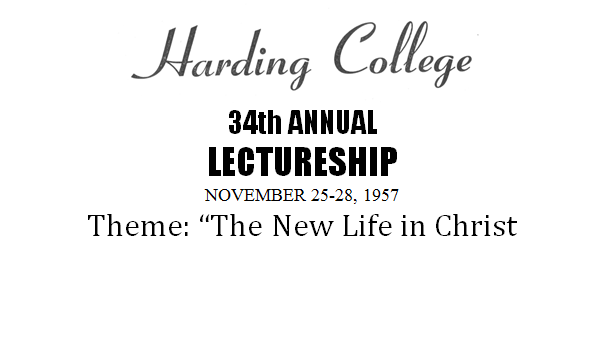
The whole theme of this lectureship, back when it was still Harding College, was “The New Life in Christ.  And as you’ll see from the speakers and the topics, it was a good one!

We won’t say anything else about it, as we believe the contents speak for themselves.  The link to read it online or to download it to your electronic device of choice is at the bottom.

Special thanks to Ivy Cobb for her proofreading skills.

Contents

  1. THE MEANING OF THE NEW LIFE IN CHRIST
    (Cleon Lyles)
  2. GOD — THE SOURCE OF ALL LIFE
    (Pat Hardeman)
  3. CHRIST HAS MADE POSSIBLE THE NEW LIFE IN HIM
    (Joe Sanders)
  4. FAITH IN CHRIST
    (Royal H. Bowers)
  5. REPENTANCE FROM PAST SINS
    (Rex A. Turner)
  6. CONFESSING CHRIST
    (Wilburn C. Hill)
  7. BAPTIZED INTO CHRIST
    (Charles Hodge)
  8. PUTTING OFF THE OLD MAN
    (Stephen Eckstein)
  9. PUTTING ON THE NEW MAN
    (Gaston Cogdell)
  10. ALL THINGS BECOME NEW: Continual Growth in The New Life
    (J. Roy Vaughan)
  11. “THE BIBLE—THE PRESENTATION OF THE NEW LIFE IN CHRIST”
    (George W. Bailey)
  12. THE MIND OF CHRIST
    (James O. Baird)
  13. COMPLETE DEDICATION TO CHRIST
    (F. W. Mattox)
  14. “ADD TO YOUR FAITH VIRTUE”
    (Robert D. Bankes)
  15. “ADD TO YOUR VIRTUE KNOWLEDGE”
    (Morris M. Womack)
  16. TEMPERANCE
    (L.L Gieger)
  17. IN YOUR FAITH SUPPLY PATIENCE
    (R.B. Sweet)
  18. TO YOUR PATIENCE GODLINESS
    (Neil R. Lightfoot)
  19. TO YOUR BROTHERLY KINDNESS
    (Olan L. Hicks)
  20. TO YOUR BROTHERLY KINDNESS LOVE
    (James G. Moffett)
  21. THE CHURCH, THE CORPORATE EXPRESSION OF THE NEW LIFE IN CHRIST
    (Ruel Lemmons)
  22. EXPRESSION OF WORSHIP AS A MEANS OF SPIRITUAL DEVELOPMENT
    (Paul W. Rotenberry)
  23. FURTHER EXPRESSION OF WORSHIP OF THE NEW LIFE IN CHRIST—LORD’S SUPPER AND GIVING
    (Joseph W. White)
  24. SOME FRUITS OF THE SPIRIT: Joy and Peace
    (Gussie Lambert)
  25. LONGSUFFERING, GOODNESS, KINDNESS
    (Jimmy Allen)
  26. FAITHFULNESS, MEEKNESS, AND SELF-CONTROL
    (Emmett Smith)
  27. THE NEW LIFE IN CHRIST AND THE EVANGELIZATION OF THE WORLD
    (Otis Gatewood)
  28. POLAND AND RUSSIA
    (R. J. Smith, Jr.)
  29. OUR MISSION WORK IN NORTHERN RHODESIA
    (J. D. Merritt)
  30. OPPORTUNITIES IN NIGERIA
    (Wendell Broom)
  31. THE CAUSE OF CHRIST IN JAPAN
    (Colis Campbell)
  32. THE CHALLENGE OF CHRISTIAN EDUCATION
    (George W. DeHoff)
  33. THE HOPE OF THE NEW LIFE IN CHRIST
    (Marshall Keeble)

We hope you enjoy this great book!

Harding College Lectures (1957)

A Special Notice

Today is the birthday of the one who (it is my conviction) is the most wonderful person this side of Jesus Christ: my wife, Jesse Cobb!  I could really go on and on about her, but I think I’ll save that for another day.

But I think you’ll understand when I say that we are taking the day off from posting a new article in order to celebrate as a family.

That’s all.  🙂

-Brad Cobb

An Angry Jesus Doing Good

The Text: Mark 3:1-12 – And He entered again into the synagogue; and there was a man there which had a withered hand.  And they watched Him, whether He would heal on the Sabbath Day; so that they might accuse Him.  And He says to the man which had the withered hand, “Stand forth.”  And He says to them, “Is it lawful to do good on the Sabbath, or to do evil?  To save a life, or to kill?”  But they held their peace.

And having looked round about on them with anger, being grieved for their hardness of hearts, He says to the man, “Stretch forth your hand.”  And he stretched it out: and his hand was restored whole as the other.

And the Pharisees went forth, and immediately took counsel with the Herodians against Him, how they might destroy Him.  But Jesus withdrew Himself with His disciples to the sea: and a great multitude from Galilee followed Him, and from Judea, and from Jerusalem, and from Idumaea, and from beyond Jordan, and a great multitude of those around Tyre and Sidon, when they had heard what great things He did, came to Him.

And He spoke to His disciples, so that a small ship should wait on Him because of the multitude, lest they should throng Him.  Because He had healed many; insomuch that they pressed on Him in order to touch Him, as many as had plagues.  And unclean spirits, when they saw Him, fell down before Him, and cried, saying “You are the Son of God.”  And He strictly charged them that they should not make Him known.

Introduction

The King who has been announcing His coming Kingdom has already conquered some of the knights of the Kingdom of Darkness.  But lately, as He’s trying to prepare people for His impending rule, a group of religious leaders—spokesmen for the way things are—have been growing bolder and bolder in opposing Him.  The King has been relatively patient with them, all things considered, but that ends today.

The Text, part 1 – Getting Jesus Angry (Mark 3:1-5).

When we consider Jesus and His personality, most often we think of His caring, kindness, and compassion.  We think of His helping the helpless, lifting the fallen, caring for the heartbroken.  We don’t usually think of Him staring down a group of people with anger in His eyes—but that is what Mark paints for us in this passage.

He entered again into the synagogue

We mentioned this several lessons ago, but Jesus made it a point to meet in the synagogue each Sabbath Day.  This serves as an example for us: make the time to meet together each week for worship to God.

There was a man there who had a withered hand.

Luke tells us that it was the man’s right hand that was withered (Luke 6:6).  The Greek indicates that he was not born this way, but that it was withered as the result of something else, either a disease or an injury (Vincent’s Word Studies, and Robertson’s Word Pictures).  The word “withered” means that his hand had shriveled up due to a lack of moisture and nutrients, and became completely unusable.

Think about the horrible situation this man must have been in.  In a time when most people did manual labor to support their family, this man couldn’t.  He couldn’t hold the plow, couldn’t hoe the ground, couldn’t hammer nails (you need a hand to hold the nail in place)—he couldn’t even sweep the floor.  Perhaps he had sons who could help with the work to support the family, but we don’t know that for certain.  It’s just as likely that this man was in dire straits, feeling like a failure because he wasn’t able to do what a man is expected to do—provide for his own.

They [the Pharisees] watched Him, whether He would heal on the Sabbath Day, so that they might accuse Him.

The Pharisees, the ones who have been stirring up trouble, trying to call Jesus into question on seemingly everything He does, sat in the synagogue—not to hear the word of God proclaimed, but because they were trying to find something that they could use against the preacher.  What a horrible attitude to have!

It seems that as irritated with Jesus as the Pharisees were, they knew that they had been beaten in trying to find things to use against Him earlier.  Otherwise, they would have already been satisfied with the evidence they had to accuse Him.  But this, they believed, was the prime opportunity—healing a man must be considered working; therefore it cannot be done on the Sabbath!

Now a quick question: why are you here?  What is it that you are focused on?  Is it on trying to criticize people: the prayer leaders, the song leader, or the preacher?  Or is your focus on worshiping God and trying to be right with Him?  Because the man leading the prayer is going to occasionally mis-speak or stumble over words.  The song leader will sometimes get the song too high or too low or get mixed up on the verses or words.  The preacher, too, will sometimes say the wrong book, chapter, or verse, or will get his words mixed up.  If being critical is what you’re here for, you will find something, because we aren’t perfect.  But by the same token, if you are here to worship God, and have your focus on Him, His will, and on how you can be a better Christian, then you will be blessed by the songs, prayers, and sermons on the Lord’s Day.

He says to the man which had the withered hand, “Stand forth.”

Jesus didn’t do this miracle in a corner, hidden away from everyone else.  He wanted the crowd to see what was about to happen.  Some people might say that this is a contradiction of Jesus’ command to do your alms in secret (Matthew 6:1-4).  But the purpose of Jesus doing this miracle was to cause people to believe in Him and listen to His message.  Whereas, in the Sermon on the Mount, Jesus instructed His disciples to help people for the sake of helping them, not because it made you look more spiritual, drawing praise from men.

So, He commands the man to stand up.

And He says to them

He’s now turned His attention, for a moment, from the man to the Pharisees, whom He knows are trying to be critical of Him and find something to accuse Him of.

“Is it lawful on the Sabbath Day to do good, or to do evil?”

Jesus isn’t asking them if it’s permissible to do anything on the Sabbath, but presenting to them two options.  All the Pharisees would agree that not everything is forbidden on the Sabbath Day, so that means some things are allowed.  The question to them is: What does the Law allow on the Sabbath—good deeds or evil deeds?  There was nothing they could do to get around this question.  Obviously, the Law never permitted evil to be done, so that wasn’t the answer.

At the same time, as Jesus asks this question, He’s laying some groundwork for what He’s about to do.  He could not perform a miracle, healing this man of his withered hand, except through the power of God.  And if Jesus heals the man, it shows that God approves of doing good on the Sabbath—in other words, it would prove Jesus right and undermine the foundation of the Pharisees’ thinking.

“Is it lawful on the Sabbath Day
to save a life or to kill?”

It was obvious to all that were there, especially when Jesus told the man to stand up, that He planned on healing this poor man.  Jesus began His question to the Pharisees with just a general “is it lawful to do good or to do evil?”  But now He takes His question to the extreme, “Is it lawful to save a life or to kill?”  Most rational people (even among the Pharisees) would admit that it was permissible to save a life (regardless of how much work it would take) on the Sabbath.  The man with the withered hand was a case that certainly fell between simply “doing good” and “saving a life.”  Thus, Jesus proved His point.

But it is also interesting that Jesus proposed to do good on the Sabbath, while the Pharisees were thinking evil, trying to take mental notes so that they could make accusations against Him later.  And after this incident, as we will see momentarily, they started making plans to kill Jesus that very Sabbath.

But they held their peace.

The answer to the question was so clear, so obvious, but they refused to answer because it would incriminate them, their motives, and their teachings.  Just like when Jesus asked them later about the baptism of John, they refused to give an answer because they would look bad either way.

Matthew records Jesus asking another question: “What man will there be among you, that will have one sheep, and if it falls into a pit on the Sabbath Day, will not lay hold of it and lift it out?  How much then is a man better than sheep?  Therefore it is lawful to do good on the Sabbath Days” (Matthew 12:11-12).  The Pharisees would absolutely save their sheep on the Sabbath, but they wanted to hold Jesus to a different standard than they were willing to hold themselves.

How often do we see this happen in families, in our jobs, and even in the church?  Look, let’s make this abundantly clear—we will all stand before the judgment seat of Christ and held to the STANDARD, and that is the Word of God.  If we are faithful to God’s word, then we will be saved, regardless of whether we match up with someone else’s standard or not.  It’s like the preacher who was told by a member, “I don’t have to visit, but you’ll be fired if you don’t.”  And Jesus has some words for people who are like that: “Do not judge [condemn], so that you will not be judged [condemned], for with what judgment you judge, you shall be judged” (Matthew 7:1-2).  When you start making demands of others, yet don’t follow them yourself, you are a hypocrite; and at the judgment, you will be judged by God in the same way that you have judged others.

And having looked around at them


The word here is a form of periblepo, which means not just looking at them, but looking around at them, making sure he looked at every one of them.  And this word doesn’t just express the fact that He looked at them all, but that He looked at each one of them for Himself.  He looked at their faces, confirming what He already knew.  Some probably stubbornly looked at him without a word, while others probably glanced away or looked down so they didn’t have to meet His eyes.


with anger

Picture the face of Jesus with the scowl, the angry fire in His eyes as He looks at each of these men who had their own disciples, but weren’t willing to answer a relatively simple and obvious question.  Mark tells us exactly what it was that made Jesus angry.

Being grieved because of their hardness of heart

People who were sincere and honestly wrong, Jesus and the apostles had patience with; but the Pharisees weren’t sincere, nor were they honestly wrong (as in simply mistaken).  They were intentionally stubborn, recognizing the truth of what Jesus said, but unwilling to admit it or live by it.  They were more interested in their position as leaders than they were in doing what was right.  They liked the power and weren’t about to give any of it up, even though they were about as ungodly as one can be.

This attitude of stubbornness angered our Lord and Savior then, and brethren, it still angers Him today.  There are members who have the attitude of criticism toward others.  There are members who stubbornly reject commands of Jesus because they simply don’t feel like following them (mostly attitude ones).  And if anyone dares point that out to them, watch out!  My friends, that is the hardness of heart that made Jesus angry—and you do not want the Judge of the world to be angry with you!

He says to the man, “Stretch forth your hand.”  And he stretched it out, and his hand was restored whole as the other.

After making His point to the Pharisees (and the other people in the room certainly caught it as well), Jesus went ahead and healed the man.  If, as many believe, this man’s hand was withered to the point that his arm was also affected, then Jesus asked him to do something that he hadn’t been able to do in some time, but the man, in faith, tried, and discovered that his hand had been completely healed!  What joy was on that man’s face and in his heart!  What amazement there was among the honest people in that synagogue!  But not everyone was happy


The Text, part 2 – Getting Angry at Jesus (Mark 3:6)

Jesus got angry with the Pharisees because they were hard-hearted.  The Pharisees, in return, got angry with Jesus.  Why?  Because they couldn’t control His every move.  Because He dared to point out their traditions weren’t Scripture.  Because he wouldn’t cater to their self-centered whims.  And because people were happy with Jesus’ life and work—the Pharisees were losing some of their power over people.

And the Pharisees went forth and immediately took counsel with the Herodians against Him, how they might destroy Him.

Just how angry were the Pharisees?  They were so angry that they immediately contemplated murder.  They were so angry that Luke describes them as “filled with madness” (Luke 6:11), or perhaps more literally, “filled with insanity.”  They were so angry that they went to their political enemies, seeking to work together to destroy Jesus.  The Herodians were a sect of the Jews who were very enthusiastic supporters of the Roman government, specifically of the Herods who had ruled over them (for Rome) for the previous several decades.

But when you dislike someone and you’re trying to get rid of him, it doesn’t really matter to you how you do it, so long as you can actually get it done.

The Text, part 3 – Continuing to Work (Mark 3:7-12)

Even though Jesus knew what was on the minds of the Pharisees, He didn’t let that stop Him from doing the good that He came to do.  Even when we might be persecuted by Satan and his minions (yes, sometimes that even includes members of the church), we can’t let that stop us from doing the work of God—that’s what Satan wants!

But Jesus withdrew Himself with His disciples to the sea: and a great multitude from Galilee followed Him

The Pharisees went out, discussing how to get rid of Jesus.  Meanwhile, Jesus went out, continuing to work for God.  His fame had spread throughout all of Galilee (most of the events in Mark up to this point took place there), and so it’s no surprise that huge numbers came out to see Him and hear Him and ask for healing from Him.

And from Judea

This is the southern portion of the Promised Land, where Jesus had spent some time baptizing people (through His disciples) back in John 3-4.

And from Jerusalem

The people following Jesus were not just the smaller towns and villages of Judea, but some were from the capital city of Jerusalem itself!

And from Idumaea

Idumaea is the land of Edom, descendants of Esau.  About 150-200 years prior to this event, a Jew named John Hyrcanus took over and reigned as king over the Jews.  One of the things he did was force the Edomites to either submit to circumcision and become Jews or die.  So, while these weren’t pure-blooded Jews, they were related, and had been proselytized to Judaism.

And from beyond Jordan

The tribes of Reuben, Gad, and half of Manasseh took up residence on the eastern side of the Jordan River when they came to the Promised Land.  Even hundreds of years later, by the time Jesus arrived on the scene, there were still Israelites that lived there.

And those around Tyre and Sidon

These cities were to the north-west of the Sea of Galilee.  Tyre was destroyed in part by Nebuchadnezzar, and then the job was finished by Alexander the Great.  But there were still Jews that lived in that general area.

A great multitude

There was a great multitude from Galilee, and a great multitude from these other areas, which covers practically the entire area that God had promised to the Israelites in the Old Testament.  This was an enormous group of people coming to Jesus.

When they heard what great things He did, came to Him

They heard about the great works Jesus was doing, and they wanted to come to Him and see for themselves, and to receive some of the same healings.  To an extent, we can look to this as an evangelistic outreach—when we do things for other people, word spreads.

And He spoke to His disciples, so that a small ship should wait on Him, because of the multitude, lest they should thong Him.

There were so many people coming and crowding around Jesus that He needed a way of escape to keep from being thronged—Thayer says the word means pressed like a grape.  It wasn’t Jesus’ time to die, and being crushed to death by His followers didn’t exactly fit with the prophecies of the Old Testament.

Sometimes, we need to get away for a little while.  Sometimes we’ve got so much going on, so many people wanting part of our time, that we need to have a way to get away from it all, our own “small ship,” so to speak.  Because it we don’t, we could find ourselves crushed, and lose our ability to bear fruit for the Lord.

Because He had healed many; insomuch that they pressed on Him to touch Him, as many as had plagues.

Literally, they were rushing on Him, crowding Him, shoving at each other in an effort to get to Him and touch Him, in the hopes that by doing so, their sicknesses would be removed.  They had seen/heard others that were healed, and they wanted it too!

And unclean spirits, when they saw Him, fell down before Him

Matthew 12:15 says that Jesus healed everyone that came to Him, so Mark is probably talking about the demon-possessed people falling down before Jesus because of the demons inside them recognizing Him.  As James tells us, “the demons also believe, and tremble” (James 2:19).

And they cried, saying, “You are the Son of God.”

These demons must have known that they were about to be cast out, and so they tried to do what they could to hamper Jesus’ work.  If the crowd was close to crushing Jesus to begin with, how much more so do you think it would get if they caught wind that Jesus was not just a man sent by God, but was in fact very the Son of God?

And Jesus strictly charged them that they should not make Him known.

The way it is written in Mark makes it seem like He’s telling the demons not to make Jesus known, but He’s actually talking to the people, the great multitudes that came to Him, whom He healed.  We know this because of Matthew’s account—Jesus healed them all, which would include the demon-possessed people.  Therefore, those demons would have been cast into the abyss (Luke 8:31), and not had the opportunity to make Him known.  Also, in Matthew’s account, the demons aren’t mentioned, and Jesus “charged them [the people who were healed] that they should not make Him known.” (Matthew 12:15-16).

Jesus didn’t want the talk of the miracles to spread even further, because there was already a dangerously-sized crowd mobbing Him.  It was already to the point where everyone was primarily interested in the miracles—not in the message that Jesus had to speak.  Jesus didn’t want that trend to continue and perhaps grow even worse.

It would be, I would think, incredibly difficult to keep it to yourself if you’d been healed, though.  But like some other commands, Jesus still expects us to follow them, even if they are difficult.  That’s why He said the words “Be thou faithful unto death—[even if it means dying]—and I will give you a crown of life” (Revelation 2:10).

Application

Helping Others Get Back to Work

Jesus had compassion on a man whose physical ailment kept him from being able to work.  It was in His power to fix the problem, to help the man, and so He did.  If we have it within our power to help someone to be able to work, to support themselves and their family, then we ought to also have compassion on them enough to offer that help.  It could be something as simple as giving someone a ride to fill out an application, or making a phone call to a friend who might be looking to hire someone.  But take compassion on those who can’t work.

It’s Okay to be Angry

Jesus was angry, yet He didn’t sin.  His anger stemmed from the sinful attitude of the Pharisees—the religious leaders of the day.  They were continually looking for things to throw at Him—even though those things weren’t sinful.  It made Him angry when their hard-heartedness kept them from admitting the truth.  It made Him angry when they were looking for reasons to criticize Him instead of seeing that God approved of His actions and teachings through the miracles.

As a side note, Jesus also shows that there’s never a wrong time to do good for others.

Invitation

Jesus did a good deed in healing that man, but the greatest thing He ever did was dying on the cross, taking with Him the sins of all of God’s faithful followers.  That sacrifice is meant for me and for you, but only if we come to Jesus in faithful obedience, believing in Him, repenting of our sins, and being baptized.  Then we must continue to grow, staying true to Him, even during the difficult times.  When we mess up as one of God’s children, we come to Him in prayer, seeking forgiveness.  Won’t you come take hold of that precious gift of salvation today?

-Bradley Cobb

Sadduceeism

Lately, there has been an increase in preachers of the gospel who have begun to advocate the idea (at least in private, though some have done it openly) that the wicked will be annihilated after the judgment.  By that, they mean that the souls of the wicked will simply cease to exist, and that eternal nothingness is their punishment.

In other words, the atheist who says there is no God, and who says that he will cease to exist–is right!?!

I will not venture to assign motives to these brethren for holding this belief.  It has been admitted by others who hold this view that they did it because they couldn’t reconcile the idea of a good God punishing someone eternally for a relatively short life of sin.  Yet they have no problem accepting the idea that God could bless someone eternally for a relatively short life of faithfulness.

I shall get off my soapbox now.

This isn’t a new issue.  In 1860, a man by the name of Israel Warren, a Congregationalist preacher, wrote a book dealing with the issue, and called it “Sadduceeism.”  We believe that overall it is a good book dealing with this doctrine, and so we are adding it to the Jimmie Beller Memorial eLibrary!

We’ve given it the same treatment as our other books.  It’s been proofed, corrected, and reformatted in order to give you the best possible reading experience!

To read it online or download for later perusal, click the link below:

Sadduceeism (Israel P. Warren)

Jesus’ Inner Circle: James (Part 4)

The Death of James

James is specifically mentioned just three times after the resurrection of Jesus.  He’s among the apostles who spent all night fishing, catching nothing until Jesus (the next morning) told them to let the net down on the right side of the ship.  Then they caught so many fish, they couldn’t bring the net into the boat.  James was one of the apostles who helped bring the boat to shore, dragging this massive catch with them.  Then Jesus invited James and the others to “come and dine,” which they did.1

Just a matter of days later, James watched as Jesus ascended into heaven after telling all the apostles to stay in Jerusalem until they received the Holy Spirit.  He went into an upper room with his fellow-apostles and other disciples where a replacement was chosen for Judas.  Then, on the Day of Pentecost, the Holy Spirit came upon James and the other apostles, and they all began to preach the word of God in different languages.  No doubt, James spent a large part of that day happily baptizing some of the 3,000 who gladly received the word of God.2

But things didn’t continue on their positive streak.  Saul of Tarsus and the Jewish leaders stirred up the people in antagonism against the church.  Herod the king, who wanted the Jews to like him, began to persecute the church.3  Some of them he arrested,4 and James was among them.  Since James was a leader of the church, Herod had him killed with the sword.5

So ends the life of a man who was Jesus’ cousin, Jesus’ disciple, and Jesus’ friend.

Traditions About James

Since his life ended in AD 42-44, and the Bible records it, there’s not much in the line of traditions about this member of the “inner circle.”  One writing says that “Zebedee was of the house of Levi, and his wife of the house of Judah.  Now, because the father of James loved him greatly, he counted him among the family of his father Levi, and similarly, because the mother of John loved him greatly, she counted him among the family of her father Judah.  And they were surnamed ‘Children of Thunder,’ for they were of both the priestly house and the royal house.”6

A writing that claims to be written by Clement (the man mentioned in Philippians 4:3) records this incident:

But a certain Samaritan, speaking against the people and against God, and asserting that neither are the dead to rise, nor is that worship of God to be maintained which is in Jerusalem, but that Mount Gerizim is to be reverenced, added also this in opposition to us, that our Jesus was not He whom Moses foretold as a Prophet to come into the world. Against him, and another who supported him in what he said, James and John, the sons of Zebedee, strove vigorously; and although they had a command not to enter into their cities, nor to bring the word of preaching to them, yet, lest their discourse, unless it were confined, should hurt the faith of others, they replied so prudently and so powerfully, that they put them to perpetual silence. For James made an oration concerning the resurrection of the dead, with the approbation of all the people; while John showed that if they would abandon the error of Mount Gerizim, they should consequently acknowledge that Jesus was indeed He who, according to the prophecy of Moses, was expected to come; since, indeed, as Moses wrought signs and miracles, so also did Jesus. And there is no doubt but that the likeness of the signs proves Him to be that prophet of whom he said that He should come, ‘like himself.’ Having declared these things, and more to the same effect, they ceased.7

The Acts of James in India says that James and Peter went to preach to the Jews in India, where they healed a blind man, were imprisoned, were released, and converted the people.8

The Martyrdom of James says that the son of Zebedee preached to the diaspora, the twelve tribes who lived outside the Promised Land, convincing them to give their “first-fruits” to the church as opposed to Herod, which then led to the murder of James by Herod.9

-Bradley S. Cobb

1 This incident is recorded in John 21:1-14.

2 These events are recorded in Acts 1 and 2.

3 Josephus, Antiquities of the Jews, 18-19, says that this Herod (Herod Agrippa I) was zealous for the Jewish law.  He, like his grandfather, Herod the Great, wanted the Jews to like him.  This is why he persecuted the church, and why he continued when he saw that killing James please the Jews.  See Chuck Northrop’s comments on Acts 12:1-2 in Preaching School Notes (Bible Institute of Missouri) for e-Sword.  Available at TheCobbSix.com.

4 See The NET Bible footnotes on Acts 12:1.

5 Most likely, this means that he was beheaded.

6 See The Genealogies of the Twelve Apostles in Budge, Contendings of the Apostles, Vol. 2, page 49.

7 The Recognitions of Clement, Book 1, chapter 57.  This writing is classed among the pseudo-Clementine literature, because its authenticity is rejected by almost all scholars.  It can be found in The Ante-Nicene Fathers, Vol. 8, page 92.

8 See The Acts of James in India, in Budge, Contendings of the Apostles, Vol. 2, pages 295-303.  This work, among other things, seeks to elevate the status of Peter, having James call him “my father” multiple times.

9 See Budge, Contendings of the Apostles, Vol. 2, pages 304-308.  This writing is shown to be a forgery because it is historically inaccurate.  James was killed between AD 42-44, yet The Martyrdom of James claims that James was teaching people not to serve Nero—who was at that point no more than seven years old, and who wouldn’t become emperor for at least another ten years.  See also International Standard Bible Encyclopedia, “James.”