All posts by BradleyCobb

Jesus’ Inner Circle: James (Part 3)

James of the “Inner Circle”

The idea of an “inner circle,” a group closer to Jesus than the rest of the apostles, first appears the next time James shows up in the biblical record.  There are three times where Jesus specifically separated James, Peter, and John from the rest of the apostles and had them join Him for an important event.

Jairus’ Daughter Raised

Jesus returned to Galilee where a crowd of people had been waiting for Him,1 and a man named Jairus, the ruler of the synagogue, fell to Jesus’ feet and begged Him, “My little daughter lies at the point of death; come and lay your hands on her so that she might be healed; and she will live.”2  Jesus, along with His disciples and a mob of people, followed Jairus towards his house; but then Jesus stopped, turned around, and said, “Who touched me?”3  James looked around at the massive crowd that was “thronging” Jesus, and in effect said, “What do you mean?  Everyone’s touching you!”4  But Jesus saw the woman who had touched the hem of His garment, and told her “Daughter, your faith has made you whole; go in peace, and be whole of your plague.”5

Then someone from Jairus’ house came and said, “Your daughter is dead, why trouble the Teacher anymore?”  Jesus responded by telling Jairus, “Don’t be afraid, just believe.”6 It is at that point that Jesus hand-picks James, his brother John, and Peter to be the only ones who are permitted to follow Him to the house.  And when they got to the house, finding people weeping and mourning, Jesus told them “Why are you making this noise and weeping?  The damsel didn’t die, but is sleeping.”  When the people mockingly laughed at Jesus, He sent them all out, only allowing James, Peter, John, and the girl’s parents to come into the room and see what He would do.  Then He took the girl by the hand and said, “Maid, arise.”  And she came back to life.  This was followed by a command not to tell anyone what happened.7

The Transfiguration

Some time later, Jesus took James (along with Peter and John) up to a mountain where He prayed.  Then something happened.  Jesus’ face began to shine like the sun,8 and His clothing was white as the light.9  But James, John, and Peter were extremely tired and had fallen asleep while Jesus was praying.  When they woke up, they “saw His glory” and they saw Moses and Elijah standing with Jesus, talking to Him.10  James was silent, but he watched as Peter said to Jesus, “It’s good for us to be here.  If you want, let us make here three tabernacles; one for you, one for Moses, and one for Elijah.”11

Then a [bright] cloud overshadowed them: and they feared as they entered into the cloud.  And there came a voice out of the cloud, saying, “This is my beloved Son, [in whom I am well-pleased]. Listen to Him.”12

And when the disciples heard it, they fell on their faces and were very afraid.  And Jesus came and touched them, and said, “Arise, and don’t be afraid.”  And when they had lifted up their eyes, they saw no man except Jesus only.13

And as they came down from the mountain, He charged them that they should tell no man what things they had seen until the Son of man was risen from the dead.  And they kept that saying with themselves, questioning one with another what the rising from the dead should mean.14

On the way down the mountain, James and the other two asked Jesus about the scribes’ contention that Elijah must come first.  After hearing the Lord explain that the scribes were right, but that Elijah had already come, understanding washed over the “inner circle” and they understood that Jesus had reference to John the Immerser.15

Inquiring About the Temple

After Jesus tells His disciples that “There shall not be one stone left upon another that shall not be thrown down,” James (along with Peter, Andrew, and John) ask Him privately, “Tell us, when shall these things be?  And what shall be the sign when all these things shall be fulfilled?”16  Jesus proceeds to give them, in some detail, information about the destruction of Jerusalem, including the events leading up to it.17

The Garden of Gethsemane

After the Last Supper, Jesus took the apostles with Him to Gethsemane, and instructed eight of them to “Sit here, while I go and pray [over] there.”  But He took with Him Peter, James, and John, and told just these three men, “My soul is exceedingly sorrowful, even unto death.  You wait here and watch with me.”  After going a bit further and praying, Jesus returned to find the inner circle sleeping, and woke them up, saying (primarily to Peter, but also to James and John),18 “What?  Couldn’t you watch with me for one hour?  Watch and pray, that you do not enter into temptation: the spirit indeed is willing, but the flesh is weak.”19

Jesus again went off to pray, and when He returned, they had fallen asleep again.  He said something to them, but then He went back to pray some more.20  After this third time, He told them (perhaps sarcastically), “Sleep on now, and take rest.  Behold, the hour is at hand, and the Son of man is betrayed into the hands of sinners.  Rise, let’s be going.  Look, He who betrays me is at hand.”21

The Inner Circle

Each time Jesus specifically called Peter, James, and John to come with Him, He had something important in mind.  First was to show His power to raise the dead.  Second was to His transfiguration where His superiority to Moses and Elijah was spoken from heaven.  Third was to watch with Him (apparently to keep an eye out for Judas and the soldiers) while He was deep in prayer. But just moments after this last event, the entire inner circle ran in fear as Jesus was taken prisoner by the band of soldiers led by Judas.

-Bradley S. Cobb

1 Luke 8:40.

2 Mark 5:21-23.

3 Mark 5:30 shows Jesus turning around and asking this question, but there the quotation is “Who touched my clothes?”  Luke 8:45 gives the quotation as “Who touched me?”  There is no contradiction here, for it is very possible that Jesus said, “Who touched me?  Who touched my clothes?”  Or it could also be that Luke records the exact quote while Mark gives the more exact meaning—since the woman didn’t actually touch Jesus, but touched His clothing.  In both accounts, the disciples asked why Jesus said “Who touched me?”

4 Mark 5:31.  This statement was made by all the disciples, and as is seen a little further in the narrative, James was indeed there.

5 Mark 5:32-34.

6 Mark 5:35-36.  Most translations render it “only believe,” which is a legitimate rendering, but “just believe” carries with it the same meaning and is more in keeping with modern speech.

7 This paragraph is an amalgamation of the accounts given by Luke (8:49-56) and Mark (5:35-43).  Matthew adds that Jesus’ fame spread because of this event (Matthew 9:23-26), probably from the people who had mocked Him just minutes before.

8 Matthew 17:2 is the only account where this description is given.  Luke simply says “His countenance was changed,” which is quite the understatement!

9 Mark 9:3 adds “like as no laundryman on earth can bleach them.”

10 Luke 9:32 is the only place where this information is given to us.  We aren’t told how exactly the three apostles knew that the two additional figures were Moses and Elijah.  Most likely it was due to overhearing part of the conversation that they were having with Jesus.  Perhaps they called each other by name as they talked.

11 It is interesting that with Moses, Elijah, and Jesus, God Himself was responsible for their deaths.  God killed Moses on Mt. Nebo, and buried him in Moab (Deuteronomy 34:5-7); God took Elijah in the whirlwind, ending his physical existence (2 Kings 2:11); and God was the one who caused the death of Jesus Christ (Acts 2:22-23).  Moses was buried, Elijah ascended, and Jesus Christ did both.

12 Luke 9:34-36.  The bracketed material is found in Matthew’s account, Matthew 17:5.

13 Matthew 17-6-8.  Matthew is the only writer to include this information.

14 Mark 9:9-10.  The other writers do not give us the information about Peter, James, and John’s conversation.

15 Mark’s account reveals for us that it was Peter, James, and John who asked this question (see Mark 9:2-13, and put with Matthew 17:9-13), and it wasn’t until after Jesus answered that they came to the other disciples (Mark 9:14, Matthew 17:14).

16 Mark 13:1-4.  That Andrew was part of this company is not surprising, since he was (1) Peter’s brother, and (2) is always joined with the other three in the listings of the apostles.

17 See Matthew 24, Luke 21, and Mark 13.

18 Matthew 26:40 shows that Jesus spoke to Peter, but he uses the plural “you” (“ye” in KJV) to show He is referencing the three of them.  It appears that even at this point, Peter was viewed somewhat as a leader among the apostles, for Jesus said this to Him.

19 Matthew 26:36-41.

20 When Mark records this incident, He says that the three men “did not know what to answer Him” the second time He came back (Mark 14:40).

21 Matthew 26:42-46.  That this is possibly sarcasm is seen in that Jesus tells them to “sleep on,” and almost immediately says “rise up.”

Correcting Hypocrites

The Text: Mark 2:23-28 – And it came to pass that he went through the grain fields on the Sabbath Day; and His disciples began to pluck the ears of grain as they went.  And the Pharisees said to Him, “Look!  Why do they do that which is not lawful [to do] on the Sabbath Day?”

And He said to them, “Haven’t you ever read what David did, when he had need, and was hungry—he and they that were with him?  How he went into the house of God in the days of Abiathar the high priest and ate the showbread, which is not lawful to eat except for the priests, and he also gave [some] to them who were with him?”  He said to them, “The Sabbath was made for man, and not man for the Sabbath.  Therefore the Son of man is Lord even of the Sabbath.”

Introduction

Even Mark’s Roman readers knew about the Jews and their Sabbath Day activities (or lack thereof).  It’s somewhat like Roman Catholicism today, in that there are certain aspects of that religion that are known throughout the whole world (priests, papacy, cathedrals, etc.).  Judaism was the same way, you couldn’t go anywhere in the Roman Empire where the people didn’t at least know about the Jews and some of their seemingly strange Sabbath customs.

But Mark also continues to show the antagonism towards Jesus, building up the tension that would eventually lead to their murder of the Son of God.

The Text, part 1 – Accusing the Disciples on the Sabbath (Mark 2:23-24).

There’s a progression of sorts in the way Mark has presented these events in chapter two and the relationship with the scribes and Pharisees.  (1) The scribes think evil of Jesus, (2) the scribes and Pharisees question Jesus disciples about Jesus, (3) the Pharisee’s disciples ask Jesus about His disciples, and now (4) the Pharisees flat-out accuse Jesus’ disciples of breaking the law (and implicitly accuse Jesus of approving of law-breaking).

It happened that He went through the grain fields on the Sabbath Day, and His disciples, as they went, began to pluck the ears of grain.

Literally, the text says that Jesus went alongside the fields.  And as He walked beside these fields of grain, His disciples who were following Him were plucking some grain here and there (KJV says “corn,” though it’s more likely that wheat or barley is under consideration due to how Luke describes their actions in Luke 6:1, rubbing them in their hands).  Normally, this would have given nothing for the antagonists of Jesus to complain about, but today was different, because today was a Sabbath Day.  So, here come the Pharisees


The Pharisees said to Him, “Look, why are they doing that which is not lawful [to do] on the Sabbath Day?”

First, it might be worth mentioning that the Pharisees seem to be following Jesus around, looking for things to complain about, jealous that people are following Him, and repulsed by His embracing tax collectors and sinners (this is spelled out for us in the beginning of chapter three).  There is nothing in this account to give the impression that the Pharisees were somehow innocent bystanders who just happened to see this, and then ran to Jesus with sincere concern about the spiritual welfare of His disciples.  Nothing of the sort!

The first thing they do is accuse Jesus of not paying attention.  You might ask where that comes from, and it’s them saying, “Behold!” or “Look!” implying that Jesus wasn’t paying attention to those who were following Him.

The second thing they do is accuse the disciples of breaking the Law of Moses.  The Jews had been sent into captivity in Babylon because of idolatry and violating the Sabbath.  The Pharisees were so determined to make sure they didn’t violate the Sabbath that they put up extra rules, and interpreted the laws so strictly that they wouldn’t even come close to breaking the Sabbath commandments.  In and of themselves, those extra rules weren’t bad.  But when the Pharisees started binding those rules on others, accusing them of violating God’s Law because they didn’t follow the man-made Pharisaical rules, it became sinful.

One of those extra rules was that plucking a single head of grain on the Sabbath meant you were violating God’s law by harvesting on the Sabbath.  If you took a single grain of wheat and rubbed it between your fingers to get the outer husk off, that meant you were threshing—thus violating the Sabbath.  One writer said that these Pharisees were so caught up in their rules that if Jesus’ disciples had walked through the field in the morning, when there was still dew on the grass, the Pharisees probably would have tried to accuse them of irrigating on the Sabbath! (Burton Coffman, notes on Mark 2:23).

The third thing they do is accuse Jesus of endorsing Law-breaking.  If Jesus says nothing to His disciples, then He consents to their actions.  And if that’s the case, then the Pharisees could discredit Him before the people.

The Text, part 2 – Answering the Objection (Mark 2:25-26).

The response from Jesus is certainly not what they expected, and is also one that seems to have confused many Christians as well.

He said to them, “Haven’t you ever read what David did, when he had need, and was hungry, he, and they that were with him?”

There’s a subtle jab at the Pharisees in the first part of Jesus’ response.  They are supposed to be the experts on the Law of Moses, and Jesus asks them, “Haven’t you ever read it?”  Subtly, He’s saying, “Are you sure you’ve read the Scriptures?”

This example of David is found in 1 Samuel 21.  The first parallel is that David and his men were hungry, and Jesus’ disciples were hungry.

How he went into the house of God

David went to the tabernacle (the temple was not yet built), but the same laws applied for the priests and the showbread in both places.

In the days of Abiathar the high priest

Some manuscripts don’t have the phrase “the high priest,” and I Samuel 21 shows Abiathar’s father, Ahimelech, was the priest at that time.  However, the phrase “in the days of” comes from a Greek word (epi) that can also mean “before,” so Jesus might have actually said “before Abiathar was high priest.”

And he ate the showbread, which is not lawful to eat, except for the priests, and gave it also to those who were with him?

Some have drawn the conclusion from this example that Jesus was agreeing with the Pharisees, that yes, His disciples were violating the Sabbath.  But that’s not a valid conclusion.

Jesus shows that these are similar situations—similar, but not exact.  What David did was eat the bread that the Scriptures said were only for the priests.  One writer said:

Lit., the loaves of proposition, i.e., the loaves which were set forth before the Lord. The Jews called them the loaves of the face, i.e., of the presence of God. The bread was made of the finest wheaten flour that had been passed through eleven sieves. There were twelve loaves, or cakes, according to the number of tribes, ranged in two piles of six each. Each cake was made of about five pints of wheat. They were anointed in the middle with oil, in the form of a cross. According to tradition, each cake was five hand-breadths broad and ten long, but turned up at either end, two hand-breadths on each side, to resemble in outline the ark of the covenant. The shewbread was prepared on Friday, unless that day happened to be a feast-day that required sabbatical rest; in which case it was prepared on Thursday afternoon. The renewal of the shewbread was the first of the priestly functions on the commencement of the Sabbath. The bread which was taken off was deposited on the golden table in the porch of the sanctuary, and distributed among the outgoing and incoming courses of priests (compare save for the priests). It was eaten during the Sabbath, and in the temple itself, but only by such priests as were Levitically pure. This old bread, removed on the Sabbath morning, was that which David ate. (Vincent’s Word Studies, notes on this verse).

When we read Matthew’s account, we find more detail than Mark gives.  Matthew (12:5-7) shows that Jesus added this:

Or haven’t you read in the Law, how that on the Sabbath Days, the priests in the temple profane the Sabbath, and are blameless?

That is, the priests are expected to work on the Sabbath, which (if we’re being legalistic like the Pharisees) is a violation of the Law of Moses.  But because they are doing the work of the temple, they are free from blame.

But I say to you, that in this place is one [who is] greater than the temple!

Thus, even if what the disciples did could technically be seen as a violation of the Law of Moses (and Jesus is not saying that they were violating it), the fact that they are in service of one greater than the temple renders them blameless from the Sabbath restrictions.

But if you had known what this means: “I will have mercy, and not sacrifice,” you wouldn’t have condemned the guiltless.

The priest in 1 Samuel 21 had mercy on David and his men, and offered them something that was supposed to be reserved for the priests.  But the point I want you to get from this is that Jesus said very clearly that His disciples had not broken the Law of Moses.  They had not broken it by principle, by precept, or by anything else.  The extra rules of the Pharisees were so strict and unbending that they completely missed the whole idea of mercy and of “thus saith the Lord”!

The Pharisees wouldn’t dare to condemn David for his actions which Jesus said were “not lawful.”  David goes and takes something that has been consecrated to God, something that has been set aside for only the priests, and eats it with his men—and the Pharisees wouldn’t dare condemn their hero for doing that.  Yet they would gladly condemn Jesus and His disciples for picking a few heads of grain out of a field.  Compare the two events, and if you had to pick one to deem sinful, it has to be David’s.  But not with the hypocritical Pharisees.

The Text, part 3 – Man’s Relationship to the Sabbath (Mark 2:27-28).

What could the Pharisees possibly say in response to this?  If they continued to insist on condemning Jesus’ disciples, they had no choice but to condemn David for his actions.  They were beaten.  But Jesus didn’t stop there.  He gave a concluding thought for them to chew on.

He said to them, “The Sabbath was made for man, and not man for the Sabbath.”

The entire basis of the Sabbath Day comes from the first week of creation.  God created the heavens and the earth, the sun, moon, and stars, the plants and animals, the atmosphere, and mankind too, all in six days.  Then, on the seventh day (the Sabbath), God rested (Genesis 1).  When the Law of Moses was given to the Israelites, they were told to remember the Sabbath Day, to keep it holy, because God created everything in six days and rested on the seventh (Exodus 20:11).  In fact, Jehovah Himself says, “In six days Jehovah made heaven and earth, and on the seventh day He rested, and was refreshed” (Exodus 31:17).

God didn’t rest because it was the Sabbath and He was forced to do it; He rested because He was done for the week, and wanted to be refreshed.

God gave the commandment regarding the Sabbath, not because the seventh day somehow needed mankind, but because man needs a time to rest and be refreshed.  We need a break.  The commandment to observe the Sabbath was for man’s benefit.  All of this goes together to show that the rules and regulations that the Pharisees added to the Law were completely destroying the spirit of what God intended the Sabbath to do.  God gave it as a required “day off,” whereas the Pharisees made it as a day where you could hardly do anything—turning it from a day of rest to a day of constant worry.

Therefore, the Son of man is Lord even of the Sabbath

It appears as though Jesus is referring to Himself here, though there are those who think that this is simply a reference to mankind in general.

The point, however, remains the same: Jesus is not a slave to the Sabbath, but is Master over it.  As we will see in the next study, Jesus makes it very clear that the Sabbath was never given to prevent people from doing good deeds to others.  He asks elsewhere whether it is permissible to get your ox out of the ditch (which is an awful lot of work) on the Sabbath.  Since this is the case, then Jesus’ disciples are also not slaves to the Sabbath.  Again, the Sabbath was a day to benefit man, not a day to restrain his every move.

But consider a little bit more that Jesus says He is Lord of the Sabbath.  Some people have taken this statement and assumed that Jesus means He can violate the Sabbath Laws all He wants because He’s God and isn’t bound by them.  Yet if Jesus really violated the Law of Moses, then He sinned, and His sacrifice was completely worthless to save us.  Jesus didn’t ever violate the Law of Moses, but lived perfectly, without sin.  Whatever the Scriptures said specifically regarding the Sabbath, Jesus obeyed.  He didn’t just keep the letter of the Law, but also the spirit of the Law.  That serves as an excellent example for us today.

Application

Don’t be a Pharisee!

We have things that we do, traditions, that are fine in and of themselves, but we can’t become like the Pharisees and condemn other Christians for not doing the same thing.  One example is Sunday evening services.  We have them, and it is a great opportunity to gather together for additional time to read and study God’s word, have fellowship with each other, be strengthened, and sing praises to the God of heaven.  But I know of some brethren who question a congregation’s faithfulness if they only meet once on Sunday.  I remember hearing, as I was growing up, someone insinuating that if you used “Song of the Church” (the songbook we have here) instead of “Sacred Selections for the Church,” you were headed into liberalism.  The person who said it meant well, wanting to make certain there was no way that we might end up singing some of the songs that were “questionable,” but to then seek to bind the choice of songbooks on others is ridiculous!  When I lived in Arkansas, a man who was visiting once told me that we were unscriptural because we didn’t end our services with the Lord’s Supper.

In short, if you can prove from the Bible that it is supposed to be a specific way, then show it, stand by it, and never forsake it.  If it is in the realm of choice, expediency, or opinion, then with grace we should permit others the same liberty that Christ gives us.  Jesus had strong words about the Pharisees in Matthew 23, and I don’t want anything like that to be said of me by our Lord.

God’s Commands are for Our Benefit

It is amazing how many people think that the laws of God are arbitrary, when in truth they actually benefit the ones obeying.  Beyond salvation, there are commands that actually make life much better here on earth.  There are commands about working hard, as though you were working for the Lord Himself—have you noticed that if you are a hard, diligent worker, you generally are able to keep your job?  There are commands about not being a gossip—have you noticed that relationships are better and there is more peace when there is no gossip?  There are commands about how to treat others—have you noticed that when you follow those commands, you have more friends, better friends, better relationships, better marriages?  Just like the Sabbath, we need to remember that those commands were given for our benefit—and remember that God knows best!

Invitation

God knows what is best for us here on this earth, but He also knows best when it comes to attaining that eternal home with Him.  We don’t have to go with any man-made doctrine, because God, in His wondrous mercy, gave us all we need to have eternal life and forgiveness of our sins.  His word, the Scriptures, lay it all out for us.  We must hear about Jesus, the one who was crucified and raised from the dead; we must believe that He is the Christ; we must repent of our sins; We must make that good confession of our belief; and we must be baptized into Him for the remission of sins.  Have you done that?

-Bradley Cobb


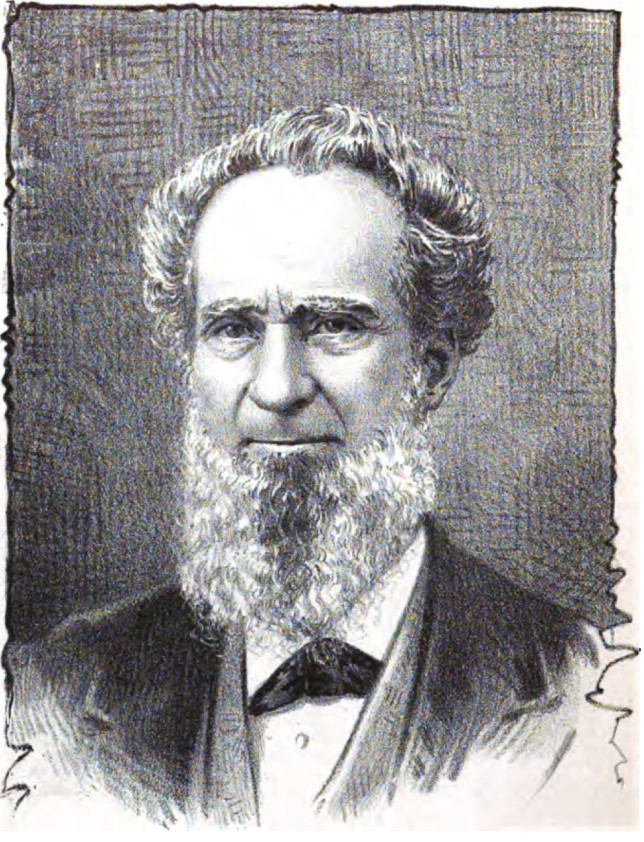
Who is A.B. Green?

One of our popular features here at The Cobb Six, that we haven’t done for a while, is “Restoration Moments.”  While this isn’t exactly the same, we thought you would enjoy getting to read about this Restoration Movement preacher, and see a sermon from his pen.

This was originally written in 1885.
ABGreen

BIOGRAPHICAL SKETCH OF A. B. GREEN.

Almon Beach Green was born in Litchfield, Conn., January 12, 1808. His parents settled in Canfield, Ohio, in the fall of 1810, and after nine years moved to Norton, Summit County, Ohio. He was baptized by Elder O. Newcomb, December 28, 1828. He preached his first sermon April 5, 1832. In the spring of 1833 he received a letter from the church commending him as a faithful and accepted minister of the gospel; and September 10 of the same year started out to make the preaching of the gospel his life-work. He served as evangelist at large, often at his own charges, two thirds of his time for twenty-nine years, when he moved to Ravenna, and took charge of the church five years. Afterward he served the churches at Warren, Collamer, Bedford, Aurora, and Willoughby, closing his pastoral ministry at the last named place after eight years of faithful and efficient service. He is now, at the age of seventy-seven, on the retired list, residing in Cleveland, near his daughter and only living child, Mrs. R. Moffett.

In 1835 he married Mary Bennett, daughter of Henry Bennett, who shared lovingly with him the burdens and joys of a minister’s life, till March 21, 1869, when she fell asleep in Jesus. This was a severe blow to Mr. Green. Few women were better qualified in heart and hand to be a help-meet for a pioneer minister. Truly can we say, in the language of Solomon: “ Strength and honor were her clothing. She opened her mouth with wisdom, and her tongue was the law of kindness. She looked well to the ways of her household, and ate not the bread of idleness. She laid her hands to the spindle, and stretched out her hand to the poor.” Indeed, but for the faith and courage and diligence of this excellent woman, Mr. Green would many a time have despaired in his work.

In 1871 he married Mrs. Amanda M. Baldwin, widow of the late Henry Baldwin, of Solon, Ohio, who now shares his comfortable home, and ministers as a faithful wife.

  1. B. Green is not what the world calls an educated man. He says he was far more familiar with the howling of wolves and hooting of owls than with schools or school books. His only library when he began to preach was his pocket Bible and “Robbin’s History of all Religions and Ceremonies.” He was, however, a great student of the Bible. He can even now, at his advanced age, quote entire chapters without prompting. It was to him the one sword of the Spirit which could vanquish all opposers of its truth; and many an adversary has felt its keen edge when wielded by his hand. Six times in his ministry he has met successfully the champions of Universalism; five times the champions of sprinkling and infant baptism, and once an apostle of Mormonism. He is preeminently a preacher of the Word. Although unacquainted with classic lore, and untrained even in the things of common grammar, he has so learned the Scriptures, and is so skilled in interpreting Scripture by the Scriptures themselves, that his judgment as to the meaning of any passage may be safely set over against that of the recognized theologian. His style is plain, clear, logical, and full of force. He survives among the last of the grand men to whom the Disciples of Christ owe a lasting debt of gratitude for self-sacrificing devotion to the restoration of primitive Christianity. The sermon here presented is one of the olden time.

THE KINGDOM OF GOD AND THE CHANGES NECESSARY TO CITIZENSHIP.

A SERMON.

By Almon B. Green.

“Now this I say, brethren, that flesh and blood can not inherit the kingdom of God; neither doth corruption inherit incorruption. Behold I show you a mystery; we shall not all sleep, but we shall all be changed.”—I Corinthians 15:50-51.

The phrase, “The kingdom of God,” is sometimes used for the reign of God by Christ in the hearts and lives of his people in this world. Hence the language, “The kingdom of God is within you.” There was a time when it was said, “The kingdom of God is at hand,” so near that Jesus said, “There are some standing here that shall not taste of death until they have seen the kingdom of God come with power.” And so it was that Jesus, the promised King, ascended into heaven, and God, the Father, said to him, “Sit thou at my right hand until I make thine enemies thy footstool;” then turned and gave command, “Let all the angels of God worship him.” Possessing all power in heaven and in earth, angels and authorities being subject to him, he shall reign until the last enemy man has to encounter, Death, shall be destroyed. “Then cometh the end, when he shall have delivered up the kingdom to God, even the Father, and God shall be all in all.” Here we are introduced to the kingdom of God spoken of in the text. In his kingdom among men, he reigns in the hearts and lives of the sanctified in Christ Jesus. In the world to come he will reign over the glorified by Christ Jesus.

When we consider the heart of man, and his condition by sin, his character before God, and his bodily infirmities, we shall not wonder that the transition from this world to that of glory should call for several changes, to fit man for the enjoyment of eternal life in the world to come. There is a wide difference between man as he was, and as he is; but a still wider difference between man as he is, and as he is yet to be, if he ever enters the Paradise of God. Man as he was, knew no guilt, and was a stranger to remorse. In the image of God “he could stand and worship him in all the joy of perfect innocence.” But, oh, how different now! Carnal in his desires, the lusts of the flesh, the lusts of the eye, and the pride of life rule him in all his actions here. The language of his heart is, “What is the Almighty that we should serve him? and what profit should we have if we pray unto him?” It is a sad thought that sin is universal, and that nowhere upon this green earth is a sinless man to be found! An alien from God, in heart, in life, and separated from God by sin, he is without hope, and without God in the world. To prepare man for the life to come, four changes are essential:

  1. A change of heart.
  2. A change of state or relation to God.
  3.  A change of character.
  4. A change of his mortal to an immortal body.

1. A change of Heart.—By this I do not mean an exchange of one heart for another, for the Lord does not propose to annihilate any part of man, and create something else in the place of it; but to purify and cleanse that which is, and so prepare it for his service. The reason why the Lord begins with the heart is seen in the fact that the heart is the fountain of all our thoughts, words, and actions. The tongue, that world of iniquity, is moved by the heart to speak, as out of the abundance of heart the mouth speaketh. The whole history of man proves the language of the prophet true, “The heart is deceitful above all things and desperately wicked.” To change the evil heart of unbelief, to a heart of faith, a heart of hatred to a heart of love, is no small undertaking. It is the changing of an enemy to a friend. But how can it be done? It can be done only by proving to that enemy that you are his friend. Gain his confidence; let him see that your goodness should lead him to repentance. If you gain his confidence, you have gained his heart; if you gain his heart, you have gained his love; and like David and Jonathan your hearts are knit together in love. Hence Peter says of the Gentiles, “God purified their hearts by faith.” Again, the Lord says of the sons of Jacob, “I drew them with cords of a man, with bands of love.” Jesus came to give demonstration to the world that God is love, and that he “so loved the world that he gave his only begotten Son, that whosoever believeth on him might not perish but have everlasting life.”

This gospel of the Son of God has made mighty changes in the world. It is well named the “gospel of peace.” Take Paul, for an example of its power; take the three thousand mocking men on the day of Pentecost, and see them bowing in submission to Jesus as Lord of all. What has changed their hearts but faith in Him whom they had crucified in anger? This change of heart prepared them to change their state, or relative position toward God, which is essential to perfection of character.

2. A Change of State—is more than a change of mind, or of purpose. Man must be made to feel that he is not his, but belongs to another. This change of state, or relation to God, is illustrated by many figures. Jesus says, Take my yoke upon you, and learn of me. How differently the ox acts when turned into the field to roam, from his acts when the yoke is put upon his neck? In the one case he acts out his own will, in the other the will of his master. The word “yoke” is therefore evidently used by the Saviour as a symbol of government. The man of the world feels and acts out his own pleasure; but when he places himself under Christ as his teacher, takes His yoke or authority upon him, he feels that he belongs to another, and that his new relation calls for a new life. How to the point the language of Paul, “Know ye not that to whom ye yield yourselves servants to obey, his servants ye are to whom ye obey?”

This change of relation is taught by another figure, to Nicodemus. “Except a man be born of water and of the Spirit, he can not enter the kingdom of God.” When Jesus comes claiming our attention as a leader, or teacher, he says take my yoke upon you and learn of me. When as a king, he speaks of his kingdom, he says, you must be born again to enter it. If men are spoken of as aliens from God, then the transaction is spoken of thus: “He hath delivered us from the power of darkness, and translated us into the kingdom of his dear Son.”

If Jesus is called the vine and his disciples the branches, then the transaction is represented by another figure, “taken from the wild olive tree and grafted into the tame.” If Jesus is called the bridegroom and his church the bride, then we are said to be married to Christ.

These figures all refer, not to a change of heart, but to that which follows it,—a change of state, or of our relation to God. It is well expressed by an apostle of Christ (Gal. 3:26-27), “For ye are all the children of God by faith in Christ Jesus. For as many of you as have been baptized into Christ have put on Christ.” This language is too plain to allow of a serious mistake as to the way this change of relation to God is effected. “Born again,” “grafted,” and “married to Christ” are all figures of speech, easily understood by their connection. So also, to “put on Christ,” as you would assume the character of another to act for him. Jesus expressed a deliverance from a state of sin to a saved state thus: “He that believeth and is baptized shall be saved.” It will be seen that salvation is not a feeling, not an emotion, but a condition. The Lord saved Israel out of Egypt; that is, he delivered them out of bondage into a state of freedom.

When a man’s heart is by faith purified from the love of sin, and he takes the yoke of Christ upon him to learn of Him who is meek and lowly in heart, he feels that he is a new creature; old things have passed away, and all things have become new. He has new desires, new aspirations, a new teacher, new society, new prospects, and a new home among the people of God. He realizes that though in the world, he is not of the world; that though once a child of the wicked one, he is now a child of God and an heir of eternal life. He now seeks not his own will, but the will of Him who has called him out of darkness into His marvelous light. ’Tis now the study of his life to please his Master, and to gain that character before God that will gain the plaudit, “Well done, good and faithful servant, enter thou into the joy of thy Lord.” As a change of heart was essential to lead us to take the yoke of Christ upon us, and thus change our relation to Him, so that change of state was necessary to aid us effectually to change our character before God. While of the world, we loved the character of the world, and studied to please the world. But entering the kingdom of God, we seek to imitate the redeemed and sanctified in Christ Jesus.

3.  A change of Character.—We must not mistake reputation for character. Reputation is what men think and say of us; but character is what we are in the eyes of Him who sees and knows the motives by which we are actuated. Jesus said of the scribes and pharisees, “Ye outwardly appear righteous unto men, but within ye are full of hypocrisy and iniquity.” But men not only often deceive others, but deceive themselves also. Alas, how many preachers are deceiving themselves, thinking how well they take among the people, and that they have a talent to sway people as they please, and are accomplishing wonders in the world, who in the great day that shall reveal the secrets of all hearts will see themselves in another light. “Many will say to me in that day, Lord, Lord, have we not prophesied in thy name? and in thy name cast out devils? and in thy name done many wonderful works? And then will I profess unto them, I never knew you: depart from me, ye that work iniquity.” Then will those egotistical preachers see themselves in their true character. Even Paul was once in great danger of being overcome by this sin, and to save him the Lord gave him a thorn in the flesh, lest he should be exalted above measure, through the abundance of the revelations given to him.

“Be not deceived, God is not mocked,” is a caution worthy of being borne in mind by all. The world has to judge from outward appearances, while the Lord looks on the heart. Hence a good reputation among men can not be a safe passport to the judgment bar of God, who sees things as they are. And those self-righteous persons who plead for the letter of the gospel, but are actuated by selfish motives instead of the glory of God, will then see the difference between the letter and the spirit worshipers.

Hence the great question, What is character? The answer is easy, It is what we are before God.

It will be seen then that character is not made by a single act in life, but by our general conduct through life. David, the man after God’s own heart, was guilty of a great sin. But it was from a sudden impulse of the mind, and foreign to the general tenor of his life. His penitence was equal to his sin, and lasting as his life. The best of men have been overcome by temptation; hence the exhortation, “Watch and pray, lest ye enter into temptation.” Again, “Let him that thinketh he standeth take heed lest he fall.”

It is not the number of years we live that makes character, but faithfulness in our calling. “He that endures to the end shall be saved.” Paul beautifully expresses it of himself thus, “I have fought a good fight, I have finished my course, I have kept the faith.”

What, then, is the course of life called for to gain that character before God that will be acceptable to Him? “He hath shewed thee, O man, what is good; and what doth the Lord require of thee but to do justly, and to love mercy, and to walk humbly with thy God.” The moral man may glory in the thought that he is honest, and seeks to deal justly with his fellow-men; and that he has a heart to feel for, and show mercy to, an offender. But does he walk humbly with God? Does he seek to cooperate with God in saving men from sin and turning them to righteousness? Or does he stand aloof from religion and from all efforts with the people of God to reclaim the world from sin? He lives upon God’s footstool, breathes His air, and lives upon the bounties of His providence, but never gives God thanks for any of his mercies! He proves himself to be unthankful and unholy, and without natural affection. When a favor is conferred on him by another, he thanks him for his kindness, and teaches his children to say, “I thank you,” when a favor is shown them. But he is totally destitute of gratitude to God for his favors. Whatever may be his reputation among men, he must be set down as an alien from God in heart and life, and therefore without hope and without God in the world. The damaging sin of ingratitude rests upon his head, and he must answer for it at the bar of God.

“Who,” then, “shall ascend into the hill of the Lord? Or who shall stand in his holy place? He that hath clean hands and a pure heart, who hath not lifted up his soul unto vanity, nor sworn deceitfully. He shall receive the blessing from the Lord, and righteousness from the God of his salvation. This is the generation of them that seek him, that seek thy face, O Jacob” (Ps. 24).

4. The change from Mortality to Immortality.—This great and last change is essential to the perfection of the children of God. “Flesh and blood can not inherit the kingdom of God, neither doth corruption inherit incorruption.” Our bodies are represented as the tabernacles in which the soul resides in this world. But they are mortal, dying bodies, that we lay aside in death. In them we groan, desiring to be clothed upon with our house which is from heaven. Sin has not only defiled the heart and conscience, but it has brought upon us death and all our woe. “Dust thou art and unto dust shalt thou return,” was the stem decree of heaven when man sinned. The whole man, body, soul, and spirit, is defiled by sin; and the body, without change, would be no more fit for the bliss of heaven, than the unchanged heart and character would be. We need a heart and character and a body suited to the new state of being we enter into.

That state, the apostle Peter informs us, is “incorruptible and undefiled, and fades not away.” It is evident then that we must have new bodies, or else have our old bodies changed, to enjoy that new inheritance, the future home of the saints of God. God purposed to change and purify the old heart, and renovate the old character; and why not change the old body, for the new home? That this is what he purposes is evident from many passages of Scripture. Paul, to the Philippians, says, “Who shall change our vile body, that it may be fashioned like unto his glorious body.” To this agrees the language of the apostle John, who says, “It does not yet appear what we shall be, but we know that when he shall appear we shall be like him; for we shall see him as he is.” Even the Psalmist had a glimpse of it in his day, and said, “I shall be satisfied when I awake with thy likeness.” The Lord purposes to quicken into life our mortal bodies, and change them from flesh and blood to immortal, spiritual bodies. Here our bodies go to decay, and waste away in rottenness and corruption. But the promise is, “It is sown in corruption, it is raised in incorruption; it is sown in dishonor, it is raised in glory; it is sown in weakness, it is raised in power; it is sown a natural body, it is raised a spiritual body.”

We are not justified in allowing philosophy to supplant our faith, by asking, How can God raise the dead and give life to our wasted bodies? From a human stand point this seems impossible. But why should it be thought a thing incredible that God should raise the dead? That the dust of the earth should be fashioned into a man of flesh, blood, and bones, is no less a mystery than that this corruptible body should be changed to incorruptibility. We are not called upon to comprehend, but to believe. Creation is a mystery, but we are compelled to believe the world was made; and it is no dishonor to a man to believe that in the beginning God created the heavens and the earth. And then, what a comfort to poor, dying man to believe that though he die, yet shall he live again. With a heart full of joy he listens to the language of the apostle as he affirms,

“Behold, I show you a mystery; we shall not all sleep, but we shall all be changed. In a moment, in the twinkling of an eye, at the last trump; for the trumpet shall sound, and the dead shall be raised incorruptible, and we shall be changed. For this corruptible must put on incorruption, and this mortal must put on immortality. So when this corruptible shall have put on incorruption, and this mortal shall have put on immortality, then shall be brought to pass the saying that is written, “Death is swallowed up in victory.” Then, child of God, shout for joy and bury your fears, and sing, “O death, where is thy sting? O grave, where is thy victory?” Death, thou mighty conquering foe, Christ has robbed thee of thy sting! Grave, thou mighty vanquisher of mortals, Jesus leads thee captive in everlasting chains since He burst thy bars and triumphed o’er thy power! Then “thanks be to God who gives us the victory through our Lord Jesus Christ.” Once we were enemies to God by wicked works, but now by his grace we have been changed in heart to love and revere him; we have been delivered from the power of darkness and translated into the kingdom of his dear Son, “in whom we have redemption through his blood, even the forgiveness of sins.”

We have been brought under his discipline and trained in character for a home in heaven. But the flesh weighs us down and our partnership will be dissolved in death; but at last deliverance will come when the angel of the Mighty One shall have blown his last blast into the ear of time,—then shall we come forth equipped for the world of light, where sin and sorrow shall be felt and feared no more. Then God’s finishing touch shall have been given and man stand complete in his sight. Amen and amen.
Jesus’ Inner Circle: James (Part 2)

The Correction of James

There are two specific incidents in the life of James (and his brother John) where he has to be corrected in his thinking.  The first is found in Luke 9.  Jesus determined to go to Jerusalem, because His time was nearing, and sent messengers1 to go before Him into a village of Samaria.  But the Samaritans would not receive Jesus because His plan was to go to Jerusalem.2 As a result, James and his brother (living up to their name, Boanerges, or “Sons of Thunder”) came to Jesus and asked, “Lord, do you want us to command fire to come down from heaven and consume them, like Elijah did?”  But Jesus stopped, turned around, and rebuked them both, and said “You don’t know what manner of spirit you are, for the Son of man is not come to destroy men’s lives, but to save.”3

The second incident occurs in Mark 10:35-45.  James, along with John, approached Jesus (Matthew 20:20-21 tells us that they had their mother ask for them):

Saying, “Master, we desire that you should do for us whatever we shall ask.”  And He said to them, “What do you desire me to do for you?”  They said to Him, “Grant to us that we might sit, one on your right hand, and the other on your left hand, in your glory.”

But Jesus said to them, “You do not know what you are asking.  Can you drink of the cup which I am drinking?  [Can you] be baptized with the baptism that I am baptized with?”

And they said to Him, “We can.”  And Jesus said to them, “Indeed the cup I am drinking, you shall drink; and the baptism with which I am being baptized with, you shall be baptized.  But to sit on my right hand and on my left hand is not mine to give; but for whom it shall be prepared.”

Of course, as a result, the rest of the apostles were very upset with James and John for asking for superiority over the rest of them.4  In this statement is a prophecy of the martyrdom of James and John, for Jesus was enduring the baptism of suffering, the cup of sorrow, the rejection that would lead to His death.5

Then, Jesus told them (and the rest of the apostles), “Whoever shall be great among you shall be your servant; and whoever among you shall be the greatest shall be the servant of all.”6

-Bradley S. Cobb

1 The Greek phrase is απΔστΔÎčλΔΜ Î±ÎłÎłÎ”Î»ÎżÏ…Ï‚ (apesteilen angelous), which is the verb form of “apostle” followed by the plural for “messengers” (or “angels”).

2 It must be remembered that the Samaritans rejected the idea of worshiping in Jerusalem (see John 4:5-20, especially the first and last verses of that section).  So it shouldn’t be surprising that they weren’t very interested in preparing to welcome a religious leader whose practice contradicted their own.

3 Luke 9:54-56.  The quotation from Jesus is missing in some corrupted manuscripts, and because of that, most modern translations leave it out.  However, it is in the majority of Greek manuscripts, and was providentially preserved by God through the ages.  The same is true for the phrase “like Elijah did” in verse 54.

4 Perhaps, as part of the inner circle, and having known Jesus the longest (they were cousins after all), they thought they were entitled to it.  But they showed their cowardice (not a good trait in your right-hand man) by having their mother ask Jesus for them, while they stood there with her.

5 It is understood that most Bible scholars claim John died a natural death around 100 years old.  However, it is almost universally agreed that when James was beheaded in Acts 12, it was a fulfillment of what Jesus said to him in Mark 10 and Matthew 20.  If the death of James fulfilled that passage, then John had to die as well, otherwise Jesus was only half-right, and was therefore a false prophet.  We will deal more with it in the chapter on John, but James’ brother was murdered prior to the destruction of Jerusalem.

6 Mark 10:43-44.

A Debate on The Fruit of the Vine (two of them, actually)

There exists within the churches of Christ some who believe that alcoholic wine is permissible to use during the Lord’s Supper.  But beyond that, there are those who teach that to use anything other than alcoholic wine in the Lord’s Supper is sinful!

Most of the ones who hold that position are among our brethren who use a single drinking vessel (i.e., one cup).  Obviously, just because some among them hold that view does not mean that all–or even most–of them do.

Recently, I came across two debates which dealt with this subject, and they are today’s additions to the Jimmie Beller Memorial eLibrary!

The Harper-Trail Discussion

Harper-Trail-Cover

This written debate took place in 1933 and was published in H.C. Harper’s paper, The Truth (Later known as Old Paths Advocate).  Brother A.J. Trail takes the position that only alcoholic wine can be used in the Lord’s Supper, while brother Harper argues that only non-alcoholic grape juice is permitted.

Propositions:

  • It is Scriptural to use grape juice as the drink element in the communion.
  • It is Scriptural to use fermented grape wine as the drink element in the communion.

We have corrected several spelling and typographical mistakes (and a couple mistaken Scripture references) in preparing this debate for you.  We hope you will find it to be interesting!  Scroll down for the download link!

The Smith-Bledsoe Debate

Smith-Bledsoe-Debate

The Smith-Bledsoe debate is interesting in that it is only half of what it was meant to be.  M. Lynwood Smith affirmed that grape juice was the only thing allowed under the phrase “the fruit of the vine,” while Jack Bledsoe argued that both alcoholic and non-alcoholic grape juice (or wine) were equally acceptable–though he puts forth the idea that alcoholic would be more in keeping with the Bible.

For some reason, the second part of the debate, with Bledsoe in the affirmative, never took place.  One man claimed that Bledsoe quit because he couldn’t answer the arguments, but one look at his final rebuttal in this work shows that certainly wasn’t Bledoe’s belief or attitude.

We have corrected several typographical errors, spelling problems, and some Scripture references in preparing this work for you.

We hope that you will find these two short debates to be interesting and will help you to better understand the actions of our Lord in taking “the fruit of the vine” which He said was His blood.

Harper-Trail Debate on Alcohol in the Lord’s Supper

Smith-Bledsoe Debate on Wine in the Lords Supper

-Bradley S. Cobb

Jesus’ Inner Circle: James (Part 1)

We now come the point in our study where we begin to focus our attention on the men who writers call Jesus’ “inner circle”1 of the apostles: Peter, James, and John.  These men enjoyed a close relationship with Jesus, and as such, the Bible gives us more information about them than any of the other original apostles.

James and His Relations

James is unique among the “inner circle” in that every time he is mentioned in the Bible, he is always mentioned in connection with at least one of his relatives.

He is known as one of the “sons of Zebedee.”  In part, this is to distinguish him from another apostle, “James, the son of Alphaeus”; but there is also something noteworthy about Zebedee himself.  Zebedee was almost certainly a very devout child of God.  He raised two sons who later became apostles, and who left their business at a moment’s notice to follow Jesus.  His own wife was a firm (though misguided) believer in the coming kingdom,2 most likely a personal financier of Jesus’ ministry,3 and was present at the crucifixion of Jesus.4  These facts point to the likelihood of Zebedee being a very faithful child of God who worked hard to instill a love of the Lord in the hearts and minds of his family.

There is not a single passage in Scripture that mentions James without also mentioning his brother John.  And with only one exception, James is always mentioned first.5  This shows that these two brothers worked well together.  They were fishermen together,6 they were sent out as a pair to preach the gospel together,7 they were told together about the suffering they would endure for Jesus,8 and were in Jerusalem together until James was put to death.9

James was most likely Jesus’ cousin.  Matthew 27:56 lists three women who were at the cross:

  • Mary Magdalene
  • Mary the mother of James and Joses [also known as Mary, the mother of Jesus],10 and
  • The mother of Zebedee’s children.

John 19:25 mentions four women:

  • Mary, the mother of Jesus,
  • Mary’s sister [Salome],11
  • Mary, the wife of Cleophas, and
  • Mary Magdalene.

The mother of Zebedee’s children (his wife) could not be the same as the wife of Cleophas.12  Thus, the only other possibility is that James’ mother was Salome, the sister of Mary.13  Therefore, James and John were cousins of Jesus and His brothers.

James the Apostle

James was one of the first disciples to be called to be a permanent follower of the Lord.14 The fullest account of his calling is given by Luke:

It came to pass, that as the people pressed on Him to head the word of God, He stood by the lake of Gennesaret [Sea of Galilee], and saw two ships standing by the lake.  But the fishermen were gone out of them, and were washing their nets.  And he entered into one of the ships, which was Simon’s, and asked him that he would thrust out a little from the land.  And He sat down, and taught the people out of the ship.

Now when He had finished speaking, He said to Simon, “Launch out into the deep, and let down your nets for a draught [a catch].”

And Simon, answering, said to Him, “Master, we’ve toiled all the night, and have taken nothing: nevertheless at your command, I will let down the net.”  And when they had done this, they caught a great number of fish, and their net broke.  And they beckoned to their partners which were in the other ship, that they should come and help them.  And they came and filled both the ships, so that they began to sink.

When Simon Peter saw it, he fell down at Jesus’ knees, saying, “Depart from me, for I am a sinful man, O Lord.”  For he was astonished, and all that were with him, at the draught of the fish that they had taken.  And so also were James and John, the sons of Zebedee, which were partners with Simon.

And Jesus said to Simon, “Fear not; from now on, you shall catch men.”  And when they had brought their ships to land, they forsook all, and followed Him.15

Matthew and Mark both record that James was “called” by Jesus at this time.16

James, along with his brother John, followed Jesus to Capernaum, entered with him into the synagogue, and listened to Him teach with authority.  James must have turned with surprise when a man in the synagogue screamed out, “Leave us alone!  What do we have to do with you, you Jesus of Nazareth? Have you come to destroy us?  I know you, who you are, the Holy One of God!”  And James watched with amazement as Jesus said, “Hold your peace and come out of him,” which was immediately followed by the man convulsing17 as a demon fought a hopeless battle to keep from being cast out of him.18

The same day, James accompanied Jesus as they went to Peter and Andrew’s house, where the Lord healed Peter’s mother-in-law.  That evening, James saw a crowd of people coming to Jesus from all over Capernaum, bringing all the sick, and all the demon-possessed people to Him—and Jesus healed them.  The next morning, James awoke from sleep and found that Jesus had left, so he accompanied Peter and looked until they found Him on a mountain where he had gone to pray.19

Some days later,20 James was called by Jesus to come to a mountain, and was selected to be part of a special group of twelve men, whom Jesus named “apostles.”21

-Bradley S. Cobb

1 The King James Commentary, on Luke 9:28, says, “Peter, James, and John made up the inner circle of disciples. At the outer perimeter was the group of five hundred who saw Christ after His resurrection (1 Cor. 15:6 ). A bit closer were the seventy disciples who were sent out two by two to preach and heal (Luke 10:1, 17 ). Still closer were the Twelve, of whom these three were specially selected to witness this event [the transfiguration], the raising of Jairus’ daughter, and Jesus’ agony in Gethsemane.”

2 Matthew 20:20-21.  More will be said on this passage later in this chapter.

3 Matthew 27:55-56 shows that Mrs. Zebedee (whose name was Salome) was among those who “followed Jesus from Galilee, ministering to Him.”  Luke 8:2-3 describes certain women, and “many others” who ministered to Jesus out of their own substance.  Most likely, then, Salome was one of the women who personally financed Jesus’ ministry.  See also the Dictionary of Christ in the Gospels, ed. James Hastings, “James” (second footnote).

4 Matthew 27:55-56.

5 That one exception is Luke 9:28, where Jesus takes “Peter and John and James” to the mount where He is transfigured.  Both Matthew and Mark, when describing the same event, say “James and John.”  There are also some Greek manuscripts which also have James listed after John in Luke 8:51 and Acts 1:13 (see ESV at those verses), but the manuscripts that God saw fit to providentially preserve throughout the past two millennia read “James and John.”

6 Matthew 4:18-22.

7 See Matthew 10:1-4, and Mark 6:7.

8 Matthew 20:20-23.

9 Acts 8:1, 14; 12:2, 12; 13:13; Galatians 2:1, 9.

10 Matthew 27:56 and Mark 15:40 do not describe Mary as “the mother of Jesus,” because Jesus had died, whereas John 19:25 mentions her prior to Jesus’ death, thus calls her “His [Jesus’] mother.”

11 See Mark 15:40.

12 John refers to himself as one of “the sons of Zebedee.”  It is beyond credulity to believe that he would then identify his mother as the wife of some other man when his father was in all likelihood still alive (see Mark 1:20).

13 As discussed in the chapter on “James, the Son of Alphaeus,” the Catholic Church wants to make Mary, the wife of Cleophas, the same as the sister of Mary (mother of Jesus).  This suggestion has been thoroughly disproven both in that chapter, as well as in writings from other individuals, and as such is not even mentioned as a possibility here.

14 See Matthew 4:18-22.  It is generally believed that, like Peter and Andrew, the two sons of Zebedee followed Jesus prior to their official calling.  Many think that John (the brother of James) refers to himself in John 1:35-37, and that after being told that Jesus was “the Lamb of God,” he would have run to tell his brother.  Behind this supposition is the fact that John never mentions himself or his brother by name in his gospel account, though it is obvious (based on the other gospel writings) that both were present.

15 Luke 5:1-11.

16 Matthew 4:18-22; Mark 1:16-20.

17 Mark 1:26, Modern Literal Version.

18 These events are recorded in Mark 1:21-28, as well as Luke 4:31-37.

19 These events are recorded in Mark 1:29-36, as well as Luke 4:38-44.

20 We are not told how much time elapsed between the events in Luke 4 and in Luke 6.  It could have been several months, considering that Jesus went around Galilee preaching in the synagogues prior to selecting the apostles (Mark 1:39, see also 2:1, 3:13-19).

21 Luke 6:12-16.

Fasting and Not Fasting

The Text: Mark 2:18-22 – The disciples of John and of the Pharisees were fasting: and they came and said to Him, “Why are the disciples of John and of the Pharisees fasting, but Your disciples are not fasting?”

And Jesus said to them, “Can the sons of the bridechamber fast while the bridegroom is with them?  As long as they have the bridegroom with them, they cannot fast.  But the days will come when the bridegroom shall be taken away from them, and then they shall fast in those days.

“Also, no one sews a piece of new cloth on an old garment: otherwise the new piece that filled it up takes away from the old, and the tear is made worse.

“And no one puts new wine into old wineskins: otherwise the new wine does burst the skins, and the wine is spilled, and the skins will be ruined: but new wine must be put into new skins.”

Introduction

One of the most neglected items of Christianity and religious devotion to God is fasting.  Think about it for a moment: Jesus fasted; Jesus taught about how to fast; the early church fasted; the apostle Paul fasted.  We have more examples of fasting in the New Testament than we do of meeting on the first day of the week, yet for many Christians, fasting is completely ignored.  Is this the way it should be?  Keep that question in your head as we look at this event in the life of Jesus.

The Text, part 1 – Question About Fasting (Mark 2:18)

Jesus is still sitting at Matthew’s house, eating with the tax collectors and sinners, when this incident takes place.

The disciples of John and of the Pharisees were fasting.

Fasting, according to the Bible, is giving up food for a certain period of time, and is always connected with one’s relationship to God.  Sometimes it was a portion of a day, other times it was a full day, sometimes it was a week or even more.  But the purpose of the fasting in the Bible wasn’t for weight-loss (though that isn’t a bad side-effect); it was for focusing your attention on God and showing your dedication to Him.  It’s connected with prayer, with worship, with mourning, with repentance, with rededication, and with “laying up treasures in heaven.”

The King James Version says “used to fast,” but literally, Mark says that the disciples of John and of the Pharisees were fasting.  That is, they were fasting at that moment.  The Pharisees fasted each Monday and Thursday, and bound that on their disciples, so this took place on one of those two days.  The disciples of John held fasting in high regard as well, especially since their teacher (John the Baptizer) had a diet (locusts and wild honey) that was almost continual fasting.

There were hypocritical fasters who twisted their faces up in pain, letting everyone know that they were fasting.  The Pharisees are probably the ones that Jesus was talking about when he said that during His Sermon on the Mount (Matthew 6:16).

In the Old Testament, there was only one day where fasting was commanded, and that was on the Day of Atonement, the day that Jews now call “Yom Kippur.”  God used the phrase “afflict your souls.”

And this shall be a statute forever to you: in the seventh month, on the tenth day of the month, you shall afflict your souls, and do no work at all
for on that day the priest shall make an atonement for you, to cleanse you, that you might be clean from all your sins before the Lord.  It shall be a Sabbath of rest to you, and you shall afflict your souls, by a statute forever. (Leviticus 16:29-31).

The same thing is mentioned in Leviticus 23 and Numbers 29.

The first time that fasting is mentioned in the Bible outside of the Day of Atonement was in connection with mourning and worshiping God, seeking His guidance (Judges 20:25-28).  The Israelites fasted for a day when they were mourning over their sin (1 Samuel 7:6), the valiant men fasted for seven days when mourning the death of King Saul (1 Samuel 31:12-13), David fasted for seven days while praying for his infant son to live (2 Samuel 12:15-20), Ahab fasted after hearing Elijah’s prophecy against him (1 Kings 21:20-29), all of Israel fasted when they prayed to God for protection from their enemies (2 Chronicles 20:3-15).  Ezra proclaimed a fast for the people to follow (Ezra 8:21-23).  Nehemiah records that the Israelites fasted and re-dedicated themselves to Jehovah (Nehemiah 9:1-3).  But Isaiah also records that even in the Old Testament, some were doing it for wrong reasons:

[They said:] We have fasted, and You don’t see it!  We have afflicted our soul, and You take no knowledge!

[God replies:] Behold, in the day of your fast, you find pleasure, and exact all your labors.  Behold, you fast for strife and debate, and to smite with the fist of wickedness.  You shall not fast as you do today to make your voice heard on high.  Is it this kind of fast that I have chosen?  A day for a man to afflict his soul?  Is it to bow down his head like a bulrush, and to spread sackcloth and ashes under him?  Will you call this a fast and an acceptable day to Jehovah? (Isaiah 58:3-5).

Thus, we can see that fasting was not inherently righteous nor inherently wicked—it all depended on the attitude of the ones fasting.  So keep that in mind when we see the question that the disciples of John and the Pharisees asked Jesus.

They came to Him and said, “Why do the disciples of John and of the Pharisees fast, but Your disciples don’t fast?”

The disciples of John were, if they paid attention to John’s teachings, honest souls who were seeking to please God and prepare themselves for the coming Kingdom of God.  Thus, we shouldn’t assume they had any ill intentions when asking this question.  They were probably asking an honest question.  The disciples of the Pharisees were quite possibly in the same situation, being taught that they’re supposed to fast twice a week, but confused as to why Jesus—a clear religious leader who could work miracles—wasn’t making His disciples fast.

We should stop here for a moment and note that when you do things differently, people tend to notice.  “You don’t use instruments; why not?” or “Why don’t you have big fancy buildings?”  Don’t be ashamed, but use it as an opportunity to teach people something about the church of the Bible.

The Text, part 2 – Jesus’ Answer (Mark 2:19-20)

Jesus didn’t have anything against fasting, if done for the right purposes.  After all, Matthew tells us that He fasted for 40 days after His baptism when He went into the wilderness to be tempted by Satan (Matthew 4:1-2).  Later on, Jesus gave instructions for how His disciples were supposed to fast: not making a show of it (Matthew 6:16-18).  And in His answer that He gives on this occasion, He foretells that His disciples will fast—just not while He was on earth.

Can the sons of the bridechamber fast while the bridegroom is with them?

In ancient wedding ceremonies, a group of men would accompany the groom to the bride’s house and when the bride came out, they escorted the two of them back to the groom’s house.  This was followed by a celebratory feast that usually lasted seven days.  It was a time of joy and celebration.  It would have been inappropriate and rude to fast during such an event.

In fact, the words Jesus chose in His response show that beyond being rude, it isn’t possible for them to fast during such a time.  The word “Can” is actually the Greek word dunamai, which means power or ability.  Literally, then, Jesus’ response is: “Do the sons of the bridechamber have the ability to fast while the bridegroom is with them?”

The use of the bridegroom illustration might seem strange, but remember that John the Immerser had already described Jesus to his disciples as the bridegroom (John 1:28-30).  John’s disciples, therefore, should have caught the reference.

As long as they have the bridegroom with them, they cannot fast.

Literally, Jesus says, “As long as they have the bridegroom with them, they do not have the ability to fast.”  They are to be celebrating, not fasting.  To fast would be an insult to the groom, the bride, and the family.

But the days will come, when the bridegroom shall be taken away from them.

Wedding celebrations do not last forever; there comes a time when they end.  Here, Jesus makes it clear that He’s not going to be on earth forever; there will come a time when He will not just be gone, but He will have been taken away.  This is a hint, a prophecy of His death, but also to His ascension, when He was taken away into the heavens (Acts 1).

Then they shall fast in those days.

The conclusion of Jesus’ initial answer to the disciples of John and of the Pharisees is that His disciples will fast, but that it would be inappropriate to fast while they’ve got Him with them.  The fasting of disciples of Jesus would take place after He ascended into heaven.

The Bible bears this out, showing that His disciples—Christians—did fast.

Now there were, at the church in Antioch, certain prophets and teachers; Barnabas, Simeon that was called Niger, Lucius of Cyrene, Manaen which had been brought up with Herod the Tetrarch, and Saul.  As they ministered to the Lord, and fasted, the Holy Spirit said, “Separate me Barnabas and Saul for the work whereunto I have called them.”  And when they had fasted and prayed, and laid their hands on them, they send them away (Acts 13:1-3).

And when they [Paul and Barnabas] had ordained them elders in every church, and had prayed with fasting, they commended them to the Lord on whom they believed (Acts 14:23).

Do not defraud one the other, except it be with consent for a time, that you may give yourselves to fasting and prayer
(1 Corinthians 7:5).


do not receive the grace of God in vain
giving no offense in anything, that the ministry be not blamed: but in all things approving ourselves as the ministers of God, in much patience, in afflictions, in necessities, in distresses, in stripes, in imprisonments, in tumults, in labors, in watchings, in fastings
 (2 Corinthians 6:1, 3-5).

Brethren, Jesus is still gone; we are still living in those days—the days in which Jesus said His followers would fast.  Jesus gave instructions on fasting:

Moreover, when you fast, do not be like the hypocrites, with a sad countenance: for they disfigure their faces, so that they might appear to men to fast.  Truly, I say to you, they have their reward.  But you, when you fast, anoint your head and wash your face; so that you do not appear to me to fast, but to your Father which is in secret: and your Father, who sees in secret, shall reward you openly.  Lay not up for yourselves treasures on earth, where moth and rust corrupt, and where thieves break through and steal: but lay up for yourselves treasures in heaven, where neither moth nor rust corrupts, and where thieves do not break in and steal: for where your treasure is, there will your heart be also (Matthew 6:16-21).

Fasting with a purpose to focus on God is laying up treasure in heaven!

The Text, part 3 – Two Parables (Mark 2:21-22)

After showing by his first illustration that it would be inappropriate for His disciples to fast while He was there, Jesus gave two parables which illustrate the point from a different angle.

No one sews a piece of new clothing on an old garment: otherwise the new piece that filled it up takes away from the old, and the tear is made worse.

Jesus is bringing the new Kingdom of God.  He’s not bringing a reform of Judaism, not trying to add something new to the Old Testament.  He’s coming to fulfill the Law, bringing it to its conclusion.  You wouldn’t take a brand-new piece of fabric and sew it over a hole in some old clothes, because when you wash it, the new fabric is going to start to shrink, and it will rip the hole even larger.  You can’t mix the old and new fabrics.  Similarly, you can’t mix fasting and celebrating—they don’t go together.

Without coming out and saying it, Jesus was announcing the end of the Old Testament system, the end of the Law of Moses, which would be replaced by the New Testament.  He did this by “nailing [the Old Testament] to the cross” (Colossians 2:14).

No one puts new win in old wineskins: otherwise the new wine bursts the skins and the wine is spilled and the wineskins will be ruined.  But new wine must be put into new wineskins.

No one with any knowledge of wine and the leather pouches they stored them in would consider putting new wine in an old, stretched skin, because it would waste the wine and destroy the skin in the process.  Instead, it was to be put in a new skin pouch so that it could stretch and expand as the wine fermented.  This was a common process that most people were at least familiar with.

Jesus is teaching about a coming kingdom, and the illustration here is basically saying that you can’t force His teachings into the rites and rituals of the Old Testament (and especially of the traditions of the Pharisees) regarding fasting.

Some have suggested that the disciples of John and the Pharisees are to be viewed as the “old wineskins” and the “old garment” that were unable to accept the new teaching of Jesus; and that perhaps Jesus is teaching them they have to destroy their old ways of thinking before they can accept the new truth that He is bringing them.  Obviously some of John’s disciples could accept the teaching, for some of them became apostles, but Luke’s account adds these words of Jesus: “Also, no man having drunk old wine immediately desires the new, for he says ‘The old is better’” (Luke 5:39).  If this is seen as more of a general statement instead of a hard and fast rule, then this interpretation is something worth considering.

But overall, remember that the question Jesus is answering is about why His disciples don’t fast.  His answers show that He was pointing toward something New, and that trying to mix the old and the new would only end up with disaster.  It’s reminiscent of what Paul says in Galatians 5:4 about New Testament saints who were trying to mix their religion with Old Testament commands—they have “fallen from grace.”

Application

How should Christians Fast Today?

Probably the biggest questions people have regarding fasting are (1) should Christians do it, and (2) if they should, how should they do it?  Since fasting is often coupled with prayer, think about it.  We aren’t given the specifics for every single time we are to pray, and how long to pray, exactly what words to use, but that doesn’t change the fact that we know we’re supposed to do it.

Jesus gave commands on how to fast, which we read earlier, and He didn’t give commands that were irrelevant to His people—therefore, Jesus expects us to fast.  But the details about how long and when aren’t given specifically to us, and are therefore up to our own judgment.  I used to tell people that I fasted four times a day, only taking breaks for meals.  Maybe choose a day where you’re going to skip just a meal in order to spend time studying God’s word or spending a long time in prayer.  One congregation I know of fasts from Tuesday evening until Wednesday evening when they all come together to share a meal before Bible study.

Whatever you decide to do, however you decide to do it, make it a time to grow closer to God and show your dedication to Him.

Don’t Mix the Covenants!

The Old Testament was nailed to the cross, but there are a lot of people who want to drag parts of it down.  Some groups demand keeping the Sabbath (which was only ever given to the Jews).  Others say that Sunday is the “Christian Sabbath,” but when you realize that Sunday is the “first day of the week” and “Sabbath” is the Hebrew word for “seventh,” you’ve got problems—seventh is not the first, and vice versa.  We’ve got friends who insist that we have to stand with Israel because they’re God’s people.  No, Christians are God’s people, the Jews were rejected because they rejected Jesus.  If you want to say we should stand with Israel because they are our friends and allies, then that’s a different discussion (a political one), but in no way, shape, or form are the Jews still God’s people today unless they have become Christians.

Invitation

They can become Christians the same way that you can become a Christian.  There is just one gospel, the power of God to save souls, both Jews and Gentiles (Romans 1:16).  That gospel is the good news about Jesus Christ and His sacrifice on the cross on our behalf.  You believe that good news, let that belief cause you to repent and confess Him, and then be buried with Him in baptism for the remission of sins (Acts 2:38, Romans 6:3-5).  After so doing, live faithfully to the best of your ability and you will have a home awaiting you with God and Jesus forever!

Contradictions in the Bible?

Introduction

All Scripture is inspired by God (2 Timothy 3:16).  If God is as the Bible presents Him, as an all-knowing, infinite Being who cannot lie, then when we read the word of God, we should be able to find no contradictions, no mistakes in the Scriptures.

Atheists and others who want to tear down the credibility of the Bible will scour its pages looking for passages that seem to disagree with each other, and will proudly pronounce, “Here is a contradiction!”  And when they present these potential problems, they proclaim the Bible to be a fraud, uninspired, and worthless.  By doing so, they have actually overturned the faith of some, causing them to deny the Lord who bought them with His own blood.

It’s easy to understand an atheist or someone like him trying to take things out of context to try to show supposed contradictions in God’s word.  But there are times when an honest, sincere Christian will read passages of Scripture and honestly has a difficult time reconciling perhaps two different records of the same event which don’t seem to agree with each other, or worse yet, some which seem to completely oppose each other.

What is a Christian to do when faced with what looks like a contradiction in the Bible?

What is a Contradiction?

It’s extremely important that we understand what a contradiction is and what it is not.  When we grasp the true meaning of what a contradiction is, and what it is not, most of the so-called “contradictions” of the Bible disappear.

A contradiction only exists when two (or more) statements cannot both be true at the same time and in the same manner.  For example: (1) My only pets are two cats. (2) I own a dog.  These two statements are a contradiction, for if my only pets are cats, then I cannot own a dog.

The Manner

It is not a contradiction if two statements, which might seem contradictory, are true in a different manner.  For example: (1) I am a father. (2) I am a son.  These are referring to two different relationships, and so they are both true at the same time.  If I were to say (pointing to a man), “I am his son,” and then (pointing to the same man) say, “I am his father,” it would be a contradiction if it was speaking of only physical relationship, for both statements could not be true at the same time and in the same manner.  But I have heard of a man who converted his father to Christ.  So, in that instance, his dad could point to him and say, “I am his father, but I am his son in the faith.”

There are examples of Jesus using language that would seem contradictory until you understand that He is describing physical things in one place and spiritual things in another.  For example, Jesus says “He that lives and believes in me shall never die” (John 11:26), but then tells Peter, “Verily, verily I say to you, When you were young, you dressed yourself, and walked wherever you wanted; but when you are old, you will stretch forth your hands, and another will dress you, and carry you where you do not want to go.”  He spoke this signifying by what death [Peter] should glorify God (John 21:18-19).  Jesus said the faithful would never die spiritually, and that Peter would die physically.

The Time

It is not a contradiction if two statements, which might seem contradictory, are true at different times.  According to George DeHoff, some skeptics of the Bible use Genesis 1:31, “God saw everything that He had made, and, behold, it was very good,” and 6:6, “It repented the Lord that He had made man on the earth, and it grieved Him at His heart.”  They claim that these two statements are contradictory, but there are over a thousand years of history that have passed between the two statements.  Each of them was true when it was spoken, but after the fall of man and the continual thoughts of evil that gripped all of mankind—except for Noah—it was no longer “very good.”

For the one who believes in God, we must never just accept someone’s word on something being a contradiction without a thorough investigation.  We must remember some principles as well that, when put into practice, answer most—if not all—of the allegations of contradiction.

The Translation Issue

Some supposed contradictions are a result of the translation(s) one uses.  If you use the King James Version, Galatians 6:2 and 5 seem to be a contradiction: “Bear ye one another’s burdens and so fulfill the law of Christ,” vs. “For every man shall bear his own burden.”  Well which one is it?  Are we to bear one another’s burdens or are they supposed to bear their own burdens?  The answer is that there are two different Greek words translated “burden” in those passages.  One of them is personal responsibility, while the other one is struggles, trials, difficulties that come upon someone.

The same thing could be said for Galatians 1:1:6-7: “I marvel that you are so soon removed from him that called you into the grace of Christ into another gospel which is not another
”  Is it another gospel or is it not?  Again, the problem here is eliminated by knowing that there are two different words translated “another” in that passage.  Paul says, literally, “into a different gospel [one of a different type], which is not another [one of the same type].”

The solution when you come some apparent contradictions is to consult some other translations and see how they translated it.  It is possible that the contradiction is one created by the word choice of the translators, and not in the text itself.

The Audience Issue

Some people have alleged that the Bible contains contradictions because in answer to the same question, different responses are given.  For example, when the question “What must I do to be saved?” or one that means the same thing is asked, there are different answers given.  The people on the Day of Pentecost were told “repent and be baptized,” but the Philippian Jailor was told, “only believe” (no mention of repentance of baptism in their answer), and Saul of Tarsus was told, “Go into the city
” where Ananias told him, “arise and be baptized” (but there was no mention of belief or repentance.

The answer to this allegation and others like it is that there is a difference in the audience.  Each of the ones being spoken to were at different levels of understanding, and at different points in their journey towards salvation.  The Philippian jailor in Acts 16 was not willing to believe in Jesus Christ until after the earthquake that opened all the prison doors, yet none of the prisoners fled.  He realized that Paul and Silas were sent by the most powerful God, and he wanted to be right with them and with the Lord.  So the response that Paul gave him was the first thing he needed to do: believe.  They then taught him what he needed to believe (which, incidentally, included the urgency of baptism), and went from there.

The people on the Day of Pentecost already believed in God, and by the time they asked their question, “What shall we do?” they believed that Jesus was the Christ.  So Peter had no need to tell them to “believe,” since they were already at that point.  He gave them what they needed for where they were in their journey: repent and be baptized.

Saul of Tarsus believed in Jesus by the time Ananias got to him; and Saul had been fasting for three days and prayed—showing he had already repented.  So Ananias told him what he needed to do next: arise and be baptized, wash away your sins, calling on the name of the Lord.  There was no need to tell Saul to believe or to repent, because those had already been done.

Some call it a contradiction, but it isn’t, because these statements were made to different people at different stages in their journey to salvation.

The Covenant Issue

Closely connected with the difference in audience is the statements made to people under different covenants.  The most famous one is the thief on the cross vs. the Jews on the day of Pentecost.  It is alleged that the example of the thief trumps (i.e., contradicts) the commands given on Pentecost.  But that ignores that the people lived under two totally different covenants.

The thief on the cross lived and died under the Old Testament.  Baptism was never a part of the Old Testament commands for salvation or forgiveness.  Baptism into Christ was something that was ordained by the Lord after His death, burial, and resurrection—that is, under the New Testament (see Mark 16:15-16, Matthew 28:19).  Since the thief on the cross never lived under the New Testament, he was never answerable to the command to “repent and be baptized
in the name of Jesus Christ for the remission of sins.”  He, like David, Samuel, Isaiah, Jeremiah, and literally millions of other Jews before him, lived and died under the Old Testament, and were never under the command to be baptized into Christ.

As a side note, we can also add to this example that when Jesus was on earth, He could do whatever He wanted regarding the forgiveness of sins.  But since He has ascended, His written covenant is what we have to guide us.  And His written covenant—His will—says “repent and be baptized.”

The Author Issue

Some skeptics have claimed that since the Gospel writers place events in different orders, they can’t be inspired.  The problem here is one that arises from the author and the author’s purpose.  Only one of the gospel writers makes the claim that he was giving events in chronological order, and that is Luke, who wrote as a detailed historian (see Luke 1:3).  Matthew’s purpose was not to give a strictly chronological sequence of events, but to show that Jesus was the Messiah foretold in the Old Testament.  As such, he often groups similar events (miracles, parables) together.  We do the same thing today on occasion, telling people things we remember which remind us of other similar stories.  Then we might go on to some other things that took place between the stories, or even before.  In short, Matthew wasn’t concerned with strict chronology.  Mark was the same way, grouping some events together because there were similarities (see Mark 3:20-35, whereas they appear in Luke three chapters apart, and in different order).  John’s account was written to show the deity of Christ and to cause people to believe.

One of the examples of a supposed contradiction in chronology comes from the temptations of Jesus in the wilderness.  Matthew 4 records them in this order: (1) turn the stones to bread, (2) jump off the temple, (3) bow down and worship me.  Luke’s record switches the second and third ones.  It’s not a contradiction, for both writers agree the same things happened, and Matthew made no claim that he was giving everything in a strictly chronological order.

The Complementary Issue

Most of the alleged contradictions come from incidents where one writer gives details that others don’t.  One of the best illustrations of this is found in Jesus’ speaking to Peter about his impending denial of the Lord.

Matthew, Luke, and John all record Jesus saying, in essence, “Before the cock crows, you shall deny me thrice.”  But Mark 14:30 adds a detail, “Before the cock crows twice, you shall deny me thrice.”  And in case someone wondered if the inclusion of that word was a mistake, verse 72 repeats it.  It’s not a contradiction, for Mark just gives Jesus’ statement in a bit fuller detail than the other writers did.  Matthew, Luke, and John each gave a slightly more summarized version.

Another example of this kind of supposed contradiction is found in the number of women at the cross.  Matthew 27:56 mentions only three specific women, Mark mentions three, Luke mentions none specifically, and John mentions four.  John just goes into more detail than the other writers at this point.

The Same Words, Different Meanings Issue

Just like in English, there are Greek words that have different meanings, depending on how the writer or speaker was using them.  The word “spirit” is a prime example, for it can mean “breath,” “attitude,” “the Holy Spirit,” “the human spirit,” or even “wind.”

I read a debate (read it free HERE) between a preacher of the gospel and a Mormon (one of the “seventy”), and in order to cast doubt on the validity of the Bible, the Mormon said that Acts 9:7 and 22:9 showed that there were contradictions in the Bible.  In the first passage, Luke tells us “the men which journeyed with him stood speechless, hearing a voice, but seeing no man.”  In the second passage, Paul (relating the same event) says, “they that were with me saw indeed the light, and were afraid, but they heard not the voice of Him that spoke with me.”

In this instance, it’s not the fault of the translators.  It’s not being said differently because of a different audience, a different covenant, or because the accounts are complementary to each other.  Luke uses the words “hearing (ἀÎșÎżÏ…ÌÏ‰) a voice (φωΜή),” and Paul uses the same words, “they heard (ἀÎșÎżÏ…ÌÏ‰) not the voice (φωΜή) of Him who spoke to me.”

The word φωΜή “voice” can also be translated “sound,” and is indeed translated that way several times in the New Testament.  It is possible, then, that Luke meant that the men heard a sound when he used the word in Acts 9, but not necessarily the voice of Jesus.

In the same way, the word ἀÎșÎżÏ…ÌÏ‰, “hearing,” can also carry the meaning of “understanding” or “comprehending,” like when Jesus says, “He who has ears to hear, let him hear.”  Jesus doesn’t mean just recognize that there is a sound, but to understand the words.  So it is legitimate to have Paul, in chapter 22, saying that the men didn’t understand the voice of Jesus.  Certainly they heard something, according to chapter nine, but that doesn’t mean they understood it.

There is an incident elsewhere in the Bible which sheds some light on this as well: John 12:20-29.  Some Greeks wanted to see Jesus, and Philip and Andrew went to Jesus to let Him know.  Then Jesus prayed a prayer which ended with the words, “Father, glorify thy name.”  Then there came a voice from heaven, saying “I have both glorified it, and will glorify it again.”  Then John says, “the people therefore, that stood by, and heard it, said that it thundered: others said an angel spoke to Him.”

These people “heard” (ἀÎșÎżÏ…ÌÏ‰) the “voice” (φωΜή) from heaven, but to some, it was a sound, a noise like thunder, and not an actual understandable voice.

So back to the supposed contradiction in Acts 9 and 22.  In chapter nine, Luke said they heard a sound, but in chapter twenty-two, Paul is saying that they didn’t understand the voice of Jesus.  Both Paul and Luke used the same words, but they had slightly different meanings when they used them.

Conclusion

There are many other places that atheists and others like them point to as contradictions in the Bible, and if there is interest in looking at these, showing how they can be easily explained, we will do more lessons like this in the future.

The main point to remember throughout all of this, however, is that the Bible is trustworthy.  If just one mistake, one contradiction was made in the original writings of the apostles and prophets, then the Bible isn’t inspired by God.  It’s that simple.  But my friends, there are no contradictions in the word of God.  Not one.  This book is given by the inspiration of God and is able to make us “perfect” (2 Timothy 3:16-17), because He has given us everything regarding “life and godliness” (2 Peter 1:3).

He’s given us the answer to the most important question we could possibly ask: what must I do to be saved?  The Philippian jailor, one who was not a believer and who had not heard the gospel before, was told to “believe” and then the gospel was preached to him, which resulted in his being baptized that very night!  The people on the day of Pentecost believed the gospel, so when they asked “men and brethren, what shall we do?” the answer was “repent and be baptized, every one of you, in the name of Jesus Christ for the remission of sins.”

You have to believe in Jesus Christ, repent of your rebellion against God, acknowledge Jesus as the Christ, and submit to His command to be baptized in order to be forgiven of your sins.  We ask that you would please make the decision to do that today if you haven’t already.

-Bradley S. Cobb

The Replacement Apostle (Part 2)

Matthias in Tradition

Almost all the early writers who deal with the topic say that Matthias was one of the seventy men chosen by Jesus in Luke 10 to proclaim the coming of the Kingdom of God, and heal sicknesses.1 These men were “sent”2 by Jesus Christ with a mission very similar to the apostles in their “limited commission.”3  Some believe that it is this group of people that Paul was referencing when he said that Jesus appeared to all the apostles (after already mentioning “the twelve”) in 1 Corinthians 15:7.4

It is said by some that the selection of Matthias was a mistake, a “blunder” made by the apostles, and that the real heir to Judas’ spot was Saul of Tarsus.5 In the face of the biblical evidence, however, it’s impossible to take such a view seriously.  (1) Peter properly applied biblical prophecy to say Judas needed to be replaced.  (2) They prayed for the Lord to make the selection, and there is no indication that the Lord ignored the prayer.  (3) God approved of the choice, for Peter stood up “with the eleven” (which would include Matthias) as ones who were speaking in tongues by the power of God.6 (4) Paul never once classed himself as one of the twelve—in fact, he showed that he was not one of them in 1 Corinthians 15:1-8.

After Matthias disappears from the biblical stage, there are traditions that say he spent time evangelizing Ethiopia with Rufus and Alexander, the sons of Simon of Cyrene, who bore the cross of Jesus in Mark 15:21.7  A work entitled “The Acts of Andrew and Matthew” is, in a significant number of manuscripts, titled “The Acts of Andrew and Matthias.”8  Because of the similarity in their names, the traditions tend to overlap, with no real certainty about which apostle is supposed to be under consideration.9  In one version of this work, Matthias, Rufus, and Alexander all go to Ethiopia to a city of cannibals, where Matthias is captured, blinded, and thrown into prison before he is healed by God and rescued by Andrew.  After they were both captured and thrown back into prison, they caused a flood to come on the inhabitants of the city, and then as they walked out of the prison, the waters divided in front of them like the Red Sea.  Though many died in the flood, the apostles prayed and all those who died were raised up.  Afterwards, many were baptized.10

The Preaching of Thomas in India claims that Matthias was taken by Peter to Persia.11

The Martyrdom of Matthias12 says that he preached in Damascus, where the people rose up against him, fastened him to a bedstead of iron, and tried to burn him alive on it for 24 days straight, but like Shadrach, Meshach, and Abednego, the flames didn’t harm him.  Thus, the people in Damascus began to follow Christ.  After some more time working among the people, he moved to Judea and there died.13

Though it is now lost to time, a heretical gospel account was written by someone who attached Matthias’ name to it.  Meanwhile, a second-century Gnostic sect falsely claimed that they got all of their doctrines from Matthias.  Some traditions say he worked in Jerusalem and died there,14 while others say he was martyred in Ethiopia,15 and still others believe he was martyred in Colchis.16

People have been tempted to identify Matthias as someone else in the biblical narrative.   At least one writer has suggested that Matthias is the same as Nathanael.17 Clement of Alexandria was of the opinion that Matthias was another name for Zacchaeus, the tax collector mentioned in Luke 19.18

-Bradley S. Cobb

1 Eusebius, Ecclesiastical History, Book 1, chapter 12.

2 The Greek word for “sent” in Luke 10:1 is the verb form of “apostle.”  Thus, Jesus “apostled” these men, and they were, in a very real sense, apostles of Jesus Christ—just not counted among “the twelve.”

3 Compare the words of Jesus in Luke 10:1-16 with Matthew 10:1-16.

4 See the commentaries of Adam Clarke; Jamieson, Fausset, and Brown; Henrich Meyer; and John Wesley.  If this is the case, then it fits together with the requirement that the nominees for Judas’ vacant spot was to be one who had seen the risen Lord.

5 See David Smith’s article in James Hasting’s Dictionary of the Bible, “Matthias.”

6 See Acts 2:1-14.

7 See Budge, Contendings of the Apostles, Vol. 2, page 163-164.

8 Unfortunately, there is confusion on whether it is Matthias or Matthew that is under consideration in some of ancient Apocryphal Acts.  In the stories about the cannibals, some manuscripts say Matthew, while others say Matthias.  As such, many of the traditions about Matthias are also said to be traditions about Matthew, simply because no one knows for certain which one is under consideration.  See the section “Matthew, According to Tradition” in the chapter on that apostle for more details.

9 The Ethiopian traditions, which were translated by Budge in Contendings of the Apostles say that it was Matthias who went to the city of cannibals, which is what is described in “The Acts of Andrew and Matthew/Matthias.”

10 This version of the story is contained in Budge’s Contendings of the Apostles, Vol. 2, pages 267-288.  Pages 370-403 give a fuller version of the story, called The Preaching of Matthias.

11 See Budge, Contendings of the Apostles, Vol. 2, page 320.  This work appears to be a slightly enlarged edition of the Acts of Thomas, at least of the opening sequence.

12 The title for this work is rather ironic, considering that it records Matthias dying a natural death.

13 Budge, Contendings of the Apostles, Vol. 2, pages 289-294.

14 See the International Standard Bible Encyclopedia, “Matthias.”

15 See Smith’s Bible Dictionary, “Matthias.”

16 See Richard Watson’s Biblical and Theological Dictionary.

17 See the International Standard Bible Encyclopedia, “Matthias.”

18 This according to John Gill, in his notes on Acts 1:23.

What Baptism is For (A Reply to a Baptist)

One day, several years ago, a preacher by the name of Moses E. Lard received a letter, which said:

Mr. Lard:
DEAR SIR:—Will you have the courtesy to state explicitly whether the body of the people with whom you stand connected hold that baptism is for, that is, in order to remission of sins? I have no motive in putting this question but to collect Information.
Very respectfully yours,
A BAPTIST.

Lard

This question was answered in a series of eight letters, appearing over the span of a year or more.

Lard goes into more detail and more depth in answering this question than anything I’ve ever read before, often using textual arguments that (while close to 200 years old) were new to me.

If you want a deep study of baptism and what it is for, according to the Scriptures, take a look at this relatively short book (just 36 pages), which is today’s addition to the Jimmie Beller Memorial eLibrary!

To read it online, or to download it to your device for later viewing, just click the link below.  And as always, we’ve gone through it, fixing any typos we found, and reformatting the whole thing to make for a pleasant reading experience.

What Baptism is For (Moses E. Lard)

-Bradley S. Cobb