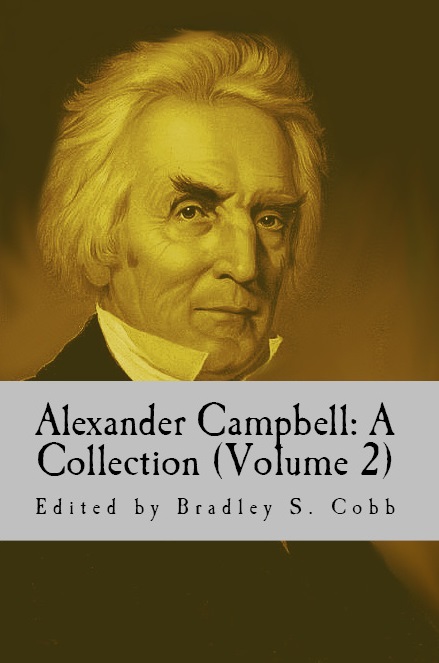
Alexander Campbell: A Collection (Volume 2)

We are proud to announce the latest book from Cobb Publishing is now available!

Campbell(02) FRONT Cover

While about half of the previous volume was about Campbell, with the other half being some of his writings, this volume is almost all him.  There is a very brief biography of Campbell to start off the collection, and then the spotlight shines on Campbell’s pen.

In this brand-new collection, you can read his famous “Sermon on the Law,” get his thoughts on instrumental music in the church, find out what he has to say about the Bible and capital punishment, and even see his own translation of the book of Acts.  This book contains over 300 pages of material for your enjoyment and edification.

We have spent well over 100 hours in selecting, proofreading, and formatting this book to give you the best possible reading experience.  We believe it was worth the effort, and after seeing it, we think you’ll agree!

Contents

  • Alexander Campbell: Matchless Defender of the Protestant Faith
    By W.L. Hayden
  • Sermon on the Law
  • Life and Death
  • Instrumental Music in Worship
  • Is Capital Punishment Sanctioned by Divine Authority?
  • Confession Unto Salvation
  • The Bible
  • God has Spoken to Man in the Bible
  • Principles of Interpretation
  • Musings on a Christmas Morning
  • Acts of the Apostles (translation)

This book is now available at Amazon.com in print ($9.49) or in Kindle format ($3.99), and if you use Amazon, feel free to go that route.  The direct link to it is here.

However, for the first week (that is, until next Monday), we will be offering a special price of $7.99 for the paperback, and $1.99 for the eBook!  Click here to order it from us directly.

And may your day be full of God’s blessings!


Christianity and Labor/Management Relations (Christian Solutions to Modern Problems – Part Five)

In this, the conclusion of F.W. Mattox’s speech on Christian Solutions to Modern Problems, he tackles the issues of big business, and of Labor/Management relations.  It is incredible that something written primarily dealing with the social structure in the late 1940s is still so relevant to today’s social structure.  But, as Mattox said, whenever the principles of Christianity are put into place, it doesn’t matter what the social structure is–it makes each person and endeavor better.

Enjoy this, the final installment of this series.  And if you want to download the entire tract as a single pdf file, simply click here.

Enjoy!

8. CHRISTIANITY AND BIG BUSINESS

There has been too much misunderstanding in regard to the place of big business in American life. Too long has it been pictured as a monster of evil. There is no ulterior motive for my defending it. I don’t own a penny’s worth of stock in any company. I have no special friends in the management of any big company. I’m just an ordinary college professor with a smaller than average income, but I listen to a fine radio— produced by big business. My food is preserved in a fine refrigerator. I drive my own car, take a trip on the train, or on occasions I travel the airlines, all made possible by big business. Last year I built a home. It contains a modern kitchen, automatic furnaces and three bath rooms. Where else in the world can a fellow like me enjoy such conveniences? And why can I afford it? Only because it is all inexpensive—thanks to the big business corporation, the American method that allows all of us to pool our strength. The keynotes of big business are economy of operation, maximum production and improvement of techniques so that lower selling costs will result. Most big business is owned by many stockholders who share in its profits. Stockholders invest money for tools that make the products all of us use. There is no reason for it to be corrupt just because it is big. There is no reason for it not having a heart. In fact it has.

In general, it works for the welfare of employees as well as stockholders. And in many companies, employees are also stock-holders.

The effort that some labor leaders and social planners are making to destroy harmony between management and labor is un-Christian. Big business will bring us increasing conveniences if those so engaged recognize they are a part of a great team. This mutual interest is the result of brotherhood and Christianity builds the most cohesive brotherhood known to man. The law of supply and demand regulates the type and quantity of production. Competition results, not only in better products at cheaper prices, but also in new products, expanded plants and more jobs. The results add up to a higher standard of living for all and this, too, is Christian. The government should serve only as a referee, and allow these natural laws to operate.

9. DOES CHRISTIANITY APPLY TO LABOR-MANAGEMENT PROBLEMS?

There is no limit to the practical applications of Christianity to modem life. No matter the sphere of activity in which one finds himself, he will be impressed with how accurately the Christian principles apply.

Let us consider the case of management in business. Christianity demands that modern management in business assume responsibility for the welfare of its employees. The manager of a business that employs a thousand men must say in his heart, “I am responsible for these families. I must see to it, if possible, that there is enough profit in this business to maintain continuous salaries at a living wage. This means that I must replace worn-out machines, and develop a backlog of capital that will see this business through recessions or depressions and take care of any adjustments made necessary by increased competition. I must not only provide for employees today, but look out for their future.”

This is a serious responsibility. It is a responsibility that labor has apparently failed to understand. Too many workers have the attitude that management is their enemy. This is truly unfortunate.

The gulf that has developed between management and labor is eliminated by the application of Christian principles. Management has the responsibility of assuring labor that both are friends and that the business is being operated in their behalf as well as in the behalf of stockholders and that the accumulation of “venture capital” is for their good.

Management has the responsibility of informing labor of the necessity for profits. From the Christian viewpoint, any business management that does not make profits sufficient to replace machines and provide a backlog of capital to care for plant expansion and enlargement so that sons of present employees might have some opportunity for employment, has not assumed its full Christian responsibility.

Christianity, therefore, demands that management assume responsibility for sound management. It is a serious matter to have a great number of human beings looking to you for food, clothing, and shelter. Christianity will cause this responsibility to be taken seriously. In view of these ideals, wages will be increased as much as is possible in the light of the above mentioned responsibilities. Working conditions will be improved in every manner possible, motivated by a feeling of brotherhood and mutual sharing of responsibilities.

10. THE CHRISTIAN DEMANDS UPON LABOR

Christianity gets down into the lives of every human and improves conditions and attitudes of all. The laborer must assume his share of responsibility, also. He must understand that if he receives $1.00 per hour for his work that he must create in that one hour, not only $1.00 in value that would come back in the form of reimbursement to his company, but he must create enough more than $1.00 in that hour to provide for the upkeep and replacement of his machinery, the upkeep and expansion of his plant, and additional value that will be stored back to provide for further emergencies in the time of depression or financial recession. This must come into the understanding of modern labor if there is ever to be harmony between labor and management. Christianity requires that labor assume these responsibilities.

In this, we see a formula for success that applies to every young man who wants to get ahead. Christianity would say to such a young man, “Your income can depend only upon the value that you create minus replacement of machines, required supervision, and a small deposit for insurance against future calamities.” The more a young man creates in value, and the more responsibility he assumes, the better care he takes of the machines, and the less supervision that is required to keep him on the job, the more income he can receive. In this way, a greater share of his creation of value belongs to him. Christianity gives one this feeling of responsibility.

CONCLUSION

There is no end to the applications of Christianity to modem life. The principles of honesty, fair dealing, sympathy, humility, as well as responsibility are applicable to every human being in every walk of life. A husband is a better husband for being a Christian. He is dependable, loyal, sympathetic, understanding, and kind. A wife is a better wife because of being a Christian on the same basis. Children are better children because of being Christians. Christianity lessens the harshness, the unkindness, and ill-will that has so marred human relations in the past and replaces these negative qualities with positive principles which improve human relations on every hand.

In society under the Caesars, human life was very cheap. Even those motivated by the very highest form of pre-Christian philosophy had not learned the value of a human life. The Roman Stoics, in their practice of slavery, would have no consideration for a slave who had become old and useless. There was no provision for his welfare and the only suggestion he would receive would be to take his own life. With the coming of Christianity into the world, every human institution felt its impact and through the years, society has come more and more into harmony with its idealism. Not only has the Christian idealism proved itself in practical applications, but stands ever ready to take humanity to still greater heights.

If modem society with its scientific know-how would work seriously to make Christian application to its social and economic problems, we would experience the dawn of a new day in which standards of living and human satisfactions would reach levels undreamed of in past generations. The challenge is to you to apply Christianity where you are today.

Christianity and Wealth (Christian Solutions to Modern Problems – Part Four)

With this installment of F.W. Mattox’s Christian Solutions to Modern Problems, the writer and professor at Harding College in the mid-1900s addresses the ideas that earning interest is sinful, and that poverty is the pinnacle of Christian virtue.

Enjoy!

6. DOES THE BIBLE TEACHING WHICH CONDEMNS USURY CURTAIL BUSINESS?

The critics of Christianity have left no stone unturned to bring it into discredit. It is being stated that the Bible opposed collecting interest on loans, and since the American system is based upon investment of capital for which a return is expected, the Bible is against the American system.

This criticism is based upon the following scripture quotations. In Psalm 15:5, the man that pleases God is described as a man who “putteth not out his money to interest.” In Ezekiel 18:8, the just man is spoken of as “he that hath not given forth upon interest, neither hath taken any increase.” These passages, upon first thought seem to prove the contention, but upon examination it is clearly seen that this prohibition is against taking interest from the poor to whom a loan has been granted in order to sustain life. In Ezekiel 8:17 it is stated that this just man, “hath given bread to the hungry, and hath covered the naked with a garment; that hath not withdrawn his hand from the poor, that hath not received interest or increase.” In Leviticus 25:35, this idea is even more clearly: stated: “And if thy brother is waxed poor, and his hand fail with thee; then shall thou uphold him …Take thou no interest of him or increase….Thou shalt not give him thy money upon interest, not give him thy victuals for increase.” This same principle applies to the passage in Nehemiah 5:3-13 which condemns the practice of some of the Jews who were taking away the lands of their poor and starving brethren through usury.

There is, however, another type of loan. The loans so far discussed were for subsistence purposes. There was no consideration here given to capital loans—or loans for the purpose of capital investment. This type of loan is made for the purpose of creating greater wealth, and justice would require that the person furnishing the money should share in the increase which his money makes possible. In Matthew 25:14-30 Jesus tells the story of the master who distributed talents to his servants. In this story the men who properly invested the money were rewarded and the man who did not was condemned for his failure. Although the story teaches a spiritual lesson the approval of Jesus for interest on capital investments is clearly seen. The language is as follows, “Wherefore givest thou not my money into the bank, and I at coming should have required it with interest.” Criticisms of the Bible are made by those who do not see the whole picture and accordingly, fail to make distinctions that alter completely premature concepts.

7. DOES CHRISTIANITY DISCOURAGE WEALTH AND ENCOURAGE POVERTY?

It has just been suggested that Christianity might be misunderstood to such an extent that the charge would be made that Christianity discourages the accumulation of wealth and sanctions poverty. It is unfortunate that any would so misinterpret the teachings of the New Testament. The statement of Jesus to the rich young ruler, “Go, sell what you have, give to the poor, and come follow me,” has been used as a proof text for such an idea. In this case, Jesus is not approving poverty but was dealing with a young man who had a love for possessions that was stronger than his devotion to God. It was this love of money (which the Apostle Paul tells Timothy is the root of all kinds of evil) that was the sin of his life. Evidence that this is correct is seen in the statement that Christians should “Maintain good works (honest occupations) for necessary uses, that they be not unfruitful.” (Titus 3:14.)

Another criticism stems from a statement in the 5th chapter of the Book of James where the rich are condemned. The passage reads, “Come now, ye rich, weep and howl for your miseries that are coming upon you. Your riches are corrupted and your garments are moth-eaten.” This passage has been used to prove that God is displeased with the rich. Such thinking overlooks entirely the 4th verse which gives a clear explanation of why the condemnation is given. It continues by saying, “Behold the hire of the laborers who mowed your fields, which is of you kept back by fraud, crieth out.” This is the key to the passage. The rich have a responsibility not to use their power as means of oppression. The passage in no way indicates a condemnation of wealth as such, but rather the un-Christian means used for making the money.

In this connection, some have misunderstood the commendation of Jesus for the widow who gave her last penny into the treasury. In this case, Jesus made the statement that she had given more than they all. But this cannot rightly be interpreted to mean that Jesus is approving poverty and condemning wealth, but rather he is commending the deep devotion of one who was poor. One does not need to be rich to be covetous; neither does one need to be poor to be liberal. Jesus is here commending one who assumes responsibility and this is a keynote of the Christian religion.

Christianity and Communism (Christian Solutions to Modern Problems – Part Three)

Greetings!  We hope that you have been finding F.W. Mattox’s work on “Christian Solutions to Modern Problems” to be interesting and challenging.  Today’s installment looks at–among other things–the assertion that the Bible endorses communism.

Enjoy!

4. DOES CHRISTIANITY OFFER A PLAN FOR SOCIETY?

Karl Pollanyi, the Austrian economist, has criticized Christianity on the basis that it presents no over-all plan for society. He calls this the greatest blind spot in Christianity. His criticism is that it is entirely too individualistic; that it might have worked in former periods, but since there are so many people living in large groups, the Christian individualistic idealism does not apply.

I would answer this charge by saying that while Christ did not give us a detailed blueprint for the ideal society, which could have been applicable in only given localities, he instead left us underlying principles which will take root in any society and bring it to a more ideal state. All who have looked into the matter of law and studied its value are impressed with the fact that no system of regulations is more effective than the majority of the members of the society will support. In other words, laws and regulations, to be effective, must be supported by the majority of the members of the society involved. This means that had Christ given the ideal social order, it would never have been effective until the majority in any society would support it as individuals.

Instead of approaching it from this angle, Christ gave plans that will build in the individual social responsibility and ideals of conduct that would make him the ideal citizen in any form of society. Not only does Christianity build into each individual heart the highest social responsibility; it requires that each individual be a missionary of these ideals to such an extent that each will use his power and influence in developing in others the same responsibility and noble principles of conduct. This plan is far more effective than any attempt would have been to require a perfect social order.

Not only is this a better plan ideally, but it is the only plan that could work from the practical point of view. If Jesus had advocated a perfect social order, it would have meant there would be outward opposition by his followers against all opposing orders and thus have caused social upheaval in the Roman Empire as well as in all subsequent times. But by working through the individual, each order is gradually improved as the principles of Christ are accepted.

5. DOES CHRISTIANITY ENDORSE COMMUNISM?

As Pollanyi has criticized Christianity for having no over-all plan for society, others have claimed that Christianity endorses Communism. Accordingly, the adherents of such an idea say that the Communistic philosophy is in harmony with the Christian religion. This definitely is a mistaken idea. The passages of scripture that are used to prove such a claim are passages in the Book of Acts telling of the church in Jerusalem.

In Acts, 2:44, the scripture says, “And all that believed were together and had all things common and they sold their possessions and goods and parted them to all accordingly as any man had need.” Again in the 4th chapter, and the 32nd verse, it reads, “And the multitude of them that believed were of one heart and soul: and not one of them said that aught of the things which he possessed was his own: but they had all things common . . . for neither was there among them any that lacked: for as many as were possessors of lands or houses sold them, and brought the prices of the things that were sold, and laid them at the apostles’ feet: and distribution was made unto each, according as any had need.”

These passages of scripture in no way endorse the Communistic philosophy, but rather, are statements of the unselfishness that Jesus taught in regard to Christians sharing with others when occasion demanded.

There is a great difference in Christian sharing and Communism. In Communism, the state takes over all of the property, even by force, and it is controlled by a small minority, theoretically for the good of all. Communism would take all wealth from all individuals. This is not what we have read in the above passages of scripture. Those who sold lands and possessions, sold them voluntarily and gave their money voluntarily to the apostles and this money was distributed, not equally to all who were Christians, but only to those who were in need.

Not only is this true, but we have the record of those who did not sell their possessions in the church at Jerusalem.

An outstanding example of this is Mary, the mother of John Mark, who owned a large home in the city of Jerusalem, which was used as a meeting place for many of the Christians. (Acts 12:12-14.) Further evidence is the fact that the Apostle Paul in his instructions to Christians in their giving, laid down the plan that each is to give as he has prospered. (I Cor. 16:2.) This clearly indicates that there were differences in prosperity.

This also indicates that the New Testament scripture does not demand equality of possession. Jesus said, “The poor will be with you always.” This, by no means, however, should be taken as a sanction of poverty but rather it is an indication that no matter what a person’s financial status, he is responsible for helping his fellow man. The conclusion is very strong that the New Testament scripture does not sanction in any of its plans, a Communistic set-up such as is being advocated today. The scripture does set forth very strongly the idea of individual responsibility and one of the greatest weaknesses of any Communistic development is the elimination of responsibility on the part of the many and the assuming of complete direction in the hands of the few.

Christianity and Government (Christian Solutions to Modern Problems – Part two)

Today, we continue our presentation of F.W. Mattox’s work Christian Solutions to Modern Problems, and see how Christianity can help make the government better.

Enjoy!

2. CHRISTIANITY AND GOVERNMENT

Our spiritual heritage is the root out of which the American system has grown. This is evidenced by recalling that our national documents are permeated with both Bible ideas and Bible language. The Bill of Rights which guarantees our freedoms is an outgrowth of the Christian emphasis upon the inherent worth and dignity of every human being. Furthermore, the American form of government presupposes that the governed are not only intelligent in being able to make wise decisions, but can be relied upon to assume the responsibility for government. Those who would change our form of government are saying that this is expecting too much from the masses. To them, society does not consist of enlightened, responsible individuals, but of ignorant, contriving self-seekers that must be controlled by force. When one looks at certain members of society this latter view seems to be correct and certainly no one would claim that all members of society are all they ought to be. My contention is that the great majority of American citizens are enlightened and responsible—capable of self-government—and that if this group will become more vocal in regard to its present rights and privileges under our free system, the system itself will not only be preserved, but the non-cooperating members of society can be brought to an appreciation and support of the system. Accordingly, every American should appreciate his religious heritage and work for its preservation.

3. CHRISTIANITY AND GOVERNMENT ECONOMY

In what way does Christianity affect government spending?

First of all government officials have an obligation to the governed. They are trustees—stewards with responsibility, and the first requirement of stewards is that they be found faithful. The present trend of bureaucratic expansion, inefficiency in office and valueless expenditures in every department is a national disgrace. Every Christian receiving a government check should look squarely at himself as he ponders whether the government could do without him. He should then either quit his job or work so hard it would become apparent that others were not needed. We must no longer deceive ourselves about government money. It is our money. No Christian father would place indebtedness upon his family to such an extent that it would take three generations to lift it. Coming generations will have problems of their own without our placing a mortgage upon their heads. Thrift, good management, hard work, and frugal economy are Christian principles our government officials need to consider.

This is no criticism of our governmental system. In spite of these defects we have more blessings than any other people on earth, but Christianity is not satisfied with such defects. Why should we be? With economy in government, our national debt can be paid, taxes reduced, and standards of living raised. It is time that all realize that “Federal Aid” is a deceptive term. The Federal government has no money. It can create no wealth. By taxation it takes our money and the small part of it given back to us is called “Federal Aid.” Christianity cries out against all waste.

Christianity and Americanism (Christian Solutions to Modern Problems – Part One)

I discovered a lengthy tract in my office, written by F.W. Mattox, best-known as the author of the book, The Eternal Kingdom.  This tract is the text of a speech given at Harding College, showing how the problems of the American marketplace could be solved if people would apply Christian principles.

We will be presenting the text of this speech in several installments (so as not to make your eyes cross reading the whole thing in one sitting on the computer).

Enjoy!

INTRODUCTION:

On October 25, 1949, Dr. F. W. Mattox spoke at the regular daily chapel service at Harding College. Many of the men attending the fourth Freedom Forum were present, several of whom requested the speech in printed form.

Believing that the true objectives of labor and management are identical; that there is desperate need for a better understanding of this fact; and that the application of Christian principles to industrial problems offers the only hope of long preserving our present standard of high wages, Harding College readily consented to print the message for the benefit of a wider audience.

-George S. Benson President

Christian Solutions To Modern Problems

By Dr. F. W. Mattox

In modem literature, there are many criticisms of attempts to apply first century principles to 20th century problems. Yet many of us are convinced that the solution to our modem problems is to be found in the application of the teachings of Christ.

Our purpose here is to examine briefly the applications of Christianity to the pressing problems of today in the light of its critics. The conclusions are of vital importance to our concept of government, society, business management, and labor.

1. THE PHILOSOPHY OF AMERICANISM

There exists in America today a strong influence designed to revamp the American way of life. Its purpose is to exalt the state and mold society according to a visionary concept. In order to accomplish these ends there must be a change in the philosophy that supports American society.

No institution exists without an underlying philosophy. Whether stated or not, there is a concept that supports each institution as a foundation does the superstructure of a building and as roots support a tree. If this basic idealism is not harmonious the institution can stand no better than can a building on a faulty foundation. This means that the reason given for doing a thing affects the way the thing is done. If men do not agree upon the why, one cannot expect them to agree upon the how.

The cause for the chief problems in America is a lack of agreement in regard to this underlying philosophy. With the encroachment of naturalism and relativity, the spiritual concepts of the Bible that gave unification to America in its formative period are being challenged. This has resulted in confusion of ideals and purposes, not only in regard to religion, but also in sociology, economics, and government.

Americanism is a word that denotes such ideas as freedom, progress, enlightenment, scientific know-how, mass production, invention and change. To many, this concept is entirely contrary to the ideas of the Christian religion. For the Bible is thought of as supporting the status quo. Its principles of permanent truth and uncompromising idealism are looked upon to support the heritage of the past and are expected to resist change.

That we are living in a world of change is not denied. Professor Whitehead was correct in reminding us that before 1914 there was in the world more of constancy than of change, but since the First World War, there has been more of change than of constancy. Let it be clearly understood, however, that the Bible is not a defender of the status quo. The ideals of the Bible have never been achieved in any society and every student of Church History has thrilled with the heroic fight of the saints of old in their struggles for social change.

It is the contention here that change in the right direction must grow out of timeless principles of truth. There must be a firm base for a great building and fertile soil for luxuriant growth. The Bible provides this base, the soil of which greatness grows. This is clearly seen by the following examination.

What are the requirements for a permanent and progressive society?

First there must be a feeling of brotherhood. A stable society cannot exist without its members working closely together. That man’s native gregariousness is not sufficient to provide this need is seen through a glance at class strife and human selfishness. The Bible develops this cohesive need by emphasizing the brotherhood of man. It is being claimed that Communism also emphasizes a brotherhood of man, but such claims are soon seen to be without foundation in fact. Brotherhood presupposes equality. Not equality of possession, as the Communists strive for, but a recognition of the equal worth and dignity of each member. Americanism is based upon this concept but apart from the Bible the concept itself is without foundation.

The second requirement for a permanent progressive society is in regard to production. Each member must contribute his fair share. Communism, finding that work is not cheerfully given, attempts to force this contribution through the existence of a police state, with its exile and forced labor camps the motivating influence. Where the state controls the production of each worker, incentive and initiative are killed and force and fear are the only alternatives.

In the American system, production is held to the highest level found anywhere in the world, by the principle of individual freedom. This freedom to plan, to work and to enjoy the fruits of labor, rests upon the requirement that each member of society assumes responsibility. This is the key to the problem. How can men be taught to assume responsibility? The Bible has the only answer. Obligation to God requires the assumption of personal and social responsibility. The Christian religion requires one to be loyal, dependable, honest, trustworthy, and unselfish. The degree to which these principles are accepted is the degree of responsibility assumed.

America has done well under this philosophy. Her present greatness is its result. To return to an earlier figure, any tree bearing abundant fruit should not have its roots molested. An attempt to replace the roots of a tree would unavoidably result in disaster. Accordingly, would it be reasonable to suppose that we could change the basic philosophy of our national life and maintain the same desirable ends? It would not. Different roots will produce different fruit. And the fruits so far produced by non-Christian roots are all of the undesirable variety.

Bible Q&A – Jesus the Only Speaking God?

Question: I read an article recently in a brotherhood paper which said that it was Jesus, not the Father, who was “walking and talking” with Adam and Eve in the Garden of Eden. His reasoning was that “A Spirit does not have feet and a voice …” And since Jesus is the only one from the Godhead who was said to become “flesh,” it must have been Him in the garden, and not the Father. This is confusing to me. Can you shed some light on the matter?—G.J.R., Oklahoma.

I have read the article that you refer to, and while I don’t necessarily have an issue with his conclusion, the arguments that he uses to get there are not valid.

The article is on the question “Where art thou?” from Genesis 3:9. This question was spoken by “The LORD God,” but as the person who wrote the article showed, the Godhead is comprised of more than one entity. And to quote the article, “therefore the phrase ‘Lord God’ does not ‘definitively’ answer the question!” To this, we fully agree. Just because something is said to be done by God doesn’t show us exactly which member(s) of the Godhead were the doers. For example, Genesis 1:1 says God created the heavens and the earth, but John 1:1-3 shows us that it was “the Word” [Jesus] who did the actual work of creating.

The article makes the statement that “the Father is the planner,” and gives some passages which show the Father is the one who planned and purposed the life, death, and resurrection of Christ (Acts 2:23, Ephesians 3:11). The article then states that Jesus is the “Executor,” that is, the one who actually does the doing of things. There is nothing in the article to pinpoint the Holy Spirit’s role is in the Godhead.

While we gladly admit that these statements are often the case, they are not always the case. They are not absolutes. We will show this to be the case momentarily.

The article, however, assumes that these distinctions are true 100% of the time, with no variation, and that therefore the Father is only ever the planner, and never the “executor” or doer of His will. Therefore, Jesus [the Word] is the only “Executor” or doer, and that everything that is actively done by God can only be done by Jesus.

Using these two descriptions as absolutes, the article proceeds to reason from them and apply them to Genesis 3:9. The exact quotation is:

[W]hen it is observed that “The Word/Logos” is the “Executor” and He created all things, it is correctly deduced that it was “The Word”, who became “flesh” (John 1:14) “walking and talking” in the Garden.

The problem with this reasoning is that the roles of the Godhead in regards to “planner” and “Executor” are not absolutes. For example, Jesus Christ was raised from the dead by the Father (Acts 13:30, 37, Galatians 1:1). The Father planned it, and the Father executed His plan Himself.

The quotation continues (immediately following the above quote):

A Spirit does not have feet and voice that spake the world into existence, which asked the question, “Where art thou?”

It is this argument that I have the biggest problem with. While it might sound good on the surface, the necessary conclusions from this statement violate Scripture. And if the necessary conclusions violate Scripture, then the statement itself must be wrong. The article argues that only one who “became flesh” can be “walking and talking” because “A Spirit does not have feet and voice that spake the world into existence.”

Here, we offer our objections:

(1) If it requires flesh to do “walking and talking,” then that demands that before the world could be spoken into existence, one of the Godhead had to become flesh. The writer states that a Spirit does not have a voice; therefore the necessary conclusion is that one of the Godhead had to be flesh before creation.

(2) Jesus is the only one of the Godhead who is said to have been “made flesh.” If it requires flesh for God to speak, the necessary conclusion is that every time we see God talking in the Bible, it’s actually Jesus speaking. This makes for a very interesting conundrum, because when Jesus was raised up out of the water after being baptized, a voice [God] spoke from heaven, saying “This is my beloved Son, in whom I am well pleased” (Matthew 3:17). Are we really to believe that Jesus (the only member of the Godhead who was ever in the flesh) was speaking to Himself from heaven, calling Himself His own Son?

(3) The Holy Spirit—one of the Godhead that did not become flesh—can speak (Acts 10:19-20).

There are other instances that could be used, but we believe these are sufficient to show that these arguments used in this article are not valid.

Please note: the article was written by a good, faithful gospel preacher. This response was written merely to bring to light some issues that the brother probably did not consider in his arguments. His conclusion, that it was Jesus who asked the question to Adam and Eve, is his opinion, and could possibly be the correct one. My problem was not with the conclusion, but with the reasoning used to get there.

———-

Because this question is now before us, I will present the evidence that I believe might point to a different conclusion.

When people read Genesis 3:8, they make an assumption that God Himself is “walking” in the Garden when this event took place. As in, this is God in human form, literally walking with human feet through the foliage. If that’s what Genesis 3:8 said, I’d stop right there and say, “that might be a pre-incarnate appearance of Jesus.” But that’s not what the text actually says.

Genesis 3:8 says “They heard the voice of God walking in the Garden.” It’s not God walking through the Garden; it’s God’s voice “walking” through the Garden. You might ask, “How does a voice walk?” The word which is translated “walking” is usually translated as went or go (or a variation of these two words). Thus, they heard the voice of God going through the Garden. They didn’t hear God Himself in human flesh walking through the Garden of Eden; they heard His voice as it went through the Garden.

Luke 3, in giving the complete genealogy of Jesus, states that Adam is the son of God (Luke 3:38). The member of the Godhead that Adam would have interacted with, it seems, would have been his “Father.”

We’ve already shown from the incident at Jesus’ baptism (and to that, we could add the Transfiguration) that the Father is fully capable of speaking to humans in a voice they can understand.

These arguments are not definitive in answering the question, but they absolutely show that the Father could easily have been the one whose voice went through the Garden of Eden, asking Adam and Eve “Where art thou?”

-Bradley Cobb

Sermon Wednesday – Ten Thousand Angels

They bound the hands of Jesus in the garden where he prayed.
They led him through the streets in shame.
That spat upon the Savior, so pure and free from sin.
They said “Crucify him. He’s to blame.”

We all know those words of that song. And we know what comes next in it.  The song contains some great thoughts, and helps us focus our minds on what is really important. But before we get into the song, let me tell you about how it was written.

Ray Overholt was a musician with his own TV show, “Ray’s Roundup,” for a time. But in 1958, something changed. He had left the TV show and started playing in nightclubs.  He was drinking heavily.  He said, “I began thinking there must be a better life than the nightclub, show-business whirlwind. I was so intent on changing my lifestyle that I went home and told my wife that I was quitting all of the smoking, drinking and cursing. I wanted to cleanup my own life.”

“One day I thought to myself: I’ve written secular songs, I’d like to write a song about Christ. I opened the Bible, which I knew very little about, and began to read the portion of Scripture that describes Jesus in the Garden of Gethsemane telling Peter to put away his sword. I read where Jesus told Peter that He could ask His Father and He would send twelve legions of angels. I didn’t know at the time that would have been more than 72,000 angels.”

“I thought a good title for a song would be He Could Have Called Ten Thousand Angels. I didn’t know what happened during the life of Christ, so I began doing a little research. The more I read about Jesus, the more I admired him for what He had done. I then remembered that He did this all for me.“

“I was playing in a nightclub in Battle Creek, Michigan, when [I started] to write the song. I wrote the first verse and put it in my guitar case. I then gave the club my notice that I was quitting. As I opened my guitar case to put my instrument away, one of the other musicians saw the music written out and he asked, ‘What are you doing there?’ I told him I was writing a song about Jesus. He asked the title and I told him. He said, ‘It will never go.’ I asked why? He said, ‘I don’t even like the title.’ But I finished the song and sent it to a publishing house, which reluctantly agreed to publish it.”

And the rest is history. The song has become one of the favorites of Christians all over the world.

Let’s think back to the time described in the words of this song.

The Arrest of Jesus

It’s late at night, and after spending several hours with His disciples, Jesus goes off alone to pray. He looks at Peter, James, and John, and says, “you guys stay awake and keep a lookout while I go pray.”  Then Jesus goes further into the garden, falls on his knees, and agonizes in prayer. He is incredibly stressed to the point where he is sweating as it were great drops of blood (Luke 22:44).  He gets back up and finds that His disciples sleeping. He wakes them up, and it’s not much later that a large group of soldiers, led by Judas, comes and arrests Jesus. “Then the band and the captain and officers of the Jews took Jesus and bound Him” (John 18:12).

Jesus, the innocent man was arrested and chained as a common criminal, and led away for trial.  The soldiers shove Jesus through the city on the way to the high priest’s home. People hear the noise and begin to look out their window and see Jesus in chains.  The man who had—just days earlier—been greeted with cries of “Hosannah” as He rode down the street in Jerusalem as a King, was now being led down the street in the early morning hours as a prisoner.

“Again, the high priest asked Him, and said unto Him, “Art thou the Christ, the Son of the Blessed?” And Jesus said, “I am: and ye shall see the Son of man sitting on the right hand of power, and coming in the clouds of heaven.” Then the high priest rent His clothes, and saith, “What need we any further witnesses? Ye have heard the blasphemy: what think ye?” And they all condemned Him to be guilty of death. And some began to spit on him.” (Mark 14:61-65).  The sinless Savior stood there while the crowd condemned Him to death and spat on Him.

“And Pilate said again to them, What do you desire then that I shall do unto him whom ye call the King of the Jews? And they cried out again, Crucify him! Then Pilate said unto them, Why? What evil hath he done? And they cried out the more exceedingly, Crucify him!” (Mark 15:12-14)

They bound the hands of Jesus in the garden where He prayed.
They led Him through the streets in shame.
They spat upon the Savior, so pure and free from sin.
They said, “Crucify him! He’s to blame!”

The Mockery of Jesus

Jesus has been dragged from one mock trial to another. The Sanherdrin condemned Him to death, and spat on Him. Herod rejects Him because Jesus wouldn’t speak against the accusers. Pilate showed himself as spineless and washed his hands of the whole situation. Then Jesus is scourged—whipped across the back until the muscles and bones in his back are clearly visible. Then he’s turned over to the soldiers for them to do whatever they want before they kill Him.

“Then the soldiers of the governor took Jesus into the common hall, and the whole band of soldiers gathered around Him. And they stripped Him, and put on him a scarlet robe. And when they had platted a crown of thorns, they put it upon his head, and a reed in his right hand: and they bowed the knee before him, and mocked him, saying “Hail, King of the Jews!” And they spit upon him, and too the reed and smote him on the head. And after they had mocked him, they took the robe off of him, and put his own rainment on him, and led him away to crucify him” (Matthew 27:26-31).

They put a robe on his bleeding back. They twisted up thorn vines and put them on his head. They mocked him in fake worship. They took the reed and started hitting him on the head, driving the thorns deeper and deeper into his head.   And during this whole time, there was no one there defending Him. He was by Himself.

Upon His precious head, they placed a crown of thorns.
They laughed, and said “Behold, the king!”
They struck Him and they cursed Him and mocked His holy name.
All alone, He suffered everything.

The Crucifixion of Jesus.

Jesus is beaten and bloody. His face is unrecognizable. And they nail his hands and feet to the cross. Jesus is hurt, exhausted, dehydrated, sleep-deprived, mentally spent, but still determined. He is still thinking clearly. But as He’s raised up on the cross to begin His final torture before dying, He looks at the crowd that’s gathered. Through the blood that’s run into His eyes, He sees Mary, His mother. As He’s on the cross, struggling for every breath, He makes sure His mother is taken care of.

“Now there stood by the cross of Jesus His mother, and His mother’s sister, Mary of Clophas, and Mary Magdalene. When Jesus therefore saw His mother, and the disciple standing by, whom he loved, he saith to His mother, “Woman, behold thy son!” Then saith He to the disciple, “Behold, thy mother.” And from that hour, that disciple took her into his own home.” (John 19:25-27).

Everything had been taken care of. It was all about over. The last request of Jesus on this earth was a drink.  “After this, knowing that all things were now accomplished, that the Scripture might be fulfilled, saith, “I thirst.” Now there was a set vessel full of vinegar: and they filled a sponge with vinegar, and put it upon the hyssop, and put it to His mouth. When Jesus therefore had received the vinegar, he said, “It is finished.” And he bowed His head and gave up the ghost.” (John 19:28-30).

The wicked work of the Jews in killing Jesus had finally accomplished their goal.

When they nailed him to the cross, his mother stood nearby.
He said, “woman, behold thy Son.”
He cried, “I thirst for water,” but they gave Him none to drink.
Then the sinful work of man was done.

The Other Side of the Story

The sinful work of man was done, but this was also in the plan of God—it was God’s grand plan to bring about redemption.  Jesus didn’t fight the mob. Jesus didn’t resist the authorities that falsely arrested, accused, and condemned Him. He refused the drink that would have helped to deaden the pain. He took the full force of His death. He was taking on the full punishment for sins, and nothing was held back. The entire world’s sins were on His shoulders while He was on the cross, and He had no helper. No one to help shoulder the burden. It was all on Him. And then He died, and His death made salvation possible for all men.

“And Jesus cried with a loud voice” (Mark 15:37) “He said, It is finished: and he bowed his head and gave up the ghost.” (John 19:30).

“Looking unto Jesus, the author and finisher of our faith, who, for the joy that was set before Him, endured the cross, despising the shame, and is set down at the right hand of the throne of God” (Hebrews 12:2).

“For the preaching of the cross is, to them that perish, foolishness. But unto us which are saved, it is the power of God” (I Corinthians 1:18).

“For I am not ashamed of the gospel of Christ, for it is the power of God unto salvation to all those who believe, to the Jew first and also to the Greek” (Romans 1:16).

To the howling mob He yielded. He did not for mercy cry.
The cross of shame He took alone.
And when He cried “It’s finished,” He gave Himself to die.
Salvation’s wondrous plan was done.

The Self-Control of Jesus.

Peter, the impetuous sword-wielding disciple of Jesus Christ, tried to stop these events from taking place. In the garden, when the soldiers came to take Jesus, Peter stood up for His master and attacked.

“And behold, one of them which were with Jesus stretched out his hand, and drew his sword, and struck a servant of the high priest’s, and smote off his ear. Then said Jesus unto him, “Put up again thy sword into his place. For all they that take up the sword shall perish with the sword. Thinkest thou not that I cannot now pray to my Father, and He shall presently give me more than twelve legions of angels? But how then shall the Scriptures be fulfilled, that thus it must be?” (Matthew 26:51-54).

He could have called ten thousand angels
to destroy the world and set Him free.
He could have called ten thousand angels,
BUT
He died alone, for you and me.

Conclusion:

He could have avoided it all, but He died alone for you and for me.

“For God so loved the world that He gave His only begotten Son, that whosoever believeth in Him should not perish, but have everlasting life.” (John 3:16).

“Repent and be baptized, every one of you in the name of Jesus Christ for the remission of sins” (Acts 2:38)

“Be thou faithful unto death, and I will give thee a crown of life” (Revelation 2:10).

“Behold now is the accepted time, behold NOW is the day of salvation.”

-Bradley Cobb

The Church Used to Grow. So What?

I’m guilty.

I’ve been one of the hundreds of preachers who have tried to guilt people out of their spiritual lethargy by saying In the 50s and 60s, the Lord’s church was the fastest growing religious body in the United States.  (Not-so-subtly implying that they aren’t doing much for the Lord).

I’m one of the hundreds of preachers who have bemoaned the fact that the church isn’t growing across this country (and locally) like it did some five decades ago.

Usually, when that statistic is thrown out there, it’s used as evidence that members of the church (overall) have stopped caring about evangelism.  It’s used to show that the Lord’s church isn’t as dedicated as they once were.  It’s pretty much always used as a comparison.

And I think we’ve made a mistake by using it that way.

The fact is, we don’t live fifty years ago.  We live now.  It doesn’t matter today whether the church grew or shrank fifty years ago.  What matters today is what we as Christians are going to do now.

Bemoaning the fact that the church isn’t growing like it used to isn’t going to encourage growth today.

If we are going to use past growth as an example or a tool to help the church, we need to stop being so negative with it.

We say The church used to grow fifty years ago.  But what the members here is You guys are worthless compared to the Christians from fifty years ago.

We say The church was baptizing hundreds upon hundreds back in the 50s and 60s.  But the congregation starting thinking, What are you trying to say about us?

If you, as a preacher or a member, want to tell other members that the church used to grow five decades ago, then you need to use it in a positive way.

Consider the following:

  • The church experienced great growth in the United States in the 50s and 60s, so there’s no reason for us to get downhearted–it can be done!  Let’s get to work!
  • The church was the fastest growing religious group in the United States, and we can make that happen again!
  • The church grew by leaps and bounds, so we know that there are still people who will respond to the truth.  It’s time to go find them!

It’s high time we bring a positive message that growth is possible and then get out there and do it!

I don’t know about you, but I’m ready to make the growth of the Lord’s church in the 50s and 60s look pitiful by comparison!  Let’s all work together and make it happen.  The Lord Jesus Christ deserves no less!

-Bradley S. Cobb

Homosexuality in Perspective

A local teenager approached me with an interesting question, one that I thought could potentially be a loaded question.  He said, “What do you teach on homosexuality?”

I told him the same thing the Bible says about it: it’s a sin.  “But,” I added, “it’s not the only sin.”

With all the talk of homosexuality, it’s as though some people think it’s the only sin.  It’s the only sin they talk about publicly (look at their Facebook pages).  It’s the only sin that they get upset over.  It seems to be the front line of all their efforts. They are outraged over every bit of ground that the homosexuals gain in promoting their lifestyle.

They don’t show this kind of outrage over people cheating on their taxes.  They are strangely silent when it comes to people speeding.  Their voice is nowhere to be heard when there are beer ads during the football game. It’s like they’ve gone mute when it comes to people using God’s name in vain.

This teenager, after my response, said, “All I hear every Sunday is how evil homosexuality is.  It’s in every sermon.  I realize it’s sin, but good grief, I think we got the message two months ago.  There’s not a homosexual in our church, and none of them are considering it, so it’d be nice if the preacher moved on to something else.”

Now, don’t take this as me somehow advocating a “soft” stance on homosexuality.  The Bible is very clear that homosexuality is an abomination (Leviticus 18:22), and that there will be no homosexuals in heaven (I Corinthians 6:9-10).  God says it’s an abomination, and that remains true, even if man stops viewing it that way (I’m looking at you, Canadian Supreme Court).

But, as a Christian, it bothers me that I have so many brothers and sisters in Christ who only get outraged over certain sins.  As a Christian, it bothers me that homosexuality is the litmus test topic, but things like having the proper attitude, showing love towards others, striving for unity in the church, bringing back the erring, and other such things are viewed as secondary in importance (if they’re even mentioned at all).

As Jesus said, “These you ought to have done, without leaving the others undone” (Luke 11:42, NKJV).

It also bothers me that so many Christians are outraged because non-Christians (those who are already lost) are accepting homosexuality as “normal” or “acceptable.”   They are beside themselves when the government (or the courts) endorse such behavior.  Yes, it’s a horrible thing that homosexuality is growing in recognition.  But if you’re expecting the government and the court system to teach on things which are morally right or wrong, then you need to reprogram your mind.  It’s not the government’s job to influence people to follow the Bible.

That’s the job of Christians.

You, as a Christian, will be much more influential on showing someone why certain things (such as homosexuality) are wrong when you stand up against the other things that the Bible shows are wrong, too.  People aren’t going to be willing to listen to you if they view you as someone who only cares about the homosexuality issue.

Let’s be balanced in our focus towards all sins.  And let’s also remember that the way to convert a homosexual to Christ is not to post a thousand status updates on Facebook about the sin of homosexuality, but to teach the truth in love, showing him/her how (1) it is possible to change, (2) it’s worth it to change, (3) it’s necessary to change, and (4) God will accept them when they change.

And if you noticed, those four things apply to every sin.

One final thought to add is this: simply believing that homosexuality is sinful won’t going to get you into heaven.  Convincing a thousand non-Christians that homosexuality is sinful won’t get them to heaven either.

What will matter in the final judgment is bringing them to Christ.

-Bradley S. Cobb