Starting Over Requires Change

Billy Milner is sent to prison for drugs, and spends the next 12 years behind bars before he is finally released.

He doesn’t want to go back.  His goal is to start over and make a new life for himself.  His goal is to avoid getting in the same mess.  But just as important to him is this: He doesn’t want to be known as the drug-addict jailbird.

Now, put yourself in his shoes.  Do you want people holding the past against you? Do you want the chance to prove yourself without the past being brought up?  Do you want to have a new start?

It’s usually about this time every year that people make up their minds to start over.  It doesn’t matter that they have failed in the past, the new year brings a sense of freshness, a sense of newness, a sense of possibilities.

Some have estimated that over 50% of the adults in the United States will make a New Year’s resolution to lose weight in 2015.  It doesn’t matter that most of them (including me) made the same resolution last year, this is a new year, a new chance.

Some make resolutions to be more healthy.  Others make resolutions to study their Bible more.  Still others decide that this is the year they are going to get their bills paid off.  Whatever it happens to be, the new year makes people feel that they truly have a chance to make things better.

Is your life the way you want it to be?  Are you happy with where you are, spiritually speaking?  Are you happy with the person you’ve become?  Are there parts of your past you wish you could just leave behind and have them disappear?

Well, here’s the good news: today you can really make it all go away and have a brand new start!

Starting over requires a change.

No one is going to lose weight if they don’t make a change in their lifestyle, like eating better, eating less, and being more active.  In the same way, no one is going to have a better life if they don’t start making some changes.  If someone wants to make this the year they get out of debt, they have to make some financial changes (less frivolous spending, less eating out, more saving, perhaps making a budget).

Have you felt like a disappointment to yourself and to God?  You want things to be better?  Then it is time for you to make some changes in your life.

First, you’ve got to make up your mind to change.  A man once complained that he was always broke because he spent so much on cigarettes.  When his buddy said, “why don’t you quit?” the man replied “I don’t think I can.”  He needed to change, but he never took the first step of making his mind up to change.

The Bible describes this concept as “repenting.”   Repenting means that you change your mind to stop doing those things you used to do, and start doing the things God wants you to do.  It’s not always easy, but it can be done.

Do you ever wonder why it is that so many people constantly make the same resolution to lose weight, year after year?  It’s because the change that’s required to lose the weight is not easy to accomplish.  It requires willpower.  It requires looking at the long-term goal instead of the immediate satisfaction.

In the same way, changing our lives so we can have peace with God is not easy, but it can be done.

We are creatures of habit, we get to doing things in a certain way and we don’t like change.  But we must change if we want to have peace with God.  We should get rid of the bad and replace it with the good.

Negative habits that should be left behind could include:

  • Leaving friends behind.
  • Giving up hobbies (drinking, going to parties, reading things they shouldn’t be reading, etc
).
  • Bad attitudes
  • and many others.

Positive changes that ought to take place include:

  • Being more outgoing in spreading the gospel.
  • Setting aside time each day to read God’s word and pray.  Most people spend hours a day in front of a screen, so can you really say you don’t have time to read the Bible?

If you are not a Christian, the change you must make to find peace with God is to become a Christian.  You will notice a consistent theme throughout the Bible: the command to repent (change).  Repentance, when put together with baptism, will take away all of your sins (Acts 2:38).

-Bradley S. Cobb


Tracts From the Past – Why Am I a Member of the church of Christ

Welcome back to another week that God has granted us!  Today, we continue our Monday series of “Tracts from the Past.”  This one (like the others from the past few weeks) was written by Paul Simon (date and location unknown), and discovered while I was cleaning my office.

Enjoy!

Why Am I A Member of The Church of Christ?

By Paul Simon, Minister.

“But sanctify the Lord God in your hearts: and be ready always to give ah answer to every man that asketh a rea­son for the hope that is in you, with meekness and fear.” —I Pet. 3:15.

You should be able to give a reason for everything that you do, and should do nothing without having a reason for doing that thing. You should be able to give a reason for being what you are religiously, politically, and socially. The only reason for being that which you are in religion is a “thus saith the Lord.”

  1. I am a member of the church of Christ because it is non-demoninational. It sub­scribes to no denominational name or creed.
  2. I am a member of the church of Christ because Christ, and not man, is its founder. “Upon this rock I will build my church.” Jesus, in Matthew 16:18. The founder of any institution instills with­in that institution principles that determine its success or failure.
  3. I am a member of the church of Christ because of its foundation. “Can no man lay than that is laid, which is Jesus Christ.” — 1 Cor. 3:11. No structure is of greater value than its foundation.
  4. I am a member of the church of Christ because Christ is its only head. “And He (Christ) is the head of the body, the church:” — Col. 1:18; Eph. 1:22-23. The success of any institution is determined by its head.
  5. I am a member of the church of Christ because the Bible is its only creed. The creeds of men have to be re­vised every few years to cor­rect some of their mistakes, but not so with the Bible. It is a perfect creed. James 1:25; II Timothy 3:16-17.
  6. I am a member of the church of Christ because of its owner and the price paid for it. “Husbands, love your wives, even as Christ also loved the church and gave himself for it.” Eph. 5:25; Acts 20-28; I Pet. 1:18.
  7. I am a member of the church of Christ because of its name. A name means every­thing. “Neither is there sal­vation in any other; for there is none other name under heaven, given among men whereby we must be saved.” Acts 4:12; Phil. 2:9-11; Eph. 1:20-21.
  8. I am a member of the church of Christ because I was born into it, just like I was born into my father’s family. My father didn’t take a vote to see if the family would accept me into the family; neither did he ask me if I wanted to wear the family name. “Jesus answered, verily, verily, I say unto thee, ex­cept a man be born of water and of the Spirit, he cannot enter into the kingdom of God.” John 3:5; Pet. 1:23; Rom. 16:17-18; Col. 1:13-14.
  9. I am a member of the church of Christ because the Lord added me to it. “And the Lord added to the church daily such as should be saved.” Acts 2:42, 47; 5:14; 11:24.
  10. I am a member of the church of Christ because the early disciples were members of it. Acts 20:28; I Cor. 12:27; Rom. 16:16.
  11. 1 am a member of the church of Christ because its members wear no name but Christian. Acts 11:26; 26:28; I Pet. 4:16.
  12. I am a member of the church of Christ because it is scriptural in origin, name, doc­trine and practice.

The Truth About Baby Jesus

This week, a large section of the world is focusing on the birth of Jesus Christ.

What we need to remember is that ANYTIME people want to focus on Jesus, we should take advantage of it and show them what the Bible says about what happened with Baby Jesus.

The problem is not that they are focusing on the birth of Christ.
The problem is not that they do it every year at the same time.

  • The problem is that most people who focus on the birth of Jesus Christ on this day tend to forget about him the rest of the year.
  • The problem is that most people who focus on the birth of Christ don’t bother to look into the rest of the story: Baby Jesus grew up!

And also, because of the Catholic Church’s influence in years gone by, and their willingness to “Christianize” pagan celebrations, we have all sorts of things that get connected with the birth of Jesus that make no sense at all.  For example, how does a tree covered in electric lights have anything to do with the birth of Christ?  How do flying reindeer help us remember the birth of Jesus Christ?

But I digress…

It seems that people only want to think of baby Jesus as a cute little harmless baby in the manger, and ignore the rest of what the Bible says about Him.

Do you realize that the passages speaking about the birth of Jesus Christ comprise less than 2% of the gospel records? That means there is still 98% of the book to go!

What would you think of someone who only read the first chapter of a book and then stopped reading, all the while gushing about how wonderful that first chapter was?  Imagine them going on and on about how great the book starts out. They have you hooked. You ask, “well, what happens next?” and they say “I don’t know, I don’t feel like reading the rest.”

That’s how people seem to act this time of the year.  They gush about the birth of Christ, but they ignore the truth about Baby Jesus – He grew up!

Don’t get me wrong, the birth of Jesus was very important.  It was prophesied in the Old Testament (Isaiah 7:14 was ultimately fulfilled in the birth of Jesus).  It was miraculous (see Matthew 1:18-25).  It was announced by angels (see Luke 1:26-33 and 2:8-14).  Yes, the birth of Christ is a VERY important event.

But Baby Jesus grew up


Baby Jesus is easy to love.  Outside around this time, you’ll frequently see nativity scenes, because people love Baby Jesus.

  • Baby Jesus is cute (most babies are cute).
  • Baby Jesus doesn’t ask anything of you, so it is easy to accept and love baby Jesus.

But God didn’t send His Son to earth to remain a baby.

Baby Jesus grew into Boy Jesus (Luke 2:40-52).  The Bible tells us that, after being circumcised, Jesus went back home with His parents to Nazareth.  There, Baby Jesus “grew” (Luke 2:40).

At age 12, Jesus was found in the temple, listening to the teachers and asking them questions, and also answering them.  After returning with His parents, boy Jesus grew some more, and “increased in wisdom and stature and in favor with God and man” (Luke 2:52).

Boy Jesus grew into the Man Jesus.  When Jesus came to John the baptizer, he was “about thirty years of age” (Luke 3:23).  Immediately afterwards, He was taken into the wilderness to be tempted by Satan.  After overcoming the direct temptations of Satan, Jesus began to go around preaching repentance.

It was soon after this that people started to reject Him (who wants to actually repent?).  The people didn’t like that He claimed to be the answer to Old Testament prophecy, and they grabbed Him, and were going to throw him off a cliff.

These people who had no problem with Baby Jesus suddenly didn’t care for Him anymore once He started exposing their sinfulness.

The Man Jesus makes demands of people.  He told His disciples to “follow me.”  He told people that unless they repented, they would perish.  He told people that they had to put Him above even their own family.  He told people that they had to be righteous from the inside and not just the outside.  He told people that they had to love their enemies.  He told people that they had to actively spread the gospel after obeying it.

Why is it, do you think, that most people who love Baby Jesus don’t follow what the Man Jesus has to say?

Outside of the first two chapters of Matthew and Luke, the birth of Jesus isn’t the focus.  Instead, the Bible constantly points to the death of Christ as the most important part of His time on earth.

The apostle Paul said that his focus was on Christ and Him crucified–not on Baby Jesus.  When Peter preached on the day of Pentecost, He started by telling the people there to listen up and then proclaimed Christ crucified–not Baby Jesus in the manger.

Jesus Himself, when instituting the Lord’s supper, said that it was a feast to remember His death–He never told people to celebrate His birth.

Religious people today seem to love Baby Jesus, but they want to ignore the Man Jesus and His teachings.  And no surprise, because the Man who was once Baby Jesus was murdered by religious people who didn’t like what He had to say.  They had no problems with Baby Jesus, but now they’ve changed their minds because this Jesus—the man—exposed their sinfulness.  They went all out to silence this man who dared make demands of them.

But still, Jesus willingly died because through His death, all people could be saved from their sins.

But even with that, Jesus made demands.

  • Jesus demanded belief.
  • Jesus demanded repentance.
  • Jesus demanded ongoing confession.
  • Jesus demanded baptism in order to be saved.
  • Jesus demanded faithfulness, even if it meant death.

Don’t get me wrong.  There is ZERO problem with thinking about and being happy about the birth of Jesus Christ.  It’s in the Scripture, and “all Scripture is profitable.”

However, if you just stop at the cute little Baby Jesus, you are ignoring 98% of what the gospels tell us about Him.

As you go through your life, remember the truth about Baby Jesus–He grew up.  He died on the cross, and He was risen again on the third day.  And come judgment day, He will be the one deciding your eternal destination.

It’s about time you read the rest of the story of Jesus, don’t you think?

Tracts from the Past – Noah’s Salvation and Ours

Continuing our series of “Tracts from the Past” written by Paul Simon (date and location unknown), we now present to you one dealing with types and antitypes that deal with Noah and ourselves.  Enjoy!

NOAH’S SALVATION AND OURS

By PAUL SIMON, Minister

Noah’s salvation was very simi­lar to ours. Both were spiritual and physical. Although, first em­phasis was placed upon Noah’s physical salvation, he was also saved from the sins of the wicked by their being destroyed in the flood. First emphasis is placed on our spiritual salvation, and yet we are saved physically in that [generally speaking] he who lives a Christian life will live longer than he would have, had he lived an ungodly life.

Noah was saved by grace.

And the Lord said, ‘‘I will destroy man whom I have created from off the face of the earth, for it hath re­pented me that I have made them. But Noah found grace in the eyes of the Lord.” (Gen. 6). We, too, are saved by grace. “By grace are ye saved through faith; and that not of yourselves.” — Eph. 2:8.

Noah was saved by faith.

“By faith Noah, being warned of God concerning things not seen as yet, moved with Godly fear, prepared an ark to the saving of his house” (Heb. 11:7). We are saved by faith. “Wherefore being justified by faith, we have peace with God through Jesus Christ our Lord” (Romans 5:1). “For ye are all the children of God by faith in Christ Jesus” (Gal. 3:26). Although these passages state that we are saved by faith, they do not say that we are saved by faith only.

Noah was saved by obedience.

“By faith Noah being warned of God, concerning things not seen as yet, moved with Godly fear pre­pared an ark (obeyed) to the sav­ing of his house” (Heb. 11:7). We too are saved            by obedience. “Though he were a son, learned he obedience through the things which he suf­fered, and being made perfect he became the author of eternal sal­vation unto all them that obey Him” (Heb. 5:8-9). “To you who are troubled rest with us. When the Lord Jesus Christ shall be re­vealed from heaven with his migh­ty angels in flaming fire taking vengeance on them that know not God and that obey not the gospel of our Lord Jesus Christ” (2 Thes. 1:7-9). “Blessed are they that do his commandments that they may have a right to the tree of life and may enter in through the gates into the city” (Rev 22:14).

Noah was saved by water.

“For Christ also hath once suffered for sins: the just for the unjust that he might bring us unto God; being put to death in the flesh, but quickened by the Spirit by which also he went and preached unto the spirits in prison; which some­time were disobedient when once the long suffering of God waited in the day of Noah while the ark was a preparing, wherein few: that is, eight souls were saved by wat­er” (I Peter 3:18-20). Likewise we are saved by water in baptism. “The like figure whereunto even baptism doth also now save us” (I Peter 3:21).

Noah was saved in the ark.

We are saved in the spiritual ark, the church. “And the Lord added to the church daily such as should be saved” (Acts 2:47). “Wives sub­mit yourselves unto your own hus­bands as unto the Lord; for the husband is the head of the wife, even as Christ also is the head of the church and he is the saviour of the body. Therefore, as the church is subject to Christ so let the wives be to their own hus­bands. Husbands, love your wives even as Christ also loved the Church and gave himself for it, that he might sanctify and cleanse it with the washing of water by the word that he may present it unto himself a glorious church, not having spot or wrinkle or any such thing, but that it should be holy and without blemish” (Eph. 5:22-27). “Take heed therefore unto yourselves and unto all the church over which the Holy Spirit hath made you overseers to feed the church of God which he pur­chased with his own blood” (Acts 20:28).

More examples:

  • Noah built the ark. Christ built the church.
  • Noah built but one ark. Christ built but one Church.
  • The ark was Noah’s ark. The Church is Christ’s Church.
  • There was only one family in the ark, Noah’s family. There is but one family in the Church, God’s fami­ly.
  • All of Noah’s family was in the ark. All of God’s family is in the church.
  • All in the ark were Noah’s family. All in the church are God’s family.
  • Only Noah’s children were in the ark. Only God’s children are in the Church.
  • All of Noah’s children were in the ark. All of God’s children are in the church.
  • All in the ark wore one name, Noah’s. All in the church wore one name, Christ’s.
  • All the righteous were in the ark. All the righteous are in the church.
  • All out of the ark were disobedient to God. All out of the church are disobedient to God.
  • All in the ark were saved. All in church are saved.
  • All out of the ark were lost. All out of the church will be lost.
  • Had Noah and his family not entered the ark, or left the ark before God told them to, they would have been lost. All who refuse to enter the church, having obtained unto the age of accountability, will be lost and those who enter the church but refuse to remain faithful to the church will be lost.
  • There was but one entrance into the ark: the door. There is but one entrance into the Church: Christ.
  • There was but one source of light in the ark, the window. There is but one source of spiritual light in the church, the Bible.

You see how understanding our salvation is made simple by com­paring it with Noah’s salvation by the flood.

Calling on the Name of the Lord

When kids misunderstand things, we think it is cute.  In fact, people share these adorable misunderstandings with their friends and anyone else who wants to know (look at Facebook for a few days and you’ll see them).

But when adults misunderstand things, it’s not the same, is it?  Adults are rightfully expected to put some effort into understanding things.  A wife isn’t going to post on Facebook about how cute it was that her husband misunderstood what she wanted.  Instead, it’s often times the basis of a (ahem) “discussion” (if you’re married, you know what I mean).

Today, we will consider one of the biggest misunderstandings in the religious world today: Calling on the name of the Lord.

The majority of so-called “Christian” denominations teach that to call on the name of the Lord is to ask Jesus into your heart, praying for salvation from sin.  It’s interesting that if you just take the sheer number (not groups, but individuals) of people claiming to be Christians, the overwhelming majority actually REJECT this doctrine.  However, it has been popularized by televangelists and others who twist God’s word to their own destruction (II Peter 3:16).  Salvation through prayer is “another gospel”, and all those who bring such doctrines will be cursed by God (Galatians 1:8-9).

But what does “calling on the name of the Lord” actually mean?

What is calling on the name of the Lord?

Though this phrase appears in the New Testament, it also appears in the Old Testament.

Seth had his son, Enos, THEN men began to call on the name of the LORD (Genesis 4:26).

This is generally referred to as the “Godly line.” This isn’t saying that no one prayed to God until Enos was born. But it was this line that obeyed God (see Enoch and Noah for examples).

Abraham built an altar and “called on the name of the LORD” (Genesis 12:8).

This “calling on the name of the LORD” could have included prayer, but that isn’t all that it entailed.  It involved praise to God, worship to God, and doing what was acceptable to God – in short, it was obedience.

Isaac built an altar and “called on the name of the LORD” (Genesis 26:25).

This is not an instance of Isaac praying, because in the previous verse, GOD APPEARED UNTO HIM.

Calling on the name of the LORD was the expression of a life lived for God in thankfulness and obedience.

Elijah, on Mt. Carmel, made the challenge to the prophets of Baal,

“you call on the name of your gods, and I will call on the name of the LORD. And the God that answers by fire, let him be God.” (I Kings 18:24).

As you will well remember, the prophets of Baal cried out long and loud and nothing happened.  Elijah then prayed,

“LORD, God of Abraham, Isaac, and Israel, let it be known this day that thou art God in Israel, and that I am thy servant, and that I have done all these things at thy word.” And of course God answered him (I Kings 18:36-38).

So, see, calling on the name of the Lord means praying! Not so fast


It is true that Elijah prayed, but notice that in his prayer, the answer was requested completely based upon Elijah’s obedience.  His calling on the name of the LORD was turning to God for help based on his–Elijah’s–obedience.

Psalm 116:12-19 describes calling on the name of the Lord.

What shall I render unto Jehovah For all his benefits toward me?  I will take the cup of salvation, And call upon the name of Jehovah.  I will pay my vows unto Jehovah, Yea, in the presence of all his people.

Precious in the sight of Jehovah Is the death of his saints.  O Jehovah, truly I am thy servant: I am thy servant, the son of thy handmaid; Thou hast loosed my bonds.  I will offer to thee the sacrifice of thanksgiving, And will call upon the name of Jehovah.  I will pay my vows unto Jehovah, Yea, in the presence of all his people, In the courts of Jehovah’s house, In the midst of thee, O Jerusalem. Praise ye Jehovah.

As you read through this passage, you will notice that calling on the name of the Lord is the equivalent of living right before God, taking the salvation that God offers, and keeping your vows to God.

In short, calling on the name of the Lord is a life of obedience and thankfulness to God.

That they may all call upon the name of the LORD, to serve Him with one consent (Zephaniah 3:9).

Here, calling on the name of the Lord is described as serving God.

In the New Testament, the concept of calling on the name of the LORD only appears three times.

Two of those times (Acts 2:21, Romans 10:13) are quotations from Joel 2:32.

Acts 2

In Acts 2:21, Peter mentions it at the beginning of his Pentecost sermon (those who call on the name of the Lord shall be saved).  In 2:38, Peter tells the people there to “repent and be baptized.”  In 2:41, those who gladly received his words were baptized and added to their number.  In 2:47, Those who were being added were the ones being “saved.”  Therefore, calling on the name of the Lord involved obedience to His word (including repentance and baptism).

Romans 10

In Romans 10:8-18, Paul discusses salvation.  10:17 – faith comes by hearing.  10:10 – belief and confession = salvation.  10:13 – Calling on the name of the Lord = salvation.  10:16 – but some have NOT obeyed the gospel. Therefore, hearing, belief, confession, and calling on the name of the Lord are requirements for salvation.

Acts 22

The other passage in the New Testament that discusses “calling on the name of the LORD” is Acts 22:16.

And now why tarriest thou? Arise and be baptized, and wash away thy sins, calling on the name of the LORD.

Calling on the name of the Lord is NOT baptism.  Let me say that again, calling on the name of the Lord is NOT baptism.  If it were, then Abraham, Isaac, David, and Elijah all got baptized
and more than once.

Calling on the name of the Lord means the same thing in the New Testament as it did in the Old Testament – OBEDIENCE to God.

The “name of the LORD.”

In Matthew 28:18-20, we read Jesus instructing the eleven apostles to baptize people in the NAME of the Father, and of the Son, and of the Holy Spirit.”  When something is done “in the name of” someone, it means it is done by their authority.

There is a big argument in some religious circles about whose name you are to baptize in.  Some say you have to recite the three names (citing Matthew 28:18-20).  Others say that we are only supposed to baptize in the name of Jesus (citing every example in the book of Acts).  People are having massive arguments over this, and it is all because they don’t understand what “in the name of” means.  If something is done by the authority of Jesus Christ, then BY DEFINITION it is by the authority of the Father, as delivered by the Holy Spirit.

The “name of the Lord” is the authority of the Lord.  Just like “stop in the name of the law” means “by the authority of the law.”

How do we call on the name of the Lord?

When a doctor called on someone (back when they did that kind of thing), they went to where the patient was.  When a boy went to call on his girl, he went to where she was.  It involved action and a need to be where the one being called on was.

Calling on the name of the LORD is going to where God is.  Calling on the name of the Lord is doing what is necessary to be with Him.

For Abraham and Isaac, this involved living properly under the laws God had given them.  For David and the Israelites, it involved living properly under the Law of Moses.

It is interesting to note that all of the Old Testament examples of people calling on the name of the Lord WERE ALREADY children of God.  They weren’t calling on the name of the Lord to become a child of God.  That didn’t take place until the New Testament.

Calling on the name of the Lord is this:

Turning yourself over to God’s authority in faithful obedience.

For those on the Day of Pentecost, and everyone since then who want to be saved, calling on the name of the Lord involves hearing the gospel, believing in Jesus Christ as the Son of God, repenting of their sins, confessing Christ with their mouth, and being baptized.

Calling on the name of the Lord isn’t baptism, but is sure includes it!

Turn your life over to God, submit yourself to His authority, and enjoy the blessings of salvation!

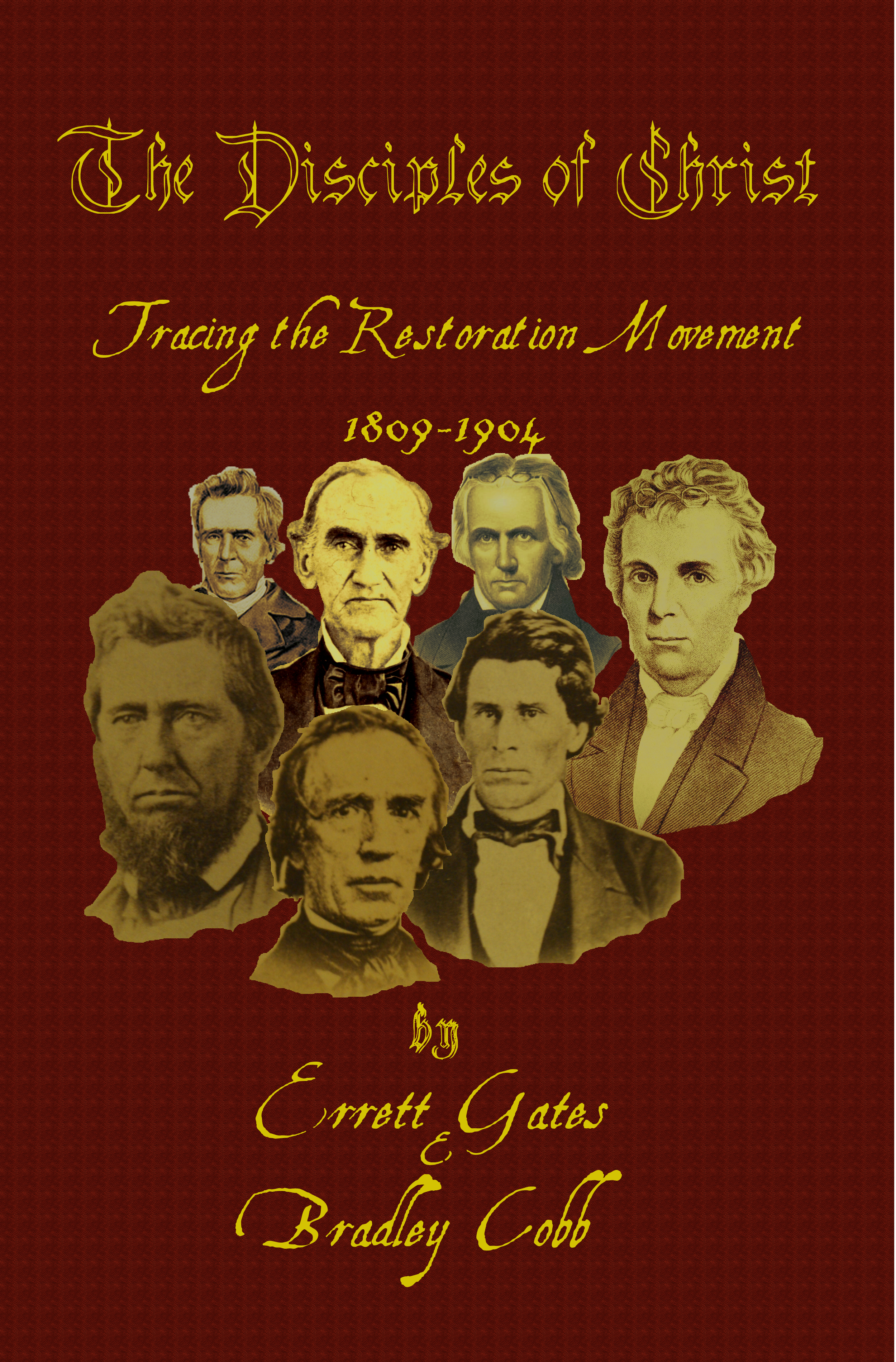
Tracing the Restoration Movement (1809-1904)

“Thus saith the Lord” was the cry of the men who preached the ancient gospel.  Their dream was the union of all the religious groups on the foundation of the Bible.  Leaving denominational names, creeds, and doctrines behind, these brave souls went back to the Scriptures and followed only what they could find in its pages.

But not everyone was happy with going back to the Bible.  The brave men of the Restoration Movement had to withstand attacks from denominationalists determined to hold on to their traditions.  Even worse, they had to withstand attacks from their own brethren who thought union was more important than obedience to God’s commands.

This book traces the rise of the “Reformers” of the 1800s, and strikingly illustrates the animosity, sadness, and division that arose when brethren refused to be bound by a “thus saith the Lord.”

DisciplesofChristFRONT COVER

This book was originally penned in 1905, but has undergone a massive overhaul to make it more accurate, more relevant, and more understandable.  Footnotes have been added when needed, and a brand-new final chapter has been added.

If you’re interested in the Restoration Movement, and you want a book that helps you understand the who, when, where, why, and how of it, this is the one.

You can purchase the book through Amazon in print ($9.49) or in Kindle format ($3.99) by clicking here.

Or you can purchase it through us in print ($8.99) or as an eBook (pdf) file ($3.99) by clicking here.

We know you will find it interesting!

Tracts from the Past – Principles In Christian Conduct

Like last week, we are posting another tract by a preacher named Paul Simon (date unknown, location unknown).  Many times it helps us to consider topics in short “tract-sized” form.  Often, preachers get overly wordy in trying to explain something when fewer words will do.

Principles In Christian Conduct

By PAUL SIMON, Minister

“Pray without ceasing” (1 Thes. 5:22).

God is not here commanding us to pray at every breath; to pray continuously, but is giving a principle: To pray always, in all things. We should continue to pray and never let the time come in our lives that we no longer pray to God, asking His blessings on us. Great men and women of history have been men and women who realized the need of prayer.

“Prayer is not overcoming God’s reluc­tance; it is laying hold of his highest willingness.” — Trench.

Abraham Lin­coln said, “I have been driven many times to my knees by the overwhelming conviction that I had nowhere else to go. My own wisdom and that of all about me, seemed insufficient for the day.”

“I know no blessing so small as to be reasonably expected without prayer, nor any so great but may be attained by it.”—South.

“I think I should have been swept away by the flood of French infidelity, if it had not been for one thing: the remem­brance of times when my sainted mother used to make me kneel by her side, taking my little hands in hers, and caused me to repeat the Lord’s prayer.”—John Randolph.

Jeremy Taylor once said. “The body of our prayer is the sum of our duty; and as we must ask of God whatso­ever we need, so we must watch and labor for all that we ask. Whatsoever we beg of God, let us also work for it.”

Although Jean Inglelow, English author, realized the need of prayer, she also realized the folly of her prayers, when she said, “I have lived to thank God that not all my prayers have been answered.”

“Lay not up for yourselves treasures
” (Matthew 6:19)

Matt. 6:19-34, “Lay not up for yourselves treasures upon earth, where moth and rust doth corrupt, and where thieves break through and steal: But lay up for yourselves treasures in heaven, where neither moth nor rust doth corrupt, and where thieves do not break through nor steal: For where your treasure is, there will your heart be also. The light of the body is the eye: if therefore thine eye be single, thy whole body shall be full of light: But if thine eye be evil, thy whole body shall be full of darkness. If there­fore the light that is in thee be darkness, how great is that darkness! No man can serve two masters: for either he will hate the one, and love the other: or else he will hold to the one and despise the other. Ye cannot serve God and mam­mon. Therefore, I say unto you. Take no thought for your life, what ye shall eat, or what ye shall drink: nor yet for your body, what ye shall put on. Is not the life more than meat and the body more than raiment? Behold the fowls of the air: for they sow not, neither do they reap nor gather into barns: yet your heavenly Father feedeth them. Are ye not much better than they? Which of you, by taking thought can add one cubit unto his stature? And why take ye thought for raiment? Consider the lilies of the field, how they grow; they toil not, neither do they spin: And yet I say unto you. That even Solomon, in all his glory was not arrayed like one of these. Where­fore. if God so clothed the grass of the field, which today is, and tomorrow is cast into the oven, shall he not much more clothe you, O ye of little faith? Therefore, take no thought, saying, What shall we eat, or What shall we drink, or Wherewithal shall we be clothed? For after all these things do the Gentiles seek: for your heavenly Father knoweth that ye have need of all these things. But seek ye first the kingdom of God and his righteousness; and all these things shall be added unto you. Take therefore no thought for the morrow: for the morrow shall take thought for the things of itself. Sufficient unto the day is the evil thereof.”

Jesus is not, here, commanding us to refuse to save against old age, sickness, or accident: neither is He saying that it is wrong to plan to wear a certain dress, or suit of clothes Sunday, or to eat beans and corn bread for dinner tomorrow—because nothing is done without planning ahead. Jesus is laying down a principle: Put first things first: give spiritual matters first place in your life. Those who fail to abide by this principle of putting God first cannot be happy; neither here, nor hereafter.

“The ground of a certain rich man brought forth plentifully: And he thought within himself, saying, What shall I do, because I have no room where to bestow my fruits? And he said. This will I do: I will pull down my barns, and build greater; and there will I bestow all my fruits and my goods. And I will say to my soul, Soul, thou hast much goods laid up for many years; take thine ease, drink and be merry. But God said unto him. Thou fool! this night thy soul shall be required of thee: then whose shall these things be which thou hast provided? So is he that layeth up treasures for himself and is not rich toward God.” — Luke 12:16-21. See, also, Luke 16:19-31.

An American Fable – Water Baptism

Due to the upcoming holidays and trying to get work done on some pressing projects, we didn’t get a Bible Q&A done for this week.  But we recently ran across something that we just had to share with you.  Once you read it, you will see why.

Have a great weekend!

An American Fable Relating to Water Baptism

(Originally appeared in Lard’s Quarterly, October 1866)

A missionary once presented a Bible to a young Indian, who possessed a fair knowledge of the English language, and exhorted him to read it, and obey its commandments. The book was received and read, as requested.

Some time afterward the Indian met the preacher, and said to him: “I want you to go with me to the river. I want to be baptized.”

“I can baptize you without going to the river,” said the preacher.

“Where?” inquired the red man.

“Here,” replied the preacher.

Said the Indian, in a tone of surprise: “I don’t see how you can baptize me here, where there is no water.”

“We can have water brought for the purpose,” responded the minister.

But the young man was perplexed; he could not understand how they were to baptize him after the water was brought. The minister then explained to him that they could baptize him “by pouring a little water on his forehead.”

“Is that baptism?”

“Yes,” said the minister.

Not yet quite satisfied, the young man again replied: “Well, if that is baptism, you have given me the wrong book.”

His idea seemed to be that each denomination had a Bible of its own, and that the minister had, through mistake, given him one that represented baptism by immersion. The impression that baptism is by immersion was made upon his mind by reading the Bible; but if pouring [or sprinkling] is baptism, it must be learned from some other book; that is, the same book can not teach both pouring and immersion to be baptism. Why not? Because there is such a difference between pouring and immersion that if one is taught to be baptism, the other cannot be.

W.W. Hayden.

The Modern Literal Version

The “Modern Literal Version 2015 Update” is officially out. So is its supplement “The New Koine Greek Textbook Vol. I & II”

PDF’s downloads and other information always at:
http://www.ChristianLibrary.org/greek-ref
http://www.ModernLiteralVersion.org

e-Sword modules are updated and now with the dictionary module you can find out more than you ever wanted to know about any word in the MLV within a few clicks including all the Greek. ALL for free. This gives you the ultimate word study tool and (free) Greek study tool.

at biblesupport.com
http://tinyurl.com/mxjhl2l
the “Modern Literal Version 2015 Update” (MLV.bblx)
http://tinyurl.com/ktoplfw
the dictionary/concordance +Greek Dictionary & Concordance (MLVDC+G.dict)

Android version of the MLV:
http://tinyurl.com/lxyosdf

A facebook group for you who want to work on making these better:
https://www.facebook.com/groups/MLVbible/

Book form (give someone a present for Christmas they need):
MLV 2013 (but 2015 inside) at $6.29 on amazon.com 6″x9″ wide margin
http://tinyurl.com/osaqlz7

MLV (2015) Pew Sized 6″x9″ at amazon.com $9.09
http://tinyurl.com/o3n7u3c

NOTE: The MLV is not sold for profit, it is the world most accurate bible translation (Greek to English; English to Greek), Open as in Open Source software. The “New Koine Greek Textbook” is a work in progress so if you want to teach millions come on board. A few million people may know about the “Modern Literal Version” one billion need to be using it daily.

The Herrin Massacre

Since being a small child, I have had a love of history. Though several years have elapsed since that time, the desire to learn about the past and better understand it has not diminished. I was raised in “Bloody Williamson,” in Southern Illinois, though by the time I came around, that nickname had faded from the memory of most.

The local history that I happened to catch while growing up mostly consisted of the mobster who had somehow–years after his death–become a “cool” anti-hero, Charlie Birger. And even at that, the details were limited to the fact that he was a gun-toting guy who fought against the KKK, and who was later hanged, uttering the final words, “It’s a beautiful world.”

The coal mines in southern Illinois, during my youth, still employed a large number of people—all of them union men. Perhaps this is why we never heard many details of the infamous “Herrin Massacre” that took place in 1922, even though it was front page news nationwide for several weeks in cities like Boston, New York, Philadelphia, and Chicago.

I have no bias for or against unions. I have several friends who are union men, and I have even been a union man myself at one time. I have nothing against unions, so long as they keep their proper place and they work within the bounds of the law and of fairness. In 1922, the union men in Herrin, Illinois performed a series of acts which cannot be justified or defended by any rational standard of right and wrong.

Recently, I ran across an old brittle copy of a book called “The Herrin Conspiracy,” wherein the details of that horrible event–the Herrin Massacre–were clearly set forth.  The author of that short booklet is unknown, though the information contained is an accurate picture of the events which took place on that day in 1922 when Williamson County earned the name “Bloody Williamson.”

This story makes for an interesting comparison with the Lord’s church.  It shows what can happen when people insist on their “liberties” even in the face of those who have problems with it.  It shows what can happen when leaders ignore their responsibility.  It shows what can happen when people of one community think only of themselves and not at all caring about the welfare of others.

It is a story of conspiracy, of murder, and ultimately a travesty of justice.

This book was written less than six months after the events, and at that point in time, no one had been charged with the murders of around 20 men and the destruction of millions of dollars of equipment.

I have taken the liberty to edit this booklet and have added footnotes to it.  It is an interesting snapshot of the times, and several illustrations can be gleaned from it.

Download it here (FREE) and see what you think.

-Bradley Cobb