All posts by BradleyCobb

Concerning the Disciples of Christ

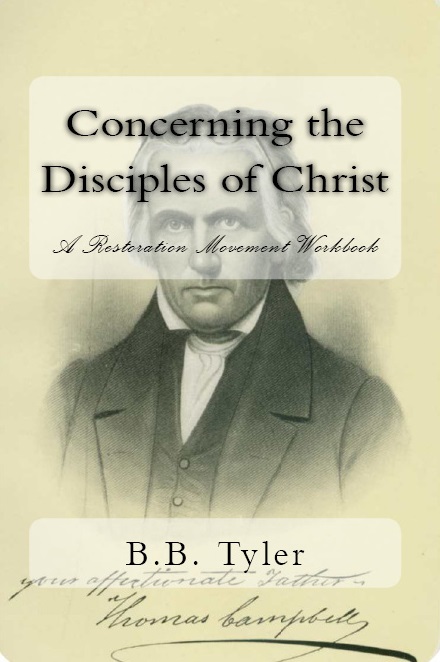
The Jimmie Beller Memorial eLibrary is proud to present the newest addition: Concerning the Disciples of Christ: A Restoration Movement Workbook.

Devout Christians, despising the divided state of Christianity, set about on a supposedly impossible mission: to bring about true unity in those who claimed Jesus Christ. From humble beginnings, the influence of this grand idea spread like wildfire, with the simple idea of unity based on Jesus Christ. Instead of creeds and confessions, denominational names and dogmas, these brave men proclaimed Jesus Christ and Him crucified, and showed what the biblical plan for saving men is.

They weren’t satisfied with reforming the existing order; they knew that what was needed was a complete Restoration!

Written for the everyman, “Concerning the Disciples of Christ” helps explain the who, what, when, where, and (most importantly) why of this movement to get back to the church found in the pages of the New Testament.

With a full editing job, including the addition of several footnotes, this updated version is made to give you the best possible reading experience!

To read this book online, or to download it for later reading, simply click the link below:

Concerning the Disciples of Christ (B.B. Tyler)

NOTE: This book is also now available in paperback for those who like having the real thing in their hands.  Click here to order it from us, or here to order it from Amazon!

Andrew, the Lesser-Known Son of Jonah (part 2)

Andrew is Called by Jesus

While Jesus traveled through Galilee preaching, Andrew and his brother Peter had apparently gone back to work as fishermen with James and John.  After a couple months or more had passed, Jesus came back to Capernaum, possibly staying at Andrew’s house.(1)  Andrew and his brother Peter were at the synagogue in Capernaum on the Sabbath when Jesus spoke with authority and cast out a demon,(2) and afterwards, they went back to their house with Jesus, James, and John.  It was there that Peter’s mother-in-law was horribly sick with a “great fever,” but was healed by Jesus.(3)

According to Luke, who explicitly stated that his gospel account was “in order” (KJV) or “in consecutive order” (NASB),(4) Andrew and Peter’s official call came after the events on the Sabbath.(5)  Jesus had gone near the Sea of Galilee, and a crowd of people found Him.  So he climbed aboard one of the two ships there, the one that belonged to Andrew and Peter, and the boat was shoved off a bit so Jesus could sit down and teach the crowds on the shore without being mobbed by them.  Andrew and Peter were both on the ship with Jesus when the Lord said, “Launch out into the deep, and let down your nets.”(6)  Andrew heard his brother explain that they’d worked all night, but caught nothing, but they still did as Jesus asked.(7)

Andrew was shocked by what happened next.(8)  The nets started to break, so they called James and John to come over in their ship as well, and the massive amount of fish filled both of the ships to the point of almost sinking.  The four men were amazed, and Jesus said to them, “from this point forward, you will catch men,”(9) “follow me.”(10)  As a result, Andrew (and the others) left his ship and the fishing business behind to follow the “Lamb of God.”

Traveling with Jesus, Andrew was present to see Him cleanse a leper, forgive the sins of a paralyzed man and then heal him, cast out demons, teach parables, and perform many other miracles.(11)  Andrew ate with the Lord and His disciples in the house of Matthew, the tax collector, and learned straight from the lips of our Savior that His mission was to “call sinners to repentance.”(12)

Andrew the Apostle (Limited Commission)

One morning, Andrew was called by Jesus, along with the other disciples, to a mountain.  This was one of the most momentous days in Andrew’s life, because it was on this day that Jesus chose him to be one of the twelve apostles.  From that point onward, Andrew was forever to be connected with the mission of Jesus.  He followed Jesus throughout Galilee, listening to His sermons, watching His miracles, and perhaps even being overwhelmed by what Jesus said on a one particular occasion:

While [Jesus] yet talked to the people, behold, his mother and brothers stood outside, desiring to speak with Him.  Then one said to Him, “Behold, your mother and your brothers stand outside, desiring to speak with you.”  But [Jesus] answered and said to him who told Him, “Who is my mother?  And who are my brothers?”  And He stretched forth His hand toward His disciples, and said, “Behold, my mother and my brothers!” (Matthew 12:46-49).

After some more travel with Jesus, Andrew and the other eleven apostles were called to meet privately with Him.  They had seen Him perform many miracles, but now Jesus did something that they probably weren’t expecting:

He
gave them power and authority over all demons, and to cure diseases.  And He sent them to preach the kingdom of God, and to heal the sick (Luke 9:1-2).

Jesus sent them out “two by two,”(13) and it is probable that Andrew went with Peter.(14)  Andrew took this mission seriously, preaching the gospel,(15) preaching that the hearers should repent, and confirming the message by “cast[ing] out many demons and anoint[ing] with oil many who were sick, and heal[ing] them.”(16)

Once the mission, often called the “Limited Commission,” was finished, Andrew met up with Jesus again in a deserted place near Bethsaida and gave a report of all that he had done in Jesus’ name (as did the other apostles).(17)

Late on that same day, after crowds had been following Jesus, Andrew and the apostles all asked Jesus to send them away to the cities because they didn’t have food to feed them with.  Jesus’ response was, “You give them [food] to eat.”(18)  Andrew found a young boy and brought him to Jesus, and told Him “There is a lad here who had five barley loaves and two fishes.  But what is that among so many?”  Andrew had to be amazed as Jesus blessed the food and fed five thousand people with it, especially after he went around with the other apostles gathering up the leftovers—which filled twelve baskets!(19)

-Bradley S. Cobb

(1) Matthew 4:13.

(2) Mark 1:21-28

(3) Mark 1:29-31

(4) Luke 1:3.  The word means in chronological order.

(5) Matthew and Mark place the call before those events.  There are some who argue that Jesus called them twice: once before the Sabbath in Capernaum, and again after a preaching tour of Galilee (aka, Luke’s account), however, Luke 4:43-44 may be Luke’s explanation that Jesus did indeed do what He planned on doing, but Luke 5:1 appears to be a continuation of the crowd scene from 4:42.  So, the preaching tour of Galilee may have come after the call of Peter and Andrew in Luke’s account.

(6) Luke 5:4.  It is the position of this writer, as well as McGarvey, that this is the same calling as described in Matthew and Mark, both of which place Andrew and Peter in the boat together at the time of their call.

(7) Luke 5:5.

(8) Luke has a habit of not mentioning people by name unless they are either (1) well-known to his original reader or (2) someone who will be an important player later on in his writings (including the book of Acts).  Luke only mentions Andrew by name when he is listing the apostles—which he does once in Luke 6:13-16 and once in Acts 1:13.

(9) Luke 5:10.

(10) Matthew 4:19

(11) See Mark 2 and Luke 5.  If we were to detail everything seen by Andrew, we would almost need to type out every part of the four gospel accounts.  Not only that, we would need to do it for each chapter.  As such, we will be summarizing, and only going into detail when the individuals are specifically named.

(12) Luke 5:29-32

(13) Mark 6:7

(14) In most of the listings of the apostles, Peter and Andrew are mentioned together.

(15) Luke 9:6

(16) Mark 6:12-13

(17) Luke 9:10

(18) Luke 9:12-13

(19) John 6:8-13

Satan, Man’s Adversary

[Guest-Blogger, Kyle Frank, presents another in his series on Satan and the occult.]

In the midst of this series on the occult, and its master, Satan, it would be a good idea to take a look at this opponent in the light of God’s word. So much is said from many different sources that we must always remember what scripture tells us and not take any other statements as truth unless viewed through the lens of scripture.

It is vitally important that we must always remember that he is a devoted foe to both God and to his creation-mankind. His business is our utmost misery and suffering and his goal is our death and eternal destruction.

Scripture tells us a number of things about him. It is important that we look at what scripture says and base our understanding upon that rather than myths or stories based upon what so-and-so says or thinks. Unfortunately, in our times many base their knowledge upon that and are thoroughly misled. It is very difficult to separate truth from legend, or opinion or just simply the false doctrines that seem to surround this being.

We know that he was in the garden with our forbearers, Adam and Eve. Scripture tells us that they believed his lie (“But the serpent said to the woman, You will not surely die.” Genesis 3:4) By that lie, he became a murderer, because that deception led them to sin and to die because of that sin. Jesus told the Jews: “You are of your father the devil, and your will is to do your father’s desires. He was a murderer from the beginning, and has nothing to do with the truth, because there is no truth in him. When he lies, he speaks out of his own character, for he is a liar and the father of lies”. John 8:44. We need to remember that!

We know that he appeared with the angels before God in the Book of Job. At that time he manifested another attribute-that of “The Accuser” He accused Job of only serving God because of his “favored” status. This led to the ordeal in which Job was tried by numerous afflictions. (see the entire Book of Job) Some of his other names are: Tempter (Matt. 4:5; 1 Thes. 3:5), Beelzebub (Matt. 12:24), Enemy (Matt. 13:39); Evil One (Matt. 13:19, 38; 1 John 2:13-14; 3:12, and particularly 5:18); Belial (2 Cor. 6:15); Adversary, (1 Pet. 5:8); Deceiver (literally “the one who deceives”) (Rev. 12:9); Dragon (Great) (Rev. 12:3); Father of Lies (John 8:44); Sinner (1 John 3:8) – these are isolated references occurring from 1 to 3 times each. In the vast majority of passages (70 out of 83) either Satan or Devil is used. These numerous titles show some of the activities in which he is involved. No matter what  name or function, he is dangerous and we ought never to stray from the way which keeps us under our great Father’s protection!

Satan often is among the people just as he was among the angels in Job’s day. His business is to keep men from hearing and accepting the message of truth which leads unto salvation. That is a primary function and one in which we ought to be ever more vigilant. We are our brother’s keepers, despite the temptation to “look after ourselves.” We need to follow the example that Jesus gave when he told the disciples to pray for more laborers because the harvest is plenty and the workers are few. Besides pray, we need to be those laborers and get to work! You probably remember my “you are the only Bible some people will ever read?” To work, to work!

Satan often comes in among God’s people. He was among the Apostles when he asked to sift Peter as wheat. Luke 22:31‑32. He certainly was with Judas Iscariot, whom all remember as being “the betrayer” Luke 22:3. The devil uses his ministers to infiltrate and work inside the church. This can be seen in 2 Pet. 2:1‑2; Jude 4; Acts 20:29‑30. His ministers within the church do more damage than those who persecute the church from without. Remember, too, that they come as ministers of righteousness in sheep’s clothing, with strong deception. How many of us can look back in recent history to see some of these fruits unto destruction which have been manifested among the churches? Not only does Satan devour God’s people through false teachings, but he is also mightily at work with the enticements of the world. Notice the example of Ananias and Sapphira in Acts 5:1‑5. Notice how Satan worked in this instance. Ananias and Sapphira wanted to be praised as though they had given all that their possession was worth; however, their love of money caused them to keep back part of the proceeds from their sale. The sin was severe because it was before God. They could have fooled their brethren, but not God. We must be careful not to give false impressions and cause others to think we are better than we actually are. We can be guilty of the same thing for which he has been judged and will be punished.

These are but a few of the facts in regards to the adversary of man and God-Satan. It is vital for our survival as well as our homes and families that we are aware of him and his tactics but let us not get fixated upon him and be diverted from our service to God!!

-Kyle Frank

Andrew, The Lesser-Known Son of Jonah (Part One)

Andrew’s First Journey with Jesus

The Orthodox tradition calls Andrew Protokletos, which means “first-called.”  Andrew was a Jew who lived in Capernaum,*[1] a fishing village off the coast of the Sea of Galilee, though he was a native of Bethsaida.*[2]  A fisherman by trade,*[3] whose father was named “Jonas” or “Jonah,”*[4] Andrew was also religiously-minded.  He was standing on the east coast of the Jordan River with two men, one of whom was John the Baptist (and the other was most likely the future apostle John),* [5] a short time after Jesus returned from His 40-day temptation in the wilderness.*[6]  Being a disciple of John, Andrew was determined to be pleasing to God.  So, when John pointed out that Jesus was “the Lamb of God,” Andrew and John followed Jesus.*[7]

Then Jesus turned and saw them following [Him], and says to them, “What are you seeking?”  They said to Him, “Rabbi (which is to say, being interpreted ‘Master’), where are you staying?”  He says to them, “Come and see.”  They came and saw where he was staying, and stayed with Him that day, for it was about the tenth hour.*[8]

First, Andrew went and found his brother, Simon,*[9] and told him “We’ve found the Messiah!”  He brought Simon to Jesus, and it is there that Jesus gives Simon the name “Cephas, which is by interpretation, Peter [a stone].”* [10]

Two days later, Andrew accompanied Jesus to a wedding in Cana, a town west of Capernaum.  At this wedding, Jesus miraculously turned water into wine, and as a result, Andrew’s belief in Him was confirmed.*[11]  After that, Andrew accompanied Jesus to Capernaum.  In that short period of time—not even a week—Andrew was in intimate company with men who would go on to become some of the most important men in the history of Christianity: Jesus Himself, Peter (Andrew’s brother), Philip and Nathanael (two of the apostles), James and Jude (brothers of the Lord),*[12] and possibly James and John (sons of Zebedee).*[13]

Andrew accompanied Jesus to Jerusalem for the Passover, and witnessed first-hand Jesus using a whip to drive out all the sheep and oxen from the temple, overthrowing the tables, and dumping out the money that the exchangers had gathered.  He heard Jesus tell the ones who sold doves to take those things out of His Father’s house.*[14]

It was while in Jerusalem with Jesus that Andrew saw Jesus perform miracles,*[15] and also heard the Lord utter something strange: “Destroy this temple, and in three days I will raise it up.”  When Jesus rose from the dead after three days, Andrew remembered this saying of Jesus, and his belief was once again strengthened.*[16]

Leaving Jerusalem, Andrew accompanied Jesus into Judea, where they stayed for a while (possibly up to seven months*[17]), baptizing people.*[18]  We aren’t given the names of the individuals who were baptized, but it is possible that this is the time in which Mary, Martha, and Lazarus became disciples of Jesus.  It is also possible that it was during this ministry that Judas Iscariot became a disciple of our Lord.  If this is the case, then it’s not out of the realm of possibility that Andrew himself is the one who baptized some of them, because Jesus didn’t do the baptizing personally.*[19]

Jesus discovered that the Pharisees had heard about His work, making and baptizing more disciples than even John was, He left Judea and went towards Galilee.  But doing that required traveling through Samaria.  Andrew walked with Jesus, and while Jesus stopped at Jacob’s well outside of Sychar because He was worn out from the journey, Andrew and the other disciples went into the city to buy some food.  Coming back to bring Jesus some food, Andrew was shocked, because Jesus was speaking with a Samaritan woman, but he kept his thoughts to himself, as did the other disciples.  After the woman got up and went into the city, Andrew and company urged Jesus to eat.*[20]   It is here that Andrew learned a valuable lesson.

[Jesus] said to them, “I have food to eat that you don’t know of.”  Therefore the disciples said to one another, “Has someone brought Him something to eat?”  Jesus said, “My food is to do the will of Him that sent me, and to finish His work.  Don’t you say ‘There are yet four months and then comes the harvest?’  Behold, I say to you, ‘Lift up your eyes and look on the fields: for they are white already to harvest.’  And he that reaps receives wages, and gathers fruit into life eternal: that both he that sows and he that reaps may rejoice together.  Herein is that saying true, ‘One sows and another reaps.’  I sent you to reap that upon which you have put no labor: other men labored, and you have entered into their labor.”

By saying this, Jesus was teaching Andrew that He had work for him to do.  He also hinted at something that would take place later—Andrew was going to be an apostle of Jesus Christ.  When Jesus said, “I sent you
” the word He used was the verb form of apostle.  He literally told Andrew, Peter, Philip, Nathanael, and probably James and John, “I apostled you.”

After a couple days in Samaria, they went back to Galilee.  It is apparently at this point that Andrew goes back to his home in Capernaum and resumes his fishing trade with Peter, James, and John.*[21]

-Bradley Cobb

[1] *Mark 1:21 places Jesus in the synagogue at Capernaum.  Verse 29 says that when He left the synagogue, he immediately went to Andrew’s house.  Verse 33 says “all the city” came to the door [of the house].  The only city mentioned in the context is Capernaum.  Jesus, in verse 38, says that He wants to go to “the next towns.”  Mark 2:1 says “He entered into Capernaum
and it was reported that He was in the house.”  The only house mentioned in the book up to this point was Andrew’s house, thus Andrew lived in Capernaum.

[2] *John 1:44 says that Andrew was “of Bethsaida.”

[3] *Mark 1:16

[4] *His brother is called “Simon, son of Jonas [or Jonah]” in John 1:42, therefore, Andrew is also the “son of Jonas [or Jonah].”  Different translations render his father’s name differently.  This name is also very similar to “John.”

[5] *John, in his gospel account, makes no mention of his own name, but refers to himself always as “the disciple” or “the disciple whom Jesus loved.”  If it is not John speaking of himself, it is strange that he would not mention the name of the other disciple who became one of the first followers of Jesus.

[6] *Matthew, Mark, and Luke are all clear that Jesus was taken to the wilderness to be tempted immediately after He was baptized.  Thus, when Jesus came to John the Immerser in John 1:29, and John spoke of what he had already seen at Jesus’ baptism, it must have been after the temptations had ended.  Thus, when Andrew first met Jesus, it was after the temptations.

[7] *This is recorded in John 1:35-37.

[8] *John 1:38-39.

[9] *There’s a bit of difficulty with the word “first” in John 1:41.  Does it mean before going with Jesus, Andrew went and found his brother?  Or does it mean that Andrew was the first of the two disciples to go find their brothers (the other being John, who would have gone and told his brother James).

[10] *John 1:41-42.

[11]* John 2:1-11, especially note verse 11.

[12]* John 1:12.

[13]* If we are correct in identifying the unnamed disciple in John 1:35-40 as John, then he almost certainly would have told his brother, and they would have been among “His disciples” who were called to the wedding (John 2:1-2).

[14] *John 2:13-17.  Verse 17 is the evidence that Andrew (as well as the rest of Jesus’ disciples up to that point) were in attendance.

[15] *John 2:23.

[16] *John 2:19-22.

[17] *McGarvey suggests that this sojourn in Judea could have lasted from April (the time of the Passover) until December, since Jesus states in the next chapter that the harvest was “four months” away.  Fourfold Gospel, page 132.

[18] *John 3:22.

[19] *John 4:2.

[20] *John 4:3-40.

[21] *For the chronology of events in the life of Andrew and the other apostles, we have leaned heavily on the outstanding work of Professor J.W. McGarvey and his chronological harmony of the gospels, The Fourfold Gospel, which he wrote with Philip Y. Pendleton.

The Emergence of the “Church of Christ” Denomination

Those of us who are conservative in doctrine insist that the church of Christ is not a denomination, and never will be.  However, there are those within the church who seemed determined to change that.

Today’s addition to the Jimmie Beller Memorial eLibrary is an interesting and worthwhile contribution to this discussion.

David Edwin Harrell, Ph.D., is a recognized scholar, whose writings have been reviewed (usually positively) by major scholarly journals in the field of history and religion.  He’s also a Christian.

In this short book, Harrell traces the rise of the Restoration Movement from what historians and sociologists call a “sect” (a devout conservative group) to a “denomination” (a liberal, complacent group).  He shows how a portion of the church fought against being denominationalized, but that the same movement is being made once again within the church.

It shows very clearly, from an objective historian’s perspective, that it is the liberals among us that are trying to turn the Lord’s church into something different–and that they are either “ignorant or dishonest” to claim otherwise.

We are happy to present to you this book.  Like always, we have proofread it, reformatted it, and made it just right for reading on your computer, phone, tablet, or other such device!  Just click the link below!


Emergence of the Church of Christ Denomination

An Introduction to “The Twelve” Apostles

The last several weeks’ worth of posts have been dedicated to looking at men who were apostles in one way or another, yet still men that the Bible never includes among “the twelve.”  “The twelve” are the men that Jesus hand-selected to be His official ambassadors to the world.  In the following chapters, we will be considering each of the individuals that the Bible includes as one of “the twelve.”  Since Paul was never numbered with this group—yet was every bit as much an apostle as they were*[1]—he will be considered in his own chapter.  There are thirteen men who were counted among “the twelve.”  They are:

  1. Simon Peter
  2. Andrew
  3. James (son of Zebedee)
  4. John (son of Zebedee)
  5. Philip
  6. Thomas (called Didymus)
  7. Matthew (son of Alphaeus)
  8. Bartholomew (also called Nathanael)
  9. James (son of Alphaeus)
  10. Simon Zelotes (the Canaanite)
  11. Judas of James (also called Thaddeus)
  12. Judas Iscariot (who betrayed Jesus)
  13. Matthias (who was chosen to replace Judas)

When you talk about “the twelve apostles” in the Bible, these are the men who spring to mind.  Each one of them was specifically chosen by Jesus Christ to be His ambassadors to the world.  The original twelve men were selected by Jesus early in His ministry.

It came to pass in those days, that He went out into a mountain to pray, and continued all night in prayer to God. And when it was day, He called to Him his disciples: and of them He chose twelve, whom also He named “apostles”; Simon (whom he also named Peter), and Andrew his brother, James and John, Philip and Bartholomew, Matthew and Thomas, James the son of Alphaeus, and Simon [who was] called “Zealot,” and Judas [the son of] of James, and Judas Iscariot, which also was the traitor. (Luke 6:12-16).

But when Judas betrayed Jesus, then, being overcome with grief, killed himself, the Lord chose a replacement.  After the resurrection and ascension of Jesus, the eleven remaining apostles were gathered together with other of His disciples.  It was then, prior to the coming of the Kingdom of God on the Day of Pentecost, that the issue of replacing Judas came up.

And in those days Peter stood up in the midst of the disciples (the number of names together were about an hundred and twenty), and said “Men and brethren, this scripture must have been fulfilled, which the Holy Spirit by the mouth of David spoke before concerning Judas, who became [the] guide to them that took Jesus. For he was numbered with us, and had obtained part of this ministry.”

(Now this man purchased a field with the reward of [his] iniquity; and falling face-first, he burst asunder in the midst, and all his bowels gushed out. And it was known unto all the dwellers at Jerusalem; insomuch as that field is called in their proper tongue, “Aceldama,” that is to say, “The field of blood.”)*[2]

“For it is written in the book of Psalms, ‘Let his habitation be desolate, and let no man dwell therein: and let another take his office.’  Wherefore of these men which have companied with us all the time that the Lord Jesus went in and out among us, beginning from the baptism of John, unto that same day that he was taken up from us, must one be ordained to be a witness with us of his resurrection.”

And they appointed two, Joseph called Barsabas, who was surnamed Justus, and Matthias. And they prayed, and said, “You, Lord, who knows the hearts of all men, show which of these two thou hast chosen, so that he may take part of this ministry and apostleship, from which Judas by transgression fell, that he might go to his own place.”

And they gave forth their lots; and the lot fell upon Matthias; and he was numbered with the eleven apostles (Acts 1:16-26).

There are some who claim this is authority for a continued office of apostle in the church.*[3]  However, the basis on which Peter knew that they needed a replacement for Judas were two Old Testament prophecies regarding enemies of Jehovah’s anointed one.

Pour out Your indignation upon them, and let Your wrathful anger take hold of them. Let their habitation be desolate; and let none dwell in their tents.  For they persecute him whom You have smitten; and they talk to the grief of those whom You hast wounded. Add iniquity unto their iniquity: and do not let them come into Your righteousness.  Let them be blotted out of the book of the living, and not be written with the righteous (Psalm 69:24-28).

When he shall be judged, let him be condemned: and let his prayer become sin.  Let his days be few; and let another take his office (Psalm 109:7-8).

The only way this authorizes a continued apostolic office is if each of the original apostles became evil persecutors of Christianity before their deaths.  Since that is not the case, then this argument is baseless.  Additionally, true biblical apostles were able to perform miracles, including speaking by inspiration, healing the sick, and raising the dead.  However, the Bible is pretty clear that miracles ceased within a generation of the establishment of the church. *[4]  Anyone claiming to be an apostle today does not match up with the description of a true biblical apostle—that person is a fraud.

It was some years after Pentecost that King Herod, troubling the church, captured James (the son of Zebedee) and had him beheaded.*[5]  “The twelve” were down to eleven.

Though the Bible does not record the details, the other eleven apostles were also murdered for their loyalty to Jesus Christ.*[6]  But before their deaths, these men, “the twelve,” worked for Jesus and spread the gospel to the point that it was spread to “all the world.”*[7]

Jesus chose ordinary men as His kingdom subjects—fishermen and the like—rather than rabbis, Pharisees, scribes, and Sadducees.  He needed men who were not bound by the traditions of the ages and the prejudices of the people, men who were thoughtful but teachable.  He knew the frailties of these men, but He knew their possibilities as leaders of the people.*[8]

[1] *2 Corinthians 11:5

[2] *This section (verses 18-19) was not spoken by Peter, but was inserted by Luke.  In Luke’s gospel account, he never mentioned anything about the death of Judas, so it would make sense for him to include it for Theophilus at this point.  Also, consider that it says “their proper tongue,” showing that the one who spoke/penned these words was not a Jew.  Had it been Peter saying this, he would have said “in our proper tongue” and wouldn’t have needed to explain the meaning.

[3] *The Mormon Church (the so-called “Church of Jesus Christ of Latter-Day Saints”) has men that they call their “twelve apostles” even today.

[4] *Apostles could also pass miraculous abilities on to others (see Acts 8, 19, and others).  For an extended treatment of the ceasing of miracles, see the author’s book, The Holy Spirit in the Book of Acts, especially the Appendix on the end of miracles.

[5] *Acts 12:1-2.

[6] *Some may argue against this statement, asserting that John died a natural death.  However, if John died a natural death, then Jesus was mistaken when He told both James and John that they would both “drink of the cup” that He was about to drink—being murdered (Mark 10:35-39).  Since such a conclusion is unacceptable, we can know for certain that John was murdered as well for his loyalty to Jesus.

[7] *Colossians 1:5-6, 23; see also Matthew 24:14.

[8] *Roland Q. Leavell, Studies in Matthew: The King and the Kingdom. (Nashville: Convention Press, 1962). Page 32. [Pronoun capitalization added]

The Satanic “Bible”?

[Note: Today’s article is by our once-a-week “guest-blogger,” Kyle Frank.]

One day, while sending an email to Brent, at the Gospel Light office, it occurred to me that I had an unusual opportunity that not many Christians have. I was not overly excited by the prospect but decided that I needed to do my very best with the opportunity I had. What I am referring to is to write a description for my brethren about what is in the so-called “Satanic Bible.”  I was attempting to gain an understanding of what is involved in the Occult movement. This, unfortunately, is growing in strength and popularity in our ever-more sickening culture. Before I begin, I do want to explain that I have mixed emotions when looking at this “work.” It is a mixture of nausea and disgust. You will understand after the series is complete.

I will make all statements and quotes from the book in italics (similar to how I quote scripture in other articles) or parenthesis marks to set it apart from my comments. I will let the book speak for itself and attempt to not let my personal revulsion in any way color my reporting to you.

This particular copy is a paperback published by Avon Books. It is obviously a paperback knock-off rather than what one would imagine; like perhaps, an old, leather-bound hardback book with parchment pages, marked by candle-wax drippings from some dark secret midnight ceremony. Uh-uh. This is trade paperback book, packaged to meet the masses. That is the problem-for the masses. Part of the introduction: “Called “The Black Pope” by many of his followers, Anton LaVey began  the road to High Priesthood of the Church of Satan when he was only 16 years old and an organ player in a carnival. On Saturday night I would see men lusting after half-naked girls dancing at the carnival, and on Sunday morning when I was playing the organ for tent-show evangelists at the other end of the carnival lot, I would see these same men sitting in the pews with their wives and children, asking God to forgive them and purge them of carnal desires. And the next Saturday night they’d be back at the carnival or some other place of indulgence.” “I knew then that the Christian Church thrives on hypocrisy, and that man’s carnal nature will win out!” and “Since worship of fleshly things produces pleasure, there would then be a temple of glorious indulgence
”

The book begins with “The Nine Satanic Statements

1) Satan represents indulgence, instead of abstinence!

2) Satan represents vital existence, instead of spiritual pipe dreams!

3) Satan represents undefiled wisdom, instead of hypocritical self-deceit!

4) Satan represents kindness to those who deserve it, instead of love wasted on ingrates!

5) Satan represents vengeance, instead of turning the other cheek!

6) Satan represents responsibility to the responsible, instead of concern for psychic vampires!

7) Satan represents man as just another animal, sometimes better, more often worse than those that walk on all-fours, who, because of  his “divine spiritual and intellectual development,” has become the most vicious animal of all!

8) Satan represents all of the so-called sins, as they all lead to physical, mental, or emotional gratification!

9) Satan has been the best friend the church has ever has, as he has kept it in business all these years!”

I will basically give the table of contents which will give the reader an idea of what is in this book. As often stated in witchcraft, it follows closely the ideas of Earth, Air, Fire and Water. Book One is: “(Fire)-The Book of Satan- The Infernal Diatribe.” This  part begins with “The first book of the Satanic Bible is not an attempt to blaspheme as much as it is a statement of what might be termed “diabolical indignation.” The Devil has been attacked by the men of God relentlessly and without reservation. Never has there been an opportunity, short of fiction, for the Dark Prince to speak out in the same manner as the spokesmen of the Lord of the Righteous
.”

“(Air)-Book of Lucifer-The Enlightenment” This book begins with: “The Roman god, Lucifer, the bearer of light, the spirit of the air, the personification of enlightenment. In Christian mythology he became synonymous with evil, which was only to have been expected from a religion whose very existence is perpetuated by clouded definitions and bogus values! It is time to set the record straight. False moralisms and inaccuracies must be corrected
.”

Next: (Earth)-Book of Belial- The Mastery of the Earth.” The greatest appeal of magic is not in its application, but in its esoteric meanderings. The element of mystery which so enshrouds the practice of the black arts has been fostered, deliberately or out of ignorance, by those who often claim the highest expertise in such matters
.”

(Water)-Book of Leviathan-The Raging Sea. “Despite all non-verbalists’ protests to the contrary, soaring heights of emotional ecstasy or raging pangs of anguish can be attained through verbal communication. If the magical ceremony is to employ all sensory awarenesses, then the proper sounds must be invoked. It is certainly true that “actions speak louder than words,” but words became as monuments to thoughts
.” It has an “Invocation To Satan” which is full of bluff and blunder and of lies, which according to our Lord-THE TRUE LORD-is his native language.

Jesus said:  

You are of your father the devil, and your will is to do your father’s desires. He was a murderer from the beginning, and has nothing to do with the truth, because there is no truth in him. When he lies, he speaks out of his own character, for he is a liar and the father of lies.

The book is full of all sorts of lies and deception as one would expect from a document of this type. The saddest thing about this is that the folks who embrace this “theology” do not realize that they are being lied to the most and that the “Lord and Master” that they believe will lead them to victory is a defeated criminal on the way to the gallows. They have nothing to look forward to besides eternity in the Lake of Fire. How truly sad it is. Jesus died for them as well and God loves them and has made the utmost effort to save them from their sins. I suspect that the “weeping and gnashing of teeth” will be from these folks who will deeply, deeply regret the decision they made and that they believed a lie and have all eternity to regret it!! We need to pray for these people day and night because they need it-probably more than most!!

In a further article, I will give a short history of Satanism and of its adherents. It is important that we know some of what the enemy is doing in order that we may be better servants, more prepared to do the will of our Father.

Soli Deo Gloria!–To God alone be the glory!!!

-Kyle Frank

A Brief Biography of Jesus’ Brother (Part Four)

The Death of James, According to Tradition

Hegesippus, a Jew who was converted to Christ in the second century, said that James lived a life of strict adherence to the Law of Moses, and was “held in the highest veneration by the Jews”*[1] earning him the nicknamed “James the Just.”*[2] Eusebius, quoting him, said that James’ knees were like those of a camel because he spent so much time on them in prayer.*[3]  He also said that James undertook the “government of the Church [universal] along with the apostles”*[4]  It appears that some outlandish legends grew up around James by the third and fourth centuries, with some writers suggesting that James dressed like the Jewish high priest, and was the only one allowed in the Holy of Holies in the temple.* [5]

Both religious and secular history confirms that James died as a martyr.  According to Josephus, the same Annas who tried Jesus*[6] had a son named Annas who served as the high priest after the death of Festus.  Annas was a strict Sadducee, and was “very rigid in judging offenders, above all the rest of the Jews.”  When he gained the high priesthood, he decided he had the opportunity to exercise his authority (Festus’ replacement, Albinus, had not yet arrived).  He “assembled the Sanhedrin of the judges, and brought before them the brother of Jesus, who was called Christ, whose name was James, and some others.  And when he [Annas] had formed an accusation against them as breakers of the Law, he delivered them to be stoned.”  Many of the Jews were very upset, and contacted Agrippa for help, and appealed to Albinus for aid to stop the dictatorial acts of lawlessness.  As a result of Annas’ actions, Albinus promised to “bring him to punishment for what he had done,” and removed him from the office of high priest after just three months.*[7]

Eusebius, quoting Hegesippus, gives a slightly different story:

James, the brother of the Lord, succeeded to the government of the Church in conjunction with the apostles. He has been called the Just by all from the time of our Savior to the present day; for there were many that bore the name of James.  He was holy from his mother’s womb; and he drank no wine nor strong drink, nor did he eat flesh. No razor came upon his head; he did not anoint himself with oil, and he did not use the bath.  He alone was permitted to enter into the holy place; for he wore not woolen but linen garments. And he was in the habit of entering alone into the temple, and was frequently found upon his knees begging forgiveness for the people, so that his knees became hard like those of a camel, in consequence of his constantly bending them in his worship of God, and asking forgiveness for the people. Because of his exceeding great justice he was called the Just, and Oblias, which signifies in Greek, ‘Bulwark of the people’ and ‘Justice,’ in accordance with what the prophets declare concerning him.

Now some of the seven sects, which existed among the people and which have been mentioned by me in the Memoirs, asked him, ‘What is the gate of Jesus?’ and he replied that he was the Savior.  On account of these words some believed that Jesus is the Christ. But the sects mentioned above did not believe either in a resurrection or in one’s coming to give to every man according to his works. But as many as believed did so on account of James.

Therefore when many even of the rulers believed, there was a commotion among the Jews and Scribes and Pharisees, who said that there was danger that the whole people would be looking for Jesus as the Christ. Coming therefore in a body to James they said, ‘We entreat you, restrain the people; for they are gone astray in regard to Jesus, as if he were the Christ. We entreat you to persuade all that have come to the feast of the Passover concerning Jesus; for we all have confidence in you. For we bear you witness, as do all the people, that you are just, and do not respect persons.

Therefore, persuade the multitude not to be led astray concerning Jesus. For the whole people, and all of us also, have confidence in you. Stand therefore upon the pinnacle of the temple, that from that high position you may be clearly seen, and that your words may be readily heard by all the people. For all the tribes, with the Gentiles also, are come together on account of the Passover.’  The aforesaid Scribes and Pharisees therefore placed James upon the pinnacle of the temple, and cried out to him and said: ‘You just one, in whom we ought all to have confidence, forasmuch as the people are led astray after Jesus, the crucified one, declare to us, what is the gate of Jesus.’

And he answered with a loud voice, ‘Why do you ask me concerning Jesus, the Son of Man? He himself sits in heaven at the right hand of the great Power, and is about to come upon the clouds of heaven.’

And when many were fully convinced and gloried in the testimony of James, and said, ‘Hosanna to the Son of David,’ these same Scribes and Pharisees said again to one another, ‘We have done badly in supplying such testimony to Jesus. But let us go up and throw him down, in order that they may be afraid to believe him.’  And they cried out, saying, ‘Oh! oh! the just man is also in error.’ And they fulfilled the Scripture written in Isaiah, ‘Let us take away the just man, because he is troublesome to us: therefore they shall eat the fruit of their doings.’[8]

So they went up and threw down the just man, and said to each other, ‘Let us stone James the Just.’ And they began to stone him, for he was not killed by the fall; but he turned and knelt down and said, ‘I entreat you, Lord God our Father, forgive them, for they know not what they do.’ And while they were thus stoning him one of the priests of the sons of Rechab, the son of the Rechabites, who are mentioned by Jeremiah the prophet, cried out, saying, ‘Stop. What are you doing? The just one prays for you.’

And one of them, who was a fuller, took the club with which he beat out clothes and struck the just man on the head. And thus he suffered martyrdom. And they buried him on the spot, by the temple, and his monument still remains by the temple. He became a true witness, both to Jews and Greeks, that Jesus is the Christ. And immediately Vespasian besieged them.*[9]

So ends the life of a man who was regarded by some ancient writers as one of the fourteen apostles.*[10]

[1] *Eusebius, Ecclesiastical History, 2:23.  See McClintock and Strong’s Cyclopedia, Vol. 4, page 755.

[2] *Eusebius, Ecclesiastical History, 2.1.2

[3] *Eusebius, Ecclesiastical History, 2.23.6

[4] *McClintock and Strong, Cyclopedia.

[5] *Epiphanius, who claims Eusebius and Clement as evidence, stated that James wore the petalon, which some argue is the ephod of the high priest, and others state is the golden plate which says JHVH, worn on his turban.  See his Haeres. 29:4, 78:13.  Hegesippius (as quoted by Eusebius, Ecclesiastical History, 2.23.6) said that he always wore linen clothing (like the high priests) which permitted him access into the “holy place.”

[6] *John 18:12-23.

[7] *Flavius Josephus, Antiquities of the Jews, 20.9.1.

[8] *Isaiah 3:10, LXX.

[9] *Eusebius, Ecclesiastical History, Book 2, 23:4-18

[10] *Apostolic Constitutions 6.14, says “On whose account also we, who are now assembled in one place, — Peter and Andrew; James and John, sons of Zebedee; Philip and Bartholomew; Thomas and Matthew; James the son of Alphaeus, and Lebbaeus who is surnamed Thaddaeus; and Simon the Canaanite, and Matthias, who instead of Judas was numbered with us; and James the brother of the Lord and bishop of Jerusalem, and Paul the teacher of the Gentiles, the chosen vessel, having all met together, have written to you this Catholic doctrine for the confirmation of you, to whom the oversight of the universal Church is committed…” See also Eusebius’ commentary on Isaiah which states explicitly his belief that James was one of the “official” apostles.

Emotional Arguments About Marriage, Divorce, and Remarriage

Another Tuesday is upon us, and just like last week, we’re adding another book to the rapidly-growing Jimmie Beller Memorial eLibrary!

This week, a topic that has touched almost every person in one way or another: divorce and remarriage.  As with all books written by man, make sure to compare what is written with the word of God–don’t take someone’s word for it.

I could write a lot more, but I think I’ll stop now and let you just read the book for yourself.  🙂

Click the link below to read online or download to your computer/phone/tablet/whatever:

Divorce and Remarriage – Some Emotional Arguments Considered (Lynn Parker)

A Brief Biography of Jesus’ Brother (Part Three)

[Okay, admittedly, today’s post is short (other than the footnotes), but we thought the last part (coming Wednesday) deserved its own post].

James the Writer

Though there is dispute about when exactly James (whose name is actually Jacob*[1]) took up his pen and wrote the letter that bears his name, the fact remains that he did indeed write.*[2]  In accordance with his status as a leader within the Jewish congregations and his acknowledgement that his mission was to the circumcision, he wrote his letter to Jewish Christians.*[3]

Throughout the Scriptures, James appears as a man who was interested in putting his religion into action.  He understood the truth of the gospel, but his focus was on “how do we make this practical?”  This is seen in the letter that he wrote in Acts 15, in his request of Paul in Acts 21, and in almost every verse of his epistle.  And since judgment from God is based on one’s works,*[4] James focuses on teaching his readers about the works to do and works to avoid, emphasizing that “faith without works is dead,” and that “by works a man is justified.”*[5]

[1] *In Greek, the name is Iacobus, which is the Hebrew name Jacob spelled in Greek letters.  Some have suggested that the name “James” was used because of King James, but Miles Coverdale, in his translation of 1535, used Iames—before King James was even born.

[2] *This letter was written near the end of James’ life, sometime between AD 62-67.  For a more detailed discussion of the dating of this epistle, see the introduction in Justified by Works: A Study of the Letter from James by this author.

[3] *There are those, such as Guy N. Woods (A Commentary on the Epistle of James, pages 16-17, 31-32), who claim it was written to all Christians—Jew and Gentile—but such a view doesn’t match up with the fact that James called their meeting place a “synagogue” (James 2:2), or that he wrote to the twelve tribes of the diaspora (James 1:1).  When these facts are considered along with his Jew-only mission (Galatians 2:9) and his insistence upon keeping the Law of Moses (Acts 21:17-26), it demands that his letter was written to Jews.  For more information, see this author’s commentary on James.

[4] *See all instances of judgment throughout both testaments, and also consider 2 Corinthians 5:10.

[5] *James 2:20, 24.  Since judgment is made by God on the basis of our works, one must be very cautious before rejecting brethren based exclusively on their beliefs, especially when those beliefs do not affect (1) the plan of salvation, (2) their works [including worship], or (3) anything the Bible connects to salvation.  There are those who reject brethren over such things as their interpretation of the book of Revelation, or of their belief regarding how the Holy Spirit indwells a Christian.  The Scriptures never state that we will be judged based on our level of theological understanding, but on our works.