All posts by BradleyCobb

The Guile-less Apostle with Two Names (Part 3)

Bartholomew the Disciple and Apostle

Bartholomew most certainly accompanied Jesus to the wedding feast in Cana—some even believe that he was the groom!1  He accompanied Jesus into Jerusalem, heard Him teach in the temple, and baptized many people in Judea before returning to Galilee.2  Throughout the 3 œ years that Bartholomew followed Jesus, he heard much teaching and saw many miracles that confirmed for him that his initial confession about Jesus was correct.  However, like the other men who were chosen to be Jesus’ closest associates, he abandoned the Lord and fled for his life.3

The Sunday after the resurrection, Bartholomew gathered with the rest of the apostles (except for Thomas, who was absent) in a room with the doors shut, fearful that the Jews would come after them. He had been told by Mary Magdelene that Jesus had risen from the grave, but he didn’t believe her.4  But now, gathered with nine other apostles, Bartholomew saw Jesus appear in their midst; he saw the wounds in His hands and side, and he believed.5

After that event, Bartholomew was one of the men who told Thomas about the encounter, trying to convince the doubting disciple that Jesus truly had risen from the grave.  The next Lord’s Day (though it was not yet given that designation), Jesus appeared to the eleven apostles once again, and Bartholomew must have been overjoyed to hear Thomas make the same basic declaration that he himself had made years earlier: “My Lord and my God!”6

Bartholomew, a matter of days later, decided to join Peter after hearing him say, “I’m going fishing.”  Along with Thomas, James, John, and two of the other disciples, they spent all night fishing, but caught nothing.  The next morning, they heard a man cry out to them, “Do you have any meat?”  They had to, frustratingly, admit that they had caught nothing, and then they heard the man say “Cast your net on the right side of the ship, and you shall find [fish].”  Bartholomew and the other disciples did as the man said, and caught so many fish that they weren’t able to bring up the net.

John realized it was Jesus, and told Peter, who dove in the sea and swam to shore, leaving Bartholomew and the other disciples to drag the net of fishes to shore.  When they made it to the shore, they saw Jesus had already started a fire, had fish cooking, and had bread ready for them.7

That is the last time the name Nathanael appears in the Scripture.  But less than a month later, he was standing with the other apostles, listening to Jesus speak, and watched as He ascended into heaven and was received by a cloud.  He was present when Peter stood up and explained from prophecy that Judas must be replaced.  He was in Jerusalem on the Day of Pentecost when the Holy Spirit came upon them all and they began to speak the wonderful words of God in foreign languages.  He spent a good portion of that day teaching and baptizing people.

Other than being arrested and beaten for preaching the word,8 being with the apostles during Saul’s persecution,9 and gathering in Jerusalem to discuss the circumcision controversy,10 we are not told anything else about Bartholomew.  But we do know that he died in faith, for his name is inscribed on the foundation of the Holy City, New Jerusalem.11

-Bradley S. Cobb

1 See McClintock and Strong’s Cyclopedia of Biblical, Theological, and Ecclesiastical Literature, Vol. 1, page 675.  The reason for this belief, apparently, is that John makes a special point to mention at the end of his gospel account that Nathanael (Bartholomew) was from Cana of Galilee (John 21:2).

2 These events are recorded in John 2-4.

3 Matthew 26:56.

4 Mark 16:9-11.  There are those who wish to discredit Mark 16:9-20, but the overwhelming weight of evidence proves its inspiration.  See The Last Twelve Verses of Mark by John W. Burgon for a full treatment of this topic.

5 John 20:19-20.

6 John 20:26-28.

7 John 21:1-14.

8 Acts 4.

9 Acts 8:1-4.

10 Acts 15

11 Revelation 21:14.

The Gospel of Jesus Christ, Son of THE God

Another one of our many “in progress” projects is a sermon commentary on the book of Mark.  Each section is broken down into a sermon, complete with introduction, points from the text, application, and invitation.

Starting today, and following each Friday for the foreseeable future, we will be posting a sermon from this collection.  It is ready to preach, so if you think it is worthwhile, preach it! (that’s why it’s being put here).

Sermon 1: The Introduction

Text: Mark 1:1 – The beginning of the Gospel of Jesus Christ, the Son of God.

Introduction

The book of Mark is a biography of Jesus Christ that differs from each of the other Gospel accounts in the Bible (Matthew, Luke, and John) in some significant ways. (1) Its size—Mark is significantly shorter than any of the other accounts. (2) Its speed—Mark pictures Jesus constantly on the move doing the Father’s will, and uses the word euthus (translated “immediately” or “straightway”) over forty times in his short book.  To put this in perspective, this word appears more times in the book of Mark than it does in the rest of the New Testament combined! (3) Its focus on Jesus’ final week—almost 40% of this book is dedicated to Jesus’ passion week. (4) Its starting point—Matthew and Luke both deal with the birth and some of the early life of Jesus; John goes all the way back to creation to show Jesus [the Word] was there; but Mark starts his record with the baptism of Jesus by John.

Mark most likely wrote his account of the gospel to a Roman audience.  He had to interpret certain Aramaic [the spoken language of the Jews] words and phrases so that his readers would understand them (Mark 3:17, 5:41, 7:34, 15:22, 34).  He also used several Latin words instead of their Greek counterparts; and Latin was the official language of the Roman Empire.  “Bushel” (Mark 4:21), “executioner” (Mark 6:27), “tribute” (Mark 12:14), “farthing” (Mark 12:42), “scourged” (Mark 15:15), “Praetorium” (Mark 15:16), “band” (Mark 15:16), “centurion” (Mark 15:39).  The Greek equivalents of each of these words appear elsewhere in the Bible, but God inspired Mark to use the Latin in those places instead, because this was written to a Roman audience.  It is also said that Romans had a penchant for fast-moving reading, and didn’t want to be bogged down with explanations and commentary on a story—Mark definitely fits the bill on that as well.

The book of Mark is controversial among biblical scholars and commentators in two ways: (1) the absence of the last twelve verses of the book in two ancient manuscripts, and (2) the date of its composition.  We will deal with the validity of Mark 16:9-20 when we cover that passage of inspired Scripture.  The date is controversial because some want to make the claim that Mark wrote his first, and that Matthew and Luke simply copied from him and embellished it—in other words, they’re claiming that an apostle of Jesus Christ wasn’t able to tell the story of Jesus’ life without first reading it from someone else and plagiarizing it.  The date of the original composition is truly irrelevant to its truthfulness (except that it obviously must have been written during Mark’s lifetime), but here are some things to consider about it.

  • Mark records the prophecy of the destruction of the temple (Mark 13:1-2), but says nothing about it having been fulfilled, which places the writing of the book prior to AD 70.
  • Biblically speaking, there is no evidence that Mark had any influence with Gentiles until Paul’s first missionary journey—which he abandoned (Acts 12:25, 13:13). Given his retreat to Jerusalem, abandoning the mission to the Gentiles, it would be difficult to believe that Mark’s writings would have been accepted among that same group.
  • It isn’t until at least fifteen years after the conversion of Paul that Mark does any more missionary work (Galatians 2:1, Acts 15, especially verses 33-37). Until that point, he had been in Jerusalem among the Jewish Christians.  This is usually estimated to be around AD 49.
  • It isn’t until AD 60 or afterwards that Mark’s name appears in the Bible in any kind of authoritative way, (a) as a fellow-worker with Peter (1 Peter 5:13) and (b) as a “profitable” minister for Paul (2 Timothy 4:11).

Taking these biblical pieces of evidence into consideration, it would appear the book of Mark was written somewhere between AD 50-65, probably close to the latter half of that timespan.  The book of Matthew, by comparison, was most likely written between AD 40-50; the early Christian writers unanimously stating that his was the first gospel account written.  Mark was not written first.

Mark’s name has always been attached to this book, and no one among the early Christians had any doubt that he was the one who wrote it.  To put it another way, there are no copies of the book of Mark that have another name put in his place as the writer.

The Text (Mark 1:1)

The Beginning

The apostle John starts off his account of the good news of Jesus Christ with the words “In the beginning was the Word.”  Mark uses the same Greek word for “beginning,” but he isn’t speaking of the creation week that starts the whole biblical record.  Mark’s focus is on the life and ministry of Jesus Christ, culminating in His victorious death on the cross.  It is when this gospel is believed and obeyed that people can be saved—this is the good news (Mark 16:15-16)!  Mark doesn’t start with “Jesus died,” but with the beginning of Jesus’ work on earth.

It’s also worth noting that Luke uses similar wording to describe his written account of the life of Jesus.  He says in his sequel (the book of Acts) that his gospel account recorded “all that Jesus began to do and teach” (Acts 1:1).  This implies that there was still more to come.  The book of Acts records more of the things that Jesus did and taught—through His servants.  The same idea is apparent in Mark’s use of the word “beginning” as well.  The death of Jesus on the cross was not the end—there was more to come.  That great event still has powerful effects to this day to save souls!

Of the Gospel

The word “gospel” comes from the Greek compound word, euangellion, which is where we get the English word “evangelize.”  It’s made up of two Greek words: eu, which means “good,” and angelia, which means “message” (see 1 John 3:11).

What makes the things contained in the book of Mark “good news”?  The answer to that question can be found by cheating a bit and skipping ahead to see how the book ends.  If you turn to Mark 16:15-16, you’ll see that the “gospel” [good news, same as in 1:1] is to be proclaimed to the whole world.  So, from that, we know that the same subject is under consideration at the end of the book as at the beginning.  But notice what this message has the power to do: he that believes [the gospel] and is baptized [obeying the gospel] shall be saved.  Salvation?  Being able to have all of our sins removed?  That certainly is good news!  Of course, the opposite is also true: he that does not believe [the gospel] shall be damned.

Mark introduces the book with “the beginning of the gospel [good news] of Jesus Christ,” and ends with the gospel being proclaimed to bring about salvation.  So we have seen what the good news does, and why it’s good news.  It’s the information between the beginning and the end of this book that shows what the good news actually is.

The apostle Paul described the gospel as that “which I preached
, which also you have received, and wherein you stand; by which also you are saved, if you keep in memory what I have preached [that is, the gospel] to you” (1 Corinthians 15:1-2).  He then states that the what he preached [the gospel] was “that Christ died for our sins
and that He was buried, and that He rose again on the third day,” and that His resurrection is proof that we will be resurrected as well (1 Corinthians 15:3-4, 12-28, 51-58).  Is it any wonder, then, that Mark spends close to forty percent of his book describing the events surrounding the death, burial, and resurrection of Jesus?

Some people have a hard time with the idea of “obeying the gospel,” because they see the gospel as a series of events, and not as any kind of command.  But God’s inspired writers said that vengeance will come on those who “do not obey the gospel of our Lord Jesus Christ” (2 Thessalonians 1:8).  Thankfully, we are not left in the dark as to what it means to obey the gospel—to somehow obey the death, burial, and resurrection of Jesus Christ.

How shall we, who are dead to sin, live any longer therein?  Do you not know that as many of us as were baptized into Christ were baptized into His death?  Therefore we are buried with him by baptism into death: that like as Christ was raised up from the dead by the glory of the Father, even so we also should walk in newness of life.  For if we have been planted together in the likeness of his death, we shall be also in the likeness of His resurrection (Romans 6:2-5).

The gospel is the good news about Jesus Christ and His sacrifice on our behalf; it is the good news about salvation that comes through Him; it is the death, burial, and resurrection of Jesus Christ that we obey when we are baptized into Christ.

Of Jesus

The phrase “of Jesus” is in the genitive case in Greek, which means that this is the good news that belongs to Jesus Christ.  It is His gospel; He lived it; He revealed it; and He confirmed it.

“Jesus” is the name that was given to the baby born to Mary after she was impregnated by the Holy Spirit (Matthew 1:18-25).  It is common to hear people say that “Jesus was at the beginning of creation” and that “Jesus created everything.”  While those statements express truth, the wording could use some fixing up, because He did not have the name “Jesus” until He was born as a human.  The name “Jesus” expresses His humanity.  Prior to His incarnation [coming to earth as a human], He was known as “the Word” (John 1:1), as “Jehovah” (Isaiah 6, compared with John 12:36-41), and as “the Angel of Jehovah” (Exodus 3:1-6, see whose appearance caused the ground to be holy).  But He was not known as “Jesus” until Matthew 1:25.

The name “Jesus” is the same as “Joshua” in the Old Testament.  “Jesus” is from the Greek, “Joshua” is from the Hebrew.  In fact, there are several Bible translations online and in print that use “Yeshua” (the Hebrew form of the name) instead of “Jesus.”  The name itself means “Jehovah is salvation.”  No other name captures the essence of who Jesus is and what His life and death means to the entire world.  It is the perfect name for the Son of God!

Even after the death, resurrection, and ascension of Jesus, He is still called “Jesus,” showing that He retains His humanity, even after taking His place at the right hand of the Father.

Christ

The words “Jesus Christ” appear together so frequently in the Bible that a lot of people mistakenly think that “Christ” is part of Jesus’ name.  It is not.  The word “Christ” is a title, and it means “anointed one.”  In the Old Testament, anointing was done to “consecrate,” “sanctify,” and turn men into God’s “minister[s]”—that is, to make someone a priest (Exodus 28:41).  Prophets were also anointed to the position as spokesmen for God (1 Kings 19:16).  And we must not forget also that kings were anointed to make their selection official (1 Samuel 10:1, 16:13; 1 Kings 19:16).  Jesus of Nazareth was given the title “the anointed one” because He is all three: prophet, priest, and king (Acts 3:20-22; Hebrews 9:11; 1 Timothy 6:15).

The Hebrew word “Messiah” (Daniel 9:25-26) is translated “anointed” everywhere in the Old Testament except for the prophecy of Daniel.  In that passage, it is given as a title—the one that the Jews had been waiting for would be known as “the Messiah” or “the Anointed One.”  So when Peter announces by inspiration that Jesus is “the Christ” (Matthew 16:16), he proclaims that Jesus is the “Messiah” or “the Anointed One.”

It’s also interesting to look at Peter’s sermon on the Day of Pentecost and notice that he’s discussing the “Christ” of prophecy, and showing how “Jesus” fits those prophecies.  We tend to think “Jesus” and “Christ” are interchangeable terms when they’re not.  Peter starts his sermon by proclaiming the murder and resurrection of Jesus of Nazareth, a man approved of God by miracles.  He states that David prophesied this event, and then says “he
spoke of the resurrection of Christ [the Anointed One]” (Acts 2:31).  Then he points out, “This Jesus, God has raised up, we are all witnesses of it” (Acts 2:32).  The conclusion of his sermon is that the Messiah and Jesus are one and the same: “Therefore let all the house of Israel know assuredly that God has made this same Jesus, whom you have crucified, both Lord and Christ” (Acts 2:36).  Most of the people there believed in Christ, believed in the Messiah, or the Anointed One, but they didn’t know that Jesus was Him!

Son

A thousand years or so before Jesus was born, a king in a relatively tiny country along the Mediterranean Sea wrote these words:

The kings of the earth set themselves, and the rulers take counsel together, against Jehovah, and against His Anointed [Hebrew Messiah], saying “Let us break their bands asunder, and cast away their cords from us.”  He that sits in the heavens shall laugh: the Lord shall have them in derision.  Then He shall speak to them in His wrath, and vex them in His sore displeasure, “Yet I have set my king upon my holy hill of Zion.”  I will declare the decree: “Jehovah has said to me, ‘Thou art my Son, today have I begotten thee.  Ask of me, and I shall give you the heathen [Hebrew Gentiles] for your inheritance, and the uttermost parts of the earth for your possession.  You shall break them with a rod of iron; you shall dash them in pieces like a potter’s vessel.’”  Therefore now be wise, O you kings: be instructed you judges of the earth.  Serve Jehovah with fear, and rejoice with trembling.  Kiss the Son, lest He be angry, and you perish from the way, when His wrath is kindled but a little.  Blessed are all they that put their trust in Him (Psalm 2:2-12).

The Old Testament prophesied that the Anointed One would be called “the Son” of Jehovah.  From the very beginning of Mark’s gospel account, he makes that point clear: Jesus Christ [the Anointed One] is the Son of God.

There are some religious groups who maintain that since Jesus is the Son of God, He cannot also be God.  What they seem to miss (some of them intentionally) is that this phrase is referring to the nature of Jesus the Christ.  Jesus frequently refers to Himself as “the Son of man,” but not a one of these groups would dare use their same argument and say that Jesus cannot be human because He was the Son of man (the Greek word means “human”).  The son of a human is human—that is his nature.  Jesus, being the Son of God, is therefore God—that is His nature.

The Son is the heir to all that belongs to the Father.  In the passage quoted from Psalms, the Gentiles are offered as an inheritance to the Son.  When we come to Jesus Christ, obeying His gospel, we become fellow heirs with Him (Romans 8:16-17).  He inherits all things that belongs to the Father, and He is willing to share it with us!

Of the God

Most English translations simply say “the Son of God” at the end of the verse, but the Greek says “Son of the God.”  This is a very important point, especially when you realize that Mark was writing to a Roman audience.  The Romans, like the Greeks, had a plethora of gods that they worshiped.  The legends that sprang up around these mythical deities included having children with humans.  For example, Hercules was the son of Zeus [Jupiter] in these legends; and he was not the only one.  The Romans would have been very familiar with the idea of someone being as son of one of the gods, or the son of a god.  But with the insertion of the word “the,” Mark immediately got his reader’s attention.  With just this one word, he denied the entire worship system of the Roman culture.  With just this one word, Mark said, “All the Roman and Greek gods are fake.”  With this one word, Mark said, “There is only one God.”  This would have grabbed his readers’ attention immediately.

Mark’s gospel account was probably written as an evangelistic tool.  Written to people who believed in many sons of many gods, Mark tells them “Let me tell you about the good news of the one Son of the real God, and why it’s important.”

Application

The Gospel is still good news!

For far too long, most Christians have been afraid to spread the “gospel” because they seem to view it as some theological concept that they would have to explain and defend.  Instead, we need to recognize that “gospel” simply means “good news”!  It’s not hard to spread good news to people—especially to friends and family, but even to strangers.  Do you view what Jesus did for you as good news?  Then share it as good news!  Tell people “I’ve been saved from my sins and it is so wonderful!”  It’s important that we remember that salvation through Jesus Christ really is good news.

The focus of the Gospel is Jesus the Christ!

The good news about salvation is that Jesus Christ—God in the flesh—came to this earth as a King, but lived as a servant; that He overcame temptation; that He lived His entire life without sinning even once; that His apparent defeat in being crucified was actually His triumphant victory over Satan; that though He was buried, He was raised up on the third day to live forevermore.  The good news is about what Jesus did.  Sometimes we focus so much on what our response should be (obeying the gospel) that we forget to focus on why it matters in the first place.  Never forget that the gospel is first and foremost about Jesus Christ and what He accomplished.

The good news of Jesus Christ requires a response!

While Jesus Christ is the focus of the Gospel, He has also given us the opportunity to join with Him in His victory.  It is good news for us as well!  But it requires a response.  Jesus told His disciples that the good news was to be spread to the whole world.  The ones who believed the good news and were baptized would be saved.  But the ones who refused to believe the good news would be damned.  Those are the two choices that Jesus gave—there is no third option.  You either believe the good news, and therefore obey it, or you don’t believe the good news.

Invitation

The Gospel of Jesus Christ, as written by Mark, was designed to show that the life, death, burial, and resurrection of Jesus Christ is truly good news.  It is only through the gospel that there is salvation (Mark 16:15-16, Romans 1:16).  But in order for the good news of Jesus Christ to do you any good, you have to believe it.  In fact, before Jesus told His apostles to preach the gospel, He severely criticized them because they hadn’t believed the gospel when it was proclaimed to them (Mark 16:14).  But believing it isn’t enough, you must also act on it.  You must let the good news of Jesus Christ change the way you live—that is, you must repent of your sins.  You must acknowledge that you truly agree that the gospel is good news—that is, confess that you believe the good news of Jesus Christ.  And you must also obey the gospel of Jesus Christ—that is, you must be baptized.

The gospel is truly good news to those who will obey it.  Won’t you?

-Bradley S. Cobb

The Guile-less Apostle with Two Names (Part 2)

The Call of Bartholomew

Bartholomew,1 from Cana in Galilee,2 was a man who put great faith in the Scripture, and who may have understood the Old Testament prophecies of the Messiah better than any of the other apostles.  He was under a fig tree when Philip approached him, probably very excitedly, and said to him, “We’ve found Him of whom Moses in the Law, as well as the prophets, did write: Jesus of Nazareth, the son of Joseph!”3  Philip knew Bartholomew, and therefore knew that he would be extremely interested in the fulfillment of the Old Testament Messianic prophecies.

In response, Bartholomew was surprised.  He replied, “Can any good thing come out of Nazareth?”  It could be, as some claim, that Bartholomew was prejudiced against Nazareth, and truly thought it was a place of evil—a place from which nothing good could arise.4  It could also be that Bartholomew, being well-versed in the Scriptures, knew that Nazareth wasn’t mentioned in the Old Testament,5 and was simply expressing confusion as to how the Messiah could come from there.6  It is also within the realm of possibility that, being from Cana, Bartholomew was familiar with Nazareth, and knew it wasn’t anything special, thus giving him cause to question that the King of Israel would reside there.

Regardless of the reason for his statement, Bartholomew was the kind of person who was willing to listen to the evidence.  Philip knew this, which is why his response was simply, “Come and see.”  Bartholomew, being well-versed in Scripture, would have been able to point out any ways in which Jesus didn’t fit the bill as the prophesied Messiah—if there were any.  So he got up and went.

As he and Philip are walking towards Jesus, the Lord said (loud enough for Bartholomew to hear), “Behold, an Israelite indeed, in whom is no guile [or hypocrisy]!” This was indeed high praise from Jesus, the one who knows the hearts of men.7  Not only is Bartholomew a physical Israelite (some early writers say he was of the tribe of Naphtali),8 but he is also of spiritual Israel, one who truly loved and followed God’s law.  Like David, Bartholomew could say, “O how I love Your Law; it is my meditation all day.”9

Bartholomew, according to Jesus, was someone who was pure in heart, with no deceit.  It’s no wonder that Philip was friends with this man, and that he had to go find him to tell him about Jesus.  After Jesus said this, Bartholomew said, “From where do you know me?”10  They hadn’t met before this moment.11  What Jesus said next was all the convincing it took for Bartholomew.

Before Philip called you, when you were under the fig tree, I saw you.12

From just this one statement, Bartholomew knew that Jesus was the one Philip was certain He was.  This shows that Bartholomew was open-minded, confident in his beliefs, but ready to accept the evidence that would prove him wrong.  He had doubted that anything good could come out of Nazareth, but with just one sentence from Jesus as evidence, he knew he had been wrong.

Bartholomew then gave the great confession—the one that years later had to be revealed by God to Peter—“You are the Son of God; You are the King of Israel.”  He had an insight into the nature of Jesus, the nature of the Messiah that came from proper understanding of several Old Testament prophecies.  The Jewish leadership considered such a statement to be blasphemous, but Bartholomew understood that the Messiah was the Son of God.13

Jesus’ response was one of commendation, and a prophecy of things that would cause even greater belief.

Because I said to you, “I saw you under the fig tree,” you believe?  You shall see greater things than these.  Truly, truly I saw to you, hereafter you shall see heaven open, and the angels of God ascending and descending on the Son of man.14

-Bradley S. Cobb

1 We have chosen to use the name Bartholomew instead of Nathanael because it is the name that appears in the listings of the apostles.

2 John 21:2 provides us with this information.

3 John 1:45.

4 See Barnes’ comments, as well as Barclay’s Daily Study Bible.

5 Matthew says that there was a prophecy, given by “the prophets” that Jesus would be a Nazarene (see Matthew 2:23), but all commentators and scholars agree that there is no prophecy that is specifically worded that way.  Instead, it is likely a compilation of prophecies about the despised and rejected nature of the Messiah.  Jesus is called the “Branch” or “Root” that grew up out of dry ground (Isaiah 53:2).  The Hebrew is “Neser,” which is where “Nazareth” apparently got its name.

6 It has been suggested that perhaps Bartholomew (Nathanael) was confused because he assumed that the Messiah would not only be born in Bethlehem, but also raised there.

7 There are some who take the position that Jesus was being sarcastic when He said this, and then let Bartholomew (Nathanael) know that He heard what he had said about nothing good coming out of Nazareth.

8 Contendings of the Apostles, Vol. 2, page 50.

9 Psalm 119:97.

10 John 1:48, Modern Literal Version.

11 This fact eliminates Simon, the son of Cleopas, from consideration as Nathanael, for that Simon was (it is believed by many) a first cousin of Jesus, and certainly would have met Him prior to this date.

12 John 1:48.

13 See John 10:31-36.

14 John 1:50-51.

The True Method of Searching the Scripture

The mid-1800s saw an incredible amount of books written by members of the Lord’s church, but unfortunately most of them are nearly impossible to find (or so expensive that only Donald Trump could afford them all).

But, we here at The Cobb Six, being caretakers of the Jimmie Beller Memorial eLibrary, are trying to make these books more accessible to you and others like you.

Take today’s addition to the eLibrary, for example.  It does double-duty as a book on hermeneutics (the science of Bible interpretation) and an introduction to the Bible; and does it well.

Tolbert Fanning was the president of Franklin College, which he established in 1837, and was the first editor of Gospel Advocate.  His legacy also includes mentoring men like David Lipscomb.

So, without further talking, we present to you the newest entry in the Jimmie Beller Memorial eLibrary:

True Method of Searching Scriptures (Tolbert Fanning)

As always, the book has been completely re-done.  We’ve checked for typos, removed literally hundreds of commas (he really liked using commas), changed the font style, and gave it a good freshening up.  We hope you find it worthwhile.  Just click the link above to download it!

-Bradley S. Cobb

The Guile-less Apostle with Two Names (Part 1)

We are continuing our free gift to you this year, giving you new sections of our upcoming book, “Who Were The Apostles” as they are being written!  We hope you’re enjoying them.

Identifying Bartholomew

Bartholomew is an enigma.  He was trusted by Jesus, given miraculous gifts, preached on Pentecost, and died faithful to his Lord, but the name Bartholomew only appears four times in the Bible—and each of those times is a listing of the apostles.

His name means “son of Tolmai,”1 which indicates that this isn’t his real first name.2  The question before us, then, is this: “Is it possible that Bartholomew was known by a different name in some of the New Testament writings?”3  This is a valid question, since the apostle Matthew was called “Levi” in some places, while he was called “Matthew” in others.4

Let us first point out some facts:

  • Bartholomew is mentioned in Matthew, Mark, Luke, and Acts—but not in the Gospel of John.
  • John does not give a listing of the apostles (so we can’t appeal to that).
  • John, it is generally agreed, wrote his gospel account last, supplementing the other three, adding some details that weren’t covered (such as the introduction of Peter, Andrew, and Philip to Jesus).
  • There is a prominent supporting character in John’s gospel who is not mentioned by name in the other three accounts—Nathanael.

The general consensus among Bible scholars is that Bartholomew and Nathanael are the same person. The reasons for this conclusion are:

  1. Nathanael’s call is given by John immediately after the call of Andrew, Peter, and Philip—all of whom became apostles.5 Thus, it would be strange for John to include Nathanael here if he wasn’t an apostle.
  2. Jesus tells Nathanael that he will see “greater things
heaven open, and the angels of God ascending and descending on the Son of man.”6 Thus, we have Jesus’ confirmation that Nathanael was going to be a close associate of our Lord.
  3. Nathanael was the first to recognize Jesus for who He really was: “The Son of God
the King of Israel.”7 It would be odd if this man was not included among the apostles.
  4. John spends more time discussing Nathanael’s introduction to Jesus than he does on Peter, Andrew, or Philip’s introduction to the Lord,8 indicating that Nathanael was an important person. This makes no sense if he wasn’t one of the apostles.
  5. Jesus appears to the apostles twice in John 20, and then He “showed Himself again” to them in chapter 21—and Nathanael is named as one of those present.9 Logic, then, dictates that Nathanael was one of the apostles.
  6. Philip brought Nathanael to Jesus, and Bartholomew is usually placed right after Philip in the listings of the apostles. This may point to the relationship those two men had.10
  7. Philip and Nathanael are connected in John 1, and it is Philip and Bartholomew who are connected in many of the extra-biblical Acts of Philip.11 Thus, it would appear that these men who John connected were the same men connected in extra-biblical writings as well.12
  8. Possibly the most conclusive piece of evidence is that in Acts 1, in order to choose a replacement for Judas Iscariot, Peter said they had to choose someone who had been with them from John’s baptism (Nathanael fits that description) and who had seen Jesus after the resurrection (Nathanael fits that description as well). Two men were nominated that fit that description: Justus and Matthias.  The only reasonable conclusion as to why Nathanael wasn’t nominated was that he was already an apostle.

Not everyone agrees with this connection, 13 but there is no biblical evidence against it, and much to be said in its favor.  Thus, we will continue with this section under the belief that Bartholomew and Nathanael are two different names for the same man.

-Bradley S. Cobb

1 See McClintock and Strong’s Cyclopedia of Biblical, Theological, and Ecclesiastical Literature, Vol. 1, page 675.  See also Eberhard Nestle, Ph.D., D.D.’s article “Matthias=Bartholomew” in Expository Times, Vol. 9 (1898), pages 566-567.

2 Simon was called “Simon Bar-jona,” meaning “Simon, son of Jonah”; “Barnabas” means “Son of Consolation.”  Though Barnabas was known by that name, it wasn’t his given name.  It was a name taken on by him later, a nickname which stuck.

3 Dr. Nestle says “There is another tradition among the Syrians, that the original name of the Apostle Bartholomew was Jesus, and that the disciples did not call him by his own name because of the name of the Master, but called him after his father (the same case as with Barabbas of the Passion, who is also said to have been called originally Jesus).” Expository Times, Vol. 9 (1898), page 567.

4 Compare the calling of the tax collector “Matthew” (Matthew 9:9-13) with the calling of the tax collector “Levi” (Mark 2:14-17).  See also the chapter on Matthew later in this book.

5 John 1:35-51.  It is possible (some would argue probable) that the call of John, the son of Zebedee, is also included in those verses, making this argument even stronger.

6 John 1:50-51.

7 John 1:49.

8 The introduction of Peter covers two verses (John 1:41-42).  The introduction of Philip covers two verses (John 1:43-44).  The introduction of Andrew covers six verses (John 1:35-40).  The introduction of Nathanael covers seven verses (John 1:45-51).

9 John 21:1-2.  It should be noted that John never uses the word “apostles” in his gospel account, but only the word “disciples.”

10 This argument is given by almost all Bible dictionaries and encyclopedias.

11 See the Ante-Nicene Fathers, Vol. 8, page 497-510.

12 As we will see in the “Traditions” section of this chapter, Bartholomew was supposedly paired up with several of the apostles as well.

13 McClintock and Strong, in their Cyclopedia of Biblical, Theological, and Ecclesiastical Literature (Vol. 6, page 859), state:

“St. Augustine not only denies the claim of Nathanael being one of the Twelve, but assigns as a reason for his opinion that whereas Nathanael was most likely a learned man in the Law of Moses, it was, as Paul tells us (1 Cor. 1:26), the wisdom of Christ to make choice of rude and unlettered men to confound the wise (in Johan. Ev. Ch. 1, Section 17).  St. Gregory adopts the same view.”

Such a view ignores that Philip was one who was well-versed in the Law of Moses (John 1:45).

A Quick Guide to the Apostles

We’ve gotten some really good feedback on our articles on the apostles (which, when completed, will be published in book form).  But, for those who might not have known about them and want to catch up a bit, here’s what’s gone on thus far:

Introduction:
What is an Apostle?

Epaphroditus:
Here

The Companions of Titus (including Luke)
Here

Barnabas:
Part 1
Part 2
Part 3
Part 4
Part 5 (Traditions)

Judas Barsabbas
Here

Silas:
Part 1
Part 2
Part 3
Part 4

Timothy:
Part 1
Part 2
Part 3
Part 4
Part 5
Part 6
Part 7

James, the Lord’s Brother:
Part 1
Part 2
Part 3
Part 4

Introduction to “The Twelve”
Here

Andrew:
Part 1
Part 2
Part 3
Part 4
Part 5 (Traditions)

Philip:
Part 1
Part 2
Part 3 (Traditions)

Coming up, starting next week, are:

  • Bartholomew
  • Thomas
  • Matthew
  • James, the Son of Alphaeus
  • Simon the Zealot

Tools of the Occult (2)

[Our guest-blogger, Kyle Frank, returns to bring us some more insight on the occult, from his own personal experience.]

In an earlier article, I began to describe a few of the means used by those who dabble in the dark realm of the occult. Having been deeply involved in my foolish youth, I experienced things which were hard to understand. Even years afterward, having been born again and having sat at the feet of some very competent teachers, I still wonder. It is the intent of the master of this present darkness to make it so. I will attempt to name a few more of the tools used to lure the ignorant and foolish to their destruction.

Another  method by which to contact “those who have gone beyond” is by channeling. Channeling is done by a medium. (someone with a e.s.p.-extra sensory perception “gift” (?) ) To channel, one opens their heart and mind to spirit beings and then relates the information by private sessions (sĂ©ances) or other by means.  This is very popular these days.

SĂ©ances are sessions where a group of people, along with a medium, seek guidance or to speak with those who have died. Often various physical manifestations can be seen. Most often, these are a trick or deception meant to mislead the unlearned or gullible. These have received a great deal of cynicism but have continued on despite the “bad press.” This is similar to the Witch of En-dor as seen in 1 Samuel 28. It was forbidden then, it is forbidden now.

Another  tool of the occult is the Tarot. This is a deck of seventy-eight cards which has various designs on it. It is shuffled and the cards are laid out and “read’ in an attempt to for-tell future events. This is a popular tool that has been used since the 1550’s. There are two different sections, called the Minor Arcana and the Major Arcana. The Minor Arcana consists of 56 cards divided into four suits of fourteen cards: wands, cups, swords and pentacles. Major Arcana consists of 22 cards with individual names and numbers. These are considered the heart of the deck and carry more weight in tarot reading. The Minor Arcana deals with the situations of everyday life.

Dowsing is the use of a forked stick or two metal rods to measure the earth’s magnetic fields, or water, which can be useful.  However, it is also used by some to contact the spirit world in order to contact spirit beings with questions or to seek guidance. A dowsing rod can find water, and it can answer direct questions put to it-questions about personal plans and problems.

Astral Travel, also called remote viewing or scrying, has been written about throughout history. In these days, it is even possible to take classes to learn how to do it. It is heavily associated these days with the New Age Movement. It is supposedly possible to travel to different places and times. But, an important part of this is to protect oneself from “negative influences.” Little do they know that EVERYTHING associated with it is from the “negative” side.  There can be no protection for one while they are in the kingdom of darkness. The only possible safe way is to obey the Lord, be saved and repudiate evil by one’s life of obedience to the Lord.

Runes are of ancient origin. One familiar to most today is the ankh. It appears as a cross with tear-shaped circle on the top rather than the upper piece. It is thought to be of Egyptian origin and is associated with the afterlife. Although modern scholars are not sure of its actual origin and meaning, it is seen by many as an ancient symbol of demon worship.

In another strange twist, the cross of Christ is now seen by the world as a charm. If one wears a cross as a fashion statement, it is seen as being protective. In today’s vampire-crazy society, a cross is the only object which a vampire will fear. The symbol of our Lord’s sacrifice is now a Hollywood prop used in movies and shows!!! The true meaning of  the only sacrifice for our sins has become a prop and the true meaning of the cross is lost in mediocrity!!! How wonderfully Satanic that is!!

Another much more sinister usage of runes are the “sig” runes that were so prevalent in the days of the Third Reich in Germany. The “SS” symbols were runes from ancient Nordic history and were thought to carry great power. These were seen on the collars of every SS officer and soldier. These few examples, sad though they may be, are just a sample of this field of demonic fetish.

These are but just a few examples of some of the tools found in Satan’s toolbox. They can be seen far and wide these days and are becoming more and more common as the days pass. Scripture did in fact warn us of this in 2 Timothy, chapter 3. Actually, the whole New Testament is full of warnings about how perilous these last days will be. Our loving Father has provided everything that we would need to not only survive, but to prosper and thrive in these unsure days. The saddest thing about those outside of Christ (not to mention no salvation) is that they suffer from the winds, trials and tribulations of these crazy times. They have no anchor, and have houses built on sand and they are all alone, despite the promises and great love shown by the Father, Son and Holy Spirit.  The enemy has them bound up in sin, suffering pain, agony and the torture of fear. Our job, our goal, is to love them as we have been loved and we have been saved to serve. Paul said in Romans 2:5-11 But because of your hard and impenitent heart you are storing up wrath for yourself on the day of wrath when God’s righteous judgment will be revealed. He will render to each one according to his works: to those who by patience in well-doing seek for glory and honor and immortality, he will give eternal life; but for those who are self-seeking and do not obey the truth, but obey unrighteousness, there will be wrath and fury. There will be tribulation and distress for every human being who does evil, the Jew first and also the Greek, but glory and honor and peace for everyone who does good, the Jew first and also the Greek. For God shows no partiality.

Paul talked about being a debtor to the Jew first and also to the Greek. In 1Cor. 9:19-23 he said:  For though I am free from all, I have made myself a servant to all, that I might win more of them. To the Jews I became as a Jew, in order to win Jews. To those under the law I became as one under the law (though not being myself under the law) that I might win those under the law. To those outside the law I became as one outside the law (not being outside the law of God but under the law of Christ) that I might win those outside the law. To the weak I became weak, that I might win the weak. I have become all things to all people, that by all means I might save some. I do it all for the sake of the gospel, that I may share with them in its blessings. We are told to follow Christ and to do as he did. In doing this, it is vital that we do our very best to be able to help these lost and trapped souls. We need not feel that we have to understand and be able to deal with each and every tool of the occult, but, we do need to know how to give an answer as to why we believe what we do. Our faith is seen clearly and that can lead to Christ if we can at least explain what we did to become a Christian. Remember, these poor souls are trapped and blind to Christ, as he truly is. If you can’t teach them out of darkness, find someone who can. Preachers, elders or those older in the faith can and will help you. But-the most important part of this process is to go to the Father in faith. Prayer changes things!! I spoke of my personal involvement. I actually got into it because I was looking for God! I remember one early morning (after spending all night using the Ouija board and automatic writing) where, in tears, I looked up and said “Oh God, where are you? I just want to find you
please help me to find you!”  Very shortly thereafter, I answered an ad for a Bible-study correspondence course. I received a knock on my apartment door one Sunday afternoon where an elderly man and woman personally brought me lesson number one of the John Hurt course. They later became my parents in the faith and he baptized me into Christ. I have NEVER looked back. I thank God that prayer changes things and God can deliver you from anything!! I cannot wait until I can someday fall at His feet and thank Him face to face!!

-Kyle Frank

The Further Adventures of the Disciple with “Horse” in His Name

Philip According to Tradition

Clement of Alexandria, in passing, claims that Philip is the man who asked for time to go bury his dead father, and to whom Jesus said, “Let the dead bury their dead.”1

The Acts of Saint Philip the Apostle When He Went to Upper Hellas(2)

This writing gives the tradition that Philip went around wearing the clothes “of a recluse” and that the philosophers of Athens thought he was one of them because of it.  After hearing Philip preach, the philosophers requested three days to research about this Jesus.  Instead, they wrote a letter to the Jewish high priest Ananias, describing the miracles that Philip was doing, and asking for help.  Ananias, enraged, took an army of five hundred men and went to Athens, joined with the philosophers, and went to kill Philip, whom they said was called “the son of thunder.”3

Ananias then gives a speech, saying that Jesus caused people to leave the Law of Moses, and so they crucified Him to keep His teaching from being fulfilled, after which the disciples stole the body and performed fake miracles, claiming it was by the power of the risen Jesus.  As Ananias ran to grab Philip to scourge him, he was suddenly blinded and his hand withered.  The five hundred soldiers were blinded as well.  And after Philip uttered a prayer that these men might believe, Jesus descended from heaven, causing all the idols of Athens to fall to the ground, demons to cry out, and people to flee.  Yet the high priest refused to recognize Jesus.  Philip restored the high priest’s sight, but still he refused to believe, so the 500 soldiers requested to be healed as well so they could “cut off this unbelieving high priest.”4

Instead, Philip caused the ground to open up and swallow the high priest to the knees, then the stomach, then the neck, each time giving him the opportunity to repent.  Finally, when he refused, the ground swallowed him whole, leaving nothing but the high priest’s garment.

It is then said that Philip founded a church there in Athens, where he remained for two years, appointing elders, before going to preach in Parthia.5

The Journeyings of Philip the Apostle
(aka “The Acts of Philip”)

This writing places Philip in Hierapolis with Bartholomew (Nathanael), Stachys (possibly a reference to a man mentioned in Romans 16:9) and Philip’s sister, Mariam.6 The focus of his preaching there dealt with snake-worship that was prominent in that city.7  After converting the wife of the proconsul, Philip and company were arrested, beaten, scourged, and then drug through the streets.  The next day, the proconsul prepared to put Philip and Bartholomew to death.  Philip, according to the story, was stripped of his clothing, and iron hooks were driven through his ankles and heels, and he was hung upside-down in a tree, while Bartholomew was stretched out and nailed to the gate of the temple of the serpent.  Philip said to John, who had just then arrived, “I shall not endure it any longer; but I will accomplish upon them my threat, and will destroy them all [with fire from heaven]!”8

After Bartholomew, John, and Philip’s sister begged him to remember Jesus’ attitude on the cross, Philip responds by saying, “Go away and do not mollify [attempt to soothe] me; for I will not bear they that hanged me head-down and pierced my ankles and heels with irons.  And John
Go away from me, and I will curse them, and they shall be destroyed utterly to a man.”  Then Philip utters a curse, “Let the great Hades open its mouth; let the great abyss swallow up these the ungodly, who have not been willing to receive the word of truth in this city.”  And then it happened, the ground opened up, and over 7,000 people fell into the abyss—alive.  Then the people cried out to God, asking for forgiveness.  It’s then that Jesus appears.

Jesus chastises Philip for returning evil for evil, but Philip responds with “Why are you angry with me, Lord?  Because I have cursed my enemies?  For why do you not tread them underfoot, because they are yet alive in the abyss?  And do you know, Lord, that because of you I came into this city, and in your name I have persecuted all the error of the idols, and all the demons?  The dragons have withered away, and the serpents.  And since these men have not received your light, therefore I have cursed them, and they have done down to Hades alive.”

Jesus responds by saying that when Philip dies, he will have to spend 40 days outside of Paradise, in terror under the flaming and turning sword before he will be allowed in.  After Jesus returned the people up from the abyss, Philip gave them a final message before finally dying,9

Other Traditions

Polycrates (AD 130-196), bishop in Ephesus, records as accepted fact that Philip died in Hierapolis,10 and an inscription has been discovered there showing that their church building was dedicated to the memory “of the holy and glorious apostle and theologian Philip.”11

Hippolytus says, “Philip preached in Phrygia, and was crucified in Hierapolis with his head downward in the time of Domitian, and was buried there.”12

One ancient writing says that Philip was of the tribe of Zebulon.13  Later writings mention Galatia (Gaul) as his area of mission work.

Legends of a later origin record that Joseph [of Arimathaea] was sent by Philip from Gaul to Britain along with 11 other disciples in 63 AD, and built an oratory at Glastonbury, that he brought the Holy Grail to England, and that he freed Ireland from snakes.14

-Bradley S. Cobb

1 Matthew 8:21-22. Clement of Alexandria, Strata, or Miscellanies, 3.4.25.  Found in The Ante-Nicene Fathers, Vol. 2. Page 385.  Note: The editors of The Ante-Nicene Fathers, for some reason, published book three (from which this information comes) in Latin instead of English (like the rest of the volumes).  The Latin quote is: Quod si usurpent vocem Domini, qui dicit Philippo: “Sine mortuos sepelire mortuos suos, tu autem sequere me:” at illud considerent, quod similem carnis formationem fert quoque Philippus, non habens cadaver pollutum.  Translated, it reads: If they quote the Lord’s words to Philip, “Let the dead bury their dead, but you do follow me,” they ought to consider that Philip’s flesh is also formed in the same way; [the] body is not a polluted corpse.  This was written in opposition to the heresies of Marcion.

2 Hellas was “the city of Athens” (The Ante-Nicene Fathers, Vol. 8, page 503).

3 This name was given by Jesus to James and John, not to Philip.  The Journeyings of Philip the Apostle also attributes this name to Philip.

4 The Ante-Nicene Fathers, Vol. 8, page 506.

5 The Ante-Nicene Fathers, Vol. 8, page 507.  It is worth pointing out that the biblical record refutes the idea of Philip first bringing the gospel to Athens.  The apostle Paul stated clearly in Romans 15:20 that he did not build on another man’s foundation (that is, labor where another apostle had begun the work); yet Paul preached in Athens (Acts 18).  Thus the “Acts of Saint Philip the Apostle when He went to Upper Hellas” is clearly a work of fiction.

6 The Ante-Nicene Fathers, Vol. 8, page 497. Philip’s family was never discussed in the biblical record, so there is no way of knowing if he had a sister and what her name really was.

7 The Journeyings of Philip the Apostle says that Hierapolis was called “Ophioryma,” which means “Serpent Town.”

8 The Ante-Nicene Fathers, Vol. 8, pages 499-500.

9 The Journeyings of Philip the Apostle was apparently written by Christians in Hierapolis, possibly seeking to elevate their standing in the universal church by claiming apostolic origins.  The book relates that Philip commanded a church building (which they call a “church,” proving its late date of composition) to be built by Bartholomew on the site where Philip died.  It is important to note that there are multiple sources (some earlier than this work) which place the death of Andrew in Hierapolis.  This work also seems to argue that Christians must live in complete chastity.

10 See The Ante-Nicene Fathers, Vol. 8, pages 773, 748.  This information also appears in Eusebius, Ecclesiastical History, 5.24.  However, Clement of Alexandria appears to claim that Philip did not die a martyr’s death (see his The Stromata, or Miscellanies, book 4, chapter 9).  It should be pointed out, though, that Clement also views Levi and Matthew as two different people in this same sentence, when they were in fact the same man.

11 Sir William Ramsay, Cities and Bishoprics of Phrygia, Vol. 1, part 2: West and West-Central Phrygia, pages 552-553.  Ramsey gives the inscription in Greek.

12 Hippolytus on the Twelve Apostles.  See The Ante-Nicene Fathers, Vol. 5, page 255.

13 Genealogies of the Twelve Apostles, see Sir E.A. Wallis Budge’s Contendings of the Apostles, Book 2, page 50.  See also, International Standard Bible Encyclopedia entry on Philip.

14 International Standard Bible Encyclopedia, “Joseph of Arimataea.”  See also Fausset’s Bible Dictionary, “Joseph,” 9.

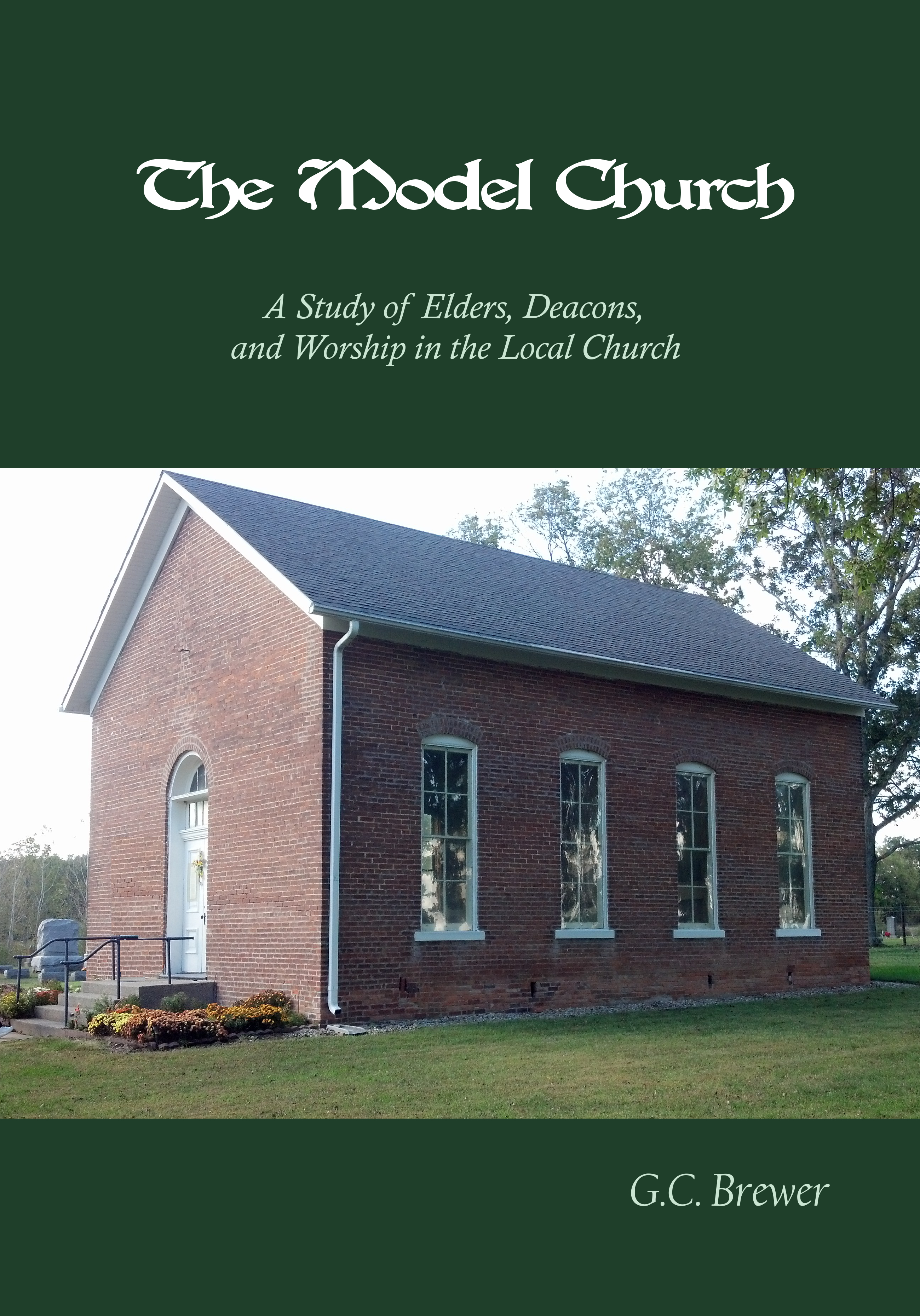
The Model Church

Sometimes, when people realize that I’ve made a lot of old brotherhood books available again (electronically and in print), they send me requests.  “Do you have this book?”  “Can you make this book available?”  And I think it’s great!  One of the ones that I get the most requests for is today’s addition to the Jimmie Beller Memorial eLibrary:

The Model Church by G.C. Brewer.

Here’s why: It is a good, succinct description of elders (and their qualifications), deacons (and their qualifications), and reverential worship in the church.

Having said that, brother Brewer did take the position in the book that female deacons were probably acceptable–so while there’s a lot in the book we agree with, there’s also that part that we don’t (we wrote an article that dealt somewhat with this here).  As always, compare everything with the word of God.

Here’s the chapters, to help give you an idea:


  1. What Constitutes A Congregation
  2. The Qualifications of an Elder
  3. The Duties of the Elders
  4. The Relation of the Overseen to the Overseer
  5. How Elders Are Made
  6. How Elders Are Unmade
  7. The Diaconate
  8. Dealing with the Disorderly
  9. Figuring on the Finances
  10. Church Music
  11. A Model Church
  12. Prayer-Meeting Topics

Because of the continual requests for this book, we are making it available in the Jimmie Beller Memorial eLibrary, but also in print for those who want to use it in their Bible classes or personal study.

To purchase the print edition, click here.

To read this book online, or save it for later enjoyment, simply click the link below!

The Model Church (G.C. Brewer)

-Bradley S. Cobb

A Disciple with “Horse” in His Name (Part 2)

Philip the Apostle

One night, the Lord spent hours alone with the Father in prayer; and afterwards, He called His disciples to Him.  From among those disciples, He selected twelve men to be His apostles.  Philip was certainly humbled and excited as he was selected to this important position.1

Following Jesus next to the Sea of Galilee shortly before the Passover feast, Philip looked around at a crowd of thousands who were gathering around.  Then Jesus looked at Philip and asked him a question in order to test him.  “Where shall we buy bread so that these people may eat?”  Philip, taking the Lord literally, answered, “Two hundred denarii of bread2 is not enough for them, that every one of them might take a little.”3  Philip trusted in his Lord, but didn’t realize that Jesus was testing his level of confidence in just how much power Jesus truly had.  When Jesus asked “Where will we buy bread,” Philip’s response was basically, “Forget about where to buy the bread, where are we supposed to come up with that much money?”  Andrew as well, bringing a boy with a very small amount of food, showed a similar lack of awareness of the immense power Jesus had.

About a year later, just days before Jesus died, a group of Greeks approached Philip, and said, “Sir, we want to see Jesus.”  Why they came to Philip instead of one of the other apostles is a matter of speculation,4 but it might just be that they saw him, knowing he was one of Jesus disciples and went to him—just like they might have done regardless of which disciple it was.  Philip probably remembered that Jesus had told the apostles not to go to the Gentiles, but only the house of Israel,5 and that Jesus Himself was only sent “to the lost sheep of the house of Israel,”6 and was hesitant about bringing a group of Gentiles to Him.  Instead, he conferred with Andrew, and the two of them together went to Jesus with the Greek’s request.  In response, Jesus gave a prophecy of His impending death.7

A few days later, after being with Jesus and the other apostles for the Last Supper, Philip heard Jesus again announced His departure (death).  Peter and Thomas both were confused about where Jesus was going and how they were going to go to where He was;8 and then Jesus responded with “I am the way, the truth, and the life: no man comes unto the Father except through me.  If you had known me, you should have known my Father also: and from henceforth you know Him and have seen Him.”9

It is at this point that Philip is confused.  Jesus has just told the disciples that they’d already seen the Father, and Philip’s response is, “Lord, show us the Father, and we are content.”10  In other words, “We’ve already seen the Father?  When?  Point Him out for us so we don’t miss Him.”  Some people have bad-mouthed Philip for being “ignorant” and “spiritually incapable”11 for not grasping the truth Jesus was teaching.  But how many among us can truly grasp the concept of the triune nature of the Godhead—three separate minds, yet still all one?  How many among us truly can grasp the idea of a member of the Godhead emptying Himself to live as a human?

That evening, Philip, along with ten other men, ran out of fear for his life, abandoning Jesus as the Jewish leaders, led by Judas, arrested Him.  After the resurrection of Jesus, Philip believed once more, repented of forsaking Jesus, and became a powerful force for the Kingdom of God.

The last time Philip’s name is mentioned is just before Pentecost, in Acts 1, where he was gathered with the rest of the apostles and disciples of Jesus.  He preached and baptized many people on the Day of Pentecost; was arrested and beaten some time later for preaching in the name of Jesus; and remained in Jerusalem during Saul’s rounds of persecution.  After the gathering in Jerusalem to discuss the issue of circumcision among the Gentile converts, Philip completely disappears from the biblical narrative.  But you can guarantee that God knows what happened.

The Character of Philip

Though there is not much evidence to go by, what little we have paints for us a picture of a man who was well-versed in the Scriptures and who had a very strong belief in the inspired words of God.  How else could Philip know that Jesus was the one “of whom Moses in the Law, and the prophets, did write”?

Philip was decisive.  He became a fully-dedicated disciple after hearing Jesus say “follow me.”  It’s probable that he asked Jesus some questions or sought more information (if he didn’t already know Jesus before that moment), but his decision was made the same day he was called.  In fact, the decision was made quick enough that he had time to go search out his friend Nathanael and bring him to Jesus as well.12

Philip wasn’t perfect.  Jesus tested him, asking how they were going to feed the 5,000 men, and Philip basically told Jesus, “We can’t afford to feed all these men.”  Philip didn’t yet have the confidence and full knowledge of the power of Jesus.  Later on, Philip told Jesus, “show us the Father, and it will suffice us,” and was told by the Lord, “When you’ve seen me, you’ve seen the Father.”  Like the other apostles, their knowledge and understanding of Jesus was not complete until the Day of Pentecost recorded in Acts 2.13

Philip was faithful.  He endured persecution as an apostle, yet rejoiced in the face of it.  Even years later, all the living apostles were held up by Paul as an example worthy of following.  His name is indeed inscribed on the holy city of God, the church!14

-Bradley S. Cobb

1 Luke 6:12-16.

2 This is the equivalent of 8 months’ wages.

3 John 6:5-7.  Some have suggested that this is how much money Jesus and the apostles had on hand, though it is much more likely this was simply Philip’s way of saying to Jesus, “How are we supposed to get that much money?”

4 Some say they came to him because he was known as a Gentile sympathizer, others because he had a Greek name, while others suggest that he had a Greek haircut and wore Greek clothing (see College Press NIV Commentary, New Testament).

5 Matthew 10:1-6.

6 Matthew 15:24

7 These events are recorded in John 12:20-33.

8 John 13:36-38; 14:1-5.  There are those (Lockyer, specifically) who want to accuse Philip of being “stupid” and “slow-witted” for his statement in 14:8, yet they won’t level the same charges against Peter and Thomas for their lack of understanding.  If Philip was “stupid,” then so were the other apostles.  The fact is, none of the apostles had complete knowledge until it was given to them from on high beginning at Pentecost.

9 John 14:6-7.

10 John 14:8.

11 Lockyer, All the Apostles of the Bible, page 160.

12 Herbert Lockyer horribly besmirches the name of this inspired servant of God by calling him, among other things, “a slow-witted plodder,” and “slow in arriving at a decision, reluctant to act on his own initiative” (All the Apostles of the Bible, page 157).

13 See their misunderstanding of the nature of the Kingdom of God in Acts 1, for instance.

14 Revelation 21:14.