In September, Jesse and I took a trip to Italy, to celebrate our 25th anniversary. Our almost-three-week holiday found us in Rome, Florence, and Venice (with two noteworthy side-trips). But without a doubt, Rome was what I’d been most excited to see.
The city oozes history. There’s even a 2,000-year-old pyramid there! We happened to see it as we rode the bus after worshiping with the saints on Sunday morning. No big signs pointing the way there. We had no idea it even existed until we passed it.
After getting our first taste of real Italian coffee (I’m hooked), we spent the first full day of our Roman stay walking (and later biking) along the Appia Antica (the Old Appian Way), the road Paul travelled on in Acts 28. It is mostly cobblestone, and there are sections of it where the stones (with ruts worn in them by chariots) date back to the first century.
There are ruins which date back to the years before Christianity, which means they were things Paul would have seen (presuming he was awake at that point, and paying attention to his surroundings). It was surreal, to put it mildly.
Along the Appian Way (which used to be outside the city limits of Rome) were a few (maybe more, but we didn’t count) catacombs, which were used as underground cemeteries. One of them had started as a rock quarry, which ceased production, and so people carved out burial chambers in them, starting in the second or third centuries. Among those buried there were many early Christians, including a guy named Sebastian (more on him in a few moments).
Sebastian was, by all counts, a martyr for the faith. For Christians in the following centuries, martyrs were heroes, legends, and it was very common for people to travel to the places where their heroes were buried, to pay respect to them. These pilgrimage sites later became commercialized by the Catholic Church, and basilicas were built over top of different catacombs, and other pilgrimage sites (ever wonder why there’s a Catholic Church built atop the place where they say Jesus was born?). So now, when pilgrims came to visit, they were encouraged to give money to help maintain this “holy” site.
The building atop the catacombs Jesse and I visited supposedly held the bodies of Peter and Paul for a short time, and so it bore their name for a while. Later, as the story goes, the bodies were moved, leaving Sebastian as the most famous citizen of the catacombs. The basilica is known as Basilica San Sebastiano (The Basilica of Saint Sebastian).
The historic record on Sebastian is not clear, but preachers in the 4th century used him as an example of being willing to die as a martyr (Ambrose is perhaps the earliest to mention him). In 354, a calendar of Christian feasts and days of veneration was produced, and Sebastian was celebrated on January 20th. Obviously, the story of his death was well-known among the believers.
Some later writers embellish the tale of his life and death, adding in obviously mythical details to add more supernatural elements. But here is what is more or less agreed upon:
During the reign of Diocletian, in the late 3rd century, Sebastian, a Christian (baptized for the remission of sins), joined the Roman military. Part of his duties including transporting Christians to prison—during which time he would (usually quietly) encourage them to stay faithful, because eternity with the Father and Son was worth it. He would tend to their injuries, and give them what care he could
He also converted other prisoners, as well as some of his fellow Roman soldiers.
His dedication and trustworthiness in his role as a soldier got the attention of folks higher up, and eventually he was elevated to a place in Diocletian’s Praetorian Guard (the emperor’s personal bodyguards). Though Diocletian had instituted a vicious persecution against Christians, Sebastian still carried out his duties with honor and dignity.
Somehow (it’s not clear how), Diocletian discovered that Sebastian—part of his own bodyguard—was a Christian. Think about that for a moment. You’ve publicly made Christians your enemy, and are willing to imprison and even kill them. And now, you find that one of them is a highly-trained soldier, armed, and if he wanted, had the means, training, and opportunity to kill you. If we take that mindset, it isn’t difficult to see why Diocletian ordered his execution.
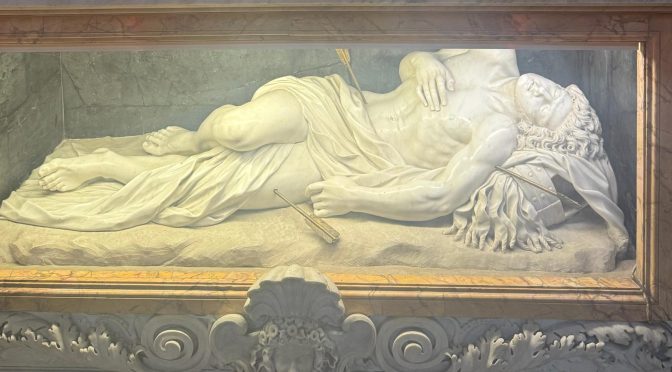
Sebastian was tied to a tree or a wooden post (accounts differ), most likely stripped naked as a way of shaming him, and Diocletian ordered his archers to shoot him with arrows.
Did the emperor have any regrets about it? I’d like to think so, but the rest of the story seems to indicate otherwise.
Sebastian was hit several times, and was assumed dead. A Christian woman came to get the body for burial, and discovered he was still alive, as none of the arrows had hit his vital organs. She cared for him in secret until he regained his strength.
Sebastian then went back into Rome, and hid near where he knew the emperor would pass. As Diocletian came by, Sebastian stepped out, and in full view of everyone began to chastise Diocletian for his wickedness and his persecution of Christians, and pleaded with him to repent of his sinfulness.
Diocletian was shocked at the outburst, at the chastisement, and at the fact that Sebastian wasn’t actually dead. But after he got over his shock, he ordered his men to grab Sebastian and beat him with clubs until he was confirmed dead. He then ordered Sebastian’s body to be thrown in the sewer.
What we see of Sebastian is a Christian, who honored the king, who cared for Christians, who taught the lost, and who desperately wanted wicked men to repent. We see someone who elevated Christ to the point he was willing to die for Him while pointing others to Him.
What we see in Rome, however. . .
The Basilica San Sebastiano, whose initial purpose was (supposedly) to be a place to worship Jesus, is filled with statues and images of Sebastian, mostly naked (private parts covered), his body impaled with arrows. The ceiling has a giant wood-carved mural with Sebastian as the centerpiece. On one side of the large “sanctuary” is an altar where you can light a candle in honor to Sebastian (like pinching incense to Caesar . . .)—and of course, they will sell you the candles to use.
They claim at least part of the post he was tied to is there as well (a relic—something connected with a “saint”).
In short, it is designed as a shrine to Sebastian, with a small sampling of Jesus on the side.
Jesse asked me, “What do you think Sebastian would have thought about this?” I didn’t hesitate—“He’d be horrified. He’d call this blasphemy.”
Sebastian would be outraged to see a church building designed to honor him alongside Jesus (let alone here, where Sebastian is actually honored more than Jesus, going by the amount of images and statues—and the name of the building).
I didn’t know about our brother Sebastian until we made this trip, but I’m glad I found out about him. His life is an encouragement, an example we can look to for dedication—but he would, like Paul, say, “follow me as I follow Christ.”