Category Archives: Books

Notes on 2 John 12-13 (Comments and Critiques Welcome)

Conclusion (12-13)

(12) Having many things to write unto you, I would not write with paper and ink: but I trust to come unto you, and speak face to face, that our joy may be full.

Having many things to write to you…

This letter is extremely short. Here, at the end of the letter, John is saying there are several things he could have added to the letter.

I’m not willing to write them with paper and ink

Another way of saying this is that there were many things he could have added, but he didn’t want to write them. The reason for this is made quite clear when he says he wants to come speak to them face-to-face. There are some things much better said face-to-face instead of in a letter.

But I trust that I will come to you and speak face to face

When you speak face-to-face with someone, as opposed to through a letter (or text message, or email, or some other written form of communication), it shows you care. Also, in person your tone, body language, and emphasis comes through. John may have had something very unpleasant things to say to them (see 3 John 9-10). John may have needed to talk to them about some things difficult to understand (see 2 Peter 3:15-16). He may have needed to have a discussion with them, to ask them questions and understand some things going on there. All of these things are much easier to do in person than by letter.

John had confidence, trust, he would be able to come see them. It is certain John prayed about it (James 4:15). We should follow the same example.

So that our joy may be full

The purpose of John’s planned face-to-face visit was to bring joy to them and to himself. We are given a clue in verse 4 about this. John rejoiced that the Christians were walking in truth. However, he didn’t say “all” of the Christians were walking in truth. Some of them were, but others were not. His plan was to go visit them, and possibly bring the wayward back to Christ. This would cause him great joy, but also bring great joy to the congregation as well. John’s joy always seems to center on the truth being followed (see also 1 John 1:1-4, especially verse 4).

(13) The children of thy elect sister greet thee. Amen.

The children of your elect sister greet you.

Since the “elect lady” of verse 1 is the church (perhaps specifically the congregation in Jerusalem), the “elect sister” would be the congregation where John was. Her children would be the members of that congregation.

They all send their greetings. This is the same word translated “salute” in Romans 16:16 (the churches of Christ salute you). It is more than just saying “hi.” It’s a greeting of friendship and fellowship.

Amen

This means “so be it,” or “I agree.” However, it is also used at the end of some of the Biblical letters to bring the letter to a close. It is a final re-emphasis of what’s been said, and showing John meant all of it.

Notes on 2 John 10-11 (Comments and Critiques Welcome)

How to Treat False Teachers (10-11)

(10-11) If there comes any unto you, and brings not this doctrine, receive him not into your house, neither bid him God speed: For he that bids him God speed is partaker of his evil deeds.

If anyone comes to you, and doesn’t bring this doctrine…

The Jews of the first century were extremely hostile towards Christians. As the end of the Jewish system got closer and closer, there were some who declared that the apostles made up the story of Jesus Christ. They said that Jesus was nothing more than a cunningly devised fable (2 Peter 1:16-18). That he wasn’t real! The Jews were doing everything they could to undermine Christianity.

This helps us understand why First John starts off with a defense of the reality of Jesus Christ’s coming to earth. John declares himself an ear-witness (“that which we have heard”), an eye-witness (“which we have seen”), and a hand-witness (“our hands have handled”).

So here in Second John, he is alerting the Christians to the Jews who were going around denying that the Christ had even come. This had the potential to destroy people’s faith, and therefore this threat must be taken seriously.

Don’t take him into house

Most translations have the word your inserted into this sentence, making it read, “Don’t receive him into your house.” However, the word your is not in the original. This is actually significant to understanding this verse.

The typical understanding of this verse is that if a false teacher comers around, don’t even let him into your house! This verse is used by some as justification for not allowing a Mormon or Jehovah’s Witness to cross the threshold of their doorway. But that’s not what John is saying.

The early church met in houses, in the home of one of the members. John is telling the Christians not to allow the false teachers to have access to the congregation. Don’t let them into the congregational gatherings. Don’t let them into the house where Christians are meeting.

The application for us today is that we should be aware of what others believe and teach before we welcome them into the congregation. We cannot give false teachers access to the congregation, because they have the potential of destroying the faith of some of the weaker or newer members.

It’s because of things like this that the early church sent letters of recommendation with members who were traveling or moving (I Corinthians 16:3, II Corinthians 3:1). This isn’t such a bad idea.

Don’t say God-speed to them, either

The word translated as God speed in the King James Version is translated as greeting in James 1:1, and as farewell in II Corinthians 13:11. But the vast majority of times, it is translated rejoice (as in Matthew 5:12). John even uses it that way in verse 4 of this letter.

This means don’t wish them well on their journey. Don’t say “good luck” to them as they go out spreading false doctrine. Don’t pray for their efforts. Don’t say anything to them that would make it seem like you approve of what they are doing. Why not?

Because the one who says God-speed to him is a partaker of his evil deeds.

Even if you don’t allow the false teacher access to the congregation, the instant you wish him good luck as he goes along destroying souls, you’ve shown your approval for his actions. And approval of sin is the same as if you had committed the sin (Romans 1:32).

But there is another way that you would become a partaker in their evil deeds. If you wish them well, they will go to other places and bring up your name as well. “Brother So-and-so wished me good luck.” And all of a sudden, your name has become attached to them and their teaching.

Be very careful about who you recommend and who you approve. When you show approval for someone, you are also showing approval for what they teach and what they do. This is most important in showing approval of Christians and recommending them to others.

But this principle also applies in other areas of life. When you vote for someone—especially if you encourage others to vote for him—you are showing approval for that person and the things he stands for. Obviously, you can’t know everything that person thinks, believes, and will do while in office. But if you know ahead of time that candidate supports homosexuality and abortion, and then you vote for him (bidding them God-speed), that makes you just as guilty.

Be very careful who you bid God-speed to.


Notes on 2 John 4-7 (Comments and Critiques are Welcome!)

Walking in the Truth (4-6)

(4) I rejoiced greatly that I found of thy children walking in truth, as we have received a commandment from the Father.

I rejoiced greatly

John frequently speaks of rejoicing. This fact alone should make us examine our lives. Are we the joyful people we should be? Do we rejoice in suffering (Acts 5:41)? Do we rejoice when we learn the truth (Acts 8:39)? Do we rejoice when we read the eyewitness accounts in the Scriptures, knowing we can have confidence in their accuracy and truthfulness (I John 1:1-4)? Do we rejoice when we hear about other Christians remaining faithful (III John 4)? Christians should be the most joyful people on the planet!

I rejoiced…that I found your children walking in truth

John’s specific reason for rejoicing is Christians were continuing to live faithfully. People frequently drift away from God’s word and place their opinions as the standard. Whether those opinions are binding where God never bound or loosing where God never loosed, or completely changing the message—either one means that person is no longer “walking in truth.”

Walking in truth is the same as “walking in the light” (I John 1:7). The inspired Psalmist said, “Thy word is a lamp unto my feet, and a light unto my path” (Psalm 119:105). It means you, dear reader, must base your life upon God’s precepts.

One man described it this way: God’s word lights the one and only path leading to heaven. You are wandering about in a world of darkness. Then you see this one lighted path. In that path is safety. In that path, you can see where you are going. It is a difficult path, to be sure, but it is well-lit. The light is God’s word. Walking in the truth or the light is the equivalent of following God’s commands from the heart. Only by that path can anyone reach the Promised Land of heaven. Why is it so many people choose to stay in darkness?

Why did this cause John to rejoice? When someone is “walking in the light” (I John 1:7) or “walking in truth,” he can have full assurance of heaven because all of his sins are forgiven him. John is rejoicing because he knows they will be in heaven! Wasn’t the entire point of the apostles’ mission to “go ye into all the world and preach the gospel to every creature” (Mark 16:15)?

The word found is the Greek word euraka (we get our word eureka from this). With all the people who had been falling away (see 2 Timothy 1:15), John rejoiced to hear of Christians remaining faithful.

Walking in truth…as a commandment of the Father

Walking in truth is not just something we should do; it is something we are commanded to do. John says walking in truth is a “commandment from the Father.” This should come as no surprise. It has been this way since the beginning. Adam and Eve were commanded to obey (Genesis 2:17). David said God’s grace is upon those who “walk uprightly” (Psalm 84:11). There must be a renewed emphasis on teaching others about the necessity of obedience. That does not mean we will ever obey perfectly; but if we do not obey at all, we are not walking in the light. If we are not walking in the light, our sins are not forgiven (I John 1:7). If our sins are not forgiven, we have no hope of going to heaven.

(5) And now I beseech thee, lady, not as though I wrote a new commandment to thee, but that which we had from the beginning, that we love one another.

I beseech thee

To beseech is to beg, to plead, or to urge someone to do something. It is not a commandment, as can be seen from Philemon 8-9, but instead an earnest request. It is interesting to see John begging them to keep the commandment of Jesus Christ: to love one another. He’s not commanding them to obey Jesus, but begging them to.

Not…a new commandment

John is not revealing something new to them. Like the prophets of the Old Testament, there were not new commandments for the Israelites to obey, but instead they were reminded to “remember the Law of Moses” (Malachi 4:4). In this letter from John to Christians, he is not giving them some new commandments, but telling them to “remember the law of Christ.”

From the beginning

This language is very similar to 1 John 2:7, “Brethren, I write no new commandment unto you, but an old commandment which you had from the beginning…”

Here in this passage, john says this commandment is something we (John, as well as the Christians he’s writing to) have had from the beginning. The Old Testament gave the command to “Love thy neighbor as thyself” (Leviticus 19:18). This command also became part of the New Testament. This one statement summarizes many of the Ten Commandments (Romans 13:9, Galatians 5:14). James called this the “royal law” (James 2:8).

This commandment was heavily emphasized in Jesus’ ministry. However, when Jesus gave this commandment, He called it a “new commandment” (John 13:34). The reason is, it is an even deeper, more powerful love commanded. Jesus said to “Love one another, as I have loved you.” Instead of just treating others the way you want to be treated, this new commandment was “be willing to die for each other.” Most people would not willingly die for a friend, let alone a total stranger. But this is the kind of love Jesus commands His disciples to show for each other.

John said which you had from the beginning, and he’s referring to either (1) the beginning of their Christian walk, (2) the beginning of Christianity itself, or (3) the beginning of Christ’s earthly ministry. The gist of his saying this, though, is to tell them this isn’t something new to them. It’s something they should already be doing, because they already knew it.

Love one another

As stated above, this commandment isn’t new, but is found clearly stated in the Law of Moses (Leviticus 19:18) and intensified in the New Testament. Jesus made this the badge of a true disciple (John 13:34-35). If one does not love his brother, he cannot honestly claim to love God (I John 4:20). Love for other Christians was also emphasized by John in verse 1 (see notes there).

(6) And this is love, that we walk after his commandments. This is the commandment, That, as you have heard from the beginning, you should walk in it.

This is love

The word “love” here is agape, a Greek word which describes sacrificial love, a mindful love. Agape doesn’t describe warm, fuzzy feelings towards someone else. Instead, it describes the conscious decision to put someone else first no matter what may come. John frequently writes about love, and every time, it has reference to putting someone else ahead of you.

That we walk after His commandments

Jesus clearly stated, “If you love me, keep my commandments” (John 14:15). Many in the world of so-called “Christendom” claim all you have to do is accept Jesus into your heart and then you are saved forever. Will Jesus save someone who refuses to keep His commandments? If you love Jesus, you will keep His commandments. If you don’t keep His commandments, then you hate Him. There is no third option.

Many people want to show the world how “loving” they are by accepting everyone and everything, and never speaking out against sinfulness or against those who are not in obedience to Christ’s commands. However, the Bible defines love as keeping the commandments. In Mark 10:21, Jesus looked at the rich young ruler; and the Scriptures plainly state Jesus “loved him.”  As a result of loving this man, Jesus pointed out where he needed to change. Love will not accept people in their sins, but will point out their sins so they can change. If we love others, we will point them to the truth and the need to obey His commandments.

That, as you have heard from the beginning, you should walk in it.

This walk is not a one-time event. It is a continuous lifestyle of obedience to Jesus Christ. All those who become Christians do so after hearing the gospel (Romans 10:17). But every New Testament writer emphasizes the necessity of continuing to obey. 1 John 1:7 says, “If we walk in the light…the blood of Jesus Christ…cleanses us from all sin.” Literally, it says “if we are walking [presently, continually] in the light…the blood of Jesus Christ…is cleansing us [presently, continually] from all sin.”

These Christians (and all Christians) heard these things from the beginning of their conversion. All Christians must continue to walk in these commandments if they expect to have their sins forgiven.


The National Church of America???

I was quite surprised to read that some people descended from the Restoration Movement actually made the claim that they were the closest thing to a national church in America that there was–and that they foresaw the day when that vision became a reality, where all the denominational groups would join together with them.

Now, some might scoff at that statement and say that the Campbells looked to unite all the denominations into one body, and that I just don’t know my history.

No, there’s a difference.  The Campbells were trying to stop the division among the denominations based on clear teachings of the word of God.  These people I’m talking about took pride in saying that none of the sermons they preached would be offensive in any denomination.  They took pride in saying that they were the only church who weren’t offensive to anyone, and who would accept anyone, so long as they would acknowledge the Bible as the word of God (whether they accepted what was written in there apparently didn’t matter, as we’ll see momentarily), and displayed a Christian attitude.

If they accepted infant baptism, sprinkling or pouring as baptism, or rejected baptism completely, it didn’t matter.  If they used instruments and women preachers, no big deal.  Ignore the Lord’s Supper?  Who cares! As long as you take the word of God and act nice, you’re more than accepted!

We have brethren today who may not be as far gone, but they’re getting close.  In the name of “Christian Unity,” they are willing to ignore anything “doctrinal,” anything to do with worship, leadership roles, and even things the Scripture clearly connects with salvation, and just proclaim to people that their sins are all forgiven and that they have a home eternally with God awaiting them–WITHOUT OBEYING THE GOSPEL!

The people that brought this post about were the early 20th Century descendants of the Christian Connexion.  In 1911, Martyn Summerbell gave a short lecture called “An Address on the Origin and Principles of the Christians,” and in it he made the claim that the “Christians” were the only ones who could bring together all the denominations.

Perhaps they could.  But bringing together all the denominations into one body still doesn’t make them the church if they haven’t come to the Father through Jesus Christ in obedient faith which exhibits itself in repentance, baptism, and a faithful life in service to our Lord.

The address, fully reformatted and corrected (and searchable) can be downloaded below.

Address on the Origin and Principles of the Christians (Martyn Summerbell)

-Bradley S. Cobb

So…You’re a Unitarian, Right?

Misrepresentations and misunderstandings abound regarding the church.  “You hate music.”  “You hate women.”  “You think water is more powerful than the blood of Jesus.”  I’ve heard all these and more spouted by our “loving” and “understanding” denominational friends.

One I haven’t heard is “You’re a Unitarian.”

For those who don’t know, a Unitarian is someone who believes that Jesus Christ is not deity (that designation only applying to the Father), that there was a time when Jesus was not (i.e., he was created), and that the Holy Spirit is a thing or a force, not a conscious being.

Today, there are some small groups who hold that belief, and then there’s the so-called Jehovah’s Witnesses, who are probably the biggest group of Unitarians claiming to be Christ’s in existence today (note: one could make the argument that Muslims might fall into this category, but as they don’t claim to be Christ’s, they aren’t being considered).

Why bring this up?  Because back in the 1800s, some of the people involved in the Restoration Movement–people associated with Barton W. Stone, James O’Kelly, and others–had to defend themselves against this accusation.

The problem arose because of some rather bold and self-promoting preachers in New England began to publicly espouse Unitarianism.  One of them, Simon Clough, had become editor of one of the prominent papers in the Christian Connexion, and published a letter written to introduce the “Christian Church” to a Baptist group in England.  In that letter (which can be seen here), he declared that the Christians were Unitarian in sentiment.

The problem was that this wasn’t as widespread as Clough was letting on.  In fact, this stance was viewed as heretical and anti-Christian by most of the “Christian Church” in the southern and western states.

So, when a Methodist preacher wrote a book declaring all those in the Christian Connexion as Unitarians, it required a response.

W.B. Wellons, a preacher and editor for the Christians in the southern states, took up the charge, and entitled his book “The Christians, South, Not Unitarians.”

In it, he exposes the faulty reasoning of attributing to all, the views of a few; he explains why they believe in the Godhead, the Deity of Jesus Christ, and the Personality of the Holy Spirit, but refuse to use the theological word “trinity” or subscribe to the historic creedal descriptions and definitions of the Trinity.

For those interested in Restoration Movement history, this book highlights some of the theological issues that caused Alexander Campbell concern, and caused Barton W. Stone problems.  Understanding the topic contained therein helps to explain why much of the New England branch of the Christian Connexion didn’t join in the union between the “Reformers” and the “Christians,” as well as why there was a distinction between the southern and northern “Christians” who had years earlier given each other the right hand of fellowship.

In all, it is an interesting read from both a historical and theological perspective.

And you can download it below in a fully-reformatted, corrected (and searchable!) edition.

Enjoy!

The Christians South, Not Unitarians (W.B. Wellons)

New Additions to the eLibrary

TWO NEW BOOKS!

Chester Estes was a fine man, and perhaps an even better preacher.  In his life, he wrote untold numbers of articles and sermons; and also wrote commentaries.  He even did his own translation of the Bible!

He also wrote some other books, one of which is being added today to the Jimmie Beller Memorial eLibrary.  It’s called “What is Truth?”

The eBook that you can download below is a scan of the original book.  I realize that isn’t our normal operating procedure (usually we completely reformat and proofread/correct every book we post), but hopefully you’ll forgive us for giving you the original this time.  🙂

What is Truth? (Chester Estes)

Now, for the people who really want to dig deep on the myth of evolution, we are presenting a booklet called “The Man from Monkey Myth,” written by Douglas Dewar.  This was originally published in a magazine in 1944, and later reprinted by James D. Bales as part of a campaign against evolution.

Dewar speaks the scientists’ language, as he shows their conclusions are unwarranted and untrue.

Fully reformatted and searchable, you can download it by clicking the link below.

Man from Monkey Myth (Douglas Dewar)


Great Preachers of the Past

Guy N. Woods, Gus Nichols, Franklin Camp, Batsell Barrett Baxter, Cleon Lyles, David Lipscomb, G.C. Brewer, N.B. Hardeman, H.A. Dixon, G.K. Wallace, Foy E. Wallace.

What do these names have in common?  They are all subjects of chapters in the book, Great Preachers of the Past!

And thanks to the kind folks at the Southeast Institute of Biblical Studies (formerly East Tennessee School of Preaching), we are making it available as a free download in the Jimmie Beller Memorial eLibrary.

And if you’re wondering who wrote this book?  Here’s the list of authors:

  • J.E. Choate
  • E. Claude Gardner
  • Alan Highers
  • Robert Taylor, Jr.
  • James W. Boyd
  • Garland Elkins
  • William Woodson
  • Richard England
  • Carroll C. Trent
  • Bobby Duncan
  • Willard Collins

To read it online, or to download for later perusal, just click the link below!

Great Preachers of the Past

A History of the Christian Connexion

Yes, we are still alive and kicking (though not so high right now, after some of us got badly sunburned on the feet…).  We don’t have any news to report, except that God is taking care of us quite well (as always) while we are trying to figure out where he wants us to be.

Today, I realized that there are some books that I had already prepared to be added to the Jimmie Beller Memorial eLibrary, and simply forgot to actually add them.  So, today, you get a short book called “An Account of the Christian Denomination in the United States” by Simon Clough.  Clough was a preacher in the “Christian Connexion,” which boasted Abner Jones and Elias Smith as some of its most prominent early preachers.

In essence, it is a letter written in 1827 to explain their beliefs, history, and practices in response to the inquiry of the General Baptists of England.

It was just four years later that a large segment of the Christian Connexion (the part which worked with Barton W. Stone) formally united with the “Reformers” (including Alexander Campbell, Raccoon John Smith, and Walter Scott,).  Clough, however, was not a party to this union, and actually opposed it.

The book can be read online or downloaded by clicking the link below:

An Account of the Christian Denomination (Simon Clough)

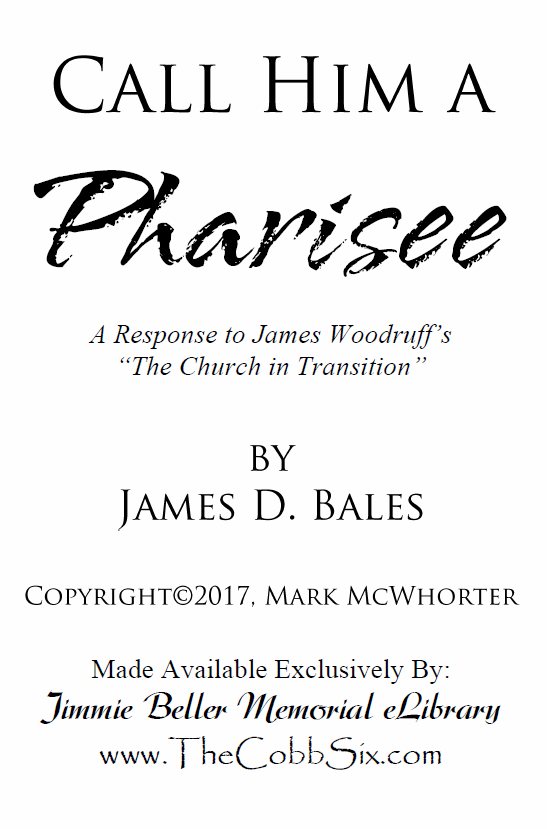
Call Him a Pharisee

Earlier this month, we told you about a bunch of unpublished manuscripts by James D. Bales which we are working to make available to the masses.

Today, we present to you the first one… and it’s FREE.

Bales-CallPharisee

Call Him a Pharisee was written in response to James Woodruff, whose book, The Church in Transition, accused the church of only preaching half a gospel, of being “astray,” and of being Pharisees.  In this short book, Bales shows what a Pharisee is, and debunks Woodruff’s theories  accusations against the Lord’s church.

This book is copyright, 2017, Mark McWhorter, and is being made available as a free digital download, exclusively from your friends at TheCobbSix.com

Just click the link below to download or read online:

Bales – Call Him a Pharisee

-Bradley S. Cobb