Category Archives: Books

Alexander Campbell’s Commentary on Acts

Back in the mid-1800s, Alexander Campbell received the ire of many religious bodies for having the audacity to produce a new translation of the New Testament (Because, they would say, God Himself inspired the translators of the King James’ Version).  In the first edition, he took most of the translation from various well-respected commentaries (George Campbell [no relation], MacKnight, and Doddridge) and edited it together in one volume.  In the second through fourth editions, he made several changes, seeking to have more uniform translating principles throughout.

It’s really interesting to note the background given above, because some years later, the Baptists organized a translation committee with some other religious groups (including the Disciples) called The American Bible Union.  And they recognized that Campbell was no slouch when it came to knowing the original language–so they chose him to translate Acts of Apostles.

As each book was translated for the A.B.U., it was published and distributed for comment, and it would then be revised prior to its inclusion into the finalized New Testament.

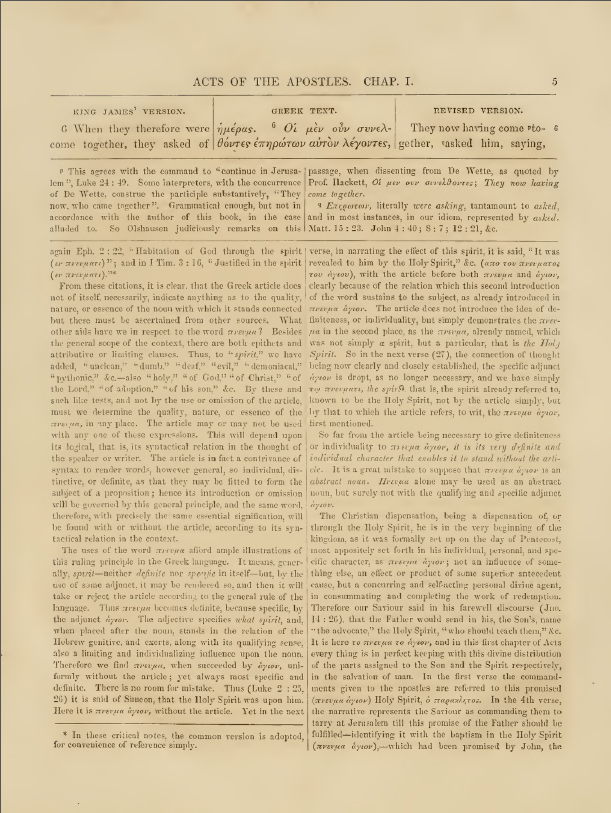
Alexander Campbell’s translation of Acts was published in a large size (8 1/2 x 11), with his commentary included–and was nearly 240 pages long.  This commentary is different from what you would expect.  It included the following features:

  • The King James’ Version text of Acts
  • The Greek original of Acts
  • His “Revised Version” of Acts
  • Translation notes on all three.

CampbellActsInside

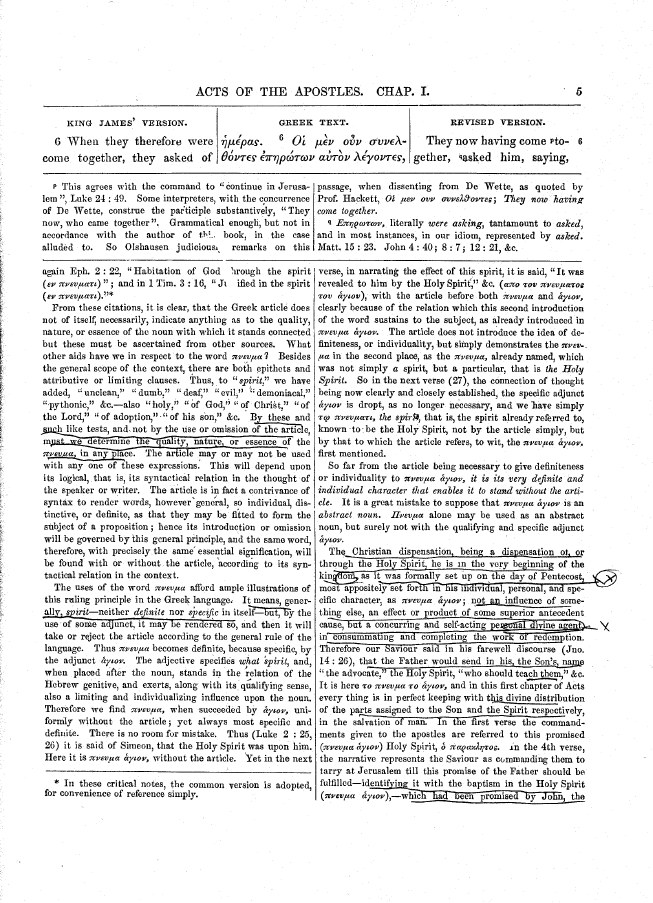
Because of the sheer amount of Greek, and the amount of notes (see picture above), we have decided to add this book to the Jimmie Beller Memorial eLibrary as published, and not attempt (at this time) to do any updating to to it (as we have with all the other books in the library).  It would just be too overwhelming of a project for now, but we want to get this book out for as many people as possible to enjoy.

Now, pay attention here, because we’re giving you two options:

The higher quality scan, as seen in the image above, is too large for us to upload to our website (115 Meg), so you will have to download it from a special link (no worries).

The second option is black/white, and is 1/10 the size of the other one, and while it is easier to read, it has a LOT of underlining and notes in the margins (This was a scan we made from Jimmie’s personal copy).  Note the picture below is the same page as the picture above, from the other copy.

CampbellActsInside(1)


To download the higher quality version, click the link below:

Alexander Campbell’s Acts of Apostles (HQ)

To download the B/W version (easier to read, other than the underlining and notes), click this link below.

Campbell, Alexander – Acts of the Apostles

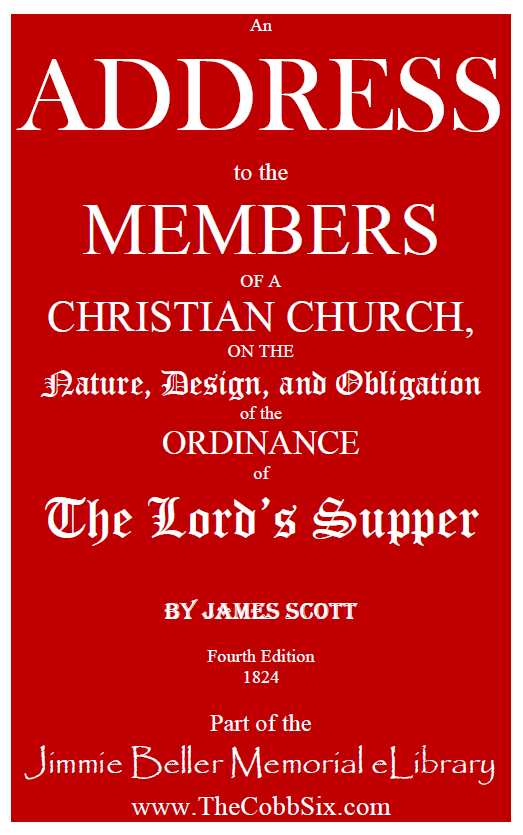
An Address on the Importance of the Lord’s Supper

Sometimes you stumble upon a book by accident, and it becomes a blessing, helping you to grow as a result.  I’ve opined before about how the Lord’s Supper, in some congregations, is given a diminished importance, when it should be the focal point of our Lord’s Day gathering (see that article here).  This was something that was a problem almost 200 years ago as well.

Today’s addition to the Jimmie Beller Memorial eLibrary is a short book (just 16 pages), but it is full of valuable observations about the importance of the Lord’s Supper in the life of a Christian.

AddressOnLordsSupper

Now, I’ll tell you ahead of time, I don’t know the religious background of the author, and I don’t agree with some of his interpretations of a couple passages.  But there are enough good points in this book that we thought it to be well worth sharing with you.  Here’s a couple short excerpts:

The institution itself is well adapted to commemorate this interesting event. The broken bread is a just and striking emblem of the body of Christ, which was wounded and crucified; and the cup of wine is an effectual memorial of his blood shed for the remission of sins; it also reminds us of the obligations and blessings of the new covenant which was sealed and ratified by his blood. And by partaking of these elements, the disciples of Jesus are naturally led to reflect upon the relations in which they stand, and the duties which they owe to their common Lord, and to each other.

and

We live in a state of frailty and imperfection; the objects of sense have too much influence upon our minds; and kind and amiable as the friend of sinners is, we are too apt to forget him. But Jesus well knew that a constant affectionate remembrance of him at his table, would inspire his followers with a penitential sorrow for sin, kindle in their bosoms an unfeigned ardent love to him, a lively gratitude for the blessings they derive from his gospel, animate them with heroic zeal and fortitude in his cause, unite them to each other in the bonds of undissembled affection, and that it would induce them to aspire to the highest attainments in universal excellence. The celebration of the Lord’s Supper tends to perpetuate the memory of his sufferings and death, not only in our own hearts, but also in the church and in the world. By frequenting his table, we openly profess our value and esteem for a crucified Redeemer; show that we are not ashamed of our Master, but glory in our relation to him; that we are not ashamed of his gospel, but obedient to its requisitions, and that we are not ashamed of his cross, but cheerfully enlist ourselves under its banner.

We’ve gone through this book, updating the spelling and punctuation, correcting any mistakes, and reformatting the entire booklet to give you the best possible reading experience (trust me…you should have seen what we had to work with to begin with…it was a MESS!)

To read or download this book, just click the link below!

Scott, James – Address on the Lords Supper (James Scott)

-Bradley S. Cobb

The Man Behind “The Last Will and Testament of the Springfield Presbytery”

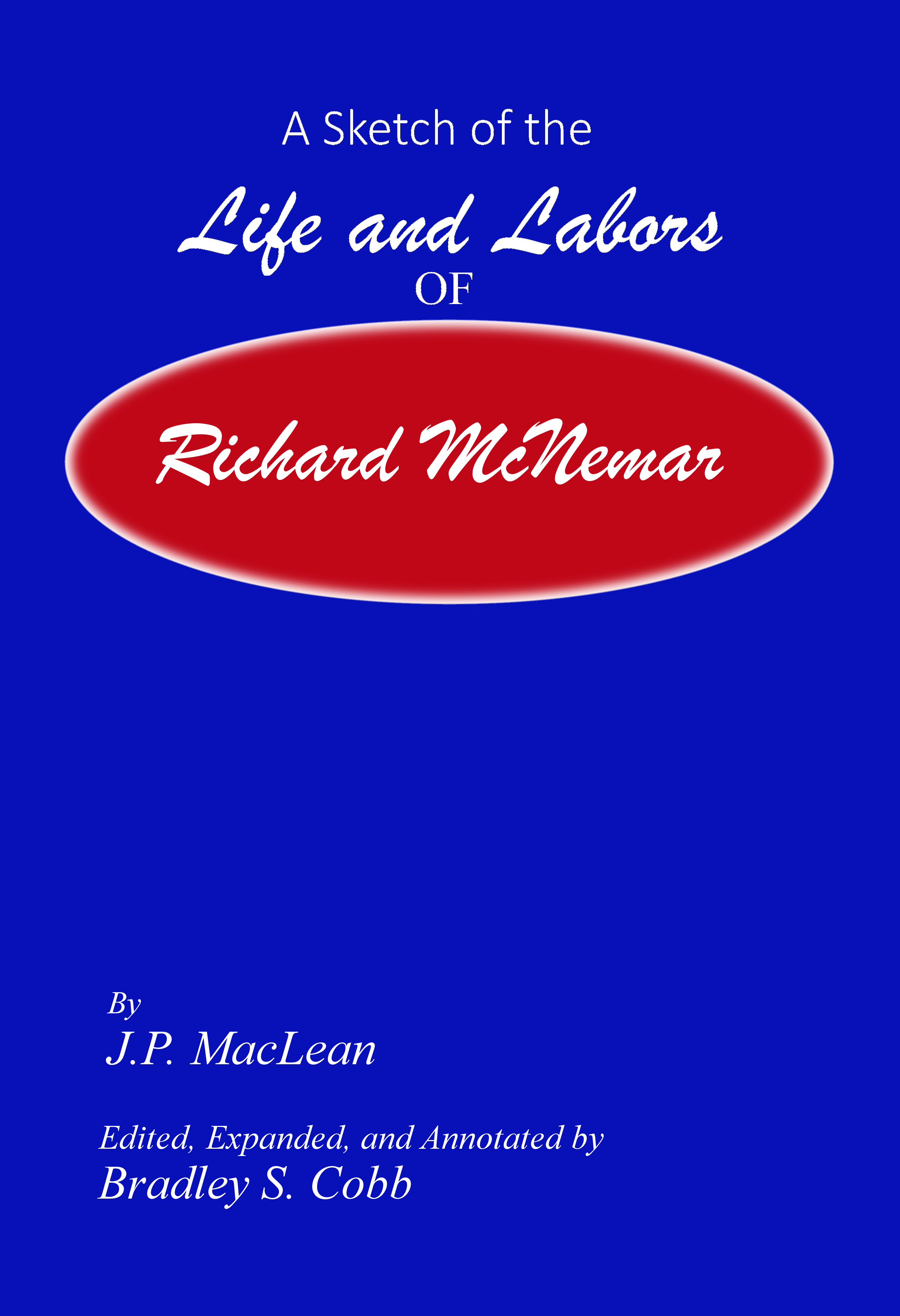
Most Restoration Movement enthusiasts and experts rank the “Last Will and Testament of the Springfield Presbytery” as perhaps the most important document in the effort to restore New Testament Christianity (or at least the second-most important).  The man who was behind this document is rarely mentioned, though.  His name is Richard McNemar.

Today’s addition to the Jimmie Beller Memorial eLibrary (yes, I know this is Monday, but we’re feeling generous, and I’m behind on my apostles notes) is the rest of the story.

McNemar Cover


We first published this book back in 2014, and if you want it in print, we’ll be happy to sell you a copy (just $5.99), but now you can read it for FREE on your computer or electronic device.

I’m sure you want to know something about it, so here’s a bit of information:

From the Preface:

Richard McNemar is an enigma to many students of the Restoration Movement. He shows up as a co-worker with Barton W. Stone, and his name is on one of the most historically significant documents of the Restoration. Yet he is not much more than a footnote in the history books. This primarily stems from his conversion to Shakerism in 1805. However, for those students who want to know more about him, and want to know what happened to him after the Last Will and Testament of the Springfield Presbytery, this book is for you.

This is a sad tale of a preacher who had great potential, but who was caught up in false doctrines.

The author of the book (J.P. MacLean) was a historian of the Shakers (publishing several Shaker-related books), and a Universalist minister from Ohio. Since much of McNemar’s work as a Shaker was in Ohio, it caught MacLean’s attention and influenced him to put together this work, originally published in 1905.

This work on the life of Richard McNemar has undergone several editorial changes in spelling, punctuation, and formatting.  Additionally, several footnotes have been added to explain various words and phrases that aren’t familiar to most readers.   There is also a new section added to the end of the book which gives a very brief overview of the history and beliefs of the Shakers.

We do trust, however, that you will find this work, A Sketch of the Life and Labors of Richard McNemar to be interesting, and that it will help you know “the rest of the story.”

Contents:

Preface.
Chapter One: Early Life.
Chapter Two: Charges of Heresy.
Chapter Three: The Kentucky Revival
Chapter Four: Conversion and New Order
Chapter Five: An Account of Labors and Suffering.
Chapter Six: Travels and Special Missions.
Chapter Seven: Literary and Other Industries.
Chapter Eight: Persecution, Expulsion, Triumph, and Death
Bibliography.
Appendix: A Brief Overview of the Shakers

Published by Cobb Publishing, 2014.

To read this book or download it for your PDF collection, just click the link below!

Richard McNemar

-Bradley S. Cobb


As Touching Those Who Were Once Enlightened…

Two men, once prominent in the Lord’s church, announced that they were leaving and joining a denomination.  On their way out, they tried to verbally attack the bride of Christ, throwing many accusations (with no evidence), and in effect condemning (and denying the intelligence and honesty of) the very people with whom they had labored for a quart of a century!

Not only did they say these things, they also put it in print for people all over the country to read.  This was in 1946.

Today’s addition to the Jimmie Beller Memorial eLibrary is a book that was written in answer to their accusations, insinuations, and outright misrepresentations.

The full title of this work is:

As Touching Those Who Were Once Enlightened

Being a Review of the Reasons Given by Two Former Friends and Co-Laborers When they “Went Back and Walked No More With Him.”

A brief history is given, including the full text of the letters written by the two men in question (brothers Reedy and Etter), and then Brewer answers their charges, and shows the flaws in their excuses so that other Christians wouldn’t be led astray by them.

This might not be every person’s cup of tea, but the book is still very relevant, for there are preachers in the Lord’s church who are making the same statements as Reedy and Etter made 70 years ago.

As usual, this book has been completely reformatted, corrected, and made pretty to give you a more pleasant reading experience.

Click the link below to download!

As Touching Those Who Were Once Enlightened (GC Brewer)

Keeble, DeHoff, Turner, Baird, Lightfoot, Gatewood and More!!!

There is a wealth of material from great preachers of the past that sit on bookshelves — unused and unread.  Like many of the others, this one deserves your attention!

1957Harding_Cover


The whole theme of this lectureship, back when it was still Harding College, was “The New Life in Christ.  And as you’ll see from the speakers and the topics, it was a good one!

We won’t say anything else about it, as we believe the contents speak for themselves.  The link to read it online or to download it to your electronic device of choice is at the bottom.

Special thanks to Ivy Cobb for her proofreading skills.

Contents

  1. THE MEANING OF THE NEW LIFE IN CHRIST
    (Cleon Lyles)
  2. GOD — THE SOURCE OF ALL LIFE
    (Pat Hardeman)
  3. CHRIST HAS MADE POSSIBLE THE NEW LIFE IN HIM
    (Joe Sanders)
  4. FAITH IN CHRIST
    (Royal H. Bowers)
  5. REPENTANCE FROM PAST SINS
    (Rex A. Turner)
  6. CONFESSING CHRIST
    (Wilburn C. Hill)
  7. BAPTIZED INTO CHRIST
    (Charles Hodge)
  8. PUTTING OFF THE OLD MAN
    (Stephen Eckstein)
  9. PUTTING ON THE NEW MAN
    (Gaston Cogdell)
  10. ALL THINGS BECOME NEW: Continual Growth in The New Life
    (J. Roy Vaughan)
  11. “THE BIBLE—THE PRESENTATION OF THE NEW LIFE IN CHRIST”
    (George W. Bailey)
  12. THE MIND OF CHRIST
    (James O. Baird)
  13. COMPLETE DEDICATION TO CHRIST
    (F. W. Mattox)
  14. “ADD TO YOUR FAITH VIRTUE”
    (Robert D. Bankes)
  15. “ADD TO YOUR VIRTUE KNOWLEDGE”
    (Morris M. Womack)
  16. TEMPERANCE
    (L.L Gieger)
  17. IN YOUR FAITH SUPPLY PATIENCE
    (R.B. Sweet)
  18. TO YOUR PATIENCE GODLINESS
    (Neil R. Lightfoot)
  19. TO YOUR BROTHERLY KINDNESS
    (Olan L. Hicks)
  20. TO YOUR BROTHERLY KINDNESS LOVE
    (James G. Moffett)
  21. THE CHURCH, THE CORPORATE EXPRESSION OF THE NEW LIFE IN CHRIST
    (Ruel Lemmons)
  22. EXPRESSION OF WORSHIP AS A MEANS OF SPIRITUAL DEVELOPMENT
    (Paul W. Rotenberry)
  23. FURTHER EXPRESSION OF WORSHIP OF THE NEW LIFE IN CHRIST—LORD’S SUPPER AND GIVING
    (Joseph W. White)
  24. SOME FRUITS OF THE SPIRIT: Joy and Peace
    (Gussie Lambert)
  25. LONGSUFFERING, GOODNESS, KINDNESS
    (Jimmy Allen)
  26. FAITHFULNESS, MEEKNESS, AND SELF-CONTROL
    (Emmett Smith)
  27. THE NEW LIFE IN CHRIST AND THE EVANGELIZATION OF THE WORLD
    (Otis Gatewood)
  28. POLAND AND RUSSIA
    (R. J. Smith, Jr.)
  29. OUR MISSION WORK IN NORTHERN RHODESIA
    (J. D. Merritt)
  30. OPPORTUNITIES IN NIGERIA
    (Wendell Broom)
  31. THE CAUSE OF CHRIST IN JAPAN
    (Colis Campbell)
  32. THE CHALLENGE OF CHRISTIAN EDUCATION
    (George W. DeHoff)
  33. THE HOPE OF THE NEW LIFE IN CHRIST
    (Marshall Keeble)

We hope you enjoy this great book!

Harding College Lectures (1957)

Sadduceeism

Lately, there has been an increase in preachers of the gospel who have begun to advocate the idea (at least in private, though some have done it openly) that the wicked will be annihilated after the judgment.  By that, they mean that the souls of the wicked will simply cease to exist, and that eternal nothingness is their punishment.

In other words, the atheist who says there is no God, and who says that he will cease to exist–is right!?!

I will not venture to assign motives to these brethren for holding this belief.  It has been admitted by others who hold this view that they did it because they couldn’t reconcile the idea of a good God punishing someone eternally for a relatively short life of sin.  Yet they have no problem accepting the idea that God could bless someone eternally for a relatively short life of faithfulness.

I shall get off my soapbox now.

This isn’t a new issue.  In 1860, a man by the name of Israel Warren, a Congregationalist preacher, wrote a book dealing with the issue, and called it “Sadduceeism.”  We believe that overall it is a good book dealing with this doctrine, and so we are adding it to the Jimmie Beller Memorial eLibrary!

We’ve given it the same treatment as our other books.  It’s been proofed, corrected, and reformatted in order to give you the best possible reading experience!

To read it online or download for later perusal, click the link below:

Sadduceeism (Israel P. Warren)

Jesus’ Inner Circle: James (Part 4)

The Death of James

James is specifically mentioned just three times after the resurrection of Jesus.  He’s among the apostles who spent all night fishing, catching nothing until Jesus (the next morning) told them to let the net down on the right side of the ship.  Then they caught so many fish, they couldn’t bring the net into the boat.  James was one of the apostles who helped bring the boat to shore, dragging this massive catch with them.  Then Jesus invited James and the others to “come and dine,” which they did.1

Just a matter of days later, James watched as Jesus ascended into heaven after telling all the apostles to stay in Jerusalem until they received the Holy Spirit.  He went into an upper room with his fellow-apostles and other disciples where a replacement was chosen for Judas.  Then, on the Day of Pentecost, the Holy Spirit came upon James and the other apostles, and they all began to preach the word of God in different languages.  No doubt, James spent a large part of that day happily baptizing some of the 3,000 who gladly received the word of God.2

But things didn’t continue on their positive streak.  Saul of Tarsus and the Jewish leaders stirred up the people in antagonism against the church.  Herod the king, who wanted the Jews to like him, began to persecute the church.3  Some of them he arrested,4 and James was among them.  Since James was a leader of the church, Herod had him killed with the sword.5

So ends the life of a man who was Jesus’ cousin, Jesus’ disciple, and Jesus’ friend.

Traditions About James

Since his life ended in AD 42-44, and the Bible records it, there’s not much in the line of traditions about this member of the “inner circle.”  One writing says that “Zebedee was of the house of Levi, and his wife of the house of Judah.  Now, because the father of James loved him greatly, he counted him among the family of his father Levi, and similarly, because the mother of John loved him greatly, she counted him among the family of her father Judah.  And they were surnamed ‘Children of Thunder,’ for they were of both the priestly house and the royal house.”6

A writing that claims to be written by Clement (the man mentioned in Philippians 4:3) records this incident:

But a certain Samaritan, speaking against the people and against God, and asserting that neither are the dead to rise, nor is that worship of God to be maintained which is in Jerusalem, but that Mount Gerizim is to be reverenced, added also this in opposition to us, that our Jesus was not He whom Moses foretold as a Prophet to come into the world. Against him, and another who supported him in what he said, James and John, the sons of Zebedee, strove vigorously; and although they had a command not to enter into their cities, nor to bring the word of preaching to them, yet, lest their discourse, unless it were confined, should hurt the faith of others, they replied so prudently and so powerfully, that they put them to perpetual silence. For James made an oration concerning the resurrection of the dead, with the approbation of all the people; while John showed that if they would abandon the error of Mount Gerizim, they should consequently acknowledge that Jesus was indeed He who, according to the prophecy of Moses, was expected to come; since, indeed, as Moses wrought signs and miracles, so also did Jesus. And there is no doubt but that the likeness of the signs proves Him to be that prophet of whom he said that He should come, ‘like himself.’ Having declared these things, and more to the same effect, they ceased.7

The Acts of James in India says that James and Peter went to preach to the Jews in India, where they healed a blind man, were imprisoned, were released, and converted the people.8

The Martyrdom of James says that the son of Zebedee preached to the diaspora, the twelve tribes who lived outside the Promised Land, convincing them to give their “first-fruits” to the church as opposed to Herod, which then led to the murder of James by Herod.9

-Bradley S. Cobb

1 This incident is recorded in John 21:1-14.

2 These events are recorded in Acts 1 and 2.

3 Josephus, Antiquities of the Jews, 18-19, says that this Herod (Herod Agrippa I) was zealous for the Jewish law.  He, like his grandfather, Herod the Great, wanted the Jews to like him.  This is why he persecuted the church, and why he continued when he saw that killing James please the Jews.  See Chuck Northrop’s comments on Acts 12:1-2 in Preaching School Notes (Bible Institute of Missouri) for e-Sword.  Available at TheCobbSix.com.

4 See The NET Bible footnotes on Acts 12:1.

5 Most likely, this means that he was beheaded.

6 See The Genealogies of the Twelve Apostles in Budge, Contendings of the Apostles, Vol. 2, page 49.

7 The Recognitions of Clement, Book 1, chapter 57.  This writing is classed among the pseudo-Clementine literature, because its authenticity is rejected by almost all scholars.  It can be found in The Ante-Nicene Fathers, Vol. 8, page 92.

8 See The Acts of James in India, in Budge, Contendings of the Apostles, Vol. 2, pages 295-303.  This work, among other things, seeks to elevate the status of Peter, having James call him “my father” multiple times.

9 See Budge, Contendings of the Apostles, Vol. 2, pages 304-308.  This writing is shown to be a forgery because it is historically inaccurate.  James was killed between AD 42-44, yet The Martyrdom of James claims that James was teaching people not to serve Nero—who was at that point no more than seven years old, and who wouldn’t become emperor for at least another ten years.  See also International Standard Bible Encyclopedia, “James.”

Jesus’ Inner Circle: James (Part 3)

James of the “Inner Circle”

The idea of an “inner circle,” a group closer to Jesus than the rest of the apostles, first appears the next time James shows up in the biblical record.  There are three times where Jesus specifically separated James, Peter, and John from the rest of the apostles and had them join Him for an important event.

Jairus’ Daughter Raised

Jesus returned to Galilee where a crowd of people had been waiting for Him,1 and a man named Jairus, the ruler of the synagogue, fell to Jesus’ feet and begged Him, “My little daughter lies at the point of death; come and lay your hands on her so that she might be healed; and she will live.”2  Jesus, along with His disciples and a mob of people, followed Jairus towards his house; but then Jesus stopped, turned around, and said, “Who touched me?”3  James looked around at the massive crowd that was “thronging” Jesus, and in effect said, “What do you mean?  Everyone’s touching you!”4  But Jesus saw the woman who had touched the hem of His garment, and told her “Daughter, your faith has made you whole; go in peace, and be whole of your plague.”5

Then someone from Jairus’ house came and said, “Your daughter is dead, why trouble the Teacher anymore?”  Jesus responded by telling Jairus, “Don’t be afraid, just believe.”6 It is at that point that Jesus hand-picks James, his brother John, and Peter to be the only ones who are permitted to follow Him to the house.  And when they got to the house, finding people weeping and mourning, Jesus told them “Why are you making this noise and weeping?  The damsel didn’t die, but is sleeping.”  When the people mockingly laughed at Jesus, He sent them all out, only allowing James, Peter, John, and the girl’s parents to come into the room and see what He would do.  Then He took the girl by the hand and said, “Maid, arise.”  And she came back to life.  This was followed by a command not to tell anyone what happened.7

The Transfiguration

Some time later, Jesus took James (along with Peter and John) up to a mountain where He prayed.  Then something happened.  Jesus’ face began to shine like the sun,8 and His clothing was white as the light.9  But James, John, and Peter were extremely tired and had fallen asleep while Jesus was praying.  When they woke up, they “saw His glory” and they saw Moses and Elijah standing with Jesus, talking to Him.10  James was silent, but he watched as Peter said to Jesus, “It’s good for us to be here.  If you want, let us make here three tabernacles; one for you, one for Moses, and one for Elijah.”11

Then a [bright] cloud overshadowed them: and they feared as they entered into the cloud.  And there came a voice out of the cloud, saying, “This is my beloved Son, [in whom I am well-pleased]. Listen to Him.”12

And when the disciples heard it, they fell on their faces and were very afraid.  And Jesus came and touched them, and said, “Arise, and don’t be afraid.”  And when they had lifted up their eyes, they saw no man except Jesus only.13

And as they came down from the mountain, He charged them that they should tell no man what things they had seen until the Son of man was risen from the dead.  And they kept that saying with themselves, questioning one with another what the rising from the dead should mean.14

On the way down the mountain, James and the other two asked Jesus about the scribes’ contention that Elijah must come first.  After hearing the Lord explain that the scribes were right, but that Elijah had already come, understanding washed over the “inner circle” and they understood that Jesus had reference to John the Immerser.15

Inquiring About the Temple

After Jesus tells His disciples that “There shall not be one stone left upon another that shall not be thrown down,” James (along with Peter, Andrew, and John) ask Him privately, “Tell us, when shall these things be?  And what shall be the sign when all these things shall be fulfilled?”16  Jesus proceeds to give them, in some detail, information about the destruction of Jerusalem, including the events leading up to it.17

The Garden of Gethsemane

After the Last Supper, Jesus took the apostles with Him to Gethsemane, and instructed eight of them to “Sit here, while I go and pray [over] there.”  But He took with Him Peter, James, and John, and told just these three men, “My soul is exceedingly sorrowful, even unto death.  You wait here and watch with me.”  After going a bit further and praying, Jesus returned to find the inner circle sleeping, and woke them up, saying (primarily to Peter, but also to James and John),18 “What?  Couldn’t you watch with me for one hour?  Watch and pray, that you do not enter into temptation: the spirit indeed is willing, but the flesh is weak.”19

Jesus again went off to pray, and when He returned, they had fallen asleep again.  He said something to them, but then He went back to pray some more.20  After this third time, He told them (perhaps sarcastically), “Sleep on now, and take rest.  Behold, the hour is at hand, and the Son of man is betrayed into the hands of sinners.  Rise, let’s be going.  Look, He who betrays me is at hand.”21

The Inner Circle

Each time Jesus specifically called Peter, James, and John to come with Him, He had something important in mind.  First was to show His power to raise the dead.  Second was to His transfiguration where His superiority to Moses and Elijah was spoken from heaven.  Third was to watch with Him (apparently to keep an eye out for Judas and the soldiers) while He was deep in prayer. But just moments after this last event, the entire inner circle ran in fear as Jesus was taken prisoner by the band of soldiers led by Judas.

-Bradley S. Cobb

1 Luke 8:40.

2 Mark 5:21-23.

3 Mark 5:30 shows Jesus turning around and asking this question, but there the quotation is “Who touched my clothes?”  Luke 8:45 gives the quotation as “Who touched me?”  There is no contradiction here, for it is very possible that Jesus said, “Who touched me?  Who touched my clothes?”  Or it could also be that Luke records the exact quote while Mark gives the more exact meaning—since the woman didn’t actually touch Jesus, but touched His clothing.  In both accounts, the disciples asked why Jesus said “Who touched me?”

4 Mark 5:31.  This statement was made by all the disciples, and as is seen a little further in the narrative, James was indeed there.

5 Mark 5:32-34.

6 Mark 5:35-36.  Most translations render it “only believe,” which is a legitimate rendering, but “just believe” carries with it the same meaning and is more in keeping with modern speech.

7 This paragraph is an amalgamation of the accounts given by Luke (8:49-56) and Mark (5:35-43).  Matthew adds that Jesus’ fame spread because of this event (Matthew 9:23-26), probably from the people who had mocked Him just minutes before.

8 Matthew 17:2 is the only account where this description is given.  Luke simply says “His countenance was changed,” which is quite the understatement!

9 Mark 9:3 adds “like as no laundryman on earth can bleach them.”

10 Luke 9:32 is the only place where this information is given to us.  We aren’t told how exactly the three apostles knew that the two additional figures were Moses and Elijah.  Most likely it was due to overhearing part of the conversation that they were having with Jesus.  Perhaps they called each other by name as they talked.

11 It is interesting that with Moses, Elijah, and Jesus, God Himself was responsible for their deaths.  God killed Moses on Mt. Nebo, and buried him in Moab (Deuteronomy 34:5-7); God took Elijah in the whirlwind, ending his physical existence (2 Kings 2:11); and God was the one who caused the death of Jesus Christ (Acts 2:22-23).  Moses was buried, Elijah ascended, and Jesus Christ did both.

12 Luke 9:34-36.  The bracketed material is found in Matthew’s account, Matthew 17:5.

13 Matthew 17-6-8.  Matthew is the only writer to include this information.

14 Mark 9:9-10.  The other writers do not give us the information about Peter, James, and John’s conversation.

15 Mark’s account reveals for us that it was Peter, James, and John who asked this question (see Mark 9:2-13, and put with Matthew 17:9-13), and it wasn’t until after Jesus answered that they came to the other disciples (Mark 9:14, Matthew 17:14).

16 Mark 13:1-4.  That Andrew was part of this company is not surprising, since he was (1) Peter’s brother, and (2) is always joined with the other three in the listings of the apostles.

17 See Matthew 24, Luke 21, and Mark 13.

18 Matthew 26:40 shows that Jesus spoke to Peter, but he uses the plural “you” (“ye” in KJV) to show He is referencing the three of them.  It appears that even at this point, Peter was viewed somewhat as a leader among the apostles, for Jesus said this to Him.

19 Matthew 26:36-41.

20 When Mark records this incident, He says that the three men “did not know what to answer Him” the second time He came back (Mark 14:40).

21 Matthew 26:42-46.  That this is possibly sarcasm is seen in that Jesus tells them to “sleep on,” and almost immediately says “rise up.”
Jesus’ Inner Circle: James (Part 2)

The Correction of James

There are two specific incidents in the life of James (and his brother John) where he has to be corrected in his thinking.  The first is found in Luke 9.  Jesus determined to go to Jerusalem, because His time was nearing, and sent messengers1 to go before Him into a village of Samaria.  But the Samaritans would not receive Jesus because His plan was to go to Jerusalem.2 As a result, James and his brother (living up to their name, Boanerges, or “Sons of Thunder”) came to Jesus and asked, “Lord, do you want us to command fire to come down from heaven and consume them, like Elijah did?”  But Jesus stopped, turned around, and rebuked them both, and said “You don’t know what manner of spirit you are, for the Son of man is not come to destroy men’s lives, but to save.”3

The second incident occurs in Mark 10:35-45.  James, along with John, approached Jesus (Matthew 20:20-21 tells us that they had their mother ask for them):

Saying, “Master, we desire that you should do for us whatever we shall ask.”  And He said to them, “What do you desire me to do for you?”  They said to Him, “Grant to us that we might sit, one on your right hand, and the other on your left hand, in your glory.”

But Jesus said to them, “You do not know what you are asking.  Can you drink of the cup which I am drinking?  [Can you] be baptized with the baptism that I am baptized with?”

And they said to Him, “We can.”  And Jesus said to them, “Indeed the cup I am drinking, you shall drink; and the baptism with which I am being baptized with, you shall be baptized.  But to sit on my right hand and on my left hand is not mine to give; but for whom it shall be prepared.”

Of course, as a result, the rest of the apostles were very upset with James and John for asking for superiority over the rest of them.4  In this statement is a prophecy of the martyrdom of James and John, for Jesus was enduring the baptism of suffering, the cup of sorrow, the rejection that would lead to His death.5

Then, Jesus told them (and the rest of the apostles), “Whoever shall be great among you shall be your servant; and whoever among you shall be the greatest shall be the servant of all.”6

-Bradley S. Cobb

1 The Greek phrase is απΔστΔÎčλΔΜ Î±ÎłÎłÎ”Î»ÎżÏ…Ï‚ (apesteilen angelous), which is the verb form of “apostle” followed by the plural for “messengers” (or “angels”).

2 It must be remembered that the Samaritans rejected the idea of worshiping in Jerusalem (see John 4:5-20, especially the first and last verses of that section).  So it shouldn’t be surprising that they weren’t very interested in preparing to welcome a religious leader whose practice contradicted their own.

3 Luke 9:54-56.  The quotation from Jesus is missing in some corrupted manuscripts, and because of that, most modern translations leave it out.  However, it is in the majority of Greek manuscripts, and was providentially preserved by God through the ages.  The same is true for the phrase “like Elijah did” in verse 54.

4 Perhaps, as part of the inner circle, and having known Jesus the longest (they were cousins after all), they thought they were entitled to it.  But they showed their cowardice (not a good trait in your right-hand man) by having their mother ask Jesus for them, while they stood there with her.

5 It is understood that most Bible scholars claim John died a natural death around 100 years old.  However, it is almost universally agreed that when James was beheaded in Acts 12, it was a fulfillment of what Jesus said to him in Mark 10 and Matthew 20.  If the death of James fulfilled that passage, then John had to die as well, otherwise Jesus was only half-right, and was therefore a false prophet.  We will deal more with it in the chapter on John, but James’ brother was murdered prior to the destruction of Jerusalem.

6 Mark 10:43-44.